Continuing this blog's monthly look at American chess from 50 and 25 years ago, who was featured on the cover of CL&R/CL in the month of May? For last month's post see
April 1975 & 2000 'On the Cover'
(April 2025).
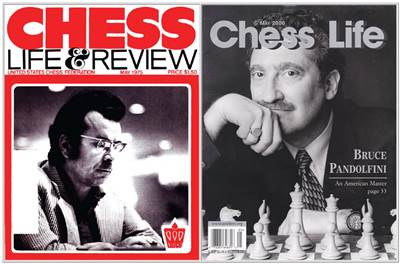
Left: '?'
Right: 'Bruce Pandolfini - An American Master'
Chess Life & Review (50 Years Ago)
Grandmaster Pal Benko, winner of the National Open. Story [inside]. Photo by Burt Hochberg.
The 'story [inside]' was titled '9th National Open' by George Koltanowski, USCF Vice-President.
This event, staged at the Stardust Hotel in Las Vegas, was
by far the most spectacular of all the National Opens. The
rooms were large, airy and exceptionally well lighted. The
total of 242 participants was below last year's record entry,
but the battle for prizes in the various sections was no less
keen.
Four players tied for lst-4th: the trophy and title of National Open Champion went to Grandmaster Pal Benko of
New Jersey (S-B 35), with second place on tiebreaks going to
GM Walter Browne of California (S-B 34 1/2). The other two
were Alfonso Ferriz, a young player from Mexico who also
won the Expert trophy, and Alex Suhobeck of California, who
also won the over-50 trophy. All scored 7.1.
I've mentioned in previous 'On the Cover' posts, e.g.
November 1971 & 1996
(November 2021), that Koltanowski's tournament reports were often unusual. Two of his six paragraphs on the 1975 National Open were about adjournment incidents.
GM Benko's previous appearance 'On the Cover' was
November 1974 & 1999
(November 2024).
That year's report (1974) on the 8th National Open, won by GM Arthur Bisguier, was covered in
July 1974 & 1999
(July 2024).
Back to May 1975, the monthly CL column 'The Editor's Page - News & Views' by Burt Hochberg carried unwelcome news for U.S. chess fans. Hochberg wrote,
When April Fool's Day passed with no word from Bobby Fischer, FIDE President
Euwe had no choice but to declare Anatoly Karpov the new World Champion by default. (FIDE regulations set the April 1 deadline for each player to announce
his intention to play for the world title under rules established at the FIDE
Extraordinary General Assembly in March.)
Few people could have realized that the forfeit signalled the beginning of the end of the great Fischer boom which had started in 1971/-72.
Two more articles in the same CL&R issue were also about Fischer:
'The Mind of Bobby Fischer' by Fischer biographer Frank Brady
and
'Hochberg vs. Darrach', by CL&R editor Burt Hochberg.
Chess Life (25 Years Ago)
Getting an exclusive interview is
always exciting -- a challenge to live
up to. As a photojournalist, I wanted
the images of Bruce Pandolfini to be
as exclusive as his words. After photographing him at Washington
Square Park and at the famous
Capablanca table in the Marshall
Chess Club, I still wanted something
more. When I suggested a formal
black and white portrait to Bruce,
he quickly agreed. The result is this
month's cover.
Technical Information:
* Nikon F100, 28-105 mm
* f11 @ 125, T-Max100
[...]
And you thought chess notation was confusing! - Brian Killigrew
The first of two articles involving Pandolfini was 'An Interview with Fred Waitzkin' by Bruce Pandolfini. The editor introduced the three pages saying,
Yes, there is life beyond chess, often referred to as "the real world." Fred Waitzkin flutters between both worlds, much like the time
shifts in The Last Marlin. Bruce Pandolfini caught Fred on the cusp, so to speak, and the result is a fascinating interview.
Pandolfini prefaced the interview saying,
Readers of Chess Life are quite familiar
with Fred Waitzkin's insightful writings
on the world of chess. In addition to his
penetrating pieces written for The New
York Times Magazine, New York, Esquire,
and Sports Illustrated, Fred has given us
two moving and unforgettable narratives.
Searching for Bobby Fischer (1988, Random House) is a poignant account of the
relationship of Fred to his gifted son
Joshua as the two of them experienced the
vicissitudes of the scholastic chess scene.
It was later adapted by Paramount
Pictures (1993) into an inspiring film of
the same title, and the book and film
have subsequently drawn legions into the
chess world. Then Fred wrote Mortal
Games (1993, G.P. Putnam's Sons), which
portrays the expanding universe of Garry
Kasparov through the machinations of welt politik and top tier chess.
The second article was 'Profiles in Chess: Bruce Pandolfini - An American Master'. The four pages were bylined 'Interview and Photography by Brian Killigrew'. He started,
There is something about Bruce Pandolfini that makes people want to be around
him. Call it the Pandolfini mystique. Kids
flock to him at tournaments. Adults constantly come up to him and whisper things like: "Is
the King's Indian good against I. d4?:' walking away
from Bruce as if they have just received some ancient
secret.
Starting in April 2023, Killigrew has been mentioned in many 'On the Cover' posts, most recently
January 1975 & 2000
(January 2025).
Pandolfini has been mentioned in a handful of posts, mostly in relation to his involvement in scholastic chess.
 On the left is the composite image I originally created for this post.
It shows the talking points I intended to develop for the post.
On the left is the composite image I originally created for this post.
It shows the talking points I intended to develop for the post.


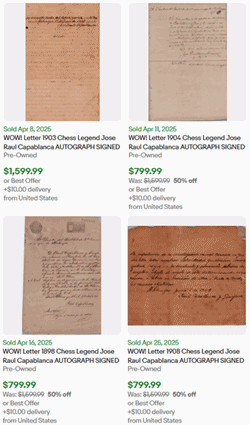 The item in the top left was titled,
'WOW! Letter 1903 Chess Legend Jose Raul Capablanca AUTOGRAPH SIGNED'.
It sold for
'$1,599.99 or Best Offer', which was around $1500.
The other three items appear to have sold for their asking price.
The item in the top left was titled,
'WOW! Letter 1903 Chess Legend Jose Raul Capablanca AUTOGRAPH SIGNED'.
It sold for
'$1,599.99 or Best Offer', which was around $1500.
The other three items appear to have sold for their asking price.



 Posts
Posts

