29 May 2025

A Schizophrenic Yahoo

In April I paused my two other chess blogs...

...and now it's time to do the same here. As I've always said, 'The first rule of chess is to have fun!'. When it's no longer so much fun, it's time to move on...

***

On the left is the composite image I originally created for this post. It shows the talking points I intended to develop for the post.

For an explanation of the data, see the previous Yahoos post: Language, Math, Music, and Yahoos (April 2025).

18 May 2025

Limitless Conceptualism

This month's featured Flickr photo had no description, but it did have a title and a useful set of tags. Among the tags were 'Museum of Art and Technology', 'Mercer Labs', and 'New York City'.


Limitless by Roy Nachum 29 - Chess Set © Flickr user Amaury Laporte under Creative Commons.

A search on the title of the photo leads to Roy Nachum (roynachum.com), where the 'About' page says,

Roy Nachum’s experimental paintings, installations, sculptures and designs incorporate elements traditionally used in conceptual and interactive art. Works often include Braille text in relief. [...] Nachum currently lives in New York and works in New York and Italy.

The photo's tags lead to Museum Of Art & Technology | Mercer Labs (mercerlabs.com), where we learn,

Museum of Art and Technology • Mercer Labs transforms the museum experience across 36,000 sq ft with 15 experimental exhibition spaces, interactive encounters, and immersive installations. Led by artists, this Experimental Institution redefines the relationship between art and technology, fostering collaboration and innovation through curated programs. At the heart of it, Roy Nachum's on-site laboratory brings visionary art to reality, inviting visitors to experience the world through a new lens.

As for the affirmation that 'Roy Nachum’s experimental paintings [...] incorporate elements traditionally used in conceptual and interactive art', conceptual art has been a recurring theme on this blog. For the previous post, see The Most Conceptual of the Conceptualists (March 2025).

11 May 2025

Common Sense in Chess960

This post should have been made on my chess960 blog, but the last post there put that blog in hibernation: 2025 FCGST, Paris [Not!] (April 2025; 'I considered closing this blog, but since I've already tried to do that twice ... I'll just declare a pause.'). I've already featured ten or so chess960 videos on this, my main, blog, so one more won't set any new precedents.


Magnus Carlsen explains why he loves Freestyle Chess (9:39) • '[Published on] Apr 25, 2025'

The description of the video said,

Magnus Carlsen breaks down his approach to Freestyle Chess, also known as Chess 960 or Fischer Random Chess. By generating random boards and analyzing the positions, Magnus gives us an unfiltered look into his mind and how he looks at this variant of chess.

The world's top-rated chess player discusses two start positions. For the first positions (SP937 RKRBBNQN), he points out,

01:25 The b-Pawn is defended only by the King.
01:47 The Queen is far from the King.
02:14 The King is 'half-castled', making the two square advance of the a-Pawn an option.
03:17 Both Bishops are in the middle, which is probably the worst place they can be.
03:52 Both Knights are in the corner away from the King; they will probably be developed behind a Pawn.
04:41 The game will probably develop slowly.
04:52 No single first move comes to mind immediately.
05:13 Mainly consider moving a Pawn two squares: a4, c4, f4, g4 make sense.
06:39 Only the Ra1 is on the same start square as the traditional start position.

Another takeaway: Carlsen refers to Kingside and Queenside, rather than a-side and h-side. This is also my preference, where common sense wins over jargon.

The video is on Youtube channel 'Team Liquid Chess'. The channel description informs, 'Who would win, 64 squares or 1 esports team? Home to all chess content for Team Liquid, including Magnus Carlsen & Fabiano Caruana.' The site Team Liquid (liquipedia.net/chess; 'Liquipedia Chess Wiki'), further informs,

Team Liquid is an esports organization, founded in the Netherlands in 2000. Originally a StarCraft: Brood War clan, the team switched to StarCraft II during the SC2 Beta in 2010, and became one of the most successful western teams. On February 13, 2025, The Dutch organization announced their entry to the chess competitive scene.

Sounds like a winner to me, but how does chess960 fit in?

06 May 2025

May 1975 & 2000 'On the Cover'

Continuing this blog's monthly look at American chess from 50 and 25 years ago, who was featured on the cover of CL&R/CL in the month of May? For last month's post see April 1975 & 2000 'On the Cover' (April 2025).
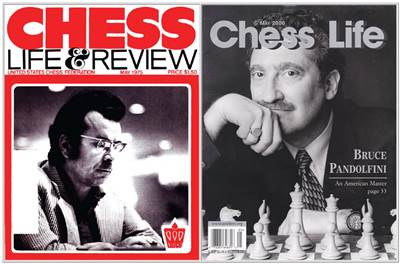

Left: '?'
Right: 'Bruce Pandolfini - An American Master'

Chess Life & Review (50 Years Ago)

Grandmaster Pal Benko, winner of the National Open. Story [inside]. Photo by Burt Hochberg.

The 'story [inside]' was titled '9th National Open' by George Koltanowski, USCF Vice-President.

This event, staged at the Stardust Hotel in Las Vegas, was by far the most spectacular of all the National Opens. The rooms were large, airy and exceptionally well lighted. The total of 242 participants was below last year's record entry, but the battle for prizes in the various sections was no less keen.

Four players tied for lst-4th: the trophy and title of National Open Champion went to Grandmaster Pal Benko of New Jersey (S-B 35), with second place on tiebreaks going to GM Walter Browne of California (S-B 34 1/2). The other two were Alfonso Ferriz, a young player from Mexico who also won the Expert trophy, and Alex Suhobeck of California, who also won the over-50 trophy. All scored 7.1.

I've mentioned in previous 'On the Cover' posts, e.g. November 1971 & 1996 (November 2021), that Koltanowski's tournament reports were often unusual. Two of his six paragraphs on the 1975 National Open were about adjournment incidents.

GM Benko's previous appearance 'On the Cover' was November 1974 & 1999 (November 2024). That year's report (1974) on the 8th National Open, won by GM Arthur Bisguier, was covered in July 1974 & 1999 (July 2024).

Back to May 1975, the monthly CL column 'The Editor's Page - News & Views' by Burt Hochberg carried unwelcome news for U.S. chess fans. Hochberg wrote,

When April Fool's Day passed with no word from Bobby Fischer, FIDE President Euwe had no choice but to declare Anatoly Karpov the new World Champion by default. (FIDE regulations set the April 1 deadline for each player to announce his intention to play for the world title under rules established at the FIDE Extraordinary General Assembly in March.)

Few people could have realized that the forfeit signalled the beginning of the end of the great Fischer boom which had started in 1971/-72. Two more articles in the same CL&R issue were also about Fischer: 'The Mind of Bobby Fischer' by Fischer biographer Frank Brady and 'Hochberg vs. Darrach', by CL&R editor Burt Hochberg.

Chess Life (25 Years Ago)

Getting an exclusive interview is always exciting -- a challenge to live up to. As a photojournalist, I wanted the images of Bruce Pandolfini to be as exclusive as his words. After photographing him at Washington Square Park and at the famous Capablanca table in the Marshall Chess Club, I still wanted something more. When I suggested a formal black and white portrait to Bruce, he quickly agreed. The result is this month's cover.

Technical Information:
* Nikon F100, 28-105 mm
* f11 @ 125, T-Max100
[...]

And you thought chess notation was confusing! - Brian Killigrew

The first of two articles involving Pandolfini was 'An Interview with Fred Waitzkin' by Bruce Pandolfini. The editor introduced the three pages saying,

Yes, there is life beyond chess, often referred to as "the real world." Fred Waitzkin flutters between both worlds, much like the time shifts in The Last Marlin. Bruce Pandolfini caught Fred on the cusp, so to speak, and the result is a fascinating interview.

Pandolfini prefaced the interview saying,

Readers of Chess Life are quite familiar with Fred Waitzkin's insightful writings on the world of chess. In addition to his penetrating pieces written for The New York Times Magazine, New York, Esquire, and Sports Illustrated, Fred has given us two moving and unforgettable narratives. Searching for Bobby Fischer (1988, Random House) is a poignant account of the relationship of Fred to his gifted son Joshua as the two of them experienced the vicissitudes of the scholastic chess scene.

It was later adapted by Paramount Pictures (1993) into an inspiring film of the same title, and the book and film have subsequently drawn legions into the chess world. Then Fred wrote Mortal Games (1993, G.P. Putnam's Sons), which portrays the expanding universe of Garry Kasparov through the machinations of welt politik and top tier chess.

The second article was 'Profiles in Chess: Bruce Pandolfini - An American Master'. The four pages were bylined 'Interview and Photography by Brian Killigrew'. He started,

There is something about Bruce Pandolfini that makes people want to be around him. Call it the Pandolfini mystique. Kids flock to him at tournaments. Adults constantly come up to him and whisper things like: "Is the King's Indian good against I. d4?:' walking away from Bruce as if they have just received some ancient secret.

Starting in April 2023, Killigrew has been mentioned in many 'On the Cover' posts, most recently January 1975 & 2000 (January 2025). Pandolfini has been mentioned in a handful of posts, mostly in relation to his involvement in scholastic chess.

04 May 2025

'WOW!' Capablanca Signed Letters

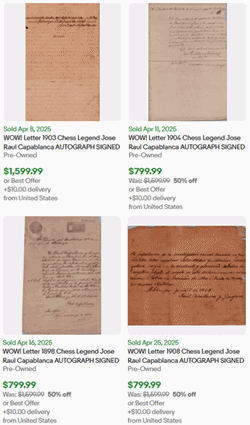
In this long running series on Top eBay Chess Items by Price (March 2010; already 15 years and still chugging along), autographed items pop up frequently. Autographs by World Champions, where the previous post was Lasker's Future Community (December 2024; book '1940 signed by Emanuel Lasker'), are particularly sought after. For this post I noticed four similar items, pictured below.

The item in the top left was titled, 'WOW! Letter 1903 Chess Legend Jose Raul Capablanca AUTOGRAPH SIGNED'. It sold for '$1,599.99 or Best Offer', which was around $1500. The other three items appear to have sold for their asking price.

The titles of those three items were nearly identical to the top left 'Letter 1903', i.e. 'Letter 1904', 'Letter 1898', and 'Letter 1908'. All four letters sold in April, within a span of three weeks.

What were the letters about? Only the buyers can answer that question. The descriptions of the four items were just copies of their titles, adding no other information.

For a previous auction from another seller -- 'Signed by famous actor and chess player Jose R Capablanca' -- see Not a Coincidence (August 2019). A few years ago I corresponded with a collector of chess autographs. He signed off the conversation saying,

Of course I can't guarantee that all my chess autographs are genuine, but I mostly buy from people I think I can trust. Besides, who would try to sell fake chess autographs? There is much more money to be made with movie stars, musicians and sportsheroes.

I would compare collecting autographs to hunting wild mushrooms. If you don't know what you're doing (and I don't) you risk getting a belly ache. For more about the subject, see ChessAutographs.com (May 2016).

29 April 2025

Language, Math, Music, and Yahoos

Last month's Yahoos post, Yahoo Sources Are Back! (March 2025), marked a new era in the Yahoo series. As I wrote then,

If you're not sure what Yahoos are, see the footnote. The problem at the time was that we could no longer see from where all the Yahoos hailed. [...] Now we've come full circle. Google News has restored the names of all sources and I can create a small chart like the first one shown below.

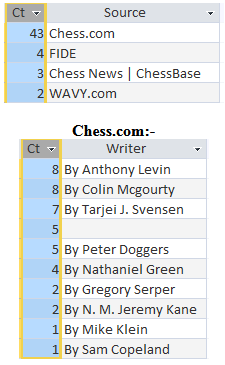
This month's equivalent chart shows five sources accounting for 61 of the 100 stories returned by Google News. Once again Chess.com was the top source, with five times the number of stories attributed to runner-up ChessBase.

The second chart on the left counts the number of stories attributed to specific Chess.com writers. The same two names top the list for the second straight month while last month's third name has disappeared. The only other non-Chess.com writer to have more than one story was Carlos Alberto Colodro of Chessbase.

Each time I prepare a post about Yahoos, I have the same challenge: Which of the 100 or so stories should I feature in the post?

This month, two stories stood above the rest because they were published by well known non-chess sources. The first was:-

What else do 'they have in store'?

(Alexandra:) We just partnered with Freestyle Chess. They’re trying to bring this new format that randomizes the starting position of the pieces, and a lot of top players really like this, because engines [chess computer models] have taken a lot of the creativity away from tournaments -- people just prepare the first moves with an engine.

So whenever we go there, we film with all the top players, and we spend the weeks leading up to it crafting good thumbnails, titles, story lines and ways to try to show the players beyond just playing chess with them.

On top of this significant mention, there were at least a half-dozen other stories on Freestyle chess (aka chess960, aka Fischer Random). I should cover these on my blog dedicated to the subject (see the right sidebar), but it's currently hibernating.

The second attention grabbing story from a non-chess source was:-

It starts,

For more than 1,000 years, chess has been synonymous with war. Now, Vladimir Putin is combining the ancient game with modern skulduggery as he tries to win an all-too-real 21st century conflict.

The geopolitical strategy of the Soviets and Russians has been deeply entwined with knights, rooks, kings and queens for so long that it’s difficult to tell where sport ends and real battle begins.

That last sentence doesn't make much sense -- 'sport ends and real battle begins' when real people start dying -- but the article still offers valuable insights. For example, following is an excerpt that summarizes the end of Soviet/Russian influence in chess:-

The Soviet dominance of the world championship, with eight winners spanning several decades, was testament to the state’s investment. However, the collapse of the USSR in 1991 dismantled much of the infrastructure that had sustained this control. Clubs were privatized, top players emigrated and funding dwindled, marking a decline in Russia’s once-unquestioned supremacy.

One other Yahoo topic is worth noting, but only because it accounted for six separate stories. Here's one:-

Since I'm certainly not the only person with an obvious question, let's tackle it here.

What is Duolingo? • Duolingo is a language-learning mobile app that uses game-like lessons to teach more than 40 languages, mathematics and music. The app, available on Apple and Android devices, launched in 2011.

Chess, like music, like love, hath the power to pop up in all sorts of unexpected places. What will next month's Yahoos bring?

[Yahoos (mainstream news stories about chess) are derived from Google News top-100 (or so) stories from the past month.]

20 April 2025

Phun with Photos

In the previous post for the monthly featured Flickr photo, Enhanced Chess Art (March 2025), I asked and answered,

Why put 'photos' in inverted commas (' ')? Because I didn't understand how they were done.

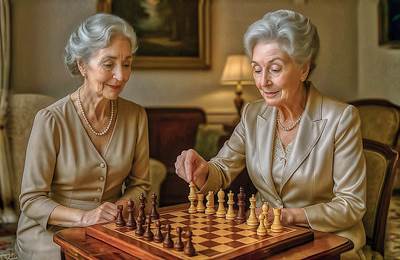
That could just as easily apply to this month's 'photo', shown below. At first glance it certainly could be a photo, but the first clue to the contrary was the unnatural arrangement of the pieces on an 8x7 board.


Playing chess keeps you fit! // This is an AI image... © Flickr user Günter Hentschel under Creative Commons.

The second clue was in the title: 'This is an AI image'. So how was it created? Here the first clue was the start of the description; it said,

ChatGPT generated this image based on a text description that I had entered.

The second clue was a tag that said, 'Luminar Neo'. What's that? Wikipedia to the rescue in Luminar Neo (wikipedia.org):-

Luminar Neo is a photo editing software application developed by Skylum (formerly Macphun) available for Windows and macOS. [It] was released in February 2022. It works as a standalone application and as a plugin for Adobe and Apple products.

Macphun? Thus arose the title of this post.

15 April 2025

April 1975 & 2000 'On the Cover'

In last month's look at U.S. chess magazines from 50 and 25 years ago, March 1975 & 2000 'On the Cover' (March 2025), we saw a non-American player on the left (GM Robert Huebner) and an American player on the right (George Koltanowski, the 'Dean of American Chess'). This month the pattern continues, with a pair of Soviet players on the left and a quartet of American teams on the right. Was U.S. chess more attentive to international chess 50 years ago?


Left: '?'
Right: 'The Teams! A 30-year Odyssey • Upcoming Scholastic Nationals!'

Chess Life & Review (50 Years Ago)

Winners of the 1974 USSR Championship -- Mikhail Tal (left) and Alexander Belyavsky. See [inside] for the story by Paul Keres. Photos by TASS from Sovfoto.

The story '[inside]' was the 'Keres Annotates...' column, titled 'USSR Championship, Leningrad 1974'. It started,

The USSR chess organization, with its 35 grandmasters, has the ability to put together a very strong group for its national championships. As an example, the 1973 USSR Championship, with all the leading grandmasters competing, was one of the strongest tournaments ever held in the Soviet Union.

With this in mind, the 1974 Championship was probably a little disappointing. Most of the leading grandmasters were unable to take part for various reasons and were replaced by other players, while the number of participants was reduced from 18 to 16. Despite this fact, it was quite interesting to see experienced grandmasters such as Tal, Polugaevsky, Vasiukov and Taimanov fight their younger rivals, many of whom had splendid records in last year's tournament, and to see just how good the young players are in really strong competition.

The tournament was a hard fight from the very first round. One is used to seeing grandmasters like Tal and Polugaevsky leading the field, but this time they did not have it so easy, being severely pressed by Belyavsky, Vaganian, Romanishin, Alburt, Dvoretsky, and other young stars, most of whom are not very well known in international chess. And when we look at the final crosstable, we see that the young players came out very well in this tough test against their experienced "examiners."

It's noteworthy that, besides Keres, the other authors of feature articles in the same issue were Pal Benko, Laszlo Szabo, Lubosh Kavalek, Svetozar Gligoric, and Edmar Mednis. All had roots in Eastern European countries.

Chess Life (25 Years Ago)

Thank you, Ed Edmondson. If you were convinced that an idea was good, you ran with it. And 30 years ago, the idea of an amateur team championship, as presented by Denis Barry, sounded good. No bids, no committee approval. You just filled your station wagon with books and equipment and drove out to the VFW Hall in East Brunswick, New Jersey, and ran a concession for the 17 teams that played in that first event. Your faith and Denis' enthusiasm grew "The Teams" to over 100 teams, playing in Atlantic City.

Ed is gone. Denis is still around, kicking up dust here and there. But they left a legacy and a framework that will last forever. Hire a good staff, put the players first, chess for fun and chess for blood, in equal proportions. Steve Doyle (who celebrated 25 years of being associated with the event) operates within that framework and has built the USATE into a 200+ team event. Friday's snow and ice storm had almost no effect, and more than 920 players took part in the 30th Anniversary of the U.S. Amateur Team Championship (East). Worthy of a cover? You betcha. And a special report in our annual yearbook section.

The related article was 'Turning the Big 3-0 Was Totally Brutal at the U.S. Amateur Team East' by Al Lawrence. The mysterious title referred to the winning team, Total Brutality, a 'three-master team'. The report on the event started,

Over the telephone from St. Louis, my brother Leo was having a hard time with what would take place at the U.S. Amateur Team East Chess Championship. "Team chess," he said, "wouldn't that be like four-man diamond cutting?" After a few forced chuckles, I said "No, it's more like having four brothers backing each other up in a schoolyard scrap." From our old days on South Chicago's playgrounds -- in an era when fights were barehanded and forgotten as soon as the shiner faded -- he understood the point.

As tournament chessplayers, we're normally lone operators. In more jet-age terms, we sit in a room full of would-be top guns whose weekend happiness is a net-sum war game. For every ace exhilarated to see black smoke pouring out of his counterpart's engines, there's a wounded pilot spinning miserably down in flames. Strangers, friends, roommates -- all morph into hoped-for airplane silhouettes painted below the cockpit glass, plusses on the wall chart.

After the one-page introduction to the USATE, the story continued on the first page and across the outer column of the next 12 pages of the '2000 USCF Yearbook - Our Heritage'. A footnote to the story informed,

The U.S. Amateur Team East Championship is one of over 25 national title events co-sponsored by the USCF and participating affiliates. Al Lawrence, president of OutExcel! Corp., is the author of eight books on a variety of subjects.

A common thread united the April editions of the two magazines. Just as with the March 1975 edition of CL&R, Burt Hochberg's April 1975 column 'Editor's Page - News & Views' carried news of the ill-fated 1975 Fischer - Karpov World Championship title match. The April 2000 edition of CL carried opinions on the controversies surrounding the World Championship in 2000: Who was the real World Champion?

13 April 2025

Dojo Talks Doggers

According to my records, I've had Youtube's ChessDojo channel on the short list for monthly featured video a total of 16 times since 2021. After four years the channel finally gets the recognition it deserves.


The Chess Revolution w/ Peter Doggers | Dojo Talks (1:00:31) • '[Published on] Apr 3, 2025'

The description said,

IM Kostya Kavutskiy, IM David Pruess, and GM Jesse Kraai talk about the book The Chess Revolution with guest journalist Peter Doggers on today's episode of Dojo Talks, the ChessDojo podcast!

For an earlier post mentioning the same book, see World Championship Yahoos 2024 (November 2024). There I highlighted an introduction to the book by Doggers and quoted him saying,

2024-11-19: The Chess Revolution: Understanding The Power Of An Ancient Game In The Digital Age (chess.com; PeterDoggers) [...] It is for chess fans but definitely also for non-chess playing readers. I am super excited that almost two years after starting this project, the book hit book stores in October. Let me tell you more about it and the writing process.'

The book is currently no.16 on Amazon's list of best sellers for chess, just behind 'Dinosaur Bingo' (?!). No.1 on the list is currently 'Check & Mate' by Ali Hazelwood: 'Life's moving pieces bring rival chess players together in a match for the heart.' I'm sure I would enjoy the Doggers book more than the Hazelwood book.

07 April 2025

Beating a Dead Horse?

As announced in a post on my World Championship blog, It's Later Than You Think (April 2025), I've temporarily suspended posting on that blog. The reason I gave was,

Since I'm not seeing an easy fix to the technical problems, I'll skip posting to [the WCC] blog until I get my affairs in order.

For the same reason, I'm going to suspend the Monday series on this blog. Since the beginning of the year it has been mostly been used for exploring AI comics, last seen in The Most Conceptual of the Conceptualists (March 2025). I have a big stockpile of AIC images to use, but I'll close with this one...


'Dead horse plays chess.'
AI Comic Factory

06 April 2025

Pocket Money

In the long running series (more than 15 years) about Top eBay Chess Items by Price (March 2010), I've never flagged a no-brainer. If there was ever a candidate for 'no-brainer', this is it.

The item below was titled 'Chess Grandmaster Magnus Carlsen's #JeansGate Jeans'. It sold for US $36.100 after 94 bids from 22 bidders. The price doubled in the last minute of bidding as two bidders slugged it out for possession of the jeans.

In the photo from the auction shown above, apparently from the '#JeansGate' incident, I've added a small inset showing the auction item. The description of the item started with an explanation of #JeansGate:-

On December 27th, 2024, Five-Time World Chess Champion Magnus Carlsen was unpaired in the 9th round of FIDE World Rapid and Blitz Championships in New York City after refusing to change out of a pair of jeans in the playing hall. This interaction, both his refusal and interaction with the arbiter in the room, was dubbed by the chess community as #JeansGate and set the world on fire, gaining hundreds of millions of social media and mainstream news impressions in the week following.

Now, GM Carlsen is looking to bring that piece of chess history to auction in support of an impactful cause - Big Brothers Big Sisters (BBBS). The jeans that Magnus wore that day, certified and authenticated by Chess.com and the World #1 himself, are up for auction with all proceeds of the sale going to support youth mentorship at chess clinics, community events, and beyond, to build connection, belonging, and enrich the lives of young people through the game.

The description continued,

About the jeans:-
Brand: Corneliani
Color: Blue
Size: 32
Inseam: 28 inches
Waist: 18 inches (measured across)
Condition: Worn by Magnus Carlsen

The jeans come with a signed certificate of authenticity from GM Magnus Carlsen.

For another mention of the jeans incident on this blog, see World Championship Yahoos 2024 (December 2024). I don't see that the incident qualifies for 'Gate' status (e.g. 'Watergate'), but chess players live in their own world.

The seller was listed as 'matchfireauctions3b'. The auction description carried a long explanation that started with:-

Frequently Asked Questions

Q: Who is Matchfire?
A: The selling party has retained Matchfire (The Matchfire Group) to manage this auction. Matchfire provides a comprehensive auction management service focused on creating successful high-value, high-profile promotional auctions for charities, nonprofit organizations and top brand companies. Matchfire is a promotional agency which helps define client brand promotional strategy through auctions, delivers creative design, and manages operations of feature online auctions for maximum visibility of well-known brands, media companies, charities, nonprofits, public relations firms and advertising agencies.

Q: Is Bidder Pre-Qualification necessary to participate in this auction?
A: All bidding activity below $5,000 does not need to be pre-qualified. Fixed price listings do not require prequalification.

Bidding above $5,000 must be Pre-Qualified. Click here to fill out the secure Bidder Pre-Qualification form. In order to help ensure a smooth and successful auction experience, Matchfire will be performing Bidder Pre-Qualification for this auction. Fixed price listings do not require prequalification.

What did one pair of jeans say to the other? 'You’re looking a little worn out today!'

31 March 2025

Magritte as Chess Artist

As this series on AI comics slides into the second quarter of the year, let's go back to the post that started it off at the beginning of the first quarter: Surrealist Chess (January 2025). There I wrote,

Somewhere in the back of my head was a factoid that Magritte played chess and sometimes incorporated the game into his paintings.

From that post I determined that he was indeed a chess player. Now I'm sure that he was also a chess artist.


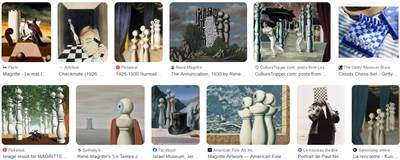
Google Image search on 'chess magritte'

The thumbnail in the lower left of the composite image was the first example of Magritte's artwork that led me to believe he was interested in chess as a subject for his art. It shows a rider on a horse and is titled 'The Lost Jockey'. For other examples, see The Lost Jockey (Le jockey perdu) 1926 Collage by Rene Magritte (renemagritte.org).

27 March 2025

Yahoo Sources Are Back!

It's been more than a year since we bid a not-so-fond adieu to the Yahoos in RIP Yahoos (January 2024). As I explained at the time,

After three years the Google Yahoos also ran out of steam: Yahoos Set a New Low (December 2023; 'So many problems, so little time.'). It's time to let them sleep in peace.

If you're not sure what Yahoos are, see the footnote. The problem at the time was that we could no longer see from where all the Yahoos hailed. The first sign of trouble appeared in Missing Yahoos (November 2023). There I explained,

For the first time in the Yahoo series, Google News stopped including the names of all sources in its list of top stories, identifying those sources only with an icon, often unreadable.

Now we've come full circle. Google News has restored the names of all sources and I can create a small chart like the first one shown below.

The chart shows only four sources that had more than two stories each, where the 'Missing Yahoos' post had eight such sources. But I'm getting ahead of myself. Let's first have some basic stats.
For the current month, Google offered 99 chess stories. Of those, 52 stories were from those four sources with more than two stories, meaning that 47 sources had a single story.

As we saw in every other previous post that counted the number of stories for each source, Chess.com topped the list. This month the world's top chess site had more than ten times as many stories as no.2 on the list, FIDE.

I don't remember exactly when Google started mentioning the writer's name for some stories, but it began as a trickle and has since become a flood. The second chart above shows the number of stories by eight Chess.com writers, many of whom have been mentioned before on this blog.

Only one other writer had more than two stories: Leonard Barden with one story for the Financial Times and one for The Guardian. Of the 56 stories not from Chess.com, 30 had no writer listed for the story, so along with Barden, 24 writers had their byline attached to a story.

At this point I should start listing chess stories that I found particularly interesting, but I'm running out of time for this post. Let's have one of Barden's stories, both of which were on the same topic.

Maybe I'll come back to this post with more stories for March, but lately my track record for follow-ups hasn't been very good. Can old leopards brighten their spots?

[Yahoos (mainstream news stories about chess) are derived from Google News top-100 (or so) stories from the past month.]

24 March 2025

The Most Conceptual of the Conceptualists

In last week's post, The Most Surreal of the Surrealists (March 2025), I wrote,

I once explored conceptual art in a post mysteriously titled (... drum roll ...), Chess in Conceptual Art (March 2017). Maybe it's time to turn the subject over to AI comics.

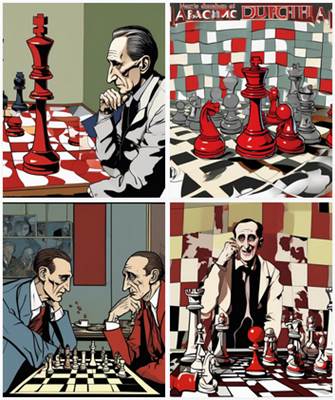
Unfortunately, the AI software doesn't seem to have 'conceptual' in its vocabulary. The half-dozen examples it created had nothing to do with anything except the royal game itself. Then I remembered a trick used in Color the Proteins (January 2025), i.e. 'Demis Hassabis plays chess with a green protein.' While 'protein' is a noun, 'conceptual' is an adjective. Can you color an adjective? I tried coloring it both green and red, and here's a sample of what I got.


'Marcel Duchamp plays red conceptual chess.'
AI Comic Factory

Can you color an adjective? No, you can't. The software applies the adjective to one of the nouns, which are Marcel Duchamp and chess. Next post: Get as far away from this nonsense as I can.

17 March 2025

The Most Surreal of the Surrealists

The previous post, MW Plays Chess -or- Call Me Clueless (March 2025) was an experiment in name recognition. What does our AI comic software do when it doesn't know who or what the subject is? I concluded,

The experiment yields more questions than answers. The next post in the series will return to subjects having greater name recognition.

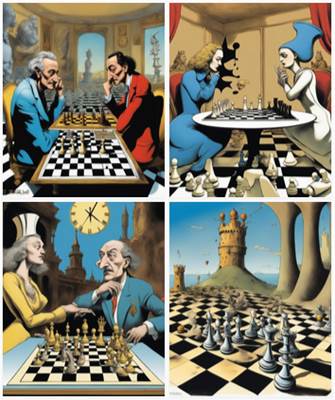
We've already had a couple of posts about surrealist chess. The previous post was Surrealist, Cubist, Dadaist Chess (February 2025; 'Marcel Duchamp plays surrealist chess.'). The best known surrealist artist is undoubtedly Salvador Dali.


'Dali plays surrealist chess.'
AI Comic Factory

It turns out that we've already seen both artists in a non-comic setting a year ago in Conceptual Artist and Surreal Artist (March 2024; 'Marcel Duchamp and Salvador Dali playing chess') I once explored conceptual art in a post mysteriously titled (... drum roll ...), Chess in Conceptual Art (March 2017). Maybe it's time to turn the subject over to AI comics.

16 March 2025

Enhanced Chess Art

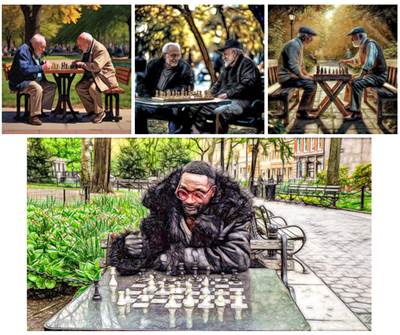
The top row of the following composite image shows three 'photos' that were on my short list for this month's featured Flickr photo. When I checked for other chess photos by the same photographer, I found the 'photo' on the bottom row, which I had already added to my favorites a year ago. Which one to use for this post? I decided to use them all.

Top: 'Two Old Friends Playing Chess' (three views)

Bottom: Afternoon Chess © Flickr user Tom McSparron
under Creative Commons.

Why put 'photos' in inverted commas (' ')? Because I didn't understand how they were done. The photo in the middle of the top row had no description other than

2_1920x1920_U_100_Original ratio

and a single tag that said,

Web Sharp Pro: Original ratio

The phrase 'Original ratio' is self-explanatory, so the only actionable info in those two strings is 'Web Sharp Pro'. This leads to Web Sharp PRO panel by Greg Benz (exchange.adobe.com), where a comment to the page informs,

WSP is a plugin that goes way beyond just cropping and sharpening in certain aspect ratios -- which it does powerfully, and well. The developer, Greg Benz, is also using it to keep folks abreast of the rapidly changing HDR landscape and leverage HDR for social media posts.

A Google search on 'HDR social media' gives the first result under the heading 'AI Overview'. It starts,

Instagram and Threads now support HDR (High Dynamic Range) photos, enhancing visual content with a wider range of colors and dynamic range, especially on HDR-capable displays. This means users can share more realistic and vibrant images, particularly those captured with smartphone cameras. Here's a breakdown of HDR on social media: [...] • Generative AI is experimental

As for the photographer responsible for the four photos, a search on 'Tom McSparron' leads to Tom and Lorraine McSparron (fineartamerica.com). There we learn,

After retiring from 'Corporate America', we both needed something new to keep us busy & entertained. We both decided on photography as that new hobby. Most of our pictures are from different parts of Colorado and the surrounding states, as we travel. Tom enjoys working in Photoshop to take a digital image from a photography to an enhanced art image.

Now I understand how the 'photos' were done.

13 March 2025

March 1975 & 2000 'On the Cover'

Last month's post about American chess 50 and 25 years ago, February 1975 & 2000 'On the Cover' (February 2025), was all about the American Open. This month's post, somewhat more diverse, is a mixture of American and international chess.


Left: '?'
Right: 'George Koltanowski 1903-2000'

Chess Life & Review (50 Years Ago)

Robert Huebner, winner of the Houston International, with his trophy which, as Lynne Babcock writes, is "custom made, gold plated and does everything a chess trophy should -- nothing." Photo by Fred Bunch. Story [inside].

The 'Story [inside]' was titled 'Another USCF Success: The Houston International 1974' by Edmar Mednis. It started,

The Houston International Chess Tournament, fourth in the series of international events organized and sponsored by the USCF, was by far the most successful one for American chess, and it ended 1974 on a number of truly positive notes.

The first seven paragraphs of the report were about the organization of the tournament and its norm possibilities for American players seeking a FIDE title. It then continued,

And now back to us, the players -- the absolute requirement for any tournament. West German GM Robert Huebner was the clear favorite and fulfilled the high expectations by finishing first. Some of the wins did not come easily, yet his high class usually showed through. Yugoslav GM Aleksandar Matanovic is known the world over as editor-in-chief of the Informants and the new Encyclopedia of Chess Openings. At Houston he also demonstrated his fine playing ability. He was the only one never to have a dubious position and deservedly finished undefeated and in second place. My third place and GM result [by Mednis] was fashioned in a rather steady way [...]

Huebner died at the beginning of 2025. See Wikipedia's Robert Huebner (wikipedia.org; '6 November 1948 – 5 January 2025'), for his biography.

For the last year or so, we've been tracking the monthly CL column 'The Editor's Page - News & Views' by Burt Hochberg, as it provided a monthly summary of the evolving situation about a 'match that never was', i.e. 1975 Fischer forfeits to Karpov (m-w.com). In March we learned a number of details about the organization of the forthcoming match, e.g.

John Prentice, Deputy President of FIDE, announced in Amsterdam on February 17 that President Euwe's choice for the site of the 1975 World Championship Match was Manila. [...]

There is far too much detail in the report for this post and the topic would be more appropriate for my WCC blog.

Chess Life (25 Years Ago)

George Koltanowski, the Dean of American Chess, had thousands of favorite chess stories, and everyone he met, left with a favorite story about George. I invite you to share your reminiscences about this great ambassador for chess with other Chess Life readers. That way, as we continue to promote the game to which he devoted his life, we can add to the legacy he left behind. George could charm the feathers off a jaybird, if that's what it took to get a chess program started, or to secure a donation or a sponsor. And we definitely want others to benefit from his expertise.

Send your thoughts to the USCF, in care of the Editor, or use our e-mail address: cleditor@uschess.org.

We wish to thank the San Francisco Chronicle and photographer Chris Stewart for providing our cover this month. It was taken in May of 1999. You can check out Steve Rubenstein's tribute to George Koltanowski at www.sfgate.com.

A two page appreciation by CL Assistant Editor Peter Kurzdorfer and Editor Glenn Petersen gave more details about Koltanowski's career. I'm sure we'll be seeing more about 'the Dean of American Chess' in future 'On the Cover' posts. The 'Dean' was also featured on the right side of November 1971 & 1996 'On the Cover' (November 2021).

10 March 2025

MW Plays Chess -or- Call Me Clueless

In the previous post in this series, Dadaist Chess (March 2025), I ended with an observation and a promise:-

Like the [AI comic] software, I'm clearly struggling here, so I'd better end this post now. • Next post in the series: Call me clueless.

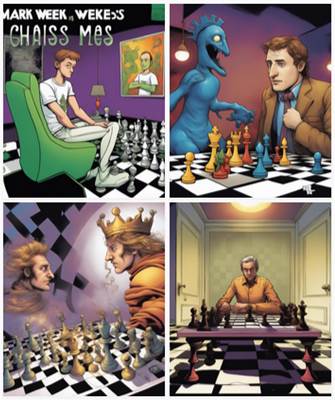
Let's try an experiment. What does the software display when it has absolutely no idea what its designated subject look like? Since there are no photos of me on the web, other than the one at the top of the navigation column on the right, I'm the perfect subject and the experiment can continue. Even that photo dates back to 2008, so it won't help much.


'Mark Weeks plays chess.'
AI Comic Factory

The white haired fellow in the lower right frame is not far from reality, but the other three frames are pure fiction. And what's that attempt to spell my name in the upper left? After all, I gave the correct spelling in the prompt. Then there's 'CHAISS MES' underneath my name. If that's supposed to be 'CHESS MESS', it makes a least a little sense.

The experiment yields more questions than answers. The next post in the series will return to subjects having greater name recognition.

09 March 2025

Quantum Chess Theory

Quantum chess is one of those intriguing ideas that appear on the CFAA radar every so often. The last time it featured as video of the month was Quantum Chess and AI (September 2020). Here's a more down-to-earth angle.


How Does Quantum Chess Work? (5:57) • '[Published on] Feb 15, 2025'

The description said,

Today, I show a new update to chess! This game features quantum chess with superposition, entanglement, and the observer effect! [...] It's a combination of chess in Ohio, Minecraft Block Battles in Chess, Anarchy Chess, ChatGPT Chess, Top Chess, Gotham Chess, Chess 2, 5D Chess, Open World Chess, and more! If you enjoy the chess memes YouTube shorts, like and subscribe!

That's all very nice, but I didn't understand the video, even after watching it twice. The missing bit in that description ('[...]') pointed to quantumrealmgames.com/play. Why not just go there and play for myself?

That also turned out to be easier said than done, because the site slowed my oldest PC -- the same PC that I use to write these blog posts -- to a crawl. It happened twice, on two different days, so I'm guessing that my PC and the site are not compatible.

For my next attempt, I'll publish this post, access the site from my newest PC, and add any fresh observations to the post. In the meantime, here are the 'HOW TO PLAY' basic instructions as copied from that Quantum Realm Games site.

Standard Move • Select the piece you want to move, then click the target square.

Split Move • Select the piece you want to move, then hold-click the first target, drag to the second, and release.

Merge Move • Hold-click the first piece, drag to the second piece, and release. Then select merge target.

Back in a jiffy...

03 March 2025

Dadaist Chess

In the previous post, What Is Dadaist Chess? (February 2025), I quoted from Wikipedia,

Dada or Dadaism was an anti-establishment art movement that developed in 1915 in the context of the Great War [aka WWI] and the earlier anti-art movement.

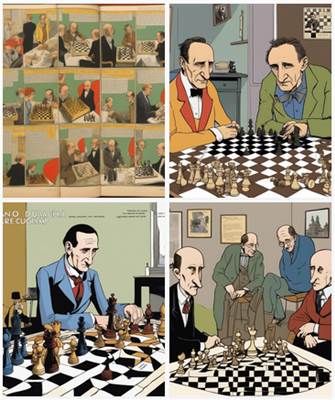
Adding that to an earlier post titled, Cubist Chess (February 2025; 'Marcel Duchamp plays cubist chess'), generates yet another view of Marcel Duchamp playing chess, shown below.


'Marcel Duchamp plays dadaist chess.'
AI Comic Factory

While those faces all look like Marcel Duchamp, where's the Dadaism? An even more fundamental question is how do you depict an 'anti-establishment / anti-art' movement? Our AI comic software is clearly struggling with the question.

One trick the software uses when lost for an appropriate image is to create a meaningless comic sequence, like the one shown in the upper left frame. Another trick is to put stuff on the wall, like the two frames on the right. Maybe the framed pictures relate to images well known to Dadaism. Then again, maybe not. What do I know?

Like the software, I'm clearly struggling here, so I'd better end this post now. • Next post in the series: Call me clueless.