Showing posts with label MW's games. Show all posts

10 March 2025

MW Plays Chess -or- Call Me Clueless

In the previous post in this series, Dadaist Chess (March 2025), I ended with an observation and a promise:-

Like the [AI comic] software, I'm clearly struggling here, so I'd better end this post now. • Next post in the series: Call me clueless.

Let's try an experiment. What does the software display when it has absolutely no idea what its designated subject look like? Since there are no photos of me on the web, other than the one at the top of the navigation column on the right, I'm the perfect subject and the experiment can continue. Even that photo dates back to 2008, so it won't help much.


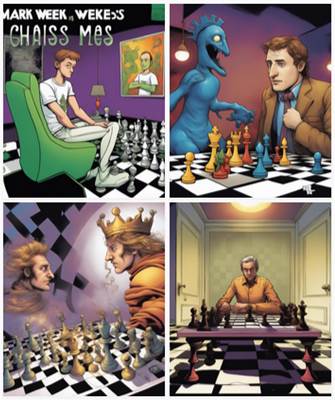
'Mark Weeks plays chess.'
AI Comic Factory

The white haired fellow in the lower right frame is not far from reality, but the other three frames are pure fiction. And what's that attempt to spell my name in the upper left? After all, I gave the correct spelling in the prompt. Then there's 'CHAISS MES' underneath my name. If that's supposed to be 'CHESS MESS', it makes a least a little sense.

The experiment yields more questions than answers. The next post in the series will return to subjects having greater name recognition.

16 January 2023

Chessify Progress Report

A month ago, in Chessify Setup (December 2022), I wrote,

I set up a Chessify account, received some free time on their service, and started a new game on the LSS server, where engine use is generally allowed. I'll report on my progress in a future post.

This post is that report. I had White in the first LSS game, and after starting a Caro Kann (1.e4 c6 2.d4 d5), decided to play a move that I have always wanted to try: 3.f3, known for some obscure reason as the 'Fantasy Variation'. After six moves, my opponent disappeared, apparently having quit LSS. I started a new game, chose the highest rated opponent I could find, and received White again. My opponent turned out to be a specialist in a little-played variant of the Ruy Lopez, and had played 15 games with it on LSS. This gave me the chance to use Chessify to analyze the moves of his previous games. We have reached move 10 and I expect to follow his previous games for another few moves.

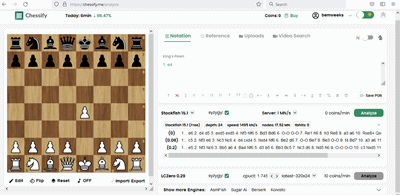
The two LSS games have given me sufficient opportunity to make an initial evaluation of Chessify. Following is a screen capture showing the user interface (GUI) after 1.e4.

The tool fits well with my method of analyzing correspondence games. I normally use three PGN copies of each game. I use one copy for my notes (the foreground copy). For the traditional start position, the opening notes include references to theory. I use another copy for engine analysis (the background copy) and I use a third copy for the moves actually played in the game (the official copy). Chessify replaces the copy for engine analysis.

I tried to keep a copy of the PGN within Chessify to carry over from one analysis session to another. That would be important if I were playing two or more games at the same time. I quickly realized that I didn't understand how it worked and decided to use the 'Import FEN' feature instead. That means I set up the current position of interest at the beginning of a session by copying the FEN string from the software that manages the foreground copy (SCID), and analyze from that point. I'll come back to Chessify PGN functionality if and when I need it.

Over the past month I've noted a few issues. The first arose from the email that confirmed my signup. It said,

Click the button below to verify your email address and receive 200 coins for free to try Chessify's up to 1,000,000 KN/s speed servers.

I never received any coins. A message at the top of the GUI always says, 'Coins : 0'. I also clicked on a free trial offer and received the message:-

Your free trial is on! Until November 23, you will have free access to all our features.

This was on December 21, well after the trial supposedly ended, and I still have no idea what 'free access' involves. Another problem is with network latency. I sometimes clicked 'Analyze' or 'Stop' engine evaluation and waited up to a minute for a response. Not sure if there was a problem, I then clicked a second time and triggered some buggy behavior that required a GUI reset to eliminate. I have other examples of some bugginess, but for now I'll just attribute it to the learning curve. A few other items worth mentioning are:-

  • No online help
  • No copying engine analysis to clipboard
  • No chess960 support

None of the issues I've mentioned are blocking problems. I can live with all of them because I really like the functionality provided by the service.

I also considered subscribing; the info is here: Chessify Subscription Plans and Coins. The difference between the 'Free' plan and the 'Amateur' plan is currently about 80 USD per year. As much as I would like to subscribe, I don't see much functional difference between the two plans.

I'll continue to evaluate the service and perhaps learn why it's worth a subscription. If I discover anything important that I've overlooked to date, I'll come back with another post.

19 December 2022

Chessify Setup

Every once in a while I wake up from my habitual sleepwalking and try to grasp the basics of current trends in chess engines. At the end of this post is a summary of those efforts over the past few years.

With this post I set out to bring myself up to date once again, but quickly decided that I needed to look at chess engines in the so-called cloud. My first stop was Chessify: Powerful Cloud Engines for Chess Analysis (chessify.me; 'Powerful Cloud Platform for Chess Training'). The site's home page promises a great deal:-

Top Engines: The latest versions of Stockfish (NNUE and traditional), Leela Chess Zero, and other engines available for your use. • Free Analysis: Analyze at up to 1,000 kN/s speed with Stockfish, asmFish, SugaR, Koivisto, and Berserk for FREE when you register on Chessify. • Cloud Servers: Fast & secure: up to 1 BN/s for Stockfish, 100 kN/s for LCZero, 130 MN/s for asmFish, SugaR AI, Koivisto, and Berserk.

Promises are one thing, but 'the proof of the pudding is in the eating', as they say. I set up a Chessify account, received some free time on their service, and started a new game on the LSS server, where engine use is generally allowed. I'll report on my progress in a future post.

***

Seven years ago I posted a long series that has already been summarized.

Following are other series plus individual posts that looked at other aspects of engines.

I expect this new cloud series will become one of the longest to date on chess engines.

01 May 2022

A Year of Anniversaries

This year we'll be seeing some big chess anniversaries:-

Those links are to my own pages, showing that I have at least passing familiarity with the subjects. Starting with Kasparov - Deep Blue this month, I expect we'll see the pundits out in force to remind us of the importance of each of those historical matches.

On a more personal note, I'll see a couple of significant anniversaries myself:-

  • 70 years prowling the third stone from the sun
  • 50 years playing correspondence chess
  • 25 years documenting the World Chess Championship (m-w.com; WCC site)
  • 16 years blogging

That last item might seem out of place, but the blogging anniversary is today. The number 16 -- which, as every computer person knows, is 10000 base 2 -- is just as significant to computers as 100 base 10 is to humans. Through the years I've noted the anniversary of the blog on several occasions:-

This might well be the last blog anniversary. A few years ago I announced, The End of Daily Blogging (September 2019). As the following table shows, the number of posts last month was about half of what it was the year that I made that announcement.

Posts in April (count):-
- 2018 April (19)
- 2019 April (22)
- 2020 April (12)
- 2021 April (15)
- 2022 April (11)

The previous tally of personal milestones across my own web resources was 2500 / 20 / 500 (August 2017). Later this year I'll be closing down the WCC site, probably after the next title match -- 'C30' using my method of counting the WCC cycles since FIDE took over. Will he play or won't he play? Carlsen that is. I'm as curious as the next person to find out. After that, it's time to put the whole thing to sleep. We will always have Wikipedia, won't we!

24 January 2022

Correspondence Forums in the 2000s

While working on a follow-up post to Correspondence Chess in the 2020s (February 2021; 'meaningless ratings and meaningless titles'), I discovered a discussion group for the ICCF: International Correspondence Chess Federation (facebook.com). A number of points caught my attention, e.g. this chart...


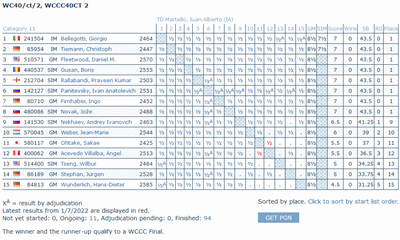
WC40/ct/2, WCCC40CT 2

'WC40' stands for World Championship no.40, 'CT' stands for Candidates Tournament. The note at the bottom says, 'The winner and the runner-up qualify to a WCCC Final.'

As the crosstable shows, with 11 games remaining, all finished games have ended in draws. By comparison, the first of the two CTs in this cycle has had three decisive games with 13 still to finish. Sounds like a lottery, doesn't it? Who will be the lucky winner of a game and earn the right to play for the World Championship? Two threads on the Facebook forum addressed a related question:-

The ICCF used to have other forums. I still have a browser bookmark for The Correspondence Chess Message Board (TCCMB). Nowadays the link returns only 'The system has failed to log you in.'

Archive.org on the forum host, pub11.bravenet.com/forum/..., returns results that stop in 2007. Two of the last threads in one of the last archived TCCMB indices include the term 'ICCF Forum' in their titles, but the URL of that forum is a mystery. All of the links in the archived index return empty pages. If there's a way to display the individual posts, no tricks come to mind. Maybe I'll discover the address of 'ICCF Forum' for a future post.

How to make correspondence chess interesting again? The ICCF could (1) ban engines, (2) use AI deep learning techniques to detect cheating, and (3) ban cheaters for life -- three strikes and you're out. If nothing else, it would light up the forums while people insist on the impossibility of all three of those actions.

10 January 2022

Ipmanchess

Later this year I hope to upgrade my chess engine hardware and software. It's been almost twelve years since I upgraded the hardware and seven years for the software (all documented on this blog), so the change is long overdue. I keep up with software developments and know what I want, but I don't pay much attention to hardware. It evolves so rapidly.

I spent a couple of hours browsing Talkchess.com to find out what the experts have been saying. Cores, hyperthreading (HT), and GPUs provoke frequent discussions. A year ago I looked at Engine Scaling (January 2021), an important subject that won't disappear anytime soon.

One site that was often used as a reference is Ipman Chess (ipmanchess.yolasite.com), especially the page AMD - Intel Chess Bench. (ditto). It's packed with data and looks like any time there would be well spent. I'll come back to the subject when I have more to say.

09 August 2021

Breaking the BDG

In the most recent TCEC/CCC post, TCEC S21 Sufi Underway; CCC Still Romancing (August 2021), I noted,

CCC: The site continues to run multi-engine, multi-round-robin blitz/bullet tournaments based on thematic 'romantic openings'.

One of the romantic openings was the:-

Blackmar-Diemer Gambit (1.d4 d5 2.e4 dxe4 3.Nc3)

I've played the BDG in both OTB and correspondence events and know something about it. It's fun to play, although White struggles to get compensation for the Pawn. I once wrote a post about it, although you wouldn't guess the subject from the title: Naming the Opening Variations (October 2014).

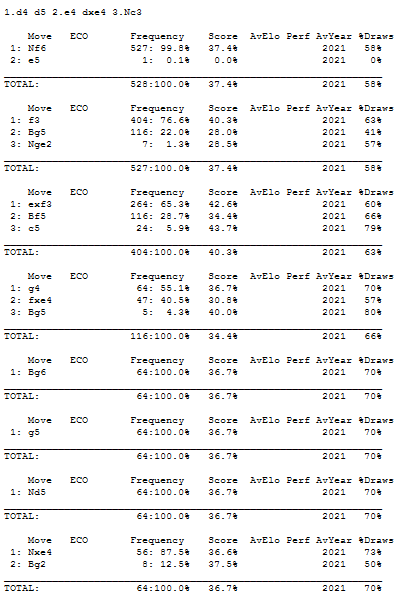
A few months ago I worked out the procedure for downloading CCC PGN files for a particular event and documented it in a post: CCC PGN IV (May 2021). I downloaded the CCC BDG file, loaded it into SCID, and analyzed the games. The following chart shows that there were 528 games played using the forced opening and that all but one continued 3...Nf6. The stats at that point aren't good for White, who scores only 37.4% with 58% of the games ending in draws. The rest of the chart shows what the stats say is the best line for both sides: 4.f3 Bf5 5.g4 Bg6 6.g5 Nd5.

I asked Stockfish to analyze the position after 6...Nd5. It told me that Black has a small advantage after 7.Nxe4, a larger advantage after 7.Bg2, and an even larger advantage after 7.fxe4. In the 2014 post, 'Naming the Variations', this line was called the 'Kampars Gambit'; the only move given was 7.fxe4. If I ever wander into this line again, I'll try 7.Bg2.

It looks like the engines are breaking the romantic openings. They are also busting the old analysis. Should anyone be surprised?

08 February 2021

Correspondence Chess in the 2020s

A couple of recent posts on the Talkchess forum raised questions about the current impact of engines on correspondence chess:-

The earlier thread was started by GM Larry Kaufman, a chess engine heavyweight who has been mentioned many time on this blog (see the search box on the right). The later thread was started by someone who admits to 'very little knowledge in the correspondence chess world'.

The bottom line is that top players all use equivalent hardware & software. They play draws against each other and are 'top players' because they have an advantage over players with lesser hardware and/or software.

Any decent club player, let's say 1500 Elo or more, having sufficient means and technical knowhow could build an engine platform comparable to those used in the TCEC/CCC (see Stockfish Wins TCEC S20; CCC 'Rapid 2021' Underway, for the latest post in a long-running series on this blog). That player would immediately become one of the best correspondence players in the world.

Why don't more people do so? Probably because they have more challenging uses for their time and money. As for the problem of too many correspondence draws, the problem has been building for years. I did an analysis more than eight years ago, Increasing Draws in ICCF Finals (December 2012), and concluded,

If the trend continues, we'll eventually see some yellow [1-0], no red [0-1], and a lot of blue [1/2].

And that's where we are today. Correspondence chess is all about mechanical results that lead to meaningless ratings and meaningless titles.

So why do I play? To learn more about chess -- to take apart a game in progress and understand what makes it tick, like an auto mechanic takes an engine apart to understand its internals. I've been doing it for decades and I have no plans to stop.

How do I take a game apart? That would be a good topic for another post.

23 January 2020

I Was FIDE's 'Person of the Day'

Since its complete makeover a few months ago, FIDE's website gets no respect. Case in point: Coffee, Chess, the FIDE webpage & other Goofiness (spraggettonchess.com), where we find this informed commentary:-

The Mad, Mad World of FIDE’s Home Page • FIDE's new website has been almost universally criticized in the online chess community. For one reason or the other, such as requiring too much scrolling to find what you are looking for, unfriendly and difficult navigation, incomplete player information and ratings, too crowded with BIG images and confusing layout, too much in your face, etc.

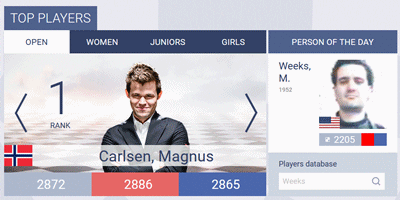
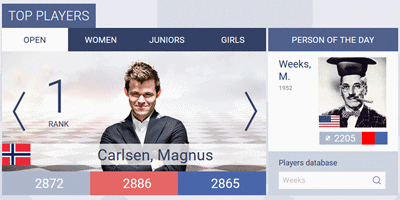
To that I would add a severe shrinking of news about FIDE's current activities. The site appears to be on information lockdown. But all is not lost. Next to 'Top players', under 'Person of the day' you'll find a search on the 'Players database'. I entered my own last name and got this...

...That's my name, my birth year, the flag of my federation, and my last published rating; but that's not my photo. My guess is that it's The other M.Weeks (May 2006), aka 'Manuel William Weeks' of Australia. I suppose I should submit my own photo to FIDE, but how?

***

Later: Re 'I should submit my own photo to FIDE', how about this one? (With apologies to the great Groucho.)

14 November 2019

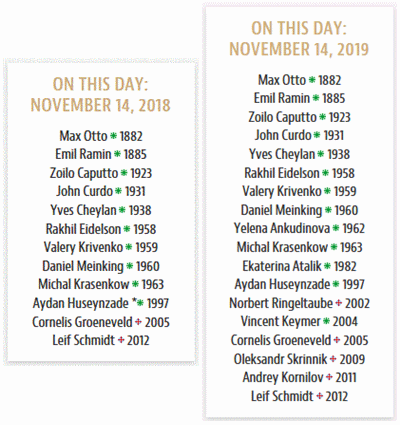
The Club of 14 November

Who are all of these people?


ChessCafe.com – Since 1996

And how did their ranks swell 50% in one year?

16 October 2018

Another Online Chess Database

Last year, in Reconsidering an Online Chess Database (November 2017), I wrote a long post about online opening databases:-

A few years back, faced with a technical problem, I scrambled to find a new online chess database and documented the effort in a series of posts on this blog (February/March 2014). [...] Looking again at the work I did in 2014, there was one service that was still under development, Chess-db.com. I decided to take another look at it.

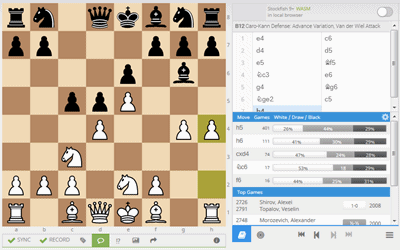
Recently I discovered another candidate database on Lichess.org. Here's a screenshot showing a position that gave me some trouble while using Chess-db.com.

I was playing White. As for the sort of trouble I had, I'll save that discussion for another post. In the meantime, I'll continue exploring the functionality available on Lichess.

26 June 2018

How Many Pawns for a Rook?

The diagram below shows an endgame position I reached in a recent chess960 game. I was playing White and although it looks like I'm down boatloads of material, I'm about to recover some of it. Looking at the material on the board, it's one of the most unbalanced positions I've ever encountered.


After 26...Rg8-c8

The game continued 27.Rxg6+ Rc6 28.Rxc6+ Kxc6 29.Qg6+. Here I was expecting 29...Kb7 30.Qxg7+, when White has a Queen and six Pawns against a Queen and Rook. The game was a correspondence game where engines were permitted and I had spent considerable time studying this position before deciding to play the line. The further variations went beyond the horizon of the engines I was using, so I was on my own to make an evaluation.

  • First observation: Black is going to recover at least one Pawn, maybe two.
  • Second observation: The White Pawns are too far back to present an immediate threat to Black.
  • Third observation: The Black King has no cover and is exposed to long sequences of checks by the White Queen.

All in all, it promised to be an interesting endgame where any result was possible. After 29.Qg6+, my opponent played 29...Kb5, and offered a draw. I realized that as long as he didn't play ...Kb7, White has nothing more than a perpetual check by the Queen on the 5th and 6th ranks. I reluctantly agreed to the draw and moved on to my other games.

14 November 2017

Kids Crafting Tips?

Whatever happened to chess.about.com? As my page linked on the sidebar, 'Chess for All Ages (site)', explains,

From September 2002 to August 2008, I was privileged to serve as the Chess Guide for About.com. During that time, I produced one feature article per week. Although About.com has an exclusive, perpetual license to use my material, it's unlikely that they will ever use it again. After I left, the company gave me permission to reuse the material: 'It would be fine to use your content as you please.' Here are copies of those articles.

First let's have a recap of the site's history, as tracked on this blog. In my last months at the company, when it was still a subsidiary of the New York Times (NYT), I noted a couple of changes at the top:-

In the month that I left, I wrote two posts giving my own perspective from within the company:-

Four years later, the NYT sold the operation to IAC (aka Answers.com, aka Ask.com):-

After that I stopped paying attention to the company, except to check on its content from time to time. I do the same for many chess sites. Wikipedia's page on About.com now goes to Dotdash, with the mention 'Redirected from About.com'. The last paragraph currently informs,

2017–present: Closure of About.com, rebranding to multiple publications under Dotdash • On May 2, 2017, IAC announced that they had renamed About.com to Dotdash, after about a year of transition. CEO Neil Vogel said that the company had lost mind share, and needed to change their marketing strategy. The company elected to refocus on vertical markets through its niche websites: The Balance (personal finance), Lifewire (consumer electronics), The Spruce (home and food), VeryWell (health), TripSavvy (travel), and ThoughtCo (education).

It turns out that chess is now included under 'The Spruce (home and food)', and its current address is thespruce.com/chess-4127460.

The breadcrumb trail for the chess articles shows:-

Thespruce.com > Crafts & Hobbies > Kids Crafting Tips > Chess
Kids crafting tips? Talk about clueless! For more about the most recent transition, see About.com launches The Spruce, a standalone site for Home Decor and Food (techcrunch.com; February 2017).

07 November 2017

Reconsidering an Online Chess Database

Decisions, decisions. A few years back, faced with a technical problem, I scrambled to find a new online chess database and documented the effort in a series of posts on this blog (February/March 2014):-

In that 'Choosing' post, I described the way I use an online database to keep up with opening theory. Basically, I start by looking at what the top players have been playing in a particular variation during the last couple of years, then broaden the parameters as the game goes deeper. I discovered that none of the databases could support this methodology and I decided to continue using the same toolset as before, accepting an increased security risk.

The database I've been using, Chesslab, was conceived around the year 2000 and is based on Java. This was adequate at the time, but the times have changed and the technology is no longer robust enough to protect against malicious activity, which is nowadays the primary disadvantage of doing anything online. Earlier this year, Firefox withdrew support for Java, effectively disabling Chesslab. Explorer still supports Java, but throws up so many warnings that I have to doubt my judgement in continuing to use it. On top of this, the downloaded PGN files are not usable 'as is' and have to be converted into a text format that can be loaded into PGN readers.

These days my main interest in online correspondence chess is chess960, where online databases have no value in the opening. A year or so before those posts on online chess databases, in Cup Play (May 2013), I wrote about continuing to play the traditional start position ('RNBQKBNR'). A new tournament will start in a week. If I play, I'll need a database to guide me through the opening phase, but which database?

Looking again at the work I did in 2014, there was one service that was still under development, Chess-db.com. I decided to take another look at it. Indeed, its 'Opening Explorer' is now an improvement over what I found in 2014, and in the direction of what I need. It has a filter on rating, but no filter on when a game was played. Is the glass half-empty or half-full?

Unfortunately, the filter on rating is not up-to-scratch. It restricts results based on the rating of the player(s), but unnecessarily adds a +/- 100-point band around the search. If I'm looking for the current practice of 2700+ players, I don't want 2600 players included in the search, but I do want 2800 players. In addition, the results look dubious. Here is a side-by-side comparison of the results for the traditional start position filtered on a 2700 rating and on 2800.

The results are identical, indicating that something is amiss. Having said that, the ability to go deeper into any variation and see what top players have tried is an advantage. Is this good enough for a tournament section of six games? The event will be the quarterfinal stage of a multi-stage tournament. Because I always prefer to finish what I've started, I'm reluctant to abandon the tournament now.

In the 'Resurrecting' post mentioned above, I wrote, 'As for giving up traditional chess and switching to chess960, I am certain that day will come. It just won't be today.' Perhaps that day is now. I have a week to decide.

12 September 2017

The Not-So-Bad Opening

Remember Alan Lasser, last seen on this blog in Front Page News (October 2016)? On a recent visit to the U.S., I met him for the first time in something like 25 years. We played a few chess games together and he chose one for his weekly Game of the Week newsletter (Warning: double blunder on move 37).

Subject: Game of the Weeks
From: Alan Lasser
Sent: 2 September 2017

Mark Weeks, of the 1975 Connecticut Bughouse Champions and author of the web sites,
- chessforallages.blogspot.com, and
- chess960frc.blogspot.com
chose a small college town in America for his first over-the-board play in a dozen years.  Amused as he was by the unknown variations of the Bad Opening, he still beat me 3-1-1. 

[Event "Skittles"]
[Site "Amherst, MA"]
[Date "2017.08.31"]
[Round "?"]
[White "Alan Lasser"]
[Black "Mark Weeks"]
[Result "1/2-1/2"]
[ECO "A45"]

1. d4 Nf6 2. Qd3 c5 3. c3 b6 4. e4 Ba6 5. Qf3 Bxf1 6. Kxf1 Nc6 7. e5 Ng8 8. Ne2 e6 9. Be3 Qc7 10. g3 d5 11. exd6 Bxd6 12. Nd2 Nf6 13. Nc4 O-O 14. Nxd6 Qxd6 15. dxc5 bxc5 16. Kg2 Ne5 17. Bf4 Rfd8 18. Bxe5 Qxe5 19. Rhd1 Ne4 20. Qe3 Qf5 21. Qf3 Qxf3+ 22. Kxf3 Nd2+ 23. Kg2 Rd7 24. b3 Rad8 25. f3 Rd3 26. Rac1 e5 27. Ng1 e4 28. fxe4 Nxe4 29. Rxd3 Rxd3 30. Re1 f5 31. c4 Kf7 32. Nf3 Kf6 33. Re2 g5 34. Ne1 Rd1 35. Nc2 Nc3 36. Ne3 Rd3 37. Nd5+ Nxd5 38. cxd5 Rxd5 39. a4 h6 40. h3 h5 41. Kf2 f4 42. gxf4 g4 43. hxg4 hxg4 44. Re3 Rh5 45. Rc3 Rh2+ 46. Kg1 Rh3 47. Rxc5 Rxb3 48. Ra5 Ra3 49. Kg2 1/2-1/2

The following diagram shows the opening in quantum format, after 1.d4 {1...d5 or 1...Nf6} 2.Qd3.


The Bad Opening

Alan insists that I named it.

It was you who gave the "Bad Opening" it's name. Back when I had a 1000 rating, a 1200 named Flynn beat me with it at one of those old tournaments at the Henry Hudson Hotel. When I tried it against you in one of our high school board challenge matches you played c6 and b5 and Qa5 and crushed my early queenside castle position in 17 moves, commenting afterwards, "That's a bad opening". I revived it in 2007, in time to show it to the "Invisible Kid"; nowadays, when I see c6, I chicken out and castle kingside.

I have a vague recollection of the incident, unlike the title of '1975 Connecticut Bughouse Champions', where I recall that Alan and I lost the final match. Given that I'm a big fan of 'Extravagant Openings' (see, for example, What Makes an Opening Extravagant?, December 2009, which partially explains my fondness for chess960), expect more about the Bad Opening on this blog.

23 February 2017

A Personal Category

A couple of personal posts over the past year -- Still There After All These Years (January 2016) and Photographic Proof of Presence (February 2017) -- left me needing a suitable label to categorize them. Otherwise I might repeat the same story in a future post. I changed the category 'Label "MW's CC games"' (CC = correspondence chess) to Label "MW's games" and the problem was solved.

21 February 2017

Photographic Proof of Presence

While gathering background info on last week's post, Joop van Oosterom (1937–2016), I flipped through old copies of Europe Echecs (EE) looking for stories about early editions of the Melody Amber tournaments. The second edition, held in March-April 1993, was the first to use the Amber formula of one rapid tournament and one blindfold tournament. Before I found its writeup in the May 1993 EE, I looked at earlier issues of EE, where the photo shown below caught my eye.

Europe Echecs, March 1993

'Aubervilliers : Computers among the GMs'
'Nearly 850 players, that makes a crowd! A partial (!) view of the tournament'
(Photo: Alain Fayard)

'I think I played in that tournament', I said to myself. At the time I was working and living in Paris from Monday through Friday, then commuting back to Brussels on the weekend. On one particular weekend I had to stay in Paris -- I can't remember why -- and decided to play chess. Friday evening at the local chess club someone mentioned Aubervilliers and told me how to get there, so the next day I took the metro, found the tournament site, and played.

Because it was a rapidplay time control I didn't record my moves and I have no record of the event in any of my chess papers from that period. Back to the photo, that's me in the third row of tables from the bottom, third player from the left, facing the camera.

I have a vague memory of a young Michael Adams at the tournament, but his name isn't mentioned in the EE report. If someone told me I dreamed the whole thing, I wouldn't argue. But there's that photo.

07 June 2016

My Two Encounters with Korchnoi

Yesterday GM Viktor Korchnoi passed away. I'll leave it to his world class opponents and to the professional journalists to relate his enormous importance to the chess world. Instead I would like to relate two small, personal stories about him.

The occasion was the 2nd SWIFT International Tournament (1986) -- Karpov, Korchnoi, Timman, Miles, eight other players -- and I was invited to the opening ceremony at the Sheraton Hotel next to Place Rogier in downtown Brussels. A good friend of mine, a non-chessplayer, was working as a consultant at SWIFT, the well known operator of a network for financial transfers, and knew about my lifelong interest in chess. He asked me if I was interested in attending the ceremony and we met there along with a SWIFT colleague of his, a Russian named Slava.

I recall that Bessel Kok, one of SWIFT's founders, made a wonderful introductory speech in three languages -- English, Dutch, and French (maybe it was four languages: German as well) -- where he said that SWIFT and chess were a good match. They were both young and dynamic; they were both international; and they both relied on technology.

I also recall standing at the reception (champagne? everything was first class that day) chatting with my friend and with Slava about chess. Korchnoi was standing nearby chatting to someone else, when Slava went over to him and said something. Korchnoi looked startled, hurried away, and hid behind a pillar in the reception room.

'What did you say to him, Slava?' • 'I told him how much I admired his play.'

A minute or two later Korchnoi came back to our group, said something to Slava in Russian, and hurried off again.

'What did he say to you, Slava?' • 'He said, "You should know better than to go up to another Russian who is a complete stranger and start talking in Russian."'

I understood that in the ten years since his defection from the USSR, Korchnoi had been constantly vigilant about Soviet security.

During the next two weeks I managed on several occasions to get away from work and from personal responsibilities to visit the tournament and watch the games.

On one of the last days of the event I wandered out of the spectator area into the lobby and saw Korchnoi standing there alone, smoking a cigarette. I hurried over to the chess book seller on the side of the lobby and bought the first book I could find about him.

I went back to where Korchnoi was standing -- fortunately he was still there -- and asked him for his autograph. I'm glad he dated it (3 April 1986), because it tells me that it was the tenth round, when he drew with Black against Timman.

On top of getting Korchnoi's autograph, I also got a great book. May the great man rest in peace.
21 January 2016

Still There After All These Years

What's the first thing everyone does when they get a new rating list? They look up their own name. That's exactly what I did when I downloaded the FIDE Rating List - January 2016, even though my rating history can be summed up in three bullets.

  • 'The last time I played a rated FIDE game was at the 1990 Paris Open in Paris, France.' (Where I Play, May 2006)
  • In 1998, 'I took a hit for 30 rating points even though I hadn't played a FIDE event in years.' (The Other M.Weeks, May 2006)
  • 'FIDE IDs were introduced in the [rating] data for 1999. For example, I was assigned FIDE ID 2003740, even though I hadn't played a FIDE event since 1990.' (FIDE Struggles with the Growing Popularity of Ratings, June 2008)

Seventeen years later I'm still on the FIDE Rating List. I wonder which player holds the record for being on the list the longest without having played?

I was reminded of all this while preparing the last post of 2015, More Rummaging, when I found the photo shown below. While not from the 1990 Paris Open, it does show the 1989 Paris Open, where I also played. There are even a couple of players in the photo that might be me. Then again, they might be someone else.

Europe Echecs, June 1989 p.10

My purpose in writing this isn't to rattle on about my long gone, active playing days. It's an introduction to the photographer listed beneath the photo, Catherine Jaeg. I'll come back to her in another post.

15 September 2015

Opening Preparation Using Engines

The August 2015 issue of Chess Life (CL) had a thought-provoking article titled 'The 7.Qf3 Taimanov Sicilian' by IM Erik Kislik. The subtitle -- 'Going deep in a line that avoids Bb5 options and keeps tension in the position' -- might scare away some people, but I found the piece interesting for two reasons: it discusses modern opening preparation using engines and it analyzes a variation that might arise in my own games (as in Time Enough for Taimanov).

IM Kislik -- where had I heard that name before? First he came up in a quote from a post earlier this year, TCEC Season 7:-

The 32 openings that will be seen in season 7’s Superfinal have been selected by IM Erik Kislik, one of the world's top (and hardest-working) opening theorists, a chess teacher, writer and advisor to grandmasters.

Then he authored an article in the April 2015 CL, titled 'The Thoresen Chess Engines Competition', the same TCEC that I had already decided was post-worthy. It was nominated for the 'Best Features Article' category in the 2015 CJA Awards, but lost out to two other articles that I discussed in Editing Matters.

Notwithstanding all of these overlaps with my own current interests, the latest piece on the '7.Qf3 Taimanov' stands on its own merits. It starts,

Grandmaster Jonathan Rowson wrote in his excellent book Chess for Zebras that the vast majority of players personally identify with "their" openings on a level that transcends the game.

That sent me scurrying off to skim the book, where I found the discussion in chapter two, 'Psycho-Logics', under the section header 'Identity'. That brief diversion reminded me that I'd already featured GM Rowson in a post about Rowson's 'Three Types of Theory' on my chess960 blog -- yet another overlap of interests.

There are so many such statements in Kislik's one-page article that I would probably end up copying the whole thing here. In the interest of 'fair use', I'll just mention a few more. Second paragraph:-

One of the most widely disputed questions in modern chess is "What should we analyze?"

If that's the same as the question "What opening repertoire should I play?", then I wholeheartedly agree. If not, then I don't understand the question. Third paragraph:-

My proposal is simple: we should create one sample main line for almost all sensible Black tries and try to analyze it out as best we can, assuming a line isn’t so obviously better for White that it is not worth looking at.

Yes, that sounds like repertoire again. I could excerpt similar statements from the rest of the article, but it's an exercise where everyone can benefit individually. The article concludes with five pages of analysis on the Taimanov variation that provoked it, which I'll study when I actually need it in one of my own correspondence games.

I'll be on the lookout for more work by Kislik. His Wikipedia page, Erik Kislik, is today little more than a collection of links to external references, but that might easily change.