Showing posts with label USchess. Show all posts

06 May 2025

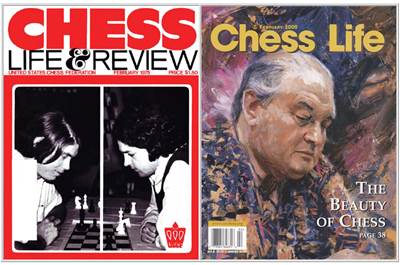
May 1975 & 2000 'On the Cover'

Continuing this blog's monthly look at American chess from 50 and 25 years ago, who was featured on the cover of CL&R/CL in the month of May? For last month's post see April 1975 & 2000 'On the Cover' (April 2025).
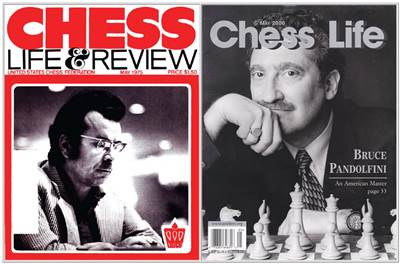

Left: '?'
Right: 'Bruce Pandolfini - An American Master'

Chess Life & Review (50 Years Ago)

Grandmaster Pal Benko, winner of the National Open. Story [inside]. Photo by Burt Hochberg.

The 'story [inside]' was titled '9th National Open' by George Koltanowski, USCF Vice-President.

This event, staged at the Stardust Hotel in Las Vegas, was by far the most spectacular of all the National Opens. The rooms were large, airy and exceptionally well lighted. The total of 242 participants was below last year's record entry, but the battle for prizes in the various sections was no less keen.

Four players tied for lst-4th: the trophy and title of National Open Champion went to Grandmaster Pal Benko of New Jersey (S-B 35), with second place on tiebreaks going to GM Walter Browne of California (S-B 34 1/2). The other two were Alfonso Ferriz, a young player from Mexico who also won the Expert trophy, and Alex Suhobeck of California, who also won the over-50 trophy. All scored 7.1.

I've mentioned in previous 'On the Cover' posts, e.g. November 1971 & 1996 (November 2021), that Koltanowski's tournament reports were often unusual. Two of his six paragraphs on the 1975 National Open were about adjournment incidents.

GM Benko's previous appearance 'On the Cover' was November 1974 & 1999 (November 2024). That year's report (1974) on the 8th National Open, won by GM Arthur Bisguier, was covered in July 1974 & 1999 (July 2024).

Back to May 1975, the monthly CL column 'The Editor's Page - News & Views' by Burt Hochberg carried unwelcome news for U.S. chess fans. Hochberg wrote,

When April Fool's Day passed with no word from Bobby Fischer, FIDE President Euwe had no choice but to declare Anatoly Karpov the new World Champion by default. (FIDE regulations set the April 1 deadline for each player to announce his intention to play for the world title under rules established at the FIDE Extraordinary General Assembly in March.)

Few people could have realized that the forfeit signalled the beginning of the end of the great Fischer boom which had started in 1971/-72. Two more articles in the same CL&R issue were also about Fischer: 'The Mind of Bobby Fischer' by Fischer biographer Frank Brady and 'Hochberg vs. Darrach', by CL&R editor Burt Hochberg.

Chess Life (25 Years Ago)

Getting an exclusive interview is always exciting -- a challenge to live up to. As a photojournalist, I wanted the images of Bruce Pandolfini to be as exclusive as his words. After photographing him at Washington Square Park and at the famous Capablanca table in the Marshall Chess Club, I still wanted something more. When I suggested a formal black and white portrait to Bruce, he quickly agreed. The result is this month's cover.

Technical Information:
* Nikon F100, 28-105 mm
* f11 @ 125, T-Max100
[...]

And you thought chess notation was confusing! - Brian Killigrew

The first of two articles involving Pandolfini was 'An Interview with Fred Waitzkin' by Bruce Pandolfini. The editor introduced the three pages saying,

Yes, there is life beyond chess, often referred to as "the real world." Fred Waitzkin flutters between both worlds, much like the time shifts in The Last Marlin. Bruce Pandolfini caught Fred on the cusp, so to speak, and the result is a fascinating interview.

Pandolfini prefaced the interview saying,

Readers of Chess Life are quite familiar with Fred Waitzkin's insightful writings on the world of chess. In addition to his penetrating pieces written for The New York Times Magazine, New York, Esquire, and Sports Illustrated, Fred has given us two moving and unforgettable narratives. Searching for Bobby Fischer (1988, Random House) is a poignant account of the relationship of Fred to his gifted son Joshua as the two of them experienced the vicissitudes of the scholastic chess scene.

It was later adapted by Paramount Pictures (1993) into an inspiring film of the same title, and the book and film have subsequently drawn legions into the chess world. Then Fred wrote Mortal Games (1993, G.P. Putnam's Sons), which portrays the expanding universe of Garry Kasparov through the machinations of welt politik and top tier chess.

The second article was 'Profiles in Chess: Bruce Pandolfini - An American Master'. The four pages were bylined 'Interview and Photography by Brian Killigrew'. He started,

There is something about Bruce Pandolfini that makes people want to be around him. Call it the Pandolfini mystique. Kids flock to him at tournaments. Adults constantly come up to him and whisper things like: "Is the King's Indian good against I. d4?:' walking away from Bruce as if they have just received some ancient secret.

Starting in April 2023, Killigrew has been mentioned in many 'On the Cover' posts, most recently January 1975 & 2000 (January 2025). Pandolfini has been mentioned in a handful of posts, mostly in relation to his involvement in scholastic chess.

15 April 2025

April 1975 & 2000 'On the Cover'

In last month's look at U.S. chess magazines from 50 and 25 years ago, March 1975 & 2000 'On the Cover' (March 2025), we saw a non-American player on the left (GM Robert Huebner) and an American player on the right (George Koltanowski, the 'Dean of American Chess'). This month the pattern continues, with a pair of Soviet players on the left and a quartet of American teams on the right. Was U.S. chess more attentive to international chess 50 years ago?


Left: '?'
Right: 'The Teams! A 30-year Odyssey • Upcoming Scholastic Nationals!'

Chess Life & Review (50 Years Ago)

Winners of the 1974 USSR Championship -- Mikhail Tal (left) and Alexander Belyavsky. See [inside] for the story by Paul Keres. Photos by TASS from Sovfoto.

The story '[inside]' was the 'Keres Annotates...' column, titled 'USSR Championship, Leningrad 1974'. It started,

The USSR chess organization, with its 35 grandmasters, has the ability to put together a very strong group for its national championships. As an example, the 1973 USSR Championship, with all the leading grandmasters competing, was one of the strongest tournaments ever held in the Soviet Union.

With this in mind, the 1974 Championship was probably a little disappointing. Most of the leading grandmasters were unable to take part for various reasons and were replaced by other players, while the number of participants was reduced from 18 to 16. Despite this fact, it was quite interesting to see experienced grandmasters such as Tal, Polugaevsky, Vasiukov and Taimanov fight their younger rivals, many of whom had splendid records in last year's tournament, and to see just how good the young players are in really strong competition.

The tournament was a hard fight from the very first round. One is used to seeing grandmasters like Tal and Polugaevsky leading the field, but this time they did not have it so easy, being severely pressed by Belyavsky, Vaganian, Romanishin, Alburt, Dvoretsky, and other young stars, most of whom are not very well known in international chess. And when we look at the final crosstable, we see that the young players came out very well in this tough test against their experienced "examiners."

It's noteworthy that, besides Keres, the other authors of feature articles in the same issue were Pal Benko, Laszlo Szabo, Lubosh Kavalek, Svetozar Gligoric, and Edmar Mednis. All had roots in Eastern European countries.

Chess Life (25 Years Ago)

Thank you, Ed Edmondson. If you were convinced that an idea was good, you ran with it. And 30 years ago, the idea of an amateur team championship, as presented by Denis Barry, sounded good. No bids, no committee approval. You just filled your station wagon with books and equipment and drove out to the VFW Hall in East Brunswick, New Jersey, and ran a concession for the 17 teams that played in that first event. Your faith and Denis' enthusiasm grew "The Teams" to over 100 teams, playing in Atlantic City.

Ed is gone. Denis is still around, kicking up dust here and there. But they left a legacy and a framework that will last forever. Hire a good staff, put the players first, chess for fun and chess for blood, in equal proportions. Steve Doyle (who celebrated 25 years of being associated with the event) operates within that framework and has built the USATE into a 200+ team event. Friday's snow and ice storm had almost no effect, and more than 920 players took part in the 30th Anniversary of the U.S. Amateur Team Championship (East). Worthy of a cover? You betcha. And a special report in our annual yearbook section.

The related article was 'Turning the Big 3-0 Was Totally Brutal at the U.S. Amateur Team East' by Al Lawrence. The mysterious title referred to the winning team, Total Brutality, a 'three-master team'. The report on the event started,

Over the telephone from St. Louis, my brother Leo was having a hard time with what would take place at the U.S. Amateur Team East Chess Championship. "Team chess," he said, "wouldn't that be like four-man diamond cutting?" After a few forced chuckles, I said "No, it's more like having four brothers backing each other up in a schoolyard scrap." From our old days on South Chicago's playgrounds -- in an era when fights were barehanded and forgotten as soon as the shiner faded -- he understood the point.

As tournament chessplayers, we're normally lone operators. In more jet-age terms, we sit in a room full of would-be top guns whose weekend happiness is a net-sum war game. For every ace exhilarated to see black smoke pouring out of his counterpart's engines, there's a wounded pilot spinning miserably down in flames. Strangers, friends, roommates -- all morph into hoped-for airplane silhouettes painted below the cockpit glass, plusses on the wall chart.

After the one-page introduction to the USATE, the story continued on the first page and across the outer column of the next 12 pages of the '2000 USCF Yearbook - Our Heritage'. A footnote to the story informed,

The U.S. Amateur Team East Championship is one of over 25 national title events co-sponsored by the USCF and participating affiliates. Al Lawrence, president of OutExcel! Corp., is the author of eight books on a variety of subjects.

A common thread united the April editions of the two magazines. Just as with the March 1975 edition of CL&R, Burt Hochberg's April 1975 column 'Editor's Page - News & Views' carried news of the ill-fated 1975 Fischer - Karpov World Championship title match. The April 2000 edition of CL carried opinions on the controversies surrounding the World Championship in 2000: Who was the real World Champion?

13 March 2025

March 1975 & 2000 'On the Cover'

Last month's post about American chess 50 and 25 years ago, February 1975 & 2000 'On the Cover' (February 2025), was all about the American Open. This month's post, somewhat more diverse, is a mixture of American and international chess.


Left: '?'
Right: 'George Koltanowski 1903-2000'

Chess Life & Review (50 Years Ago)

Robert Huebner, winner of the Houston International, with his trophy which, as Lynne Babcock writes, is "custom made, gold plated and does everything a chess trophy should -- nothing." Photo by Fred Bunch. Story [inside].

The 'Story [inside]' was titled 'Another USCF Success: The Houston International 1974' by Edmar Mednis. It started,

The Houston International Chess Tournament, fourth in the series of international events organized and sponsored by the USCF, was by far the most successful one for American chess, and it ended 1974 on a number of truly positive notes.

The first seven paragraphs of the report were about the organization of the tournament and its norm possibilities for American players seeking a FIDE title. It then continued,

And now back to us, the players -- the absolute requirement for any tournament. West German GM Robert Huebner was the clear favorite and fulfilled the high expectations by finishing first. Some of the wins did not come easily, yet his high class usually showed through. Yugoslav GM Aleksandar Matanovic is known the world over as editor-in-chief of the Informants and the new Encyclopedia of Chess Openings. At Houston he also demonstrated his fine playing ability. He was the only one never to have a dubious position and deservedly finished undefeated and in second place. My third place and GM result [by Mednis] was fashioned in a rather steady way [...]

Huebner died at the beginning of 2025. See Wikipedia's Robert Huebner (wikipedia.org; '6 November 1948 – 5 January 2025'), for his biography.

For the last year or so, we've been tracking the monthly CL column 'The Editor's Page - News & Views' by Burt Hochberg, as it provided a monthly summary of the evolving situation about a 'match that never was', i.e. 1975 Fischer forfeits to Karpov (m-w.com). In March we learned a number of details about the organization of the forthcoming match, e.g.

John Prentice, Deputy President of FIDE, announced in Amsterdam on February 17 that President Euwe's choice for the site of the 1975 World Championship Match was Manila. [...]

There is far too much detail in the report for this post and the topic would be more appropriate for my WCC blog.

Chess Life (25 Years Ago)

George Koltanowski, the Dean of American Chess, had thousands of favorite chess stories, and everyone he met, left with a favorite story about George. I invite you to share your reminiscences about this great ambassador for chess with other Chess Life readers. That way, as we continue to promote the game to which he devoted his life, we can add to the legacy he left behind. George could charm the feathers off a jaybird, if that's what it took to get a chess program started, or to secure a donation or a sponsor. And we definitely want others to benefit from his expertise.

Send your thoughts to the USCF, in care of the Editor, or use our e-mail address: cleditor@uschess.org.

We wish to thank the San Francisco Chronicle and photographer Chris Stewart for providing our cover this month. It was taken in May of 1999. You can check out Steve Rubenstein's tribute to George Koltanowski at www.sfgate.com.

A two page appreciation by CL Assistant Editor Peter Kurzdorfer and Editor Glenn Petersen gave more details about Koltanowski's career. I'm sure we'll be seeing more about 'the Dean of American Chess' in future 'On the Cover' posts. The 'Dean' was also featured on the right side of November 1971 & 1996 'On the Cover' (November 2021).

13 February 2025

February 1975 & 2000 'On the Cover'

The leading American chess magazine -- both 50 years ago and 25 years ago -- featured the American Open. For last month's post in the series, see January 1975 & 2000 'On the Cover' (January 2025).


Left: '?'
Right: 'The Beauty of Chess'

Chess Life & Review (50 Years Ago)

Kim Commons, left, and Peter Biyiasas, co-winners of the American Open. Story [inside]. Photo by Carl Budd.

The 'story [inside]' by Carl Budd, 'Vice President, Santa Monica Bay Chess Club', was titled '10th American Open'. It started,

The tenth anniversary of the American Open resulted in co-champions for the first time since its inception. Kim Commons, formerly a California Champion, and Peter Biyiasas, current Champion of Canada, led the field after the eighth and final round to tie for top honors. [...]

Altogether there were 168 entries in the Championship Section. And with 300 entered in the Amateur Section, the grand total of 468 players makes this American Open the largest rated tournament ever held in California and the third largest open tournament co-sponsored by the U.S. Chess Federation. It is surpassed only by the U.S. Open in Chicago in 1973 with 778 players and the U.S. Open in New York in 1974 with 549 players.

For the previous edition of the American Open, 51 years ago, see February 1974 & 1999 'On the Cover' (February 2024; 'James Tarjan, winner of the American Open in California').

Chess Life (25 Years Ago)

Again we thank Steven Seward for his excellent work, providing us with a cover portrait of the winner of the 35th American Open, Grandmaster Eduard Gufeld. Jerry Hanken's happy recap begins on [inside] and is followed by an interview with Gufeld. Keeping with the theme of the interview, Gufeld's "Artistic Beauty in Chess" begins [inside].

That's a lot of Gufeld for one issue of CL: cover portrait, winner of the 35th American Open (four page story), interview (two pages), essay on beauty in chess (five pages). The 'On the Cover' introduction continued with a Gufeld anecdote:-

You should also note that Bobby Fischer's last sacrifice -- was Gufeld. When Fischer forfeited his match against Karpov in 1975, the Soviets were desperate to prove that Karpov was worthy of the title. Gufeld was scheduled to travel (a rarity) to Ljubljana for the Third Vidmar Memorial, a super-strong event. That's right, Eddie got bumped -- sacrificed if you please -- in order to allow Karpov to participate (Karpov won, ahead of Gligoric, Ribli, Furman, Hort, Parma, Portisch, et. al. [June 1975, Karpov: +7-0=8]).

By some unusual coincidence, the February 1975 issue of CL&R had news about the Fischer - Karpov match, so I'll come back to that story after finishing with Gufeld. The tournament report was titled 'Gufeld Tops 35th American Open' by Jerry Hanken. It started with a bit of chess history:-

A little over a year after Lyndon Johnson announced his "Great Society" and "War on Poverty" and 14 months before Super Bowl I, the American Open was born. A brainchild of Al Bisno of the Santa Monica Bay Chess Club and USCF Executive Director Ed Edmondson, this tournament became part of the original "Triple Crown" (along with the U.S. Open and National Open). The first running drew over 200 players to the Miramar Hotel in Santa Monica and was won by then-super GM (twice a world championship candidate in the 50's and 60's) Pal Benko. [...]

In 1979 the American Open achieved "American Classic" status (marking the difference between a National and one run by a local organization which has drawn over 400 players three years running). And in 1989 it was awarded the "American Heritage" designation for lasting 25 consecutive years. Only one other tournament holds both these distinctions — the World Open, of course.

This information is for historical perspective in reporting on the just-completed 35th Annual American Open, held Thanksgiving weekend at the spacious LAX Sheraton Gateway.

The report then turned to a discussion of the winner.

Quite fittingly, the tournament, an eight-round Swiss, was won by a grandmaster whose career and accomplishments span the last 35 years! In a mild upset, the American Open champ of 1999, the last of the millennium, was Eduard Gufeld! I use the word "upset" because Eduard was only the ninth highest USCF-rated player in the event, and many thought that at 63 years of age he was simply too old and too outclassed to win such an event. After all, there were three GMs (Pavel Blatny, Sergey Kudrin, and Alex Yermolinsky) among those seeded ahead of him.

Since he recently settled in the Los Angeles area, Gufeld has been known as a fine teacher and lecturer, but not a great tournament player. Well, he certainly struck a blow for us old folks! Not only did he become the champion, but he won with a clear half-point advantage at 6 1/2 of 8.

I'll skip both the Gufeld interview and his essay and return to the phantom 1975 Fischer - Karpov match. Burt Hochberg described the status in his monthly column for February 1975, 'The Editor's Page - News & Views'.

The FIDE Bureau meeting in Panang, Malaysia, December 15-18 [1974], resulted in some very discouraging news. The most pressing matter was the World Championship Match for 1975: by a narrow 5-4 vote the Bureau reluctantly declined to consider changing the Regulations adopted last June by the General Assembly at Nice.

President Euwe expressed the hope that the Chess Federation of the USSR would now, in a grand gesture designed to demonstrate the sportsmanship it has so long professed, announce that Karpov would agree to the match conditions proposed by Fischer. If the Soviets do not make this gesture -- and several Bureau members consider it unlikely -- only an Extraordinary General Assembly could make any changes in the Regulations.

After more bad news involving the 1975 World Student Team Championship and the 1976 Olympiad, Hochberg returned to the title match.

Some hope remains, however, that the World Championship may yet be saved. The Chess Federations of Japan, Iran and the Philippines have called for an Extraordinary General Assembly, as provided for in FIDE statutes. For this meeting to be held -- it must be done before April 1 -- 29 of the 87 member federations must support the call.

On January 1, the bids for the Match were opened at FIDE headquarters in Amsterdam. There were only three: Mexico City $387,500; Milan $426,250; and the Philippines $5,000,000. According to FIDE regulations, the match winner gets five-eighths of the purse and the loser three-eighths. Details of the bids have been sent to Karpov and Fischer, each of whom must list the bids in order of preference and notify FIDE of their choices not later than February 17. If the two players do not agree, FIDE President Euwe will choose the site.

For the previous major development involving the 1975 match, see August 1974 & 1999 'On the Cover' (August 2024; 'The [1974] FIDE Congress was shaken by several controversial decisions.').

16 January 2025

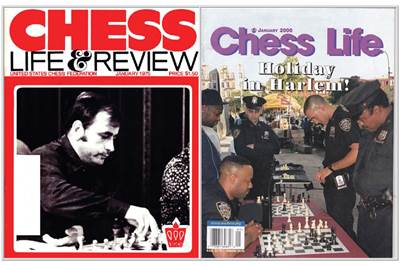
January 1975 & 2000 'On the Cover'

At the end of the old millennium, 25 years ago, the right side of last month's post, December 1974 & 1999 'On the Cover' (December 2024), announced,

Whether you consider it to be the millennium or just the beginning of a new year, one thing is clear: Chess is still going strong.

At the start of the new millennium, also 25 years ago, it was business as usual.


Left: '?'
Right: 'Holiday in Harlem!'

Chess Life & Review (50 Years Ago)

Vlastimil Jansa of Czechoslovakia, winner on tiebreak of the Atlantic Open in New York City, Nov. 28-Dec. 1. See the brief report [inside] and the full story next month. Photo by Nigel Eddis.

The 'brief report' said,

In N.Y., the Atlantic Open had 348 players; winners were Jansa, Matanovic, Bisguier, Zuckerman and Balmazi, with Jansa first on tiebreaks. GM Damjanovic withdrew when he realized that he and the swiss system were incompatible.

As for 'the full story next month', I climbed into my time machine to dive into the next 3-4 issues of CL&R, but came up empty-handed. Maybe something will surface in the next few 'On the Cover' posts. The January 1975 issue of CL&R also contained the 'FIDE International Rating List' with the following details:-

Closed 31 Oct. 1974; effective 1 Jan. 1975; provided by Arpad Elo

The 85 players rated 2500 or higher were also listed in descending order of rating. At the top of the list were:-

No.1 Fischer 2780
No.2 Karpov 2705
No.3 Korchnoi 2665
No.4-6 Petrosian, Polugaevsky, Tal 2645

After the American and five Soviets, the nationalities of the other players were given. The full counts of the nationalities were USA 8, USSR 36, and Other 41. Pachman was listed as 'Stateless'.

GM Jansa was listed in a block of players at no.36-41 rated 2540: Balashov, Gheorghiu, Jansa, Kholmov, Pfleger, and Schmid. His nationality was given as 'Czechoslavakia', where he was the third (of three) from that country after Hort and Smejkal. For an overview of his career, see Vlastimil Jansa (wikipedia.org; 'born 27 November 1942, is a Czech chess player [...] Grandmaster, in 1974').

Chess Life (25 Years Ago)

Holiday in Harlem! That's the most appropriate way of describing the all-day celebration of the opening of the HEAF (Harlem Educational Activities Fund) Harlem Chess Center. The city closed 119th Street and pawns were pushed not only by off-duty, gold-shielded sergeants, but by the likes of Wynton Marsalis, GM Maurice Ashley, New York Congressman Charles B. Rangel, and NYC Parks Commissioner Henry J. Stern. The story begins [inside], but it does not end there. • Cover photo by Brian Killigrew

That was the first of six paragraphs introducing the issue, each paragraph covering a separate topic. The Ashley / Harlem story continued in more than three pages and 18 color, captioned photos.

Maurice Ashley is not one to rest on his laurels. Having completed his goal of becoming a grandmaster, Maurice turned his attention to another passion of his: opening a world-class chess center for kids in Harlem.

On September 25, his passion became a reality as the Harlem Educational Activities Fund (HEAF) held a grand opening for its Harlem Chess Center (HCC) and announced to the world that chess in the inner city is here to stay.

Chess took over Harlem, as 119th Street was closed to traffic and chess games lined the street. The playground of PS190 was turned into a chess-playing area and a large stage was erected for the ceremonial speeches and the great entertainment to come by special guest star Wynton Marsalis and his band.

After the opening speech by HEAF president and Police Atheletic League Board of Directors vice-president Dan Rose, Maurice Ashley spoke to the crowd about wanting to give back to a community that has given him so much. "The center will be wonderful for the community" said Maurice, "My hope is that the idea will not be limited to Harlem, but that it will spread all over the city and eventually, the country." His words were greeted by an enthusiastic audience, filled by people who know how much chess can help a young persons' development.

The only info I could find about the fate of the chess center was on Maurice Ashley (heroic.us). It informed,

From 1991 to 1997 Ashley was the chess director of the Harlem Educational Activities Fund, Inc., where he led teams to three scholastic national championships -- three of his players also won the individual national championships for their age groups. [...] After earning his International Grandmaster title in 1999, Ashley returned to coaching and community action by becoming the first director of the Harlem Chess Center (closed in 2002 due to lack of funds).

Starting 2013, there is evience of a website in harlemchesscenter.org (archive.org).

12 December 2024

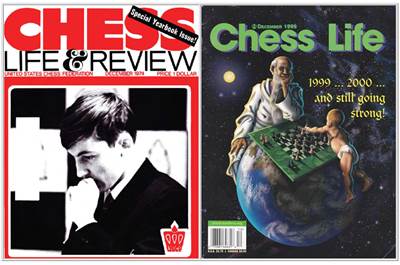
December 1974 & 1999 'On the Cover'

What do the Chess Life issues of December 1974 and December 1999 have in common? Yes, they are obviously the next in the 'On the Cover' series last seen in November 1974 & 1999 'On the Cover' (November 2024). On top of that, they were both dominated by rating lists.


Left: '?' (also 'Special Yearbook Issue!')
Right: '1999... 2000... and still going strong!'

Chess Life & Review (50 Years Ago)

Anatoly Karpov: if he beats Korchnoi, and if Fischer and FIDE cannot resolve their differences, he will be World Champion in 1975. Match games continue [inside].

Karpov's previous cover appearance was May 1974 & 1999 'On the Cover' (May 2024; 'Anatoly Karpov and Tigran Petrosian, winners of their quarterfinal candidates matches.') Everyone who knows anything about modern chess history knows what happened in 1975. I suppose we'll see the story unfold in next year's 'On the Cover' posts.

The December 1974 CL&R was 108 pages. Of those, 70 were allocated to the '1975 USCF Yearbook', and of those, 52 were allocated to the rating list. The Karpov - Korchnoi match, the inspiration for the cover, was a single page, with only raw game scores for games 11-21.

Chess Life (25 Years Ago)

No, we will not enter into the argument as to when the millennium arrives. We do knows that the end of December 31, 1999, will usher in a new year. Appropriately, the babe (2000) is playing the decisive Rg7+ against the old man (1999). The artist, Jose Angel Pardo, of Orlando, Florida, notes "That was the winning move I played in the first game I was ever able to beat my father."

Whether you consider it to be the millennium or just the beginning of a new year, one thing is clear: Chess is still going strong. Of our 86,000 members, fully 74,000 played at least one rated game of chess between October 1998 and October 1999. We've separated the Annual Rating List from the rest of the magazine and included a few items we hope you will find useful throughout the new year. And that includes a comprehensive listing of all changes to the Official Rules of Chess, 4th Edition.

Again we see a rating list. Of the 128 pages in the December 1999 CL, 49 were allocated to the list. Interspersed throughout the list were a number of interviews by Jerry Hanken, including one with 13-year old Lawrence Trent for the World Open and another with 8-year old David Howell. The same Howell, now a GM, commentated for FIDE on the recent World Championship match between Ding Liren and Gukesh.

There was more to the 'On the Cover' introduction for the same December CL. It continued,

Transition is never easy or particularly palatable for many. The Executive Board, in closed session, passed an enigmatic resolution to terminate the contract of Michael Cavallo as our Executive Director. I say enigmatic not as a judgement as much as a statement of fact.

After four paragraphs on the same subject I still didn't have a clue why this was newsworthy for the general CL readership. There is a ton of relevant information in the rgcp archive at groups.google.com, e.g. search?q=Cavallo, but who has the time to plow through it? For a previous cover illustration by Jose Angel Pardo, see September 1974 & 1999 'On the Cover' (September 2024).

19 November 2024

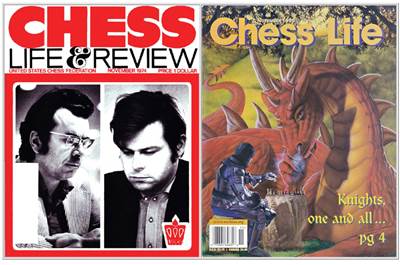
November 1974 & 1999 'On the Cover'

For the second month in a row, after October 1974 & 1999 'On the Cover' (October 2024), top U.S. tournaments dominated the covers of American chess magazines both 50 and 25 years ago. Artwork was also a recurring theme.


Left: '?'
Right: 'Knights, one and all...'

Chess Life & Review (50 Years Ago)

Pal Benko (left) and Vlastimil Hort, co-winners of the U.S. Open. Story and games [inside]. Photos by Burt Hochberg.

'Story and games [inside]' came after three articles on the 1975 World Championship. The first article was about the Karpov - Korchnoi match, the final match of that cycle's Candidate matches; see 1973-75 Candidates Matches (m-w.com), for a record of all the matches that took place during that cycle. The final match became a de-facto title match when Fischer forfeited his title in 1975. The introduction to the article said,

The Finals match in the 1974 Candidates series began in Moscow September 10. Aften ten games, the score was Karpov 2, Korchnoi 0. To win the match a player must score five victories or be in the lead after 24 games; if the score is even after 24 games, a coin toss (or other chance drawing) will decide the contest. Here are the first ten games.

The second article was the monthly column 'The Editor's Page - News & Views' by Burt Hochberg. It started,

World Champion Bobby Fischer, defending the match rules he favors, comments: "The whole idea is to make sure the players draw blood by winning games, and the spectators get their money's worth." The accuracy of his judgment is borne out by the current Karpov-Korchnoi match in Moscow, in which after 14 games the score remains 2-0 in Karpov's favor.

The third article was the monthly column 'Larry Evans on Chess', subtitled, 'The World Champion Speaks'. It started with a letter from Bobby Fischer and continued for two pages. The whole Fischer forfeit saga deserves to be documented from the USCF's point of view as recorded in the pages of Chess Life. Has this ever been done?

Only after the three articles on the World Championship do we find 'The U.S. Open: An Interesting Disappointment' by Burt Hochberg. It immediately took a dark tone, starting,

In this scientific age of ours, we are obsessed with numbers. Record-breaking is becoming a common concern of our daily lives. In chess, the establishment of records, to the point of pointlessness, already occupies the thoughts of a great many intelligent people.

After a few more paragraphs, Hochberg revealed the reason for the 'Disappointment'.

If we are convinced that record-making and record-breaking are legitimate concerns because of their incentive value, then we must also take it upon ourselves to explain why a standing record was not broken -- or even met -- despite every expectation that it would be far exceeded. To descend from the metaphysical to the specific: why did the 1973 U.S. Open in Chicago (a city of about 3.5 million) attract almost 50% more entries than the 1974 U.S. Open in New York (a city of about 8 million)?

A second article, 'New York's U.S. Open' by Bill Goichberg, explained the circumstances for the disappointment. It started,

After 35 years. the U.S. Open was finally held in New York. It was not an event I will fondly remember. Not only were entries far below what most people expected, but the out-of-town turnout was particularly poor. The host hotel had been guaranteed 100 sleeping rooms, and when the actual count proved to be far lower, we were socked with a whopping rental charge of $5,000.

Heavy financial losses were suffered by both USCF and the co-sponsoring Continental Chess Association. jeopardizing the latter's nationwide tournament promotion program. CCA has been losing money for the past year, and will have to cut back in many areas unless attendance suddenly recovers or enough voluntary donors can be found.

Chess historians accept that the 1970s Fischer boom started in 1972, but when did it end? It appears that 1973-74 was the start of a long slide to pre-1972 levels.

What happened to our two cover GMs? They each won $1.675 (which would be more than $10.000 today). Benko was last seen in October 1969 'On the Cover' (October 2019), although his compositions made the cover in both the January 1970 & 1995 (January 2020) and January 1972 & 1997 (January 2022) 'On the Cover'. Hort was last seen in June 1969 'On the Cover' (June 2019).

Chess Life (25 Years Ago)

Dragons or dragon-slayers, depending on your outlook. But they all wind up being Knights of the 64 squares. Huzzah! Huzzah! for our new Interplay champions Boris Gulko, Marcel Martinez, and Anjelina Belakovskaia, and for Gregory Serper (World Open), Alex Yermolinsky (U.S. Open), and Andrei Zaremba and Steven Winer (Denker champions).

And it is that time of year. The call for nominations for the Hall of Fame appears on page 23.

The cover design is by Patrick Kelly of Grand Rapids Michigan.

The first five players were also named in last month's 'On the Cover' introduction for 1999. They were the winners of four tournaments reported inside the November 1999 issue (Gulko and Belakovskaia won their respective sections of the U.S. Championship). Did the Chess Life editors have some trouble deciding what story to feature?

Since the U.S. Open was the featured tournament in the 1974 CL and was also the first of the four tournaments covered in the 1999 CL, let's continue with it here. The article '1999 U.S. Open: The Big Bang' by GM Edmar Mednis started,

The 100th Annual U.S. Open Championship at the luxurious Sands Regency Hotel Casino in Reno was held August 10-19, 1999. It started with a bang and never let up. At the welcoming ceremony in the evening of August 9, the participants were treated to an exhibition by Buckeroo Beau, the reigning world bullwhip champion and award-winning gun slinger and trick roper. For those having quieter interests there was Christa Lynn Jones, the reigning Miss Reno Rodeo. Some 80 people enjoyed the action and sumptuous Western-style barbecue.

How about the bang from the $63,300 prize fund unconditionally guaranteed by the Sands Regency? Truly a record -- just compare with the $22,000 of the 1998 Open! And the bang from the $10,000 first prize and the many bangs from the total of 61 cash prizes.

Bang, bang, bang, bang... The four bangs in that excerpt were followed by six more bangs in the rest of the paragraph. Anyone feel like banging their head against the wall?

The Hochberg report on the 1974 U.S. Open mentioned that there were 549 players. The Mednis report on the 1999 U.S. Open mentioned,

The 338 players at the start did a lot of banging and it became even louder when the busy-persons joined the action at the start of Round 5, bringing the total up to 485.

If 549 players were a disappointment, what can be said about 338/485 players exactly 25 years later? And what happened 25 years after that ... in 2024?

08 October 2024

October 1974 & 1999 'On the Cover'

For last month's post, September 1974 & 1999 'On the Cover' (September 2024), we saw four Americans who were newly minted IMs 50 years ago and the logo for a controversial type of FIDE World Championship played 25 years ago. This month we see the leading American GM of 50 years ago, but the FIDE event has disappeared.


Left: '?'
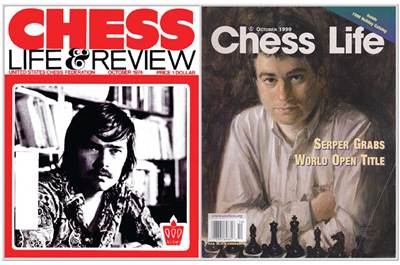
Right: 'Serper Grabs World Open Title'

Chess Life & Review (50 Years Ago)

U.S. Champion Walter Browne, who after winning his title went on to win the Pan-American Championship in Winnipeg, Canada. The U.S. Championship story is [inside]. Photo by Burt Hochberg.

There was more about GM Browne on 'The Editor's Page - News & Views' by Burt Hochberg. This was a regular column in those days.

Walter Browne continues onward and upward. Following his crisp U.S. Championship victory, the American grandmaster went after the Pan-American Individual Championship in Winnipeg, Canada. Though he expected to win it, his dominance of the field was reminiscent of Fischer's performances in tournaments of equivalent strength: Walter gave up only three draws in fifteen games, winning the other twelve. Starting with the World Open in July and including the U.S. Championship and the Winnipeg tournament, Browne has played 37 games without a loss, and this record no doubt stretches further back.

His sudden prominence has not gone unnoticed by the media. The September 2 issue of Newsweek, for instance, devoted two thirds of a page to Browne, reacting to the public's increased awareness of chess since the onset of the Fischer era. The public needs heroes, and so do the media. Walter's youth, his confidence, his lifestyle, his looks -- all fit the public's idea of the dynamic modern sports figure. And since media interest is good for chess, we say more power to him.

This was the first of Browne's six American championship titles. In the same issue he authored a report titled 'The U.S. Championship, by Walter Browne, U.S. Champion'. The five page article, half of which were raw game scores, started,

After the poorly-organized Olympics at Nice (construction noises at the hotel began at 6:00 A.M.), I was looking forward to the excellent conditions normally surrounding a U.S. Championship. Unfortunately, however, on first sight of the playing room I noticed that the players would be quite cramped, while the lighting was very dim.

It was also clear that there was no analysis room, so after the games the players had to sit on the floor outside the playing room. Near the end of the tournament, Bisguier and Evans came up with a table and chairs. Obviously, they had a lot of influence!

The opening ceremony went smoothly. Evans chose No. 1 and I had to play Black against John Grefe in the first round. After the ceremony we all adjourned to a fine Yugoslav restaurant which provided lively entertainment.

The tournament report was a game-by-game description of Browne's progress through the event. For example, 'In the ninth round against Bisguier, I played one of the best games of my life.' That game is available online: Walter Browne vs Arthur Bisguier; United States Championship (1974), Chicago, IL USA, rd 9, Jul-25 (chessgames.com; '"Browne Bagging It", game of the day Oct-07-2006'). For Browne's previous cover appearance, see July 1974 & 1999 'On the Cover' (July 2024; 'On the right is GM Walter Browne, winner of the 4th Statham Tournament in Lone Pine, Cal.').

Chess Life (25 Years Ago)

Congratulations to Alexander Khalifman for winning FIDE's Knockout World Championship, which ended August 29th. And kudos go out to Alex Yermolinsky for his tiebreak victory in the 100th U.S. Open, held at the Sands Regency in Reno, Nevada. Marcel Martinez won the Junior Invitational, hosted by the Mechanic's Institute of San Francisco. And while Boris Gulko, Yasser Seirawan, Gregory Serper and Alex Yermolinsky battle it out in the finals of the Interplay U.S. Championship, we congratulate Anjelina Belakovskaia for winning the Interplay U.S. Woman's Championship in Salt Lake City. Stories will follow next month.

Our main feature this month is on the World Open, won by Gregory Serper, after a tiebreak session of quick play games. Steven Seward of Cleveland, Ohio, again provided the artwork for this month's cover. He enjoys doing portraits, and, judging by your letters, you enjoy his work.

This marks the third time we've seen artwork by Seward of Ohio. The previous cover was January 1974 & 1999 'On the Cover' (January 2024; 'We again called on portraitist Steven Seward of Cleveland, Ohio, to work his magic for our cover.')

The 'main feature' of the issue was a three page report, 'Serper Breaks Log Jam at World Open' by Jerry Hanken. The author was a regular contributor of reports on top-level U.S. chess events of that period. It started,

The 27th Annual World Open, held over the Independence Day weekend, was one of the most exciting and interesting of this great series of tournaments. This was the 15th in a row held at the elegant Adams Mark Hotel in the upscale City Line area of Philadelphia. With adjustments for re-entries in the lower sections (they're not allowed in the Open), the total was 1,470 players, a significant increase of 36 over last year's. The prize fund was increased by $10,000, making the prizes even deeper than last year's.

As it is every year, the World Open was by far the largest U.S. non-scholastic open in attendance and prizes. With the New York Open taking a sabbatical this year, the 30 grandmasters who graced the Open section was again by far the largest number in any U.S. tournament. (Of course, I am not counting the FIDE Las Vegas extravaganza.)

"So who won the shooting match, Hanken? Don't keep us in suspense!" Ah, as Bill Shakespeare said, "Thereby hangs a tale!" In a word, it was Gregory Serper, a very likeable and genial ex-Soviet player who now lives in Cleveland, Ohio (GM City USA, with Yermolinsky, Goldin, and Lein also making the lakeside big town home), who hopes soon to be a U.S. citizen.

GM Serper is today a regular contributor to Chess.com. For an index of his writings, see Gserper's Articles (chess.com).

So what about the news on the FIDE Championship? It was confined to 'Alexander Khalifman Is FIDE World Chess Champion' by Peter Kurzdorfer and started,

Who would've thunk it? The FIDE Knockout World Chess Championship in Las Vegas produced the biggest upset in all world championship history!

Russian Grandmaster Alexander Khalifman, while certainly a very good player. has never been ranked at the very top among world-class grandmasters. He was seeded 36th in the knockout championship, even though top-10 GMs Kasparov, Anand, Morozevich, and Karpov were not competing. Nevertheless, he fought his way through the tournament, winning all seven matches by knocking out grandmasters Dibyendu Barua, Gata Kamsky, Karen Asrian, Boris Gelfand, Judit Polgar, Liviu-Dieter Nisipeanu, and Vladimir Akopian.

The two-column report by CL Assistant Editor Kurzdorfer was the eighth feature in that month's magazine, sandwiched between 'Six Tie for First at North Bay [Ontario, Canada] International' and '1999 U.S. Blind Champion'. The Jerry Hanken report on the World Open was the fifth feature after 'U.S. Amateur Playoffs', 'Pan-Am Promo', 'CJA Awards', and '1999 U.S. Amateur Championships'.

We can only speculate on the reason for the low profile of the FIDE event in CL. Was it because of the bad showing by the U.S. players, all of whom were eliminated no later than the second of the seven rounds? Or was it because of bad blood between USCF, as the American federation was known at that time, and FIDE? I'm guessing it was both.

08 September 2024

US Chess on Video

With less than 100 views and zero comments after three weeks on Youtube, this video might be the least popular chess clip that I've ever selected for a monthly featured video post. So why feature it? Because I liked the inside look at the US Chess federation.


US Chess Federation Staff Forum Friday August 2 2024 (5:57) • '[Published on] Aug 19, 2024'

The description said,

US Chess is the official, not-for-profit US membership organization for chess players and chess supporters of all ages and strengths, from beginners to Grandmasters. Find out more at uschess.org

That was followed by around a dozen links to various aspects of US Chess, four of which were under the header 'Women in Chess'. At the end of the video, the staff forum morphs into a membership meeeting which has also been recorded for posterity:-

If you like this sort of thing -- I appreciate that it's not for everyone -- don't miss:-

Nearly nine hours long, it even has a transcript. For more about the venue, see What to Expect at the 124th Annual U.S. Open (uschess.org; JJ Lang). It starts,

The 124th Annual U.S. Open Chess Championship begins Saturday, July 27 at the Sheraton Norfolk Waterside Hotel in Norfolk, Virginia. Here is a primer of what to expect and how to follow all the action!

For more about the meetings, scroll to the bottom of that page to find 'Meet, Mingle, Delegate'. Even though online chess gets most of the attention and the players, US Chess is alive and well.

03 September 2024

September 1974 & 1999 'On the Cover'

This month's 'On the Cover' features two unique, historical chess events in the USA. Fifty years ago, four up and coming American players received the IM title at the 1974 FIDE Congress. Twenty-five years ago, a controversial World Championship tournament was held at Las Vegas, aka 'Sin City'. For last month's 'On the Cover', see August 1974 & 1999 'On the Cover' (August 2024).


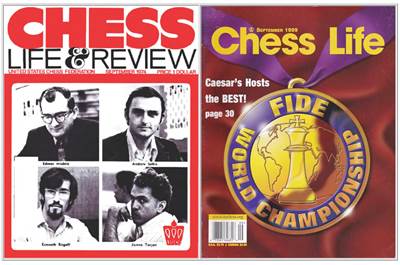
Left: 'Mednis/Soltis/Rogoff/Tarjan'
Right: 'FIDE World Championship; Caesar's hosts the BEST!'

Chess Life & Review (50 Years Ago)

Our four new International Masters: Edmar Mednis (top left); Andrew Soltis (top right); Kenneth Rogoff (bottom left); James Tarjan (bottom right). Photos by Burt Hochberg.

A story inside, 'FIDE Titles' by Arpad E. Elo, Secretary, [FIDE] Qualification Committee, started,

After a drought of several years, four U.S. players were awarded the International Master title by the FIDE Congress at Nice: Edmar Mednis, Kenneth Rogoff, Andrew Soltis and James Tarjan. These, plus a Cuban IM and a Correspondence Master, were all the Western Hemisphere could claim of the 63 titles approved by the Qualification Committee.

All four American players went on to become grandmasters -- Mednis (b.1937; GM 1980), Rogoff (b.1953; GM 1978), Soltis (b.1947; GM 1980), Tarjan (b.1952; GM 1976) -- and all but Soltis played in World Championship Interzonals: Rogoff in the 1976-78 cycle, Mednis and Tarjan in the 1979-81 cycle; see FIDE Events 1948-1990 (m-w.com) for links. Coincidentally, all four had six-letter family names. The Arpad Elo article continued,

Among the interesting new title holders is a Woman Master of whom the USSR players are exceptionally proud, Maya Chiburdanidze, just thirteen years old!

Four years later Chiburdanidze won a match against the reigning Women's World Champion -- see 1978 Chiburdanidze - Gaprindashvili Title Match (m-w.com) -- who had held the title since 1962. When Chiburdanidze lost the title in 1991, it would mark nearly 30 years of an uninterrupted reign by Georgian women players.

Chess Life (25 Years Ago)

By the time you receive this issue, the Second FIDE Knockout World Championship will be history. We were able to report the results of the first two rounds. Unfortunately, that was all that was needed to determine the fates of our nine participants. [...] Jose Angel Pardo put together the artwork for Chess Life in Adobe Photoshop. He holds a BA in Fine Arts from Jersey State College.

For more about the cover teaser, 'Caesar's hosts the BEST!', see two previous posts on my World Chess Championship blog:-

A few months ago we saw the same paragraph about cover artist Pardo in July 1974 & 1999 'On the Cover' (July 2024). An article inside the September issue, 'Americans at Las Vegas' by Brian Killigrew, started,

The FIDE World Championship Knockout Tournament has given chess fans a great deal to be excited about. One month of top-level chess, one hundred players, and speed games where one mistake can cost you a match. The format is exciting, if not controversial.

Do the short matches really prove who is the best? Should speed chess determine the winner of the world championship? And is the winner really the world champ if he hasn't beaten Kasparov -- or, for that matter, Karpov?

These are a few of the questions I posed to the players representing the United States at the tournament. While they were all excited to be part of it, their feelings about the format were mixed. But they all agreed on some points. The players said that it wasn't fair when Karpov was seeded directly into the finals last year, and they also showed a great deal of respect for their first round opponents.

The first (Groningen / Lausanne) and second (Las Vegas) FIDE World Championship Knockout events are documented on my index page for the World Chess Championship (m-w.com). There would be a total of five title events using the knockout format, which never escaped the 'exciting, if not controversial' criticism.

06 August 2024

August 1974 & 1999 'On the Cover'

For the last couple of months, 'On the Cover' has been alternating between the World Championships of 50 and 25 years ago. Last month's post, July 1974 & 1999 'On the Cover' (July 2024), had the 1999 event on the right. Now we have both events behind the respective covers.


Left: '?'
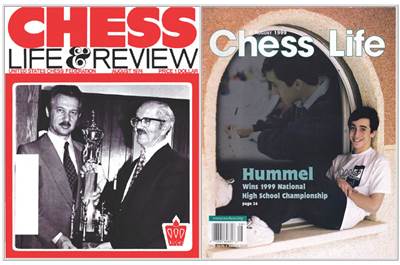
Right: 'Hummel Wins 1999 National High School Championship'

Chess Life & Review (50 Years Ago)

Dapper Grandmaster Svetozar Gligoric happily receiving his 1st-place trophy from TD Isaac Kashdan at the Los Angeles International. Story [inside].

The 'story [inside]' was titled 'Los Angeles International Tournament 1974' by Edmar Mednis. It started,

The United States Chess Federation has organized and sponsored three international invitational toumaments within the space of less than a year. The latest of these was held April 6-19, 1974 in Los Angeles.

These tournaments are intended to provide American masters the opportunity to obtain international titles and FIDE (Elo) ratings. [...] It is important that our top masters receive these rating for two reasons: (1) foreign organizers do not invite Americans rated at 2200 in absence of a FIDE rating, but whose real strength is 2400-2500, because to do so would artificially lower the rating category of the tournament: (2) even in our own tournaments, a 2200-rated American is a handicap, as this lowers the category of the tournament and thus increases the point total required for achieving IM and GM norms.

So far the USCF has been most successful in achieving the goals set for these tournaments. At the first one, held in June 1973 in Norristown, Pennsylvania, Ken Rogoff achieved an IM result, while Kim Commons and Craig Chellstorp obtained FIDE. ratings. At the second, Chicago, November-December 1973, Norman Weinstein was a smashing first with an IM result, Jim Tarjan also had to IM result, and Andrew Karklins obtained a FIDE rating. And at Los Angeles, this writer obtained an IM result, his third this year, and will be awarded the IM title at the FIDE Congress in Nice.

A crosstable for the event appeared in the July issue of CL. The big news of recent months was recorded on the 'The Editor's Page - News & Views' by Burt Hochberg, a column which was running monthly in 1974 and which I've already referenced in previous 'On the Cover' posts. The August column started,

Chess players of every strength, their wives and team captains, FIDE delegates and committee members, armies of tournament directors and arbiters, journalists from everywhere -- and assorted problems -- descended like a plague on the world's most famous jet-set resort, the French Riviera. The 21st Olympiad and the concurrent FIDE Congress, hosted by the bustling tourist city of Nice, took place June 6-30 with a record participation of 73 FIDE-affiliated federations.

[Chess 'descended like a plague'?] The big news followed. It would affect world chess for the next decade and even beyond.

The FIDE Congress was shaken by several controversial decisions. Following Dr. Euwe's reelection as President, the Congress decided to approve only part of World Champion Fischer's set of "non-negotiable" proposed conditions for the 1975 title fight. He had asked that 10 wins determine the match winner, that there be no limit on the number of games played, that draws not be counted in the scoring, and that if the score was 9-9 the Champion would retain his title.

FIDE approved the 10-win regulation and the elimination of draws from the scoring, but imposed a 36-game limit and rejected the 9-9 proposal. On learning this, Fischer (in daily contact by phone with Fred Cramer at Nice) cabled the Congress: "FIDE has decided against my participation in the 1975 World Chess Championship. I therefore resign my FIDE World Championship title." FIDE'S response was to ask Bobby to "reconsider possibility of defending title under regulations adopted here."

Also important for the future of chess was a political decision from the Congress.

Another painful episode was the "temporary exclusion" from FIDE of South Africa and Rhodesia because of their racial policies. The motion had been made by Bulgaria at Helsinki last year.

The idealistic FIDE motto 'Gens Una Sumus' was no longer a reality.

Chess Life (25 Years Ago)

Congratulations to Patrick Hummel, our 1999 National High School Champion and not just for winning a national title, but for his stellar performances at the Memorial Day Classic (beat Ehlvest, drew with Ziatdinov) and the Chesswise University - CCA International (defeated WGM Anjelina Belakovskaia in the last round to earn his first IM norm). The cover photos were taken by Carla Hummel and the design is by Jami L. Anson.

For more about Hummel's chess career, see The chess games of Patrick Hummel (chessgames.com). For more about his current whereabouts, see Patrick Hummel (patrickhummelecon.github.io). I imagine that two years after Kasparov lost a match to a computer -- see Kasparov vs. IBM's Deep Blue (m-w.com) -- a chess careeer was not an attractive option for a brilliant teenage student with so many tantalyzing choices in front of him.

The 'On the Cover' introduction continued with the 1999 version of the World Championship.

FIDE WORLD CHAMPIONSHIP UPDATE • We now have NINE USCF representatives in the FIDE Knockout World Championship, which will begin on July 30, 1999 (opening ceremony) at Caesar's Palace in Las Vegas, Nevada. There is no charge for watching the games, which begin July 31.

With a number of invitations having been turned down, a spot opened up for Alex Yermolinsky. Thus, the first round of two-game matches will begin on July 31 and we will see: [...]

The intro continued with a list of the initial pairings of the nine U.S. players. According to my page on the event, 1999 FIDE Knockout Matches, Las Vegas (m-w.com), eight of the players started the event in the first round, where three won their matches to join GM Kamsky in the second round. All four were eliminated in the second round, Kamsky losing to GM Khalifman, the eventual winner of the tournament.

***

Later: I neglected to mention the article 'Hummel Wins 1999 National High School Championship' by IM John Donaldson in the August 1999 CL. It started,

The 1999 National High School Championship, held April 8-11 in Sioux Falls, South Dakota, will be long remembered for the emergence of a new talent and for the excellence of its organization. Patrick Hummel, representing Meadows High School of Las Vegas, won the event with a score of 6 1/2 - 1/2.

The 14-year-old Hummel, who recently became a Senior Master after learning how to play five years ago, won his first six games before drawing in the last round with Steven Winer of Vermont. Hummel is in distinguished company as he joins GMs Larry Christiansen (1971) and Michael Rohde (1974) as the youngest-ever winners of the event.

None of the games from the event are listed on the Chessgames.com page that is linked in the main post. For a long article on Hummel, see Las Vegas teen on his way to becoming a chess grandmaster (lasvegassun.com).

23 July 2024

July 1974 & 1999 'On the Cover'

Last month's 'On the Cover' post, June 1974 & 1999 'On the Cover' (June 2024) had news about the World Championship (50 years ago) on the left and the National Open (25 years ago) on the right. This month the roles are switched.


Left: '?'
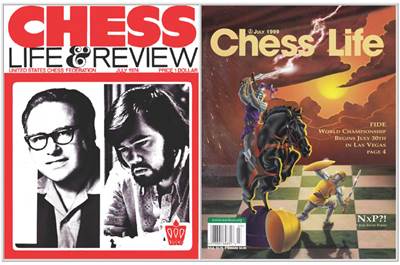
Right: 'FIDE World Championship Begins July 30th in Las Vegas • NxP?! (c) Jose Angel Pardo'

Chess Life & Review (50 Years Ago)

On the left is GM Arthur Bisguier, winner of the 8th National Open in Las Vegas. Story [inside]. Photo by Galati. On the right is GM Walter Browne, winner of the 4th Statham Tournament in Lone Pine, Cal. Story [inside]. Photo by Nigel Eddis.

GM Bisguier was last seen in June 1973 & 1998 'On the Cover' (June 2023). GM Browne was last seen in April 1974 & 1999 'On the Cover' (April 2024). Both of those stories '[inside]' began with complications arising from contemporary global affairs. U.S. chess was grappling with troubled times.

Let's start with 'National Open: No Shortages' by Ed Edmondson. First, some bad news:-

No Gas Shortage • Three months before the 8th National Open, the nation was caught up in the Arab Oil Embargo and experiencing very serious gas and oil shortages. We in the North were faced with the possibility of an inadequate supply of fuel oil for heating purposes, and it looked as though -- even if we could pull up roots -- we might not be able to find enough gasoline to drive south and avoid freezing to death.

From a planning standpoint, we were much afraid that drastic cutbacks in driving and curtailed airline schedules would mean not many people could make the trip to Las Vegas for our tournament. As it turned out, the problem had eased considerably in mid-March; by then, however, we had already changed playing rooms at the Stardust Hotel in anticipation of a turnout no greater than 1973's (246 players).

Then some good news, tempered by a bit more bad news:-

No Player Shortage • We changed our reservation from a playing room which could have held more than 400 players in great comfort to one which would hold 250 quite adequately. With fuel restrictions eased, the 1974 National Open set a new attendance record with 296 players. As a result. we did have a Playing Room Shortage. To those who (like me) played and felt a bit crowded at times. I apologize. For 1975. we have already reserved a much larger, better lighted and air-conditioned room which will accommodate 500 players in luxury.

As for the tournament itself, it was covered in two more sections, No Thrill Shortage (the results) and No Fun Shortage (after all, we're talking Las Vegas). The other cover story was 'Louis D. Statham Masters-Plus Tournament' by Isaac Kashdan, Tournament Director. It started,

The fourth annual Louis D. Statham Tournament was again held in Lone Pine, California. We expected it to be the strongest, but not the best attended of the series. As it happened, it excelled on both counts.

First the results. Walter Browne of Berkeley was the highest rated player, and justified that status by winning with the fine score of 6-1. He won his first two games, lost to Ruben Rodriguez of the Philippines, then took his last four games in a row. The streak included former U.S. champion Larry Evans of Reno, and present co-holder of the title, John Grefe of Berkeley.

Grefe finished with 5 1/2, points, tied with Pal Benko of New York, who beat Florin Gheorghiu of Rumania [sic] in the final round to make it. Evans, Julio Kaplan of Puerto Rico, Kim Commons of Los Angeles and Andrew Karklins of Chicago all tied at 5 points For the other prize winners and details of the play read the round by round summary which follows.

Skipping ahead 25 years, we're approaching the end of the millennium.

Chess Life (25 Years Ago)

Maybe this artistic cover is what things looked like up close in the Nunn - Nataf game from the French Team Championship (Letter from Europe, [inside], Move 14). Jose Angel Pardo put together the artwork for Chess Life in Adobe Photoshop. He holds a BA in Fine Arts from Jersey State College.

At that time in its evolution, CL had been featuring regularly artwork on its cover for several years. The previous such cover was March 1974 & 1999 'On the Cover' (March 2024).

The 'On the Cover' write-up continued,

World Championship • FIDE is holding the second World Championship Knockout tournament in Las Vegas July 30-August 29 at Caesar's Palace. Invited are 100 of the top players in the world. Accepting invitations are all eight invited Americans -- including Gata Kamsky! The other U.S. players are U.S. Champion Nick de Firmian, Joel Benjamin, Dmitry Gurevich, Tal Shaked, Boris Gulko, Sergey Kudrin, and Alexander Ivanov.

Kasparov and Anand (who recently won the Chess Oscar for the second time) aren't playing in the FIDE Knockout World Championship because they are piay1ng each other for the Ultimate World Championship and a $3,000,000 prize fund some time during the last quarter of the year. We don't know as we go to press where they are going to play, but it will be a 16-game match, with Kasparov maintaining his title in case of a drawn match.

Alexei Shirov, who qualified as Kasparov's challenger by defeating Vladimir Kramnik in a match late last year, is not involved in this Ultimate World Championship, despite being ranked number two just ahead of Anand and Kramnik, on the World Chess Ranking that Kasparov has set up in competition with FIDE.

Other forthcoming events mentioned in the long preview of the issue were the 1999 U.S. Open, the Interplay U.S. Championship, and Kasparov vs. the World, plus a call to help cover the costs of IM John Watson's medical urgency.

04 June 2024

June 1974 & 1999 'On the Cover'

In last month's post about American chess magazines of yesteryear, May 1974 & 1999 'On the Cover' (May 2024), we had the Candidates stage of the World Championship on the left and American news on the right. Here we go again.


Left: '?'
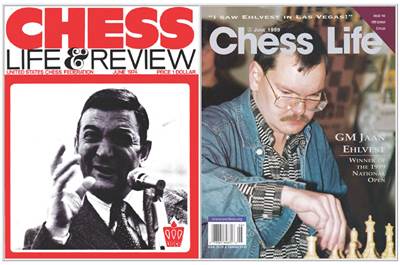
Right: '"I saw Ehlvest in Las Vegas" • GM Jaan Ehlvest; Winner of the 1999 National Open'

Chess Life & Review (50 Years Ago)

Soviet Grandmaster Viktor Korchnoi, vanquisher of Mecking and then Petrosian. during a talk on the Mecking match before an exhibition at Chess City in New York. The delightful Korchnoi describes the Mecking encounter [inside]. Photo by Nigel Eddis.

Once again, the first chess content in the magazine was 'The Editor's Page - News & Views' by Burt Hochberg. His summary of the contemporary scene is again worth quoting. It started,

It will come as startling news to many that Anatoly Karpov, who turned 23 in May, has roundly defeated ex-World Champion Boris Spassky in their semifinal Candidates Match in Leningrad. Though widely expected to be Fischer's "revenge" challenger in 1975, Spassky was not everyone's choice. His compatriot Korchnoi, for example, told us in New York that despite Spassky's decisive win of the Soviet title last year, some grandmasters (including Korchnoi) recognized in Spassky's games signs that he had not yet recovered from his 1972 defeat at Fischer's hands. [...]

A few paragraphs later, Hochberg covered the other half of the semifinals.

In Odessa, USSR, the Korchnoi-Petrosian semifinal match came to an abrupt end when Petrosian resigned the match on account of illness with the score 3-1 against him. Five games were played, with only one draw among them, a stark contrast with the 1971 match between these rivals. Svetozar Gligoric analyzes this match in our July issue. [NB: Yes!]

After news about various U.S. championships, Hochberg ended his summary with a quote from GM Korchnoi's four page report on the match.

Quotation of the month: "Despite the objective difficulty of the position, I continued to play quietly and confidently, as though all was well, as though I, and not my opponent, was winning. As I later learned, this manner of play really drove Mecking mad!" -- V. Korchnoi

The full title of the Korchnoi report was 'The Korchnoi - Mecking Match' by Viktor Korchnoi. Echoing the 'Quotation of the month', it started,

There were many critical moments in my match with Mecking. A lot of mistakes were made and in fact there was not a single error-free game. My opponent has learned to set up his game rather well strategically and his tactical skill was always up to par. However, owing to his character disposition he was not capable of consistent play through the match. At difficult moments I succeeded in saving bad positions and even scoring important points by means of stubborn defense unforeseen by my opponent. Here are three fragments from the match which were turning points in the overall struggle.

For the results of all the matches mentioned here, see 1973-75 Candidates Matches (m-w.com).

Chess Life (25 Years Ago)

It was a three-way tie for first place in Las Vegas, at the National Open, and Jaan Ehlvest took home the Edmondson Cup on tiebreaks. It was the third time that Jaan tied for top honors, but this was the first time he won the Cup, edging out Ilya Smirin and Gregory Kaidanov. Almost 1,000 players journeyed to Las Vegas to compete over the board, and to enjoy the ambiance of the Riviera Hotel and Casino, enhanced by the organizing skills of Al Losoff and a skilled staff. Coverage, provided by Edmar Mednis, begins [inside].

And yes, one could say one saw Ehlvest in Las Vegas... • Cover photo by Brian Killigrew.

The four-page, illustrated tournament report 'National Open: More Excitement and Fun' by GM Edmar Mednis started,

The 1999 National Open was held from March 19-21 at its luxurious home, Riviera Hotel & Casino, on the famous "Strip" in Las Vegas. Chief organizer Alan ("Al") Losoff had again put together a fantastic festival of competitive chess and pure enjoyment. Players were guaranteed a lot more money than last year ($50,000 vs. $42,000), with the actual payout being $53,350.

The turnout was an impressive 986, with 260 (including 27 GMs) in the Open section, 347 in the Reserve section (under 2000), 340 in the Booster section (under 1600), and 39 in the Unrated section. The larger guaranteed prizes meant that all section winners received more for their successful efforts. The three winners in the Open each made $4000, the two in the Reserve got $2500 each, and the two in the Booster each pocketed $1200. The schedule was two rounds per day, the time limit was 40/2, 20/1, SD/30, and an unlimited number of half-point buys [sic] were available.

And in case you're as clueless about the cover as I was ... Q: What means 'I saw Ehlvest in Las Vegas'? • A: That must be Ehlvest Presley. • Q: Is that a hound dog's name?

14 May 2024

May 1974 & 1999 'On the Cover'

Last month's post about American chess magazines of 50 and 25 years ago, April 1974 & 1999 'On the Cover' (April 2024), was all about American chess. This month we're reminded that there are always important chess events happening in the rest of the world.


Left: '?'
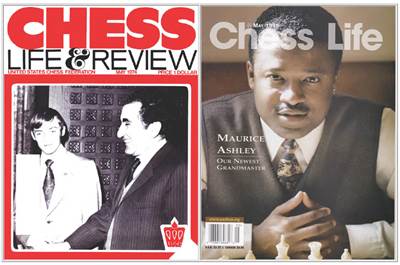
Right: 'Maurice Ashley - Our Newest Grandmaster'

Chess Life & Review (50 Years Ago)

Anatoly Karpov (left) and Tigran Petrosian, winners of their quarterfinal candidates matches. See [inside] for Spassky's assessment of his match opponent in the current semi-finals, and for Szabo's penetrating review of Petrosian's victory.

For the report on the two other quarterfinal matches, see March 1974 & 1999 'On the Cover' (March 2024). For the crosstables of all four matches, see 1973-75 Candidates Matches (m-w.com).

Chess Life (25 Years Ago)

Maurice Ashley, Grandmaster
Grandmaster Maurice Ashley.
Sounds good either way

Technically, until the next meeting of the FIDE Qualifications Committee, I [CL Editor Glenn Petersen] suppose we should say "Grandmaster-Elect" Maurice Ashley. But that's a technicality I'm willing to ignore. Although there are many who are strong enough to achieve the aim (but lack opportunities; see [inside]), few are more deserving than Mr. Ashley.

And not just for what he has accomplished over the board, is he deserving. As a coach, as a role model for young people, as a chess teacher, chess author, chess announcer -- indeed, as an enthusiastic spokesman in almost all areas of chess promotion, Maurice has made his presence notable. Certainly, as the first Black Grandmaster in the world, his place in history is assured. However, there will be no mere 15 minutes of fame for this young man. As he continues to climb mountains (see Brian Killigrew's interview [inside]), and to set standards for generations of youngsters to come, we predict Mr. Ashley 's moment in the sun will be lifelong. • Cover photo by Brian Killigrew

I'm guessing we'll see GM Ashley on the right side of many future 'On the Cover' posts.

05 May 2024

1976 U.S. Junior (Closed)

In this monthly series on Top eBay Chess Items by Price (March 2010), the sellers often label their items as 'Rare' or 'Amazing'. More often than not, a more appropriate label would be 'Commonplace' or 'Banal'.

The item pictured below was titled 'Amazing Chess History - 8 Autographs'. I won't argue with the adjective here, although 'Rare' or 'One of a Kind' would be equally appropriate. The autographed photo sold for 'US $450.00 Best offer accepted'. Despite eBay's usual obfuscation of the actual selling price, the stated price appears to be close to the actual price.


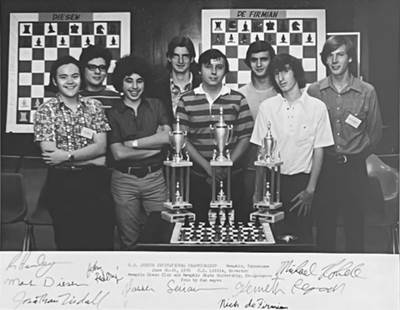
Left to right: Tisdall, Regan, Seirawan, Henley, Diesen, Fedorowicz, Rohde, DeFirmian.

The description said,

Amazing photo of the 1976 US Junior Chess Championship. Signed by all eight players. This is an amazing piece of chess history. It is signed by six Grandmasters and two International Masters. [...; full names, titles, and ratings for all players] This is NOT something you will see again.

A link titled 'I want to know more!' led to "Fed" Up With Chess? / John's First Visit (memphischessclub.blogspot.com; May 2012). The blog post started,

What a wonderful season the summer of 1976 was in the Bluff City. The United States was preparing to celebrate the bicentennial in July, but before that national event the Memphis Chess Club was presenting the city's chess players a miraculous moment, the 11th U.S. Junior Invitational Championship Chess Tournament; this Memphis event would be repeated only once more in 1978, and in both events, John Fedorowicz participated.

'Fed' was and still is a nickname for Fedorowicz. The September 1976 issue of Chess Life & Review carried a report on the tournament. Titled 'U.S. Junior Invitational Championship' by Carol Little, ITD, it started,

The 11th Annual U.S. Junior Invitational Championship, held in Memphis, Tennessee, June 20-26. was won by Mark Diesen of Potomac, Maryland. and Michael Rohde of South Orange, New Jersey. They each had a score of 5 points and were declared Co-Champions.

This did present a problem for the USCF: Who was going to represent the U.S. in the Netherlands later this year? After a long-distance call to the New Windsor office, an equitable solution was agreed upon by both players, and Mark Diesen will go to Holland as the U.S representative to the World Junior Championship.

The 1976 U.S. Junior Championship was the first national tournament to be held in the Mid-South since the Western Open Championship, the forerunner of the U.S. Open, was held in Memphis in 1914.

The Wikipedia page John Fedorowicz (wikipedia.org) says, 'co-winner of the 1977 U.S. Junior Championship (with Kenneth Regan) and outright winner in 1978'. Somewhat curiously, the same page carries no link to a separate page on the series of U.S. Junior championships.

09 April 2024

April 1974 & 1999 'On the Cover'

As I noted last month, in March 1974 & 1999 'On the Cover' (March 2024), that month was 'the tenth anniversary of the first "On the Cover" post'. Now we start the next ten years of brief, monthly looks at the leading U.S. chess magazine from 50 and 25 years ago.


Left: '?'
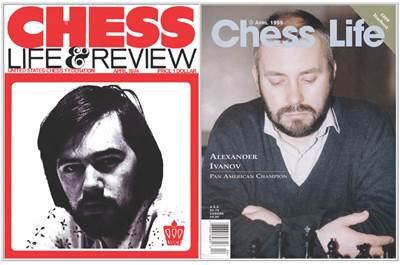
Right: 'Alexander Ivanov - Pan American Champion' (also '1999 Yearbook')

Chess Life & Review (50 Years Ago)

Grandmaster Walter Browne of California, winner of the Hoogover [sic; 'Hoogoven' or 'Hoogovens', see below] tournament in Wijk aan Zee. Games etc. next month. Photo by Nigel Eddis.

A month later the May 1975 CL&R had a report 'Browne Wins at Wijk aan Zee' by Burt Hochberg. It started,

The strong annual tournament sponsored by the Hoogoven steelworks in Wijk aan Zee, Holland, was won this year by American Grandmaster Walter Browne. His eight wins and six draws gave him a convincing 1 1/2 point advantage over second-place Jan Hein Donner, the Dutch grandmaster.

Browne's only loss was to the young Hungarian grandmaster, Andras Adorjan, in the last round when Browne was already assured of undisputed first place. (That was also Adorjan's only win!)

GM Browne's previous cover was May 1973 & 1998 'On the Cover' (May 2023; 'won the [1973] National Open in Las Vegas'). A couple of pages further in the March 2024 CL&R we see 'The Editor's Page - News & Views' by Burt Hochberg with a paragraph on the rules for the 'semifinals of the 1974 Candidates Matches' (tiebreak: 'a coin toss if the score is tied after 20 games'!). This was followed by a paragraph that started,

The latest in a series of international tournaments hosted by the USCF will be held April 5-19 at the plush new Continental Chess Club in Los Angeles, California. [...] 2nd USCF International in Chicago late last year.

After all these years, I've managed to overlook this series of tournaments. Where are they documented?

Chess Life (25 Years Ago)

Alexander Ivanov, of Brookline, Massachusetts, won the 1998 Pan American Championship and secured a spot in the FIDE World Championship, a knock-out affair which, as of this writing, is scheduled for August of this year in Las Vegas, Nevada.

I recently covered this event on my World Championship Blog in 1998 Zonals 2.x References (February 2024). The post started, 'In a feature article for the April 1999 issue of Chess Life, GM Ivanov wrote [...]'.

The 'On the Cover' introduction continued with two other stories. The first story was:-

Still no word on a Kasparov - Anyone match, although recent comments by Kasparov (after his victory at Hoogovens) indicate that Alexei Shirov has fallen out of favor with the World Chess Council (WCC), and that Viswanathan Anand (who has already lost one match to Kasparov) is now the frontrunning challenger. Which doesn't sit well with Shirov. [...]

The second story was titled 'Standing on the Terrace'. It started,

A ripple passed through the chess world with the passing of Lazslo [sic; 'Laszlo'] Szabo late last year. And that was followed by a tidal wave, with the loss of Efim Geller. For Americans, however, the darkest monsoon struck on February 4, 1999, when it was announced that Ken Smith had died. We will have articles on all three in future issues of Chess Life, but it is important to say a word or two about the impact Ken Smith had on the development of chess in the United States during the last 30 years. [...]

The name Ken Smith is almost always associated with Chess Digest. This would be a good time to review Smith's contributions to U.S. chess, but I've run out of time for this post. Hopefully later...

05 March 2024

March 1974 & 1999 'On the Cover'

This post marks the tenth anniversary of the first 'On the Cover' post, which was March 1964 'On the Cover' (March 2014). For the first five years the posts showed the covers of the two leading American chess magazines of the 1960s.

The series changed direction in November 1969 & 1994 'On the Cover' (November 2019), shifting to the format showing both 50 and 25 years ago. For last month's post, see February 1974 & 1999 'On the Cover' (February 2024).


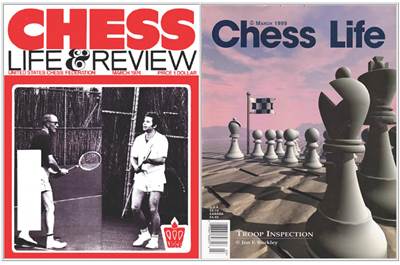
Left: '?'
Right: 'Troop Inspection (c) Jon F. Buckley'

Chess Life & Review (50 Years Ago)

No, this in not a tennis magazine. But R. Byrne and Spassky did use the courts during their San Juan match. See the games [inside]; full analysis next month. Spassky photo by Betty Marshall; Byrne photo by Burt Hochberg.

The 'full analysis next month', in the April 1974 CL&R, was by Lubosh Kavalek a member of Byrne's team in San Juan. Once again, I'll quote the March 'The Editor's Page - News & Views' by Burt Hochberg for the full, contemporary picture of that cycle's Candidate matches. For the crosstables, see 1973-75 Candidates Matches (m-w.com).

Ex-World Champion Boris Spassky took the first step towards challenging current Champion Fischer by defeating Robert Byrne in Puerto Rico. Spassky won the third, fourth and sixth games, the other three being drawn.

The second match to finish was Karpov's rout of Polugaevsky. The match lasted eight games, Karpov winning the fourth, sixth and eighth, with the others drawn. Now Karpov must play Spassky in April.

Soviet veteran Victor Korchnoi undoubtedly took great satisfaction in his victory against Brazil's Henrique Mecking. This match, held in Augusta, Ga., went 13 games. The Russian won games five and seven, but Mecking scored in game 12. The young grandmaster's elation was short-lived, however, as Korchnoi took game 13 and the match.

In the last match to finish, Petrosian defeated Portisch, three wins to two. Petrosian had won games five and nine, but Portisch caught up with wins in the 10th and 12th games. Then Petrosian won the 13th. He will be faced with Korchnoi in April.

By the way, draws do not count in match scoring. The quarter-final matches require three wins for match victory, the semi-finals (in April) require four wins, and the final match will go to the player who first scores five wins. A match is won by the player who is leading after a certain number of games (16 in the quarters, 20 in the semis, 24 in the finals), but if a tie exists after the game limit, the match is decided by fervent praying, followed by tossing a coin.

Fifty years ago it was not acceptable to decide a match with a shorter time control than was used in the match games, i.e. rapid or blitz tiebreaks. Today it is the norm. 'Fervent praying', however, is still with us.

Chess Life (25 Years Ago)

Okay, it's a stretch, I admit. But when you read IM [now GM] Larry Kaufman's article "The Evaluation of Material Imbalances," you will see a connection to Jon Buckley's "Troop Inspection," our cover. The troops have been inspected, evaluated, and promoted (for the most part), so that you can make intelligent decisions over the board. • © 1998 Jon F. Buckley

Don't overlook the report on the Eastern Open. We're very lucky to have two games annotated by GM Lubomir Kavalek.

A black and white version of the 1999 CL cover illustrated the Kaufman article. I once featured the ground breaking Kaufman analysis in a series on Practical Evaluation (February 2013); see '2013-01-15: Kaufman's Material Imbalances * Kaufman 1999'

Buckley's artwork was also seen in August 1973 & 1998 'On the Cover' (August 2023). Will we see more in future 'On the Cover' posts?

03 March 2024

Polgar Plus Seirawan GT Nakamura

A few months ago, also for the long-running series Top eBay Chess Items by Price (March 2010), we saw Chess Rookie Card (November 2023). I recorded the basic info for that auction as,

The item pictured below was titled 'Hikaru Nakamura #390 American Chess Equipment Ultimate Card Auto'. It sold for around $500, 'Best offer accepted'.

For this month's post we have two more cards in the series, both pictured below. The titles of the auctions are large enough to be readable, but I'll copy them here for the benefit of the search engines:-

  • Susan Polgar #390 American Chess Equipment Ultimate Card Auto - NM
  • Yasser Seirawan #256 American Chess Equipment Ultimate Card Auto - NM

As you can see, the Polgar card sold for $299.00 'or Best Offer' and the Seirawan card for $299.00 'Best offer accepted'. Since the cards were displayed one over the other in a list sorted by descending price, I suppose they sold for close to the same amount.

The description for the Polgar card added,

This is an extremely rare American Chess Equipment card. The card is hand-numbered and signed by Grandmaster Susan Polgar.

The Seirawan card had identical text -- other than the name -- as did the earlier Nakamura card, so I suppose all three cards were from the same seller. The various abbreviations used in the auction were explained in the Nakamura post and I won't repeat them here.

In that previous post I wondered about the original selling price of the Nakamura card. Thanks to an anonymous comment I was informed, 'The Hikaru cost $8.00 at the time' along with a URL to the original product page. I'll leave it to interested parties to locate the two cards mentioned on this current post.

08 February 2024

February 1974 & 1999 'On the Cover'

The previous 'On the Cover' post, January 1974 & 1999 'On the Cover' (January 2024), had several twists on the World Championships of 50 and 25 years ago. In the current post, we return to important events of national interest.


Left: '?'
Right: 'EuroDisney and the World Rapids for Kids'

Chess Life & Review (50 Years Ago)

James Tarjan, winner of the American Open in California. Carl Budd's story is [inside]. Photo by Paula Muller.

The Carl Budd story was titled, 'Tarjan Wins American Open', and identified Budd as 'President, Santa Monica Bay Chess Club'. After five paragraphs about the organizational challenges presented by the event ('403 players, 137 in the Open section and 266 in the Amateur'), the report continued,

The new American Open Champion is James Tarjan, a popular master from Sherman Oaks, California, who now calls Berkeley home. He earned his fine victory by defeating strong competition, including GM Larry Evans and IM Anthony Saidy, After the seventh round, Tarjan was a half point ahead of former California State Champion Kim Commons and needed only a draw to clinch the title, which he achieved. His final score of 7.5-0.5 was worth the first prize of $1.000.

Tarjan. one of America's fastest-rising stars, is 21. In 1965, at the age of 13. he played in his first American Open, winning a junior trophy. Top prizes eluded him until this year. In the 1970 American Open he tied for second with Walter Browne. In 1972 he tied for second with four others. But then, at the National Open in Las Vegas earlier this year, he tied for first with Browne and Laszlo Szabo (though Browne took the title on tiebreaking points). He performed very well in the West Coast Invitational, coming in second, and then finished fourth in the strong U.S. Championship in El Paso. Just one month before the American Open, he indicated his latest playing form by winning the Capps Memorial in the Bay Area.

He will be seeking an international title in 1974 and has already had his first IM result at the Chicago Invitational tournament played after the American Open. Later in the year he will be going to Holland and Spain in furtherance of his ambition.

I included these details because GM Tarjan has been mentioned before on this blog, but was never featured as the top finisher. See, for example, the 1973 National Open in May 1973 & 1998 'On the Cover' (May 2023).

Chess Life (25 Years Ago)

"Can you be in Paris tomorrow?" asked Jami Anson, senior art director of Chess Life. Although it sounds romantic -- Paris/Chess/Disneyland -- I know from experience that a working trip is quite different from a pleasure trip. After deciding to go, I knew I wanted to get something unique for the cover, like my April '98 cover of Sean Lennon and Yoko Ono. Here is the result. Exclusively for the readers of Chess Life -- the current FIDE World Chess Champion, Anatoly Karpov, with Asuka Nakamura, playing the one and only (French!) Mickey Mouse.

The reporting on the event started with 'Adventures in Fantasyland' by FM Aviv Friedman, who explained,

Once a year FIDE, with the help of the French Federation, holds its World Rapid Championship for Boys and Girls Under 14 at the EuroDisney Theme Park in Paris. Does that sound a bit amazing to those who have often read about the usual, army-style youth championships, with bad conditions, poor food and nothing to do? Well, it is as good as it sounds! It really can't be much more fun that that. This year, between the 15th and the 18th of November, 157 players from 55(!) countries all flocked to EuroDisney on the outskirts of Paris, to combine chess and fun.

The reporting continued with 'Disney's World Rapid Chess Championship -- for Kids' by Brian Killigrew. His report included two pages of color photos, an interview titled, 'Anatoly Karpov Speaks', and another interview with Pierre Sissman, Disney Executive VP (Europe). See also the previous post Karpov at Disney (October 2015).

02 January 2024

January 1974 & 1999 'On the Cover'

A new year means turning the page to the next twelve months of 'On the Cover' posts. This year will mark the tenth anniversary of the series, which started with March 1964 'On the Cover' (March 2014). In the last post for 2023, December 1973 & 1998 'On the Cover' (December 2023), I noted,

Last month's post about U.S. chess magazines 50 and 25 years ago, November 1973 & 1998 'On the Cover' (November 2023), had an arty portrait on the right. This month's post has a different sort of art.

This month we return to an 'arty portrait on the right'. More about that after we see the January covers from 50 and 25 years ago.


Left: '?'
Right: 'de Firmian Grabs Third Title'

Chess Life & Review (50 Years Ago)

President Ferdinand Marcos of the Philippines (left), presenting a check and winner's trophy to Bent Larsen. The Danish grandmaster has just won the greatest chess tournament ever held in the Asian and Pacific zones. Stories and games next month.

For once, I'm not going to use the 'On the Cover' time machine to preview next month's tournament story. A new column in January 1974, titled 'The Editor's Page - News & Views' by Burt Hochberg, gave sufficient details:-

The great Philippines International Tournament, the most important chess event ever held in Asia and the Pacific area, ended November 6. The significance of the event was highlighted by the ceremonial presence of World Champion Bobby Fischer and Philippines President Ferdinand Marcos.

Bent Larsen, the tournament's highest-rated player, won it with 12 1/2 - 2 1/2, losing only to Gligoric. Yugoslavia's most promising young grandmaster, Ljubomir Ljubojevic, was second with 11 1/2, and our own Lubomir Kavalek, one of the world's most active grandmasters recently, scored 11 points to take 3rd place. Other scores: [...] Lombardy won the brilliancy prize for his win against Quinteros. The prize was $1,000! First prize in the tournament was $4,000.

That mention of Fischer and Marcos deserves further exploration, but I'm worried it might lead me down a rabbit hole from which I won't return in time to finish this current post. Maybe later...

Chess Life (25 Years Ago)

Nick de Firmian won the 1998 U.S. Championship by defeating the defending champion, Joel Benjamin, 2 1/2 - 1 1/2. We again called on portraitist Steven Seward of Cleveland, Ohio, to work his magic for our cover.

Coverage of the championship, the Women's Championship (won by Irina Krush), and the U.S. Senior Championship (won by Arthur Bisguier), will begin next month.

And there we have our connection to the arty portrait of two months ago: November 1973 & 1998 'On the Cover' (November 2023; 'Steven Seward, a portraitist from Cleveland, Ohio'). That makes three arty covers in a row and there is more to come later in 1999. The cover introduction continued with news about two World Championships.

FIDE UPDATE: De Firmian, Benjamin, and the other semi-finalists, Dmitry Gurevich and Tal Shaked, qualified to participate in the FIDE World Championship, along with Boris Gulko and Sergey Kudrin, both of whom qualified by previous performance or rating; and Alexander Ivanov, who qualified by winning the 1998 Pan American Championship, which was held in Venezuela in October. Gata Kamsky has also been invited (by rating). His participation will hinge on whether or not the finalized dates for the event interfere with his medical studies.

Alisa Galliamova-Ivanchuk forfeited her match with Jun Xie. China was awarded the bid for the match; Alisa wanted to play at least half of the match in Russia, so she didn't show up at all. Jun Xie, the former women's world champion, will now challenge the current champion, Susan Polgar.

Once again, that news 'deserves further exploration'. I'll put this month's rabbit hole on the follow-up list.