Showing posts with label Photos. Show all posts

18 May 2025

Limitless Conceptualism

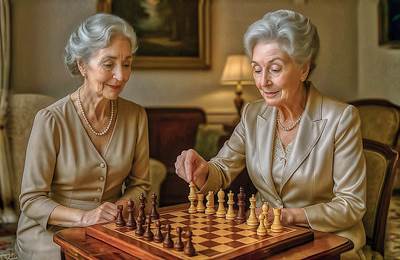
This month's featured Flickr photo had no description, but it did have a title and a useful set of tags. Among the tags were 'Museum of Art and Technology', 'Mercer Labs', and 'New York City'.


Limitless by Roy Nachum 29 - Chess Set © Flickr user Amaury Laporte under Creative Commons.

A search on the title of the photo leads to Roy Nachum (roynachum.com), where the 'About' page says,

Roy Nachum’s experimental paintings, installations, sculptures and designs incorporate elements traditionally used in conceptual and interactive art. Works often include Braille text in relief. [...] Nachum currently lives in New York and works in New York and Italy.

The photo's tags lead to Museum Of Art & Technology | Mercer Labs (mercerlabs.com), where we learn,

Museum of Art and Technology • Mercer Labs transforms the museum experience across 36,000 sq ft with 15 experimental exhibition spaces, interactive encounters, and immersive installations. Led by artists, this Experimental Institution redefines the relationship between art and technology, fostering collaboration and innovation through curated programs. At the heart of it, Roy Nachum's on-site laboratory brings visionary art to reality, inviting visitors to experience the world through a new lens.

As for the affirmation that 'Roy Nachum’s experimental paintings [...] incorporate elements traditionally used in conceptual and interactive art', conceptual art has been a recurring theme on this blog. For the previous post, see The Most Conceptual of the Conceptualists (March 2025).

06 May 2025

May 1975 & 2000 'On the Cover'

Continuing this blog's monthly look at American chess from 50 and 25 years ago, who was featured on the cover of CL&R/CL in the month of May? For last month's post see April 1975 & 2000 'On the Cover' (April 2025).
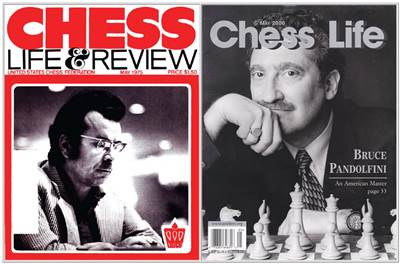

Left: '?'
Right: 'Bruce Pandolfini - An American Master'

Chess Life & Review (50 Years Ago)

Grandmaster Pal Benko, winner of the National Open. Story [inside]. Photo by Burt Hochberg.

The 'story [inside]' was titled '9th National Open' by George Koltanowski, USCF Vice-President.

This event, staged at the Stardust Hotel in Las Vegas, was by far the most spectacular of all the National Opens. The rooms were large, airy and exceptionally well lighted. The total of 242 participants was below last year's record entry, but the battle for prizes in the various sections was no less keen.

Four players tied for lst-4th: the trophy and title of National Open Champion went to Grandmaster Pal Benko of New Jersey (S-B 35), with second place on tiebreaks going to GM Walter Browne of California (S-B 34 1/2). The other two were Alfonso Ferriz, a young player from Mexico who also won the Expert trophy, and Alex Suhobeck of California, who also won the over-50 trophy. All scored 7.1.

I've mentioned in previous 'On the Cover' posts, e.g. November 1971 & 1996 (November 2021), that Koltanowski's tournament reports were often unusual. Two of his six paragraphs on the 1975 National Open were about adjournment incidents.

GM Benko's previous appearance 'On the Cover' was November 1974 & 1999 (November 2024). That year's report (1974) on the 8th National Open, won by GM Arthur Bisguier, was covered in July 1974 & 1999 (July 2024).

Back to May 1975, the monthly CL column 'The Editor's Page - News & Views' by Burt Hochberg carried unwelcome news for U.S. chess fans. Hochberg wrote,

When April Fool's Day passed with no word from Bobby Fischer, FIDE President Euwe had no choice but to declare Anatoly Karpov the new World Champion by default. (FIDE regulations set the April 1 deadline for each player to announce his intention to play for the world title under rules established at the FIDE Extraordinary General Assembly in March.)

Few people could have realized that the forfeit signalled the beginning of the end of the great Fischer boom which had started in 1971/-72. Two more articles in the same CL&R issue were also about Fischer: 'The Mind of Bobby Fischer' by Fischer biographer Frank Brady and 'Hochberg vs. Darrach', by CL&R editor Burt Hochberg.

Chess Life (25 Years Ago)

Getting an exclusive interview is always exciting -- a challenge to live up to. As a photojournalist, I wanted the images of Bruce Pandolfini to be as exclusive as his words. After photographing him at Washington Square Park and at the famous Capablanca table in the Marshall Chess Club, I still wanted something more. When I suggested a formal black and white portrait to Bruce, he quickly agreed. The result is this month's cover.

Technical Information:
* Nikon F100, 28-105 mm
* f11 @ 125, T-Max100
[...]

And you thought chess notation was confusing! - Brian Killigrew

The first of two articles involving Pandolfini was 'An Interview with Fred Waitzkin' by Bruce Pandolfini. The editor introduced the three pages saying,

Yes, there is life beyond chess, often referred to as "the real world." Fred Waitzkin flutters between both worlds, much like the time shifts in The Last Marlin. Bruce Pandolfini caught Fred on the cusp, so to speak, and the result is a fascinating interview.

Pandolfini prefaced the interview saying,

Readers of Chess Life are quite familiar with Fred Waitzkin's insightful writings on the world of chess. In addition to his penetrating pieces written for The New York Times Magazine, New York, Esquire, and Sports Illustrated, Fred has given us two moving and unforgettable narratives. Searching for Bobby Fischer (1988, Random House) is a poignant account of the relationship of Fred to his gifted son Joshua as the two of them experienced the vicissitudes of the scholastic chess scene.

It was later adapted by Paramount Pictures (1993) into an inspiring film of the same title, and the book and film have subsequently drawn legions into the chess world. Then Fred wrote Mortal Games (1993, G.P. Putnam's Sons), which portrays the expanding universe of Garry Kasparov through the machinations of welt politik and top tier chess.

The second article was 'Profiles in Chess: Bruce Pandolfini - An American Master'. The four pages were bylined 'Interview and Photography by Brian Killigrew'. He started,

There is something about Bruce Pandolfini that makes people want to be around him. Call it the Pandolfini mystique. Kids flock to him at tournaments. Adults constantly come up to him and whisper things like: "Is the King's Indian good against I. d4?:' walking away from Bruce as if they have just received some ancient secret.

Starting in April 2023, Killigrew has been mentioned in many 'On the Cover' posts, most recently January 1975 & 2000 (January 2025). Pandolfini has been mentioned in a handful of posts, mostly in relation to his involvement in scholastic chess.

20 April 2025

Phun with Photos

In the previous post for the monthly featured Flickr photo, Enhanced Chess Art (March 2025), I asked and answered,

Why put 'photos' in inverted commas (' ')? Because I didn't understand how they were done.

That could just as easily apply to this month's 'photo', shown below. At first glance it certainly could be a photo, but the first clue to the contrary was the unnatural arrangement of the pieces on an 8x7 board.


Playing chess keeps you fit! // This is an AI image... © Flickr user Günter Hentschel under Creative Commons.

The second clue was in the title: 'This is an AI image'. So how was it created? Here the first clue was the start of the description; it said,

ChatGPT generated this image based on a text description that I had entered.

The second clue was a tag that said, 'Luminar Neo'. What's that? Wikipedia to the rescue in Luminar Neo (wikipedia.org):-

Luminar Neo is a photo editing software application developed by Skylum (formerly Macphun) available for Windows and macOS. [It] was released in February 2022. It works as a standalone application and as a plugin for Adobe and Apple products.

Macphun? Thus arose the title of this post.

15 April 2025

April 1975 & 2000 'On the Cover'

In last month's look at U.S. chess magazines from 50 and 25 years ago, March 1975 & 2000 'On the Cover' (March 2025), we saw a non-American player on the left (GM Robert Huebner) and an American player on the right (George Koltanowski, the 'Dean of American Chess'). This month the pattern continues, with a pair of Soviet players on the left and a quartet of American teams on the right. Was U.S. chess more attentive to international chess 50 years ago?


Left: '?'
Right: 'The Teams! A 30-year Odyssey • Upcoming Scholastic Nationals!'

Chess Life & Review (50 Years Ago)

Winners of the 1974 USSR Championship -- Mikhail Tal (left) and Alexander Belyavsky. See [inside] for the story by Paul Keres. Photos by TASS from Sovfoto.

The story '[inside]' was the 'Keres Annotates...' column, titled 'USSR Championship, Leningrad 1974'. It started,

The USSR chess organization, with its 35 grandmasters, has the ability to put together a very strong group for its national championships. As an example, the 1973 USSR Championship, with all the leading grandmasters competing, was one of the strongest tournaments ever held in the Soviet Union.

With this in mind, the 1974 Championship was probably a little disappointing. Most of the leading grandmasters were unable to take part for various reasons and were replaced by other players, while the number of participants was reduced from 18 to 16. Despite this fact, it was quite interesting to see experienced grandmasters such as Tal, Polugaevsky, Vasiukov and Taimanov fight their younger rivals, many of whom had splendid records in last year's tournament, and to see just how good the young players are in really strong competition.

The tournament was a hard fight from the very first round. One is used to seeing grandmasters like Tal and Polugaevsky leading the field, but this time they did not have it so easy, being severely pressed by Belyavsky, Vaganian, Romanishin, Alburt, Dvoretsky, and other young stars, most of whom are not very well known in international chess. And when we look at the final crosstable, we see that the young players came out very well in this tough test against their experienced "examiners."

It's noteworthy that, besides Keres, the other authors of feature articles in the same issue were Pal Benko, Laszlo Szabo, Lubosh Kavalek, Svetozar Gligoric, and Edmar Mednis. All had roots in Eastern European countries.

Chess Life (25 Years Ago)

Thank you, Ed Edmondson. If you were convinced that an idea was good, you ran with it. And 30 years ago, the idea of an amateur team championship, as presented by Denis Barry, sounded good. No bids, no committee approval. You just filled your station wagon with books and equipment and drove out to the VFW Hall in East Brunswick, New Jersey, and ran a concession for the 17 teams that played in that first event. Your faith and Denis' enthusiasm grew "The Teams" to over 100 teams, playing in Atlantic City.

Ed is gone. Denis is still around, kicking up dust here and there. But they left a legacy and a framework that will last forever. Hire a good staff, put the players first, chess for fun and chess for blood, in equal proportions. Steve Doyle (who celebrated 25 years of being associated with the event) operates within that framework and has built the USATE into a 200+ team event. Friday's snow and ice storm had almost no effect, and more than 920 players took part in the 30th Anniversary of the U.S. Amateur Team Championship (East). Worthy of a cover? You betcha. And a special report in our annual yearbook section.

The related article was 'Turning the Big 3-0 Was Totally Brutal at the U.S. Amateur Team East' by Al Lawrence. The mysterious title referred to the winning team, Total Brutality, a 'three-master team'. The report on the event started,

Over the telephone from St. Louis, my brother Leo was having a hard time with what would take place at the U.S. Amateur Team East Chess Championship. "Team chess," he said, "wouldn't that be like four-man diamond cutting?" After a few forced chuckles, I said "No, it's more like having four brothers backing each other up in a schoolyard scrap." From our old days on South Chicago's playgrounds -- in an era when fights were barehanded and forgotten as soon as the shiner faded -- he understood the point.

As tournament chessplayers, we're normally lone operators. In more jet-age terms, we sit in a room full of would-be top guns whose weekend happiness is a net-sum war game. For every ace exhilarated to see black smoke pouring out of his counterpart's engines, there's a wounded pilot spinning miserably down in flames. Strangers, friends, roommates -- all morph into hoped-for airplane silhouettes painted below the cockpit glass, plusses on the wall chart.

After the one-page introduction to the USATE, the story continued on the first page and across the outer column of the next 12 pages of the '2000 USCF Yearbook - Our Heritage'. A footnote to the story informed,

The U.S. Amateur Team East Championship is one of over 25 national title events co-sponsored by the USCF and participating affiliates. Al Lawrence, president of OutExcel! Corp., is the author of eight books on a variety of subjects.

A common thread united the April editions of the two magazines. Just as with the March 1975 edition of CL&R, Burt Hochberg's April 1975 column 'Editor's Page - News & Views' carried news of the ill-fated 1975 Fischer - Karpov World Championship title match. The April 2000 edition of CL carried opinions on the controversies surrounding the World Championship in 2000: Who was the real World Champion?

07 April 2025

Beating a Dead Horse?

As announced in a post on my World Championship blog, It's Later Than You Think (April 2025), I've temporarily suspended posting on that blog. The reason I gave was,

Since I'm not seeing an easy fix to the technical problems, I'll skip posting to [the WCC] blog until I get my affairs in order.

For the same reason, I'm going to suspend the Monday series on this blog. Since the beginning of the year it has been mostly been used for exploring AI comics, last seen in The Most Conceptual of the Conceptualists (March 2025). I have a big stockpile of AIC images to use, but I'll close with this one...


'Dead horse plays chess.'
AI Comic Factory

06 April 2025

Pocket Money

In the long running series (more than 15 years) about Top eBay Chess Items by Price (March 2010), I've never flagged a no-brainer. If there was ever a candidate for 'no-brainer', this is it.

The item below was titled 'Chess Grandmaster Magnus Carlsen's #JeansGate Jeans'. It sold for US $36.100 after 94 bids from 22 bidders. The price doubled in the last minute of bidding as two bidders slugged it out for possession of the jeans.

In the photo from the auction shown above, apparently from the '#JeansGate' incident, I've added a small inset showing the auction item. The description of the item started with an explanation of #JeansGate:-

On December 27th, 2024, Five-Time World Chess Champion Magnus Carlsen was unpaired in the 9th round of FIDE World Rapid and Blitz Championships in New York City after refusing to change out of a pair of jeans in the playing hall. This interaction, both his refusal and interaction with the arbiter in the room, was dubbed by the chess community as #JeansGate and set the world on fire, gaining hundreds of millions of social media and mainstream news impressions in the week following.

Now, GM Carlsen is looking to bring that piece of chess history to auction in support of an impactful cause - Big Brothers Big Sisters (BBBS). The jeans that Magnus wore that day, certified and authenticated by Chess.com and the World #1 himself, are up for auction with all proceeds of the sale going to support youth mentorship at chess clinics, community events, and beyond, to build connection, belonging, and enrich the lives of young people through the game.

The description continued,

About the jeans:-
Brand: Corneliani
Color: Blue
Size: 32
Inseam: 28 inches
Waist: 18 inches (measured across)
Condition: Worn by Magnus Carlsen

The jeans come with a signed certificate of authenticity from GM Magnus Carlsen.

For another mention of the jeans incident on this blog, see World Championship Yahoos 2024 (December 2024). I don't see that the incident qualifies for 'Gate' status (e.g. 'Watergate'), but chess players live in their own world.

The seller was listed as 'matchfireauctions3b'. The auction description carried a long explanation that started with:-

Frequently Asked Questions

Q: Who is Matchfire?
A: The selling party has retained Matchfire (The Matchfire Group) to manage this auction. Matchfire provides a comprehensive auction management service focused on creating successful high-value, high-profile promotional auctions for charities, nonprofit organizations and top brand companies. Matchfire is a promotional agency which helps define client brand promotional strategy through auctions, delivers creative design, and manages operations of feature online auctions for maximum visibility of well-known brands, media companies, charities, nonprofits, public relations firms and advertising agencies.

Q: Is Bidder Pre-Qualification necessary to participate in this auction?
A: All bidding activity below $5,000 does not need to be pre-qualified. Fixed price listings do not require prequalification.

Bidding above $5,000 must be Pre-Qualified. Click here to fill out the secure Bidder Pre-Qualification form. In order to help ensure a smooth and successful auction experience, Matchfire will be performing Bidder Pre-Qualification for this auction. Fixed price listings do not require prequalification.

What did one pair of jeans say to the other? 'You’re looking a little worn out today!'

31 March 2025

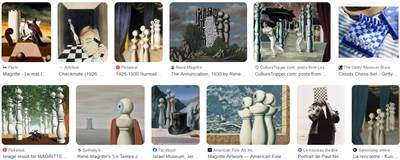
Magritte as Chess Artist

As this series on AI comics slides into the second quarter of the year, let's go back to the post that started it off at the beginning of the first quarter: Surrealist Chess (January 2025). There I wrote,

Somewhere in the back of my head was a factoid that Magritte played chess and sometimes incorporated the game into his paintings.

From that post I determined that he was indeed a chess player. Now I'm sure that he was also a chess artist.


Google Image search on 'chess magritte'

The thumbnail in the lower left of the composite image was the first example of Magritte's artwork that led me to believe he was interested in chess as a subject for his art. It shows a rider on a horse and is titled 'The Lost Jockey'. For other examples, see The Lost Jockey (Le jockey perdu) 1926 Collage by Rene Magritte (renemagritte.org).

24 March 2025

The Most Conceptual of the Conceptualists

In last week's post, The Most Surreal of the Surrealists (March 2025), I wrote,

I once explored conceptual art in a post mysteriously titled (... drum roll ...), Chess in Conceptual Art (March 2017). Maybe it's time to turn the subject over to AI comics.

Unfortunately, the AI software doesn't seem to have 'conceptual' in its vocabulary. The half-dozen examples it created had nothing to do with anything except the royal game itself. Then I remembered a trick used in Color the Proteins (January 2025), i.e. 'Demis Hassabis plays chess with a green protein.' While 'protein' is a noun, 'conceptual' is an adjective. Can you color an adjective? I tried coloring it both green and red, and here's a sample of what I got.


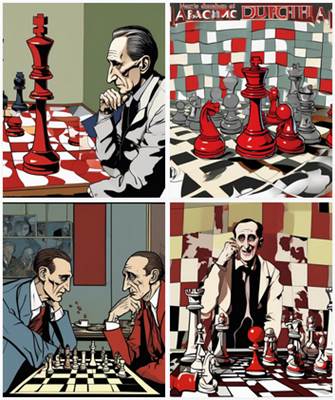
'Marcel Duchamp plays red conceptual chess.'
AI Comic Factory

Can you color an adjective? No, you can't. The software applies the adjective to one of the nouns, which are Marcel Duchamp and chess. Next post: Get as far away from this nonsense as I can.

17 March 2025

The Most Surreal of the Surrealists

The previous post, MW Plays Chess -or- Call Me Clueless (March 2025) was an experiment in name recognition. What does our AI comic software do when it doesn't know who or what the subject is? I concluded,

The experiment yields more questions than answers. The next post in the series will return to subjects having greater name recognition.

We've already had a couple of posts about surrealist chess. The previous post was Surrealist, Cubist, Dadaist Chess (February 2025; 'Marcel Duchamp plays surrealist chess.'). The best known surrealist artist is undoubtedly Salvador Dali.


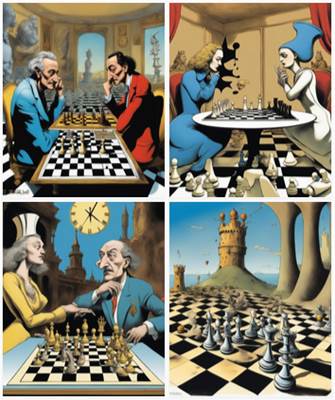
'Dali plays surrealist chess.'
AI Comic Factory

It turns out that we've already seen both artists in a non-comic setting a year ago in Conceptual Artist and Surreal Artist (March 2024; 'Marcel Duchamp and Salvador Dali playing chess') I once explored conceptual art in a post mysteriously titled (... drum roll ...), Chess in Conceptual Art (March 2017). Maybe it's time to turn the subject over to AI comics.

16 March 2025

Enhanced Chess Art

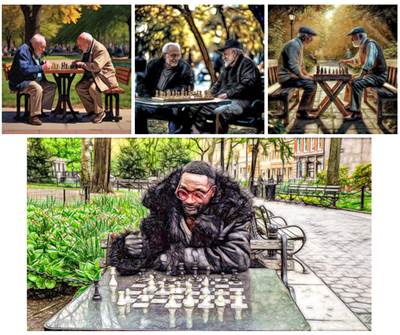
The top row of the following composite image shows three 'photos' that were on my short list for this month's featured Flickr photo. When I checked for other chess photos by the same photographer, I found the 'photo' on the bottom row, which I had already added to my favorites a year ago. Which one to use for this post? I decided to use them all.

Top: 'Two Old Friends Playing Chess' (three views)

Bottom: Afternoon Chess © Flickr user Tom McSparron
under Creative Commons.

Why put 'photos' in inverted commas (' ')? Because I didn't understand how they were done. The photo in the middle of the top row had no description other than

2_1920x1920_U_100_Original ratio

and a single tag that said,

Web Sharp Pro: Original ratio

The phrase 'Original ratio' is self-explanatory, so the only actionable info in those two strings is 'Web Sharp Pro'. This leads to Web Sharp PRO panel by Greg Benz (exchange.adobe.com), where a comment to the page informs,

WSP is a plugin that goes way beyond just cropping and sharpening in certain aspect ratios -- which it does powerfully, and well. The developer, Greg Benz, is also using it to keep folks abreast of the rapidly changing HDR landscape and leverage HDR for social media posts.

A Google search on 'HDR social media' gives the first result under the heading 'AI Overview'. It starts,

Instagram and Threads now support HDR (High Dynamic Range) photos, enhancing visual content with a wider range of colors and dynamic range, especially on HDR-capable displays. This means users can share more realistic and vibrant images, particularly those captured with smartphone cameras. Here's a breakdown of HDR on social media: [...] • Generative AI is experimental

As for the photographer responsible for the four photos, a search on 'Tom McSparron' leads to Tom and Lorraine McSparron (fineartamerica.com). There we learn,

After retiring from 'Corporate America', we both needed something new to keep us busy & entertained. We both decided on photography as that new hobby. Most of our pictures are from different parts of Colorado and the surrounding states, as we travel. Tom enjoys working in Photoshop to take a digital image from a photography to an enhanced art image.

Now I understand how the 'photos' were done.

13 March 2025

March 1975 & 2000 'On the Cover'

Last month's post about American chess 50 and 25 years ago, February 1975 & 2000 'On the Cover' (February 2025), was all about the American Open. This month's post, somewhat more diverse, is a mixture of American and international chess.


Left: '?'
Right: 'George Koltanowski 1903-2000'

Chess Life & Review (50 Years Ago)

Robert Huebner, winner of the Houston International, with his trophy which, as Lynne Babcock writes, is "custom made, gold plated and does everything a chess trophy should -- nothing." Photo by Fred Bunch. Story [inside].

The 'Story [inside]' was titled 'Another USCF Success: The Houston International 1974' by Edmar Mednis. It started,

The Houston International Chess Tournament, fourth in the series of international events organized and sponsored by the USCF, was by far the most successful one for American chess, and it ended 1974 on a number of truly positive notes.

The first seven paragraphs of the report were about the organization of the tournament and its norm possibilities for American players seeking a FIDE title. It then continued,

And now back to us, the players -- the absolute requirement for any tournament. West German GM Robert Huebner was the clear favorite and fulfilled the high expectations by finishing first. Some of the wins did not come easily, yet his high class usually showed through. Yugoslav GM Aleksandar Matanovic is known the world over as editor-in-chief of the Informants and the new Encyclopedia of Chess Openings. At Houston he also demonstrated his fine playing ability. He was the only one never to have a dubious position and deservedly finished undefeated and in second place. My third place and GM result [by Mednis] was fashioned in a rather steady way [...]

Huebner died at the beginning of 2025. See Wikipedia's Robert Huebner (wikipedia.org; '6 November 1948 – 5 January 2025'), for his biography.

For the last year or so, we've been tracking the monthly CL column 'The Editor's Page - News & Views' by Burt Hochberg, as it provided a monthly summary of the evolving situation about a 'match that never was', i.e. 1975 Fischer forfeits to Karpov (m-w.com). In March we learned a number of details about the organization of the forthcoming match, e.g.

John Prentice, Deputy President of FIDE, announced in Amsterdam on February 17 that President Euwe's choice for the site of the 1975 World Championship Match was Manila. [...]

There is far too much detail in the report for this post and the topic would be more appropriate for my WCC blog.

Chess Life (25 Years Ago)

George Koltanowski, the Dean of American Chess, had thousands of favorite chess stories, and everyone he met, left with a favorite story about George. I invite you to share your reminiscences about this great ambassador for chess with other Chess Life readers. That way, as we continue to promote the game to which he devoted his life, we can add to the legacy he left behind. George could charm the feathers off a jaybird, if that's what it took to get a chess program started, or to secure a donation or a sponsor. And we definitely want others to benefit from his expertise.

Send your thoughts to the USCF, in care of the Editor, or use our e-mail address: cleditor@uschess.org.

We wish to thank the San Francisco Chronicle and photographer Chris Stewart for providing our cover this month. It was taken in May of 1999. You can check out Steve Rubenstein's tribute to George Koltanowski at www.sfgate.com.

A two page appreciation by CL Assistant Editor Peter Kurzdorfer and Editor Glenn Petersen gave more details about Koltanowski's career. I'm sure we'll be seeing more about 'the Dean of American Chess' in future 'On the Cover' posts. The 'Dean' was also featured on the right side of November 1971 & 1996 'On the Cover' (November 2021).

10 March 2025

MW Plays Chess -or- Call Me Clueless

In the previous post in this series, Dadaist Chess (March 2025), I ended with an observation and a promise:-

Like the [AI comic] software, I'm clearly struggling here, so I'd better end this post now. • Next post in the series: Call me clueless.

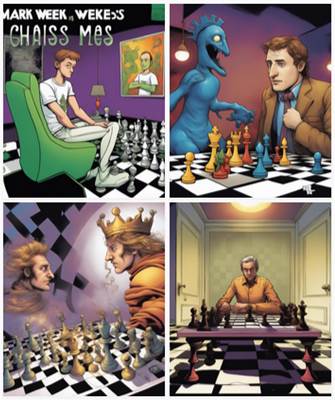
Let's try an experiment. What does the software display when it has absolutely no idea what its designated subject look like? Since there are no photos of me on the web, other than the one at the top of the navigation column on the right, I'm the perfect subject and the experiment can continue. Even that photo dates back to 2008, so it won't help much.


'Mark Weeks plays chess.'
AI Comic Factory

The white haired fellow in the lower right frame is not far from reality, but the other three frames are pure fiction. And what's that attempt to spell my name in the upper left? After all, I gave the correct spelling in the prompt. Then there's 'CHAISS MES' underneath my name. If that's supposed to be 'CHESS MESS', it makes a least a little sense.

The experiment yields more questions than answers. The next post in the series will return to subjects having greater name recognition.

03 March 2025

Dadaist Chess

In the previous post, What Is Dadaist Chess? (February 2025), I quoted from Wikipedia,

Dada or Dadaism was an anti-establishment art movement that developed in 1915 in the context of the Great War [aka WWI] and the earlier anti-art movement.

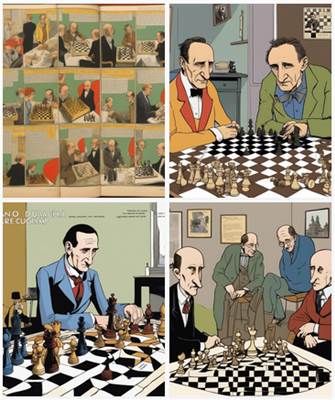
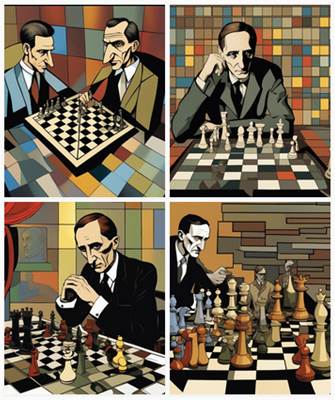
Adding that to an earlier post titled, Cubist Chess (February 2025; 'Marcel Duchamp plays cubist chess'), generates yet another view of Marcel Duchamp playing chess, shown below.


'Marcel Duchamp plays dadaist chess.'
AI Comic Factory

While those faces all look like Marcel Duchamp, where's the Dadaism? An even more fundamental question is how do you depict an 'anti-establishment / anti-art' movement? Our AI comic software is clearly struggling with the question.

One trick the software uses when lost for an appropriate image is to create a meaningless comic sequence, like the one shown in the upper left frame. Another trick is to put stuff on the wall, like the two frames on the right. Maybe the framed pictures relate to images well known to Dadaism. Then again, maybe not. What do I know?

Like the software, I'm clearly struggling here, so I'd better end this post now. • Next post in the series: Call me clueless.

02 March 2025

More Fun Tops Eerie

First question: How much artwork has been featured in the long running series Top eBay Chess Items by Price (March 2010)? In last month's post, A Sammarinese Artist (February 2025), I wrote, 'I almost always go for any artwork', so there must have been plenty.

Second question: How much of that artwork has featured comic books? It turns out not to be so much, because I count exactly six posts.

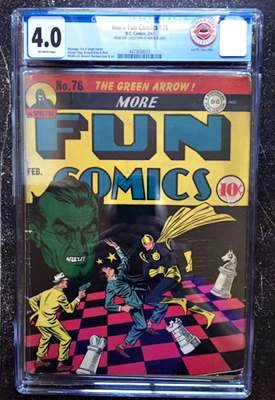
The title of the item pictured below was 'MORE FUN COMICS #76 CGC VG 4.0; OW; Dr. Fate chess cover! Scarce!' It sold for 'US $1,350.00 or Best Offer', where that USD number looks to be close to the real price.

The description just repeated the title. Fortunately, there are resources elsewhere, like More Fun Comics Vol 1 76 (dc.fandom.com; 'DC database'). There we learn that this particular comic was published February 1942. If we go back to a post from almost two years ago, Eerie Tops Strange (May 2023), I noted,

'Strange Adventures #35' [...] sold for US $643.93 • 'Eerie Adventures' comic [...] was considerably more than the 'Strange Adventures' comic.

It looks like we've upped the ante again. For my take on comic book prices, see the first of the six 'Top eBay Chess Items' posts featuring a comic, Batman Plays Chess with the Joker (December 2011), especially the last paragraph.

***

This month will see the 15th anniversary of 'Top eBay Chess Items by Price'. Am I looking forward to another 15 years? Hardly!

24 February 2025

What Is Dadaist Chess?

In the previous post for the series inspired by AI Comics, Cubist Chess (February 2025; 'Marcel Duchamp plays cubist chess.'), I wrote,

Cubism I understand -- at least I think I do -- Dadaism is a mystery. Let's go with what I understand. [...] Next on the agenda: dadaist.

First and foremost, what's Dadaism? In Dada (wikipedia.org), we learn,

Dada or Dadaism was an anti-establishment art movement that developed in 1915 in the context of the Great War [aka WWI] and the earlier anti-art movement. Early centers for dadaism included Zürich and Berlin. Within a few years, the movement had spread to New York City and a variety of artistic centers in Europe and Asia.

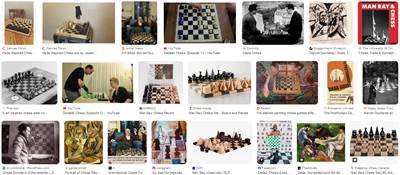
To explore its relationship to chess, I'll use the same Google search technique last seen in 1992 Fischer - Spassky 'Under the Weather' (September 2022), i.e. a composite image.


Google Image search on 'chess dadaist'
[Call the rows 'A' to 'C' (from top to bottom) and number the images in each row '1' to '8' (from left to right).]

More than a third of those thumbnails show chess sets and half of those are the 'Man Ray chess set', most prominently in dead center of the composite at B4. Another third have something to with Marcel Duchamp, including his 'Portrait of Chess Players' in A6 and C2. Both artists are seen playing each other in A5.

As for his several mentions in this blog, Marcel Duchamp made a Chess Review cover appearance in November 1968 'On the Cover' (November 2018; 'Marcel Duchamp died at 81 last October 1st, in Paris. [...]') I can't imagine what 'Marcel Duchamp plays dadaist chess' ('anti-establishment art'?) will look like. We'll find out in the next post in the series.

17 February 2025

Cubist Chess

The title of the previous post on AI Comics, Surrealist, Cubist, Dadaist Chess (February 2025; 'Marcel Duchamp plays surrealist chess'), suggests the theme of this current post. I ended that post saying,

That gives me at least two more avenues to explore -- (1) conceptual art and (2) Salvador Dali, not to overlook cubism and dadism.

Cubism I understand -- at least I think I do -- Dadaism is a mystery. Let's go with what I understand.


'Marcel Duchamp plays cubist chess.'
AI Comic Factory

So cubist means breaking up surfaces into a patchwork of smaller, rectangular pieces. A chessboard is inherently cubist; chess pieces are not. Next on the agenda: dadaist.

16 February 2025

More Text to Art

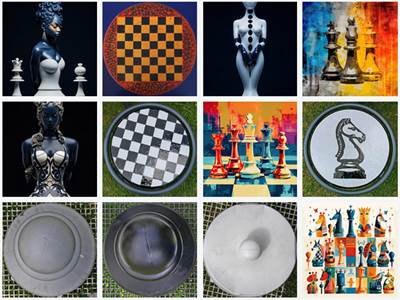
While creating the short list for this month's Flickr Favorite post, I saw many photos similar to the one in the upper left of the composite image below. See, for example, the photo directly beneath it (leftmost image second row). When I tried to look at that family of photos together, I discovered that the photographer frequently used 'chess' as a theme. The image in the lower right looked familiar and, sure enough, I had 'faved' it sometime last year.


Upper left: Chess-esque © Flickr user Leo Reynolds under Creative Commons.
Bottom right: Chess mosaic © [same as upper left]

The descriptions of both photos were identical:-

Artwork created by Midjourney from a sequence of text.

No prizes for guessing that Midjourney (wikipedia.org), is an AI image generator. That Wikipedia page starts,

Midjourney is a generative artificial intelligence program and service created and hosted by the San Francisco-based independent research lab Midjourney, Inc. Midjourney generates images from natural language descriptions, called prompts, similar to OpenAI's DALL-E and Stability AI's Stable Diffusion. It is one of the technologies of the AI boom.

The last time we saw a Flickr chess image of this genre was No Hunk-o'-Junk Here (April 2024). Although the generator of that image wasn't explicitly identified, a piece of additional info informs,

This photo is in 1 album: AI Gen Sci-fi (Midjourney).

Midjourney again. So there we have it.

13 February 2025

February 1975 & 2000 'On the Cover'

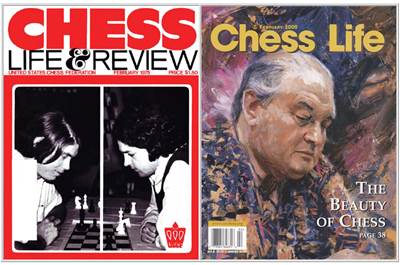
The leading American chess magazine -- both 50 years ago and 25 years ago -- featured the American Open. For last month's post in the series, see January 1975 & 2000 'On the Cover' (January 2025).


Left: '?'
Right: 'The Beauty of Chess'

Chess Life & Review (50 Years Ago)

Kim Commons, left, and Peter Biyiasas, co-winners of the American Open. Story [inside]. Photo by Carl Budd.

The 'story [inside]' by Carl Budd, 'Vice President, Santa Monica Bay Chess Club', was titled '10th American Open'. It started,

The tenth anniversary of the American Open resulted in co-champions for the first time since its inception. Kim Commons, formerly a California Champion, and Peter Biyiasas, current Champion of Canada, led the field after the eighth and final round to tie for top honors. [...]

Altogether there were 168 entries in the Championship Section. And with 300 entered in the Amateur Section, the grand total of 468 players makes this American Open the largest rated tournament ever held in California and the third largest open tournament co-sponsored by the U.S. Chess Federation. It is surpassed only by the U.S. Open in Chicago in 1973 with 778 players and the U.S. Open in New York in 1974 with 549 players.

For the previous edition of the American Open, 51 years ago, see February 1974 & 1999 'On the Cover' (February 2024; 'James Tarjan, winner of the American Open in California').

Chess Life (25 Years Ago)

Again we thank Steven Seward for his excellent work, providing us with a cover portrait of the winner of the 35th American Open, Grandmaster Eduard Gufeld. Jerry Hanken's happy recap begins on [inside] and is followed by an interview with Gufeld. Keeping with the theme of the interview, Gufeld's "Artistic Beauty in Chess" begins [inside].

That's a lot of Gufeld for one issue of CL: cover portrait, winner of the 35th American Open (four page story), interview (two pages), essay on beauty in chess (five pages). The 'On the Cover' introduction continued with a Gufeld anecdote:-

You should also note that Bobby Fischer's last sacrifice -- was Gufeld. When Fischer forfeited his match against Karpov in 1975, the Soviets were desperate to prove that Karpov was worthy of the title. Gufeld was scheduled to travel (a rarity) to Ljubljana for the Third Vidmar Memorial, a super-strong event. That's right, Eddie got bumped -- sacrificed if you please -- in order to allow Karpov to participate (Karpov won, ahead of Gligoric, Ribli, Furman, Hort, Parma, Portisch, et. al. [June 1975, Karpov: +7-0=8]).

By some unusual coincidence, the February 1975 issue of CL&R had news about the Fischer - Karpov match, so I'll come back to that story after finishing with Gufeld. The tournament report was titled 'Gufeld Tops 35th American Open' by Jerry Hanken. It started with a bit of chess history:-

A little over a year after Lyndon Johnson announced his "Great Society" and "War on Poverty" and 14 months before Super Bowl I, the American Open was born. A brainchild of Al Bisno of the Santa Monica Bay Chess Club and USCF Executive Director Ed Edmondson, this tournament became part of the original "Triple Crown" (along with the U.S. Open and National Open). The first running drew over 200 players to the Miramar Hotel in Santa Monica and was won by then-super GM (twice a world championship candidate in the 50's and 60's) Pal Benko. [...]

In 1979 the American Open achieved "American Classic" status (marking the difference between a National and one run by a local organization which has drawn over 400 players three years running). And in 1989 it was awarded the "American Heritage" designation for lasting 25 consecutive years. Only one other tournament holds both these distinctions — the World Open, of course.

This information is for historical perspective in reporting on the just-completed 35th Annual American Open, held Thanksgiving weekend at the spacious LAX Sheraton Gateway.

The report then turned to a discussion of the winner.

Quite fittingly, the tournament, an eight-round Swiss, was won by a grandmaster whose career and accomplishments span the last 35 years! In a mild upset, the American Open champ of 1999, the last of the millennium, was Eduard Gufeld! I use the word "upset" because Eduard was only the ninth highest USCF-rated player in the event, and many thought that at 63 years of age he was simply too old and too outclassed to win such an event. After all, there were three GMs (Pavel Blatny, Sergey Kudrin, and Alex Yermolinsky) among those seeded ahead of him.

Since he recently settled in the Los Angeles area, Gufeld has been known as a fine teacher and lecturer, but not a great tournament player. Well, he certainly struck a blow for us old folks! Not only did he become the champion, but he won with a clear half-point advantage at 6 1/2 of 8.

I'll skip both the Gufeld interview and his essay and return to the phantom 1975 Fischer - Karpov match. Burt Hochberg described the status in his monthly column for February 1975, 'The Editor's Page - News & Views'.

The FIDE Bureau meeting in Panang, Malaysia, December 15-18 [1974], resulted in some very discouraging news. The most pressing matter was the World Championship Match for 1975: by a narrow 5-4 vote the Bureau reluctantly declined to consider changing the Regulations adopted last June by the General Assembly at Nice.

President Euwe expressed the hope that the Chess Federation of the USSR would now, in a grand gesture designed to demonstrate the sportsmanship it has so long professed, announce that Karpov would agree to the match conditions proposed by Fischer. If the Soviets do not make this gesture -- and several Bureau members consider it unlikely -- only an Extraordinary General Assembly could make any changes in the Regulations.

After more bad news involving the 1975 World Student Team Championship and the 1976 Olympiad, Hochberg returned to the title match.

Some hope remains, however, that the World Championship may yet be saved. The Chess Federations of Japan, Iran and the Philippines have called for an Extraordinary General Assembly, as provided for in FIDE statutes. For this meeting to be held -- it must be done before April 1 -- 29 of the 87 member federations must support the call.

On January 1, the bids for the Match were opened at FIDE headquarters in Amsterdam. There were only three: Mexico City $387,500; Milan $426,250; and the Philippines $5,000,000. According to FIDE regulations, the match winner gets five-eighths of the purse and the loser three-eighths. Details of the bids have been sent to Karpov and Fischer, each of whom must list the bids in order of preference and notify FIDE of their choices not later than February 17. If the two players do not agree, FIDE President Euwe will choose the site.

For the previous major development involving the 1975 match, see August 1974 & 1999 'On the Cover' (August 2024; 'The [1974] FIDE Congress was shaken by several controversial decisions.').

10 February 2025

Surrealist, Cubist, Dadaist Chess

Continuing to explore the bizarre, parallel world of AI chess comics, it's been a month since the post on Surrealist Chess (January 2025; 'Rene Magritte plays surrealist chess'). Perhaps the best known chess artist is Marcel Duchamp, so let's see what the AI software thinks about him and his work.


'Marcel Duchamp plays surrealist chess.'
AI Comic Factory

While that's unmistakably Marcel Duchamp, the images aren't nearly as compelling as those in the Magritte post. What went wrong? Wikipedia, in Marcel Duchamp (wikipedia.org), says,

Henri-Robert-Marcel Duchamp (1887–1968) was a French painter, sculptor, chess player, and writer whose work is associated with Cubism, Dada, and conceptual art.

There's no mention of 'surrealism' there, so maybe I got my wires crossed. The rest of Duchamp's Wikipedia page mentions variations of 'surreal' more than a dozen times. One of the first mentions says,

The [Dada] movement influenced later styles, such as the avant-garde and downtown music movements, and groups including surrealism, Nouveau réalisme, pop art, and Fluxus.

The most recent post on this blog featuring Duchamp was Conceptual Artist and Surreal Artist (March 2024). There I quoted the UK Royal Academy of Arts,

Take another look at two artistic giants: father of conceptual art Marcel Duchamp, and larger-than-life surrealist Salvador Dali.

That gives me at least two more avenues to explore -- (1) conceptual art and (2) Salvador Dali, not to overlook cubism and dadaism -- in the bizarre, parallel world of AI chess comics.

03 February 2025

Playing Chess with Money

One of the insights from my recent explorations into AI Comics was that people's likenesses are best rendered using the '3D Render' style. Consider the images produced for the recent post Color the Proteins (January 2025; 'Demis Hassabis plays chess ...').

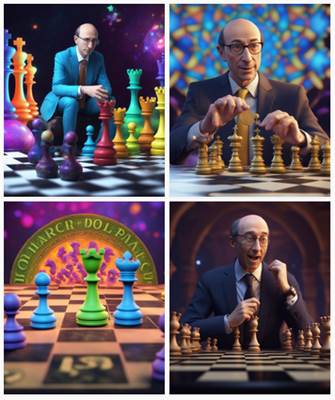
Another insight was that AI Comics are perfectly happy to create images of inanimate objects playing chess. Consider the following images inspired by the world of economics and finance.


'Kenneth Rogoff plays chess with money.'
AI Comic Factory

Now I don't know what you think, but I think those are pretty good likenesses of one of the most famous GMs who became much better known in a real world profession (is there another?). Photos of {GM/Dr./Professor} Rogoff have appeared many times on this blog.

The earliest appearance was Kenny Rogoff as You've Never Seen Him (February 2012). Note the contrast between the photo of young Rogoff in that post and an older Rogoff in Wesley So & Kenneth Rogoff (February 2015). Since there are many more photos of the older Rogoff on the web, it's those photos that have been used as the base for the composite image shown above.

As for 'plays chess with money', the only frame where money is obvious is the lower left. The round thing behind the board looks to be based on the seals you find on U.S. dollar paper bills.

***

Later: I received a message from A.L. saying, 'In the upper right frame, he appears to be tossing a gold coin.' It took me a few minutes to see it, but yes indeed, there is a gold coin near the center of the upper right frame. I missed it before because it is nearly the same color as Professor Rogoff's tie.