Showing posts with label Downloads. Show all posts

24 February 2023

Chess.com's Game Review Tools PGN
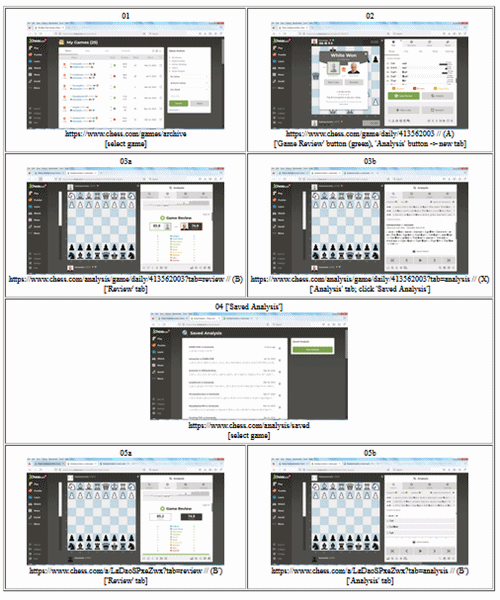
Last week, in Chess.com's Game Review Tools (February 2023), I developed the chart shown on the left (see that post for a larger version of the chart as well as the codes used to identify the different boxes). Because all names in computerdom eventually reduce to an acronym, let's use GRT to mean 'Game Review Tools'.

Since you're reading this post, you're probably interested in analyzing your games and you're undoubtedly aware that chess games are nearly always recorded in a format called 'Portable Game Notation' (PGN). It follows that the different boxes in the GRT chart offer downloads in PGN format.

Specifically, the boxes coded '02, 03a, 03b, 05a, 05b' all have a download, aka 'Share', option. Are the downloads all the same? No, they aren't, but the differences between them aren't enormous and the rest of this post is to discuss their similarities and the differences.

A Chess.com pop-up window like the one shown below appears when you click a 'Share' option. This particular example is from the GRT window coded '03b' in the previous post.
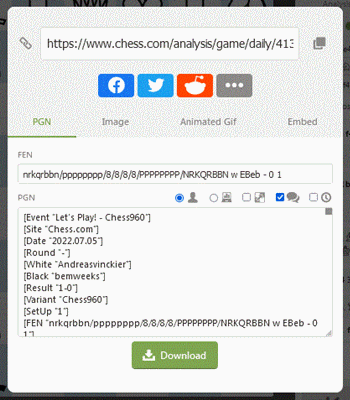
Along with the link for the URL of the game analysis, the pop-up offers functions for posting it to various social media platforms, plus functions for saving the current game in other formats like 'Image', etc. The lower portion of the pop-up, with the background in White, is specific to the PGN function.

The first PGN box, titled 'FEN' is a character string that describes the essential elements of the current position in text format. It is recognized by most chess software. This particular example is for the chess960 start position 'NRKQRBBN'. Its initial castling option are, of course, all available and are shown by the characters 'EBeb'.

Just below the 'FEN' string, to the right of the 'PGN' title, is a series of icons for tailoring the format of the PGN. They are:-

  • Annotation
  • Computer Analysis

  • Highlights
  • Comments, and
  • PGN Timestamps.

The first two icons are selected by a circle, indicating that they are mutually exclusive. The last three icons, which apply to the 'Annotation' icon, are selected by a square, indicating that they can be combined. I haven't tried all of the icons, but they are related to info/data visible via various GRT windows.

The chart box coded '02' has only the icon for 'PGN Timestamps' (default = 'no'). An example of the PGN output -- only moves, without variations or notes-- was shown near the end of the most recent post on my chess960 blog Chess.com Pinpoints a Tactical Error (February 2023). The other PGN functions are added as the 'Review' (chart box '03a') and 'Analysis' ('03b') tabs are invoked from '02'.

The PGN produced by the two chart boxes coded '05a' and '05b' is similar to '03a' and '03b'. The biggest differences are in the many tags (e.g. '[Event "Let's Play! - Chess960"') that make up the PGN header section. There are smaller differences in the moves themselves, but these aren't worth mentioning for now. Maybe later, maybe not; there is already much to explore here...

24 August 2020

CCC PGN II

Near the end of last year I posted CCC PGN (December 2019), which started,

The 'CCC PGN Archive' (see the tab 'TCEC/CCC Links' at the top of this page) hasn't been updated in over six months, and only shows events through CCC8.

While preparing that post I found a more recent archive and documented its existence in the same tab 'TCEC/CCC Links'. That second archive was only maintained another four months before it, too, stopped being updated. Recently, another attempt was made at documenting CCC PGN files via the site's Discord resource:-

#complaints

the_real_greco 25/07/2020
@LILMAFYA Someone just gave me this, which has a huge number of our old PGNs (I haven't checked it for completeness).

https://cdn.discordapp.com/.../CCCC.xlsx

If it's still missing anything you want (and you're still interested), let me know. You'd actually be doing me a favor if you could point out any that are missing.

See the Discord resource for the full URL of the XLSX file.

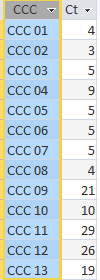
I downloaded the XLSX file, loaded it into a database, and discovered that 'huge number' meant 144 PGN files plus one 'TBA'. After doing that, I produced the chart on the left. It shows the number of PGN files per CCC season.

The XLSX data is also useful for a number of other tasks. First, it can be used to crosscheck the older archives mentioned in the original 'CCC PGN' post. Second, I can use it to catalog the CCC-live weekly snapshots that I've been taking for the last year or so. These show the name of the live event that was running at the time of the snapshot, plus events just before the live event.

I didn't have time to complete either of those two other tasks. I'll try to do that another time.

02 December 2019

CCC PGN

The 'CCC PGN Archive' (see the tab 'TCEC/CCC Links' at the top of this page) hasn't been updated in over six months, and only shows events through CCC8. For this post I set out to find more recent PGN files and found links for them via #tournament-pgns (discordapp.com). The Discord messages are of the type...

CCC Archive 9/21
https://pastebin.com/ZKLFBFfU

... and look like this:-

Download links are all of the form:
https://cccfiles.chess.com/archive/tournament-TOURID.pgn

Tourid Title
40044 CCC10 Finals
39682 CCC10 Semifinals
[...]

With this data it should be trivial to download the relevant files. I'll add the link given in the first paragraph to 'TCEC/CCC Links'.

29 November 2019

US Chess CL Archive

This week, in US Chess Digital Archive Is Live, USchess.org announced,

US Chess has been working on digitizing its archive of Chess Life and Chess Review magazines (as well as titles such as Chess Life & Review). This project is now complete and the archive is now online and available for download by the general public.

I've referenced existing digital CL collections in at least two previous posts:-

I downloaded the files that were missing from my own collection and have started flipping through them. Unfortunately, the document scans aren't first rate -- many pages are skewed and/or clipped on the side of the magazine fold, and the text is often too light, making it difficult to read -- but who's complaining? Thanks, US Chess!

26 September 2016

Carlsen's TMER 2000-2016

Finishing with Carlsen's TMER 2015-16, I merged events Carlsen played since September 2014 into the master index, updated the associated PGN file, and uploaded the new resources to Magnus Carlsen's Tournament, Match, and Exhibition Record (2000-); Last updated 2016-09-26. The files include two more events played since I started the update a month ago:-

  • Chess.com Semifinal Blitz 2016 (vs.Grischuk)
  • 42nd Olympiad, Baku

The final stage of the Chess.com Blitz was announced in the past week: Carlsen - Nakamura Championship set for 27 October. This is a new event using a new, unusual format that deserves attention, perhaps in a future post. As for the chess960 games played in each stage of the event, I noted them on the master index without including them in the PGN file.

***

Follow-up: Chess.com's GM Blitz Battle (February 2017; on Chess960 FRC).

28 March 2016

The Winner and New Challenger

Congratulations to GM Sergey Karjakin who today won the 2016 Candidates Tournament in Moscow. In the last round he defeated the only other participant who still had a chance of winning the event, GM Fabiano Caruana, to become the undisputed winner.


GM Karjakin at the rd.14 press conference

In November, Karjakin will play World Champion Magnus Carlsen, thereby joining an elite list of players who have earned the right to a title match. What's their current record against each other? According to Chessgames.com, in classical games Magnus Carlsen beat Sergey Karjakin 3 to 1, with 15 draws.

As for this blog, I'll suspend the Monday-Monday series on PGN Files for Book Reviews, and will instead develop a Tournament, Match, and Exhibition Record (TMER; last seen in TMERs: Kasparov Wrapup) for Karjakin.

21 March 2016

PGN Files for Book Reviews

In a recent post I created a PGN Download Directory for storing some of the PGN files I've created through the years. Which files should I add to it?

First I looked at the book reviews indexed in Chess Product Reviews (May 2009) of which there are nearly 50, mainly from the years 2004-2008. Of the reviews that have a corresponding PGN file, about a dozen were for opening books with titles like 'Beating the Unorthodox Repertoire Explained'. I don't know how much value these books have ten years after they were written, but it can't be high. I'll skip those for now.

Three titles still looked to be as interesting today as they were when I reviewed them. Here are links to the corresponding reviews along with the introductory blurb.

  • Test Your Chess • Book review of 'Test Your Chess with Daniel King'. Match wits with the world's greatest players of the late 1990s and early 2000s.

  • Najdorf: Life and Games • Book review of 'Najdorf: Life and Games' by Tomasz Lissowski, Adrian Mikhalchishin and Miguel Najdorf. 'Miguel Najdorf’s chess career spanned more than six decades. It included two World Championship Candidates tournaments and 15 Olympiads -- where he represented his native Poland and later Argentina' [from the back cover]

  • Chess for Tigers • Book review of 'Chess for Tigers' by Simon Webb.

I'll come back to these files in future posts.

14 March 2016

PGN Download Directory

Continuing with PGN Downloads (2016), I created a new directory m-w.com/cfaa/download and copied six existing files to that directory. The six files are documented in the following posts:-

For now I have two copies of each file: the original and the new copy. I'll address that situation in a future post.

03 March 2016

PGN Downloads (2016)

What can I say about chess copyrights that hasn't already been said? Just about everyone knows that the moves of a chess game can't be copyrighted, but any notes to that game are automatically protected. Five years ago, in PGN Downloads (February 2011), I noted,

Many players don't realize it, but the list of games in a book is copyrighted material.

That pretty much precludes anyone who respects copyright from creating a file containing the PGN game scores from such-and-such a chess book. Or does it? In 'PGN Downloads (2011)' I offered a few files to test the waters, but I've never been entirely comfortable with the scenario.

Recently I was re-reading the Associated Press Stylebook (I have the 39th edition, June 2004), where the last section is 'Copyright Guidelines'. The AP says,

While copyright generally prohibits the use of another's protected expression, the doctrine of "fair use" permits, in certain circumstances, the use of copyright material without its author's permission.

To determine whether a particular use is fair, courts are required to evaluate and balance such factors as:
(1) the purpose of the use;
(2) the nature of the copyright work that is used;
(3) the amount and substantiality of the portion used in relation to the copyright work as a whole; and
(4) the effect of the use upon the potential value of the copyright work.

I had never considered 'fair use' in the context of a file of PGN games, but there is an excellent match. Going through each of the AP's four bullets, '(1) the purpose' of a PGN file is

  • to read a chess book with the help of a PGN reader,
  • to apply a chess engine to the notes in a book
  • to produce statistics on the games in a book

As for '(2) the nature of the copyright work', I believe that for books this means fiction vs. nonfiction, where chess books are nearly always nonfiction. The stylebook says later,

Fair use is more likely to be found if the copyrighted work is informational rather than fictional.

As for '(3) the amount and substantiality of the portion used', I am currently preparing a PGN file for Walter Browne's 'Stress of Chess'. Its list of 101 games takes a little more than two pages in a book with 463 pages. That is probably typical for a chess book and amounts to less than 0.5% of the material in the book.

The last bullet, '(4) the effect of the use upon the potential value', is the easiest. A PGN file containing only the original moves of the games in a book -- no variations or notes! -- considerably enhances the value of the book. In my opinion, it should be produced together with a book and distributed digitally by the publisher when the book is first published.

I took away one more general point from the AP's discussion of copyright:-

Proper attribution cannot transform an infringing use into a fair one.

With this discussion in mind, I can return to the subject of Tag Maintenance, specifically 'Tag: Downloads'.

18 February 2016

Tag Maintenance

If you want to make sure that no one reads a certain post, just put the word 'maintenance' in the title, as in Blog Maintenance (January 2015). Why write about the topic at all? Because a blog is a personal diary as well as a public forum.

Tag: Blog Carnival • First I deleted the tag for carnivals; the relevant posts are easily found via a standard search tool. I use tags to group posts that are not easily identified as belonging together and this doesn't apply to blog carnivals. On top of that, the concept has fallen out of fashion and I doubt that we will see future carnivals for chess blogs.

Tag: Downloads • Then I looked at the posts under this tag, which covers both downloads for this blog and downloads from the web. After starting to collect downloads for this blog -- PGN Downloads (February 2011; could be my most-visited post) -- I never developed the idea. The six ZIP files available today are downloaded regularly, which tells me that there is some interest in providing more of the same. I'll pursue this in another post.

20 October 2014

TMERs: Carlsen - Anand PGN Master

A couple of weeks ago, in TMERs: Carlsen - Anand Index, I mentioned, 'Next step: Add the games to the TMER PGN master files'. To download those ZIP files, see the links in the 'Carlsen - Anand Index' post.

(*) TMER = Tournament, Match, and Exhibition Record

24 March 2014

Sicilian Najdorf 6.h3

After Resurrecting an Online Chess Database, I decided to take the software for a test drive. In the ongoing 2014 Candidates Tournament there have been several Sicilian Najdorf games -- 1.e4 c5 2.Nf3 d6 3.d4 cxd4 4.Nxd4 Nf6 5.Nc3 a6 -- with 6.h3. I haven't played the Najdorf for several years and I wasn't aware that this old move also played by Fischer was in vogue. What was its recent history within the SuperGM crowd?

I went to Chesslab, found 99 recent games by players rated over 2700, downloaded them to my PC, and loaded them into SCID. Using SCID (see Frontend and Backend for more about SCID), I put together the following analysis.

The first question involved the three games with 6.Be3. After using SCID to locate those games, I discovered that they all started 6.Be3 Ng4 7.Bc1 Nf6 8.h3, a transpositional nuance of the Najdorf that I had forgotten about. No real surprise there.

The second question was when the GMs' attention turned to 6.h3. It turns out that after a few games by other players in the early 2000s, a certain GM Carlsen played it four times in 2008, achieving a +2-0=2 result. His first recorded use of the move was against GM Gelfand during that year's Amber Blindfold event, when the 17-year old Norwegian was rated 2733. Carlsen won the game. After 2008, he played the move only once, in 2012 for his game in Mexico against 'The World'.

GM Anand has also played 6.h3 a couple of times, starting in 2012. Perhaps we'll see the move in Carlsen - Anand II, which appears to be the most likely result of the Candidates tournament, where he is leading by a full point after nine rounds. He also has the tiebreak advantage over the only other player with a plus score, GM Aronian, having won their minimatch with +1-0=1. With only five games remaining, that's a huge advantage for the Indian GM.

17 March 2014

Resurrecting an Online Chess Database

After my failure in Choosing an Online Chess Database, I decided I had three options (in order of preference):-

  • Find another online database
  • Get Chesslab working, whatever it takes
  • Stop playing traditional chess and switch 100% to chess960

I went back to Google and found two more candidates for a chess database, but these also proved to be insufficient:-

Then I used Google to uncover every bit of information I could find about the Java problem mentioned in Searching for an Online Chess Database. Finally I discovered a solution that worked. I won't say what it was, except to mention that it involved a security compromise. I know what the risk is and I'm willing to accept it.

As for giving up traditional chess and switching to chess960, I am certain that day will come. It just won't be today.

10 March 2014

Choosing an Online Chess Database

It's been three weeks since I started Searching for an Online Chess Database. I first narrowed the choice to two services in Short List for an Online Chess Database, then added a third in Short List Is Longer. For convenience, here are the specs I developed in that first post, 'Searching'.

The first few moves are usually played on auto-pilot. I'm a 1.e4 player, and I don't need to refer to a database for the first few moves of the Najdorf Variation (1.e4 c5 2.Nf3 d6 3.d4 cxd4 4.Nxd4 Nf6 5.Nc3 a6). At this point I have a couple of favorite moves (6.Be2 and 6.Be3), but I'm willing to play most alternatives for White, of which there are many.

When I reach this point in a game, the first decision after auto-pilot, I want to see what the top players have been playing in their recent games. This means going to the database and researching what 2600+ players have been playing during the last few years. I don't do a deep analysis at this point. I assume that the top GMs have done their homework and that their systems are sound.

After a few more moves, usually in variations that I have played before, the number of sample games starts to diminish and I broaden the research to include 2400+ players over, say, the last ten years. Here I have somewhat less confidence and I start to check variations that I haven't seen before.

At some point, usually around moves 10-12 in the Najdorf, I start to run into moves and ideas that I haven't seen before. Here I want to see every game played in the variation since the beginning of time and the research involves playing through the games until the early endgame has been reached.

All opening databases use the same basic 'explorer' mechanism. Starting with the initial position:-

  • See next moves with counts and stats (W-L-D)
  • Click a move for next position
  • Repeat

Here is a screen capture from database.chessbase.com. The current position is shown on the left (after 1.f4). In the middle is a list of games matching that position. On the right are the next moves. The panels in the bottom left and bottom right show the current game and engine analysis, respectively, and can be removed from the display.

I spent a few hours switching back and forth among the three services on my short list. This isn't enough time to appreciate the subtleties of a service, but it gave me a feel for the possibilities.

>>> database.chessbase.com: The list of next moves can be switched between 'Book' and 'Live Book', but I couldn't determine what these terms meant. The service offers two required functions:-

  • Search current board for games on database
  • Sort on Year or on Elo (either White or Black) descending
Some further observations:-
  • W-L-D stats are a single number
  • Earliest games are from 2009
  • No PGN download

>>> chess.com/explorer: Two required functions:-

  • 'View all games from current position'
  • Sort on year or rating descending
Further observations:-
  • Latest games are from 2012
  • A player's rating is one number for the entire career, e.g. the top Black rating for 1.f4 is Romanishin - Kasparov 1975, when Kasparov was 12
  • Download 20 games at a time

>>> chess-db.com: Beyond the basic explorer functions, I couldn't find any of my requirements.

>>> Conclusion: What can I say? All three services are basically of limited value for my purposes. I never realized until now just how good Chesslab was.

03 March 2014

Short List Is Longer

Looks like I goofed. In last week's post, Short List for an Online Chess Database, I reported that the last database in my list ('6: chess-db.com') had 'No search on openings'.

While I was working on today's follow-up post, to compare the two databases on the short list, I took another look at Chess-db.com. Lo and behold, there were two functions 'OpExp' and 'OpCmp' that I overlooked last week.

The first, 'OpExp', stands for 'Opening and Position Explorer (Beta)', which has similar functionality to the two short-listed databases. The second, 'OpCmp', stands for 'Historical Comparison of Openings by Popularity'. It does exactly what it says for any two variations that you feed it. Here is an example for 1.e4 c5 (in blue) and 1.e4 e5 (in red). I don't know how useful that is, but it's available.

As for 'OpExp', I have to return to last week's post to correct my error before I go any further with this post...

24 February 2014

Short List for an Online Chess Database

In a recent post, Searching for an Online Chess Database, I listed five chess game databases for further consideration, then added,

To go further, I need a practical exercise. I'll report on that in a future post on this blog.

For convenient reference, here are links to the five databases plus a sixth that was recommended in a comment to that first post.

One of the first questions is the relative size of the databases. I queried each database on From's Gambit (1.f4 e5) and noted the game counts for the first moves. Following the table are notes specific to each database.

1: database.chessbase.com • According to Introducing the online ChessBase database, the latest incarnation of this well known tool was released in January 2014.

Fairly recently, a new online tool was released by ChessBase with little if any fanfare, but that is of no small use for casual users: an online searchable version of the ChessBase database, accessible from your browser, and free. It brings well over 6.5 million games, includes the playerbase pictures, move statistics, and even the Let’s Check computer evaluations. Here is a tutorial.

PGN download? No.

2: 365chess.com • The service is the 'Chess Opening Explorer' running on the 'Big Database'. The corresponding counts for the 'Masters Database' are 1.f4: 519 and 1... e5: 21. • PGN download? No. 'As a free member you can download only one game at a time. Become a Supporter now and you'll have unlimited downloads!'

3: chess.com/explorer • The counts are for 'Master Games'. • PGN download? Yes, but I'm a full member and am not sure if free members have the same access.

4: shredderchess.com • PGN download? No.

5: chessgames.com/explorer • '705,230 games · 1475-2014'; After a few more moves, 2.fxe5 d6 3.exd6, I received the message 'The links below [i.e. further moves] are restricted to premium members.' • PGN download? Unknown.

6: chess-db.com • No search on openings

As for my requirements (stated in the 'Searching' post) that I be able to restrict the search to top rated players and recent games, none of the services offered that functionality. The best I could get was sort by rating or by year played.

At this point, the best of the six services to suit my purposes appear to be those offered by Chessbase.com and Chess.com. I'll come back to these with a further practical exercise.

17 February 2014

Searching for an Online Chess Database

As I mentioned in Fishing on the River Chess, my favorite source of top level games has gone belly-up.

Chesslab.com has been problematic lately, throwing up Java security warnings. I checked my settings and couldn't determine the cause of the errors. If I can't fix it, I'll need a new source of games. That will require some research.

I've spent several hours looking into the Java security issues, have tried all of the recommendations I could locate, and nothing has worked. The service, which I have been using since the 1990s (see Chess History on the Web [2000 no.3] for my early experiences with it) has been out-of-order since late last year and I need a replacement.

Some people like to maintain their own database of top level games, but I have no time for that. I go online when I'm researching a specific opening, usually for a new correspondence game, and my methodology changes as I get further into the opening.

The first few moves are usually played on auto-pilot. I'm a 1.e4 player, and I don't need to refer to a database for the first few moves of the Najdorf Variation (1.e4 c5 2.Nf3 d6 3.d4 cxd4 4.Nxd4 Nf6 5.Nc3 a6). At this point I have a couple of favorite moves (6.Be2 and 6.Be3), but I'm willing to play most alternatives for White, of which there are many.

When I reach this point in a game, the first decision after auto-pilot, I want to see what the top players have been playing in their recent games. This means going to the database and researching what 2600+ players have been playing during the last few years. I don't do a deep analysis at this point. I assume that the top GMs have done their homework and that their systems are sound.

After a few more moves, usually in variations that I have played before, the number of sample games starts to diminish and I broaden the research to include 2400+ players over, say, the last ten years. Here I have somewhat less confidence and I start to check variations that I haven't seen before.

At some point, usually around moves 10-12 in the Najdorf, I start to run into moves and ideas that I haven't seen before. Here I want to see every game played in the variation since the beginning of time and the research involves playing through the games until the early endgame has been reached.

I use SCID (see the recent post Frontend and Backend for an overview) to keep my own copy of the games. It does a good job of searching the games I've collected, of producing basic statistics on the results, and of scrolling through the games and moves.

In a nutshell, the functions I need in an online games database are:-

  • Search on games by rating
  • Search on games by when played
  • Download all relevant results in PGN format

What alternatives are there to Chesslab? I did a web query on 'chess database online', spent some time looking at the top results, added a few resources that I've tried before, and developed a short list of databases to investigate further (in no particular order):-

To go further, I need a practical exercise. I'll report on that in a future post on this blog.

10 February 2014

Frontend and Backend

After Fishing on the River Chess and Testing an Engine, I still had two other chess packages to install and test: SCID and Arena. Why use both? I've discovered through the years that it's useful to separate the frontend from the backend when analyzing a chess position.

SCID is the software I use for the frontend. It lets me build a chess game the way I like to do it -- move by move, variation by variation, note by note. Because it recognizes PGN, which is essentially a text format, I can rearrange a game's components using a standard text editor. Unfortunately, SCID doesn't recognize chess960, but I have procedures to get around that limitation.

Arena is the software I use for the backend. It handles the details of running an engine. Whatever noteworthy results it discovers, I record using SCID.

Having two pieces of software means I have two copies of a game. The SCID version contains everything I've collected about the game, while the Arena version contains only what I need to analyze specific positions of interest. The advantage of being able to annotate and analyze simultaneously outweighs the slight disadvantage of maintaining two versions of a game.

The biggest challenge in switching to a new version of any software is to tailor it according to my preferences. This is never as easy as it should be and I didn't finish the job before completing this post. Looks like I'll be running the older versions of both SCID and Arena for at least a few more days.

03 February 2014

Testing an Engine

After posting Fishing on the River Chess, it took me a few days before I found the time to install the chess software that I had downloaded. I started with Komodo, the engine that won the Thoresen Chess Engines Competition (TCEC; Wikipedia) a few months ago.

Starting with Komodo meant I had to plug it into the previous version of Arena. This suited me just fine because I don't like grappling with too many new unknowns at the same time. It took me some time to rediscover the parameters that require tailoring in Arena, but after a few minutes everything was up and running as expected.

For a history of the engine, see Komodo on chessprogramming.wikispaces.com. For some inside info from one of its developers, see Q&A with Larry Kaufman. Last year I ran a series largely based on GM Kaufman's work, Practical Evaluation, and know that he is one of the best in the field of chess programming.

I was a bit concerned when I noticed that the engine seemed to run considerably slower than Houdini, the engine I'm using currently. I found a plausible explanation on the same chess programming wiki under Nodes per second.

Whereas comparing different version of the same program is fine, comparisons between different engines are more difficult, since programmers use different schemes of counting nodes.

I also encountered a few tuning parameters I hadn't seen before. These are explained on the same wiki under Late Move Reductions (LMR) and Null Move Pruning. I decided to leave them alone, again so as not to introduce too many new unknowns. A discussion of the concepts by Don Dailey, another Komodo developer, can be found on a forum thread, Relationship between move ordering and pruning.

Over the next few days I'll run some comparison tests between Houdini and Komodo on a few of my current games where engines are allowed. Then I'll decide which engine will be my primary tool.

27 January 2014

Fishing on the River Chess

Just because I'm Gone Fishing (*), doesn't mean all chess activity stops. Today I caught up on chess software downloads.

Komodo: The first stop was an offer for 'three months of ICC free' with the purchase of the Komodo TCEC. Since I was planning to extend my ICC membership, this offer was too good to pass up.

Arena: The Komodo product page mentioned a newer version of Arena than I'm currently running, so I picked up a copy from PlayWithArena.com.

It's been a few years since I last updated most of my chess software, documented in Arena, Rybka, Houdini, & Scid and Learn from Your Engines?. It's never good to let this slide for too long.

Scid: Sure enough, I found a newer version of this useful database program on Scid at SourceForge.net. There was also a more recent version, released a few months ago, but I decided to take it one step at a time and opted for one version older.

Chesslab.com: My favorite source of recent games has been problematic lately, throwing up Java security warnings. I checked my settings and couldn't determine the cause of the errors. If I can't fix it, I'll need a new source of games. That will require some research.

That's not a bad way to spend a rainy afternoon. I'll report on further progress if anything seems worthwhile.

***

(*) Photo: 'Fishing on the River Chess', Gone fishing...on the River Chess [watfordobserver.co.uk].