Showing posts with label Soviet School. Show all posts

29 April 2025

Language, Math, Music, and Yahoos

Last month's Yahoos post, Yahoo Sources Are Back! (March 2025), marked a new era in the Yahoo series. As I wrote then,

If you're not sure what Yahoos are, see the footnote. The problem at the time was that we could no longer see from where all the Yahoos hailed. [...] Now we've come full circle. Google News has restored the names of all sources and I can create a small chart like the first one shown below.

This month's equivalent chart shows five sources accounting for 61 of the 100 stories returned by Google News. Once again Chess.com was the top source, with five times the number of stories attributed to runner-up ChessBase.

The second chart on the left counts the number of stories attributed to specific Chess.com writers. The same two names top the list for the second straight month while last month's third name has disappeared. The only other non-Chess.com writer to have more than one story was Carlos Alberto Colodro of Chessbase.

Each time I prepare a post about Yahoos, I have the same challenge: Which of the 100 or so stories should I feature in the post?

This month, two stories stood above the rest because they were published by well known non-chess sources. The first was:-

What else do 'they have in store'?

(Alexandra:) We just partnered with Freestyle Chess. They’re trying to bring this new format that randomizes the starting position of the pieces, and a lot of top players really like this, because engines [chess computer models] have taken a lot of the creativity away from tournaments -- people just prepare the first moves with an engine.

So whenever we go there, we film with all the top players, and we spend the weeks leading up to it crafting good thumbnails, titles, story lines and ways to try to show the players beyond just playing chess with them.

On top of this significant mention, there were at least a half-dozen other stories on Freestyle chess (aka chess960, aka Fischer Random). I should cover these on my blog dedicated to the subject (see the right sidebar), but it's currently hibernating.

The second attention grabbing story from a non-chess source was:-

It starts,

For more than 1,000 years, chess has been synonymous with war. Now, Vladimir Putin is combining the ancient game with modern skulduggery as he tries to win an all-too-real 21st century conflict.

The geopolitical strategy of the Soviets and Russians has been deeply entwined with knights, rooks, kings and queens for so long that it’s difficult to tell where sport ends and real battle begins.

That last sentence doesn't make much sense -- 'sport ends and real battle begins' when real people start dying -- but the article still offers valuable insights. For example, following is an excerpt that summarizes the end of Soviet/Russian influence in chess:-

The Soviet dominance of the world championship, with eight winners spanning several decades, was testament to the state’s investment. However, the collapse of the USSR in 1991 dismantled much of the infrastructure that had sustained this control. Clubs were privatized, top players emigrated and funding dwindled, marking a decline in Russia’s once-unquestioned supremacy.

One other Yahoo topic is worth noting, but only because it accounted for six separate stories. Here's one:-

Since I'm certainly not the only person with an obvious question, let's tackle it here.

What is Duolingo? • Duolingo is a language-learning mobile app that uses game-like lessons to teach more than 40 languages, mathematics and music. The app, available on Apple and Android devices, launched in 2011.

Chess, like music, like love, hath the power to pop up in all sorts of unexpected places. What will next month's Yahoos bring?

[Yahoos (mainstream news stories about chess) are derived from Google News top-100 (or so) stories from the past month.]

15 April 2025

April 1975 & 2000 'On the Cover'

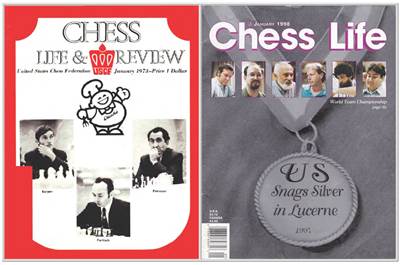
In last month's look at U.S. chess magazines from 50 and 25 years ago, March 1975 & 2000 'On the Cover' (March 2025), we saw a non-American player on the left (GM Robert Huebner) and an American player on the right (George Koltanowski, the 'Dean of American Chess'). This month the pattern continues, with a pair of Soviet players on the left and a quartet of American teams on the right. Was U.S. chess more attentive to international chess 50 years ago?


Left: '?'
Right: 'The Teams! A 30-year Odyssey • Upcoming Scholastic Nationals!'

Chess Life & Review (50 Years Ago)

Winners of the 1974 USSR Championship -- Mikhail Tal (left) and Alexander Belyavsky. See [inside] for the story by Paul Keres. Photos by TASS from Sovfoto.

The story '[inside]' was the 'Keres Annotates...' column, titled 'USSR Championship, Leningrad 1974'. It started,

The USSR chess organization, with its 35 grandmasters, has the ability to put together a very strong group for its national championships. As an example, the 1973 USSR Championship, with all the leading grandmasters competing, was one of the strongest tournaments ever held in the Soviet Union.

With this in mind, the 1974 Championship was probably a little disappointing. Most of the leading grandmasters were unable to take part for various reasons and were replaced by other players, while the number of participants was reduced from 18 to 16. Despite this fact, it was quite interesting to see experienced grandmasters such as Tal, Polugaevsky, Vasiukov and Taimanov fight their younger rivals, many of whom had splendid records in last year's tournament, and to see just how good the young players are in really strong competition.

The tournament was a hard fight from the very first round. One is used to seeing grandmasters like Tal and Polugaevsky leading the field, but this time they did not have it so easy, being severely pressed by Belyavsky, Vaganian, Romanishin, Alburt, Dvoretsky, and other young stars, most of whom are not very well known in international chess. And when we look at the final crosstable, we see that the young players came out very well in this tough test against their experienced "examiners."

It's noteworthy that, besides Keres, the other authors of feature articles in the same issue were Pal Benko, Laszlo Szabo, Lubosh Kavalek, Svetozar Gligoric, and Edmar Mednis. All had roots in Eastern European countries.

Chess Life (25 Years Ago)

Thank you, Ed Edmondson. If you were convinced that an idea was good, you ran with it. And 30 years ago, the idea of an amateur team championship, as presented by Denis Barry, sounded good. No bids, no committee approval. You just filled your station wagon with books and equipment and drove out to the VFW Hall in East Brunswick, New Jersey, and ran a concession for the 17 teams that played in that first event. Your faith and Denis' enthusiasm grew "The Teams" to over 100 teams, playing in Atlantic City.

Ed is gone. Denis is still around, kicking up dust here and there. But they left a legacy and a framework that will last forever. Hire a good staff, put the players first, chess for fun and chess for blood, in equal proportions. Steve Doyle (who celebrated 25 years of being associated with the event) operates within that framework and has built the USATE into a 200+ team event. Friday's snow and ice storm had almost no effect, and more than 920 players took part in the 30th Anniversary of the U.S. Amateur Team Championship (East). Worthy of a cover? You betcha. And a special report in our annual yearbook section.

The related article was 'Turning the Big 3-0 Was Totally Brutal at the U.S. Amateur Team East' by Al Lawrence. The mysterious title referred to the winning team, Total Brutality, a 'three-master team'. The report on the event started,

Over the telephone from St. Louis, my brother Leo was having a hard time with what would take place at the U.S. Amateur Team East Chess Championship. "Team chess," he said, "wouldn't that be like four-man diamond cutting?" After a few forced chuckles, I said "No, it's more like having four brothers backing each other up in a schoolyard scrap." From our old days on South Chicago's playgrounds -- in an era when fights were barehanded and forgotten as soon as the shiner faded -- he understood the point.

As tournament chessplayers, we're normally lone operators. In more jet-age terms, we sit in a room full of would-be top guns whose weekend happiness is a net-sum war game. For every ace exhilarated to see black smoke pouring out of his counterpart's engines, there's a wounded pilot spinning miserably down in flames. Strangers, friends, roommates -- all morph into hoped-for airplane silhouettes painted below the cockpit glass, plusses on the wall chart.

After the one-page introduction to the USATE, the story continued on the first page and across the outer column of the next 12 pages of the '2000 USCF Yearbook - Our Heritage'. A footnote to the story informed,

The U.S. Amateur Team East Championship is one of over 25 national title events co-sponsored by the USCF and participating affiliates. Al Lawrence, president of OutExcel! Corp., is the author of eight books on a variety of subjects.

A common thread united the April editions of the two magazines. Just as with the March 1975 edition of CL&R, Burt Hochberg's April 1975 column 'Editor's Page - News & Views' carried news of the ill-fated 1975 Fischer - Karpov World Championship title match. The April 2000 edition of CL carried opinions on the controversies surrounding the World Championship in 2000: Who was the real World Champion?

03 January 2023

January 1973 & 1998 'On the Cover'

Once again, we change the calendar for the monthly post on American chess from 50 and 25 years ago. For last month's post, see December 1972 & 1997 'On the Cover' (December 2022).


Left: 'Churchie • Karpov, Portisch, Petrosian'
Right: 'World Team Championship; U.S. Snags Silver in Lucerne 1997'

Chess Life & Review (50 Years Ago)

The three winners of Church's Fried Chicken International Tournament, San Antonio 1972: Anatoly Karpov (left), Tigran Petrosian, (right), and Lajos Portisch. The other guy on the cover is a registered trademark of Church's Fried Chicken, Inc. See [inside] for tournament results. Photos by Burt Hochberg.

After introducing the winners, the tournament report inside only listed the final results of the 16 players. The introduction started,

Church's Fried Chicken. Inc. First International Chess Tournament ended December 11 in a triple tie for 1st. Anatoly Karpov, the most promising of the USSR's young grandmasters, won 7 games and lost only one (to Portisch) to add the San Antonio tournament to his recent string of important successes. Veteran former World Champion Petrosian, with 6 wins and no losses, achieved his greatest tournament success in about ten years to tie for top honors. Hungarian GM Portisch, after scoring only 4 1/2 points in the first 8 rounds, scored 6 points in the last 7 rounds to tie with Karpov and Petrosian with 10 1/2 points. Full reports on this significant event will appear in forthcoming issues.

All of the North American players, except Duncan Suttles of Canada in 6th-7th place, finished in the bottom half of the tournament. Played just a few months after the 1972 Fischer - Spassky title match (m-w.com; 'Reykjavik, VII-VIII, 1972'), the 1972 San Antonio tournament will always have a guaranteed place listed among Strong American Chess Tournaments (August 2016).

Despite all the fuss about 1972 Fischer - Spassky, the match did not usher in a golden era of American chess tournaments. The next event on the list of 'Strong American Tournaments' was 1982 Chicago.

The January 1973 CL&R featured interviews of Fischer, Spassky, and Gudmundur Thorarinsson, president of the Icelandic Chess Federation. The issue also included the last four games of the Fischer - Spassky match, annotated by Robert Byrne. Between the two articles was a 'Keres Annotates' column titled 'Two Karpov Wins'. GM Keres, a three-time champion of the USSR who finished 5th at 1972 San Antonio, wrote,

Karpov has a solid grounding in opening play, due partly to his second, Furman, wbo is considered one of the best in this field in the USSR. His general style of play is rather cairn. centered on positional considerations and somehow recalling Capablanca's attitudes towards the game. His technique is reasonable, but of course a player of only 21 still has some things to learn in this area. It seems to me that in five years Karpov will be able to replace any current leading Soviet grandmaster, provided he continues to make normal progress.

We know now that Karpov would become World Champion in 1975, after Fischer declined to defend the title. One positive outcome of the boom for American chess was a new generation of American players attracted to the royal game during the peak interest in Fischer. Their rise to the top of U.S. rating lists was undoubtedly one of the reasons behind the next part of this 'On the Cover' post.

Chess Life (25 Years Ago)

A gold cover would have been much nicer than silver. But silver is better than bronze (see the February 1997 cover). And it would have been a gold cover if not for a miraculous finish by the Russians at the World Team Championship, held in Lucerne, Switzerland. Our team played hard and well, garnering three board prizes along with second place.

GM Larry Christiansen's eight-page tournament report, 'World Team Championship', cast doubts on the legitimacy of the Russian victory. Last year we saw the February 1997 cover in February 1972 & 1997 'On the Cover' (February 2022). There we find the same six players shown on the January 1998 CL cover: GMs Yermolinsky, Benjamin, Gulko, De Firmian, Kaidanov, and Christiansen. The numbers 2, 4, and 6 were all home-grown American talent. The others emigrated from the USSR in the 1980s.

30 December 2022

World Championship Columnists

Back in the mid-1990s, both Garry Kasparov and Anatoly Karpov -- bitter rivals at the time -- wrote separate columns for the USCF's Chess Life (CL). I mentioned Karpov's column in last week's post, Wayback to Chess.net (December 2022).

I've never studied these columns, even though they might contain interesting material for my World Chess Championship site (WCC; see link on the right). Following is a table overviewing the content of both columns.

CL p. Title Notes
Kasparov, Fighting Chess, Chess Life
1993-01     6 Opening innovation see also cover
1993-02 13 Local Searchings KK5, g.11
1993-03 10 Natural Suspicions opening refutation
1993-04 14 Battle with the Viewers Spanish TV Channel 1
1993-05 10 Battle with the Viewers (cont.)
1993-06 12 Battle with the Viewers, Part III
1993-07 16 Battle with the Viewers (concluded)
1993-08 40 The Bloodless Revolution PCA; see also 'Interview with Bob Rice'
1993-09 12 Simuls in My Life
1993-10 14 Simuls in My Life (Part II) 1984 London/New York; 1985 Hamburg
1993-11 18 Simuls in My Life (Part III) 1987 Zurich; 1989 Evry
1993-12 14 Simuls in My Life (Part IV) 1992 Baden-Baden
1994-01 6 Simuls in My Life (Part V) 1992 Buenos Aires
1994-03 12 Looking Back 1993 Kasparov – Short; Opening prep; 1.e4; g.3
1994-04 18 Looking Back, Part II (cont.)
1994-05 12 Looking Back, Part III 1.d4; g.9
1994-06 12 Looking Back, Part IV GK Black; 1.e4 c5; g.2,4
Karpov, Grandmaster Musings, Chess Life
1994-10 42 The Caro-Kann
1994-11 14 Dortmund 1994
1994-12 12 Sanghi-Nagar Semi-finals
1995-01 8 Sanghi-Nagar, Part II
1995-02 12 Opening Survey: Tilburg 1994
1995-03 12 Opening Survey: Tilburg 1994, Part II
1995-04 12 Exploring the Sicilian, Part I Buenos Aires Sicilian Thematic, 1994
1995-05 34 Exploring the Sicilian, Part II (ditto)
1995-06 21 Sanghi-Nagar: The Semi-Finals Good intro; aka Finals [leading to title match]
1995-07 34 Sanghi-Nagar, Part II
1995-09 10 Linares, Part I
1995-10 16 Linares, Part II
1995-11 32 Melody Amber 4th
1996-01 36 Melody Amber, Part II
1996-02 24 Melody Amber, Part III
1996-04 20 Dos Hermanas, Part I “Before we discuss my match with Kamsky...”
1996-05 28 Dos Hermanas, Part II; Groningen, Part I
1996-06 32 Groningen, Part II see note on PCA
1996-07 38 Groningen, Part III
1996-08 26 Groningen, Part IV
1996-10 38 Melody Amber I
1996-11 38 Melody Amber II
1997-01 44 Melody Amber III
1997-02 32 Biel, Part I
1997-03 19 Biel Schachfestival, Part II
1997-05 22 Las Palmas 1996
1997-06 24 Vienna Schachfestival
1997-09 36 Dos Hermanas, 1997
1997-10 38 Dos Hermanas, Part II
1997-11 40 Biel Schachfestival, Part I
1997-12 48 Biel, Part II
1998-01 21 Biel, Part III
1998-04 73 Lausanne, 1998 Karpov - Anand; gms. 1, 2, 7, 8
1998-05 42 A Magical Weekend in Parsippany Henley, Karpov, Krush
1998-06 30 The Teams, Part II (ditto)

The table might be more appropriate incorporated into the WCC site itself, but I can always move it later. In the meantime, I'll use it as the basis for a post or two on my WCC blog.

23 December 2022

Wayback to Chess.net

In the recent post, The SmartChess Saga (December 2022), I highlighted a SmartChess.com press release:-

An earlier press release, titled 'A Press Release by Anatoly Karpov' and dated 18 December 1996, had stated, "Statement by Anatoly Karpov: In the opening paragraphs of my January 1997 "Grandmasters Musings" column (in Chess Life), I briefly mentioned one of my recent involvements in chess on the Internet in which I appeared as a guest of Chess.net, a company of which I recently became a shareholder. [...] I would also like to mention that I am a frequent guest lecturer at the superb Internet Chess Academy (yourmove.com) created by the talented young GM Gabriel Schwartzman. [...]"

What did former World Champion Karpov say exactly? This:-

Before we begin the discussions of the games for this issue, I would like to let my readers know of a significant new development in my chess activities. I am very excited to have become a new owner of Chess.net, the leading site for interactive Internet chess. Chess.net offers interactive play. the opportunity to train with masters and grandmasters. and one of the world's strongest tournament-proven chess engines -- ROboMAN.

I joined Chess.net because I was impressed with the sophistication of the software and technology and excited by the group's com- mitment to chessplayers. The Internet will propel chess to a much higher level of world- wide participation and interest This is a very significant turning point in the history of chess.

Although I am extremely busy. I will still be able to log onto Chess.net for at least two or three hours a week from anywhere in the world. If you don't see me on one of my impromptu visits. check out the Chess News section of our web site at www.chess.net to see when I will he logged on again. Most likely I will be playing blitz games against the 20 or so grandmasters who regularly play there, but I am sure that every so often I will find the time to play a game with a committed club regular, as these are the individuals who make the club successful for all of us. Naturally, I will be broadcasting all of my events on Chess.net, and I hope to see you there.

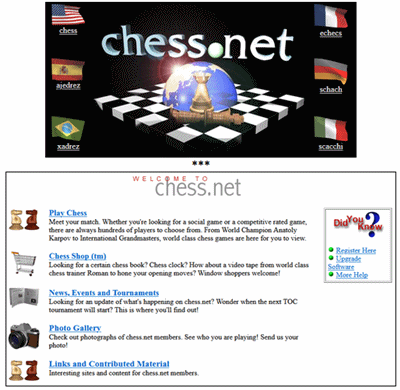
Reading between the lines, we surmise that Karpov was guilty of divided loyalty -- SmartChess.com on one side, Chess.net on the other. Once again, the Wayback Machine on archive.org -> chess.net gives us a top-level glimpse of an early web resource, Chess.net (circa 2000).


Top: Chess.net language selection • Bottom: Home page (English)

That second menu link says,

Chess Shop (tm) • Looking for a certain chess book? Chess clock? How about a video tape from world class chess trainer Roman to hone your opening moves?

Does 'chess trainer Roman' have anything to do with the 'ROboMAN' mentioned by Karpov? I'll try to find out in a follow-up post.

09 December 2022

Shirov's SmartChess Videos

In last week's post, The SmartChess Saga (December 2022), I wrote,

Karpov's active involvement with the [SmartChess] site lasted about six months and was usually documented in an issue's 'Publisher's Message'. At the same time Karpov's participation was decreasing, that of another, younger link to Soviet chess was increasing. The February 1998 issue of SmartChess announced, "Press Release - 26th February 1998: Superstar GM Alexei Shirov signs contract with WWW Chess Superstore to make a series of instructional chess videos!"

I've already featured a couple of Karpov's SmartChess videos on my World Championship Blog, most recently in the post Boris the 10th and Bobby the 11th (December 2022). Here's one of the Shirov videos.

Shirov crushes Karpov: Ultimate Chess Battle - Amber 1998 (King's Indian Defense) (17:22) • '[Published on] Jul 12, 2012'

More accurate would be to say here's half of one of the Shirov videos. The clip is truncated just at the point where Shirov starts to gain an advantage against Karpov.

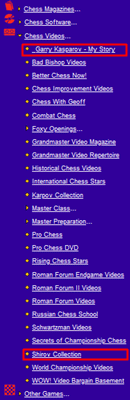
The screen capture on the left shows the categories of 'Chess Videos' listed on the SmartChess Catalog (archive.org -> smartchess.com). The Archive.org page is from 2005, making it one of the last versions of the catalog.
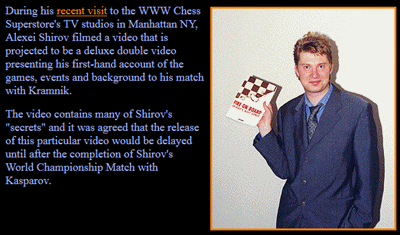
The first in the list is '_Garry Kasparov - My Story' (circled in red). The five titles available there correspond to the titles I listed in two posts -- Garry's Story (September 2011) and Garry's Games (October 2011).

The 'Shirov Collection' (also in red) expands to offer 'Shirov! (Best Endgames Vol.1)' for $33.95, 'Shirov! (Best Games - The Complete Set, Volumes 1-5)' for $139.00 [single volumes also are listed], and 'Shirov! (Shirov - Kramnik 1998)' for $39.95. I once discussed the third title in the list in a post Shirov on Shirov - Kramnik 1998 (January 2012).

Many of the videos featured in those old posts are no longer available on Youtube. They might have migrated to another channel or been removed for copyright infringement. The description on the Shirov video embedded above started,

Karpov begins with 1.d4 and Shirov responds with the double-edged King's Indian Defense. Karpov employs his preferred Fianchetto system and Shirov also goes with his pet line, the Panno Variation with 6...Nc6, 7...a6, 8...Rb8 -- intending to initiate counterplay on the Queenside before White is able to complete development and commence operations in the center.

The description also pointed to Shirov's Best Games and End Games - 6 Volume Set (ichess.net). The page summarizes all six videos in the set, where we learn that the 1998 Karpov game is part of 'Shirov’s Best Games: Volume 5'. Its 'Overview' mentions,

These DVDs were originally released in 1997, 1998 and 2000 for $25.99 each, but you can own the entire 6 discs set in digital form for only $17.95.

We also learn from the page that the videos were 'Originally Produced by Paul Azzurro'. That might be worth additional investigation but I've run out of time for this post.

02 December 2022

The SmartChess Saga

Last week's Friday post, Wayback to Smartchess (November 2022), discussed a trailblazer among chess-on-the-web sites. I noted, 'The first issue of 'SmartChess Online' was dated August 1997 and the last was dated August/September 2003, a total of 45 issues.'

The first item in the August 1997 issue was titled 'Publisher's Message by International Grandmaster Ron Henley'. Largely editorial, it was to become a regular column in future issues, appearing more often than not. In it GM Henley gave his thoughts on topical issues related to chess, to video publishing, and to the internet in general. The first such column started,

Dear Readers: It gives me great pleasure to introduce to you the premier issue of SmartChess Online - a new FREE monthly magazine brought to you by R&D (Chess) Publishing's World Wide Web Chess Superstore.

In 1993, my good friends Anatoly Karpov, Paul Hodges and I set a mission for ourselves. We laid the foundations of a chess resource that would provide the world's chessplayers with a high-quality, one-stop chess educational and shopping experience. To this end, we have worked with people of exceptional and varied talents, resulting in the launch of this all-new version of our popular World Wide Web site.

With this monumental step forward the World Wide Web Chess Superstore clearly establishes itself as the world's leading Internet-based chess retailer. The introduction of this version of our World Wide Web site (which replaces the one that many tens of thousands of visitors have frequented since its inception in 1995), marks only the completion of an intermediate phase of our overall plans for our World Wide Web presence.

That earlier version of SmartChess is presumably lost, having predated the introduction of Archive.org and the Wayback Machine. The Henley column continued,

For your convenience, this new version of our site contains a dynamic, illustrated chess catalog, featuring online shopping capabilities and a powerful catalog search engine. To protect the privacy of our valued customers, transactions on this Web site are safeguarded by the use of state of the art encryption and secure server technology.

In addition to the regular features and guest contributions in SmartChess Online (presented by some of the world's best chessplayers) we will be constantly expanding the frequently visited chess education resources that are archived on our site. In the near future, we will bring you analysis, updates and reports from the most important chess events from around the world.

SmartChess Online will also include interviews of chess stars and penetrating reviews of the many chess products that are now available to the consumer. We will strive to incorporate the latest technological developments available for the dissemination of chess information and instructional material as the World Wide Web Chess Superstore blazes the trail into the Twenty-First Century.

Regards, Ron

The mention of GM Karpov was not accidental. He was one of the magnets intended to draw visitors to the site. An earlier press release, titled 'A Press Release by Anatoly Karpov' and dated 18 December 1996, had stated,

Statement by Anatoly Karpov: In the opening paragraphs of my January 1997 "Grandmasters Musings" column (in Chess Life), I briefly mentioned one of my recent involvements in chess on the Internet in which I appeared as a guest of chess.net, a company of which I recently became a shareholder. Elsewhere [in that issue of CL], FM David Gertler reported on my recent "Internet Match" sponsored by PT Finland. I would also like to mention that I am a frequent guest lecturer at the superb Internet Chess Academy (www.yourmove.com) created by the talented young GM Gabriel Schwartzman.

However, I would like to take a brief aside to clarify my primary "business status" on the Internet with my fellow Chess Life readers. I am on the Board of Directors and part owner of R&D (Chess) Publishing and its subsidiary the World Wide Web Chess Superstore - a chess retailer and chess publisher with a strong Web presence, that serves customers in (currently) 57 countries. I have had a long and mutually rewarding relationship with R&D (Chess) Publishing which is based in New Jersey. Its President is Chess Life columnist GM Ron Henley - my good friend and chief trainer.

Our Web site at www.smartchess.com is in fact my one and only Official Home Page, and this company also acts as my only official agent in the USA regarding chess publishing matters. Any inference otherwise can be considered inaccurate. I have not revealed my association with the World Wide Web Chess Superstore before in my Chess Life column, as my fellow Directors and I considered this to be an inappropriate forum for the dissemination of this information. Although I am heavily in favor of promoting our wonderful sport and interacting with chess enthusiasts all across the world via the Internet, I felt it necessary to dispel any possible misconceptions about my primary "Internet chess persona."

Transmitted to GM Ron Henley by Anatoly Karpov and posted by GM Ron Henley and submitted to Chess Life.

[signed] GM Anatoly Karpov, GM Ron Henley

Karpov's active involvement with the site lasted about six months and was usually documented in an issue's 'Publisher's Message'. At the same time Karpov's participation was decreasing, that of another, younger link to Soviet chess was increasing. The February 1998 issue of SmartChess announced,

Press Release - 26th February 1998: Superstar GM Alexei Shirov signs contract with WWW Chess Superstore to make a series of instructional chess videos!

The World Wide Web Chess Superstore is pleased to announce that the Latvian-born Spanish GM Alexei Shirov has signed a contract that will bring him to the United States in June 1998 in order to film a series of instructional chess videos hosted by GM Ron Henley.

The twenty-five year old Shirov is rated 2710 ELO on the January 1998 Rating List and is ranked at #8 in the World. Shirov - a brilliant tactician - is famous for his dynamic, sharp and imaginative style of play, and has built a substantial fan base for himself in online chess play. [...]

The May-June 1998 issue of SmartChess included the following promotional material.

The same issue of SmartChess announced that Shirov had beaten Kramnik, thereby earning him the chance to play Kasparov for glory and big bucks. For more about that match, see my page World Chess Championship : 1998-99 World Chess Council and more (m-w.com); 'Kasparov seeks a title match', 'The World Chess Council', 'Shirov beats Kramnik', etc. The SmartChess partnership with Shirov was eventually limited to a series of his videos.

Henley's last 'Publisher's Message' appeared in the May/June 2001 issue of SmartChess. In it he mentioned,

Over the years many people have approached me about giving them private lessons. For the most part I have resisted, due primarily to lack of time. However, helping others to improve, understand and appreciate chess is something I thoroughly enjoy doing. As my life has now become more organized and focused, I now have TIME to teach a strictly limited number of private students.

Another article, appearing in the same issue, said,

International Grandmaster Ron Henley Available for Private Chess Lessons • MY CURRENT CLASS OF STUDENTS IS COMPLETE • Available (Manhattan, NY Only) for private lessons • Fee $100 per hour (2 hour minimum) [...]

It was to be Henley's final involvement with SmartChess Online. The site continued with less interesting material and updates ceased two years later. The final issues had little content.

Many editions of GM Henley's 'Publisher's Message' discussed his efforts to make a success of both SmartChess and its associated 'WWW Chess Superstore'. Its fate mirrored that of many early web sites in other sectors: so much promise, so much hope, so little to finally show for it.

[This post is only an outline setting a few chronological boundaries. There is much more to the story, in particular the progress of teenage Irina Krush and, later, pre-teen Hikaru Nakamura.]

09 September 2022

Fischer - Spassky Zeitgeist

Last week's post in the Fischer Friday series, Benson Called Bobby (September 2022), was about the 21st and final game of the 1972 Fischer - Spassky Match (m-w.com):-

Brad Darrach described the transition from the 10th World Champion to the 11th in his usual colorful style.

A more straightforward account of the end of the match can be found in the book I introduced in an earlier post, GM Svetozar Gligoric, Player/Journalist (August 2022):-

Gligoric's book 'Fischer v Spassky: The Chess Match of the Century' (Fontana, 1972), contains good accounts of the off-board happenings between games.

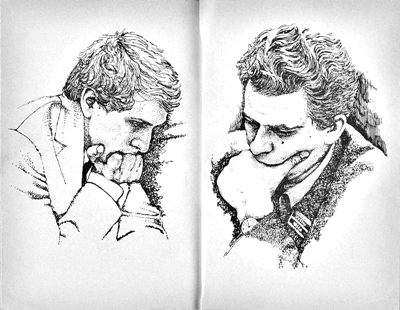
The only artwork in the book consists of two uncaptioned, unattributed sketches of the pensive chess warriors inserted after the historic 21st game.


Left: Robert Fischer • Right: Boris Spassky

The artwork is followed by two pages summarizing the zeitgeist of the match. Titled, 'In Retrospect', it starts,

Among the world champions since the war, Boris Spassky has distinguished himself. During a relatively short period of five years he came victorious out of personal duels with a most exquisite group of contemporary grandmasters -- Keres, Geller, Tal, Larsen, Korchnoi and Petrosian. No other world champion could boast such an impressive list of triumphs in matches.

At the same time, Robert Fischer was growing alongside him into another chess giant who, with his general results and high percentages, outclassed the achievements not only of his contemporaries, but of any individual in the whole history of world chess.

Years had to go by, and many difficulties had to be overcome, until the match between these two players in their prime became reality, the match which every chess enthusiast considered as the most wishful chess event of our century. By happy coincidence -- after a quarter of a century of supremacy by one country -- it was also the first clash at the top in the spirit of healthy sporting rivalry between the best representatives of two different parts of the world.

All that gives a clue to the unexpected chess fever which overwhelmed continents during those two months in Reykjavik. The match opened a new, unforeseen chapter in the history of this noble game, which has existed modestly for more than one thousand years, only now to be discovered, by a good part of mankind as the best game ever invented by the human mind.

The last page in the book has a single paragraph:-

The American grandmaster Robert Byrne played in the very strong Alekhine Memorial Tournament in Moscow in November / December 1971. He was asked for his opinion on the result of the Fischer-Spassky match and was widely quoted in the Soviet press as follows:-

"Fischer will win by 12 1/2 to 8 1/2 and will be World Champion for the next twelve years!"

GM Byrne's prediction about the final score was right on the mark. Who could have known that his prediction about the length of Fischer's reign was far-fetched fantasy?

29 July 2022

Spassky's Team

The previous post in this Fischer Friday series, 'Only an IM' (July 2022), was about IM {Jivo / Iivo / Ivo} Nei. I neglected to mention that he co-authored a book about the match: Both Sides of the Chessboard (books.google.com; 'An Analysis of the Fischer/Spassky Chess Match'; Quadrangle 1974) by Robert Byrne and Iwo Nei. [NB: Add 'Iwo' to the variants for spelling Nei's first name.]

Although that Google page says, 'No eBook available', there is a digital copy at Both Sides of the Chessboard (archive.org). It is offered with 'Free Download, Borrow, and Streaming'. One of the 15 photos in the book is shown below.

The caption said,

The Russian contingent leaves a press conference at the Loftleidir Hotel on July 1st after hearing of Fischer's delay in arriving in Iceland. (l. to r., Ivo Nei, Boris Spassky, Nikolai Krogius, Efim Geller).

GM Krogius died earlier this month. For an obituary, see Nikolai Krogius (1930-2022; fide.com).

I've referenced the book 'Russians Versus Fischer' by Plisetsky and Voronkov, several times on this blog, often for the 1972 Fischer - Spassky Match. See, for example, The 'Clear Head' Theory (October 2009), concerning Karpov's participation in the preparations for the match. Toward the end of the book is a section titled 'Sports Committee Post Mortem' by Yuri Averbakh. It starts,

Shortly after the Spassky v Fischer match a meeting was held at the USSR Sports Committee to discuss its results. It was attended by Spassky, his coaches Geller and Krogius, and some top chessplayers including Tal, Petrosyan [Petrosian], Boleslavsky, Kotov, and Korchnoi.

Also invited were members of the Presidium of the Soviet Chess Federation, FIDE Vice-President B. Rodionov, Chairman of the RSFSR Chess Federation V. Boikov, and Chairman of the Leningrad Chess Federation A. Tupikin.

The meeting was chaired by V. Ivonin, Deputy Chairman of the Sports Committee with special responsibility for chess. I have kept the notes I made during that meeting as the then Chairman of the Federation.

Given that the meeting was a classic exercise in corporate style finger pointing, Nei, who was not present, was not spared. For example:-

Geller: 'The delegation's composition was also ill-considered. Spassky had no idea what it should be like. Nei, for example, mainly performed the functions of a fitness coach. We suspect that information leakage occurred during the match.'

Spassky: 'My first concern was to improve my health. Nei proved to be very helpful in that. But we clearly missed a manager: organizational matters took up a lot of our energy. [...] Mistakes had been made in the selection of the delegation. This is my fault. We had no leader, we shouldn't have taken along Nei and I should have taken my wife instead.'

From this we learn that Nei was expected to serve as a team manager. As for 'leakage', this is not about the book with GM Byrne, which was published two years later. A discussion of the book or of Nei's role in its writing goes beyond the scope of this current post. He wrote the introductions to the games and supplied other valuable annotations, but did not divulge any secrets.

***

Fifty years ago today, our two intrepid cold warriors had time off between games eight and nine. The score was 5-3 (+4-2=2) in Fischer's favor.

22 July 2022

'Only an IM'

Last week's Fischer Friday post, Drawing for Colors in 1972 (July 2022), centered on an event two days after Fischer arrived in Iceland. Let's rewind the clock to two days before he arrived.

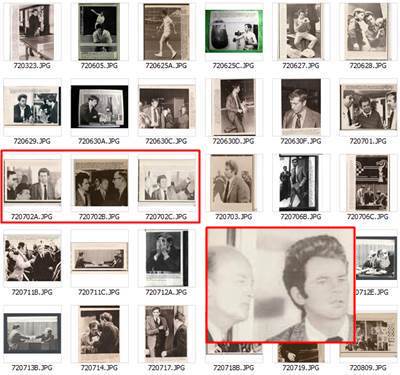
The photo below is adapted from Fischer Wirephotos I (March 2016). I've highlighted in red three consecutive wirephotos that all show Spassky with the same man. Who was he?

The larger photo highlighted in red is a cropped version of the third wirephoto. Its caption explained,

(NY4) REYKJAVIK, Iceland, July 2 -- SO FAR STILL CHAMPION -- Boris Spassky of Russia, present World Chess Champion, holds thumb up outside his hotel in Reykjavik, Sunday. Challenger Bobby Fischer of the United States has so far failed to arrive in the Icelandic capital for the championship match that had been scheduled to start Sunday. Officials gave Fischer until Tueday at noon to show up or else risk forfeit. At left is Jivo Nei, a Soviet chess master. (AP Wirephoto via cable from Reykjavik) (See AP AAA Wire Story) (lsk12300pw) 1972 (REY2)

'Jivo Nei, a Soviet chess master' is better known as Iivo [or Ivo] Nei. He has a Wikipedia page, Iivo Nei. It starts,

Iivo Nei (born 31 October 1931 in Tartu) is an Estonian chess master.

The first comment on his Chessgames.com page, Iivo Nei, speculates on his role in Spassky's team:-

He wasn't there for his chess talent -- he was only an IM -- and instead was there for his talent with a tennis racket. He was Spassky's "physical trainer".

Only an IM? The first of the historical rating files in my database -- see FIDE Historical Ratings 1971-74, on my World Championship blog (January 2008), for links -- lists players' titles along with their ratings. Of the 592 players on the first list, 83 were GMs and 178 were IMs. Fifty years ago, the strongest IMs were among the top-100 players in the world.

My recent post, According to Darrach, Day by Day (July 2022), gave a chronology covering the first half of July 1972. For the day of the captioned wirephoto, the chronology says,

Sun, 02 Jul • Scheduled match start, Iceland; Euwe postpones 1st game for two days • p.092

That chronology stopped at the third game, played 16 July 1972. [NB: later changed to the fourth game, the first game that was not overshadowed by off-board antics.] The date of this post, 22 July, was the off-day before the dramatic sixth game, when the match was tied at 2-1/2 points for both players.

***

Later: Re 'Fifty years ago, the strongest IMs were among the top-100 players in the world', On the first FIDE rating list in 1971, Fischer was no.1 at 2760, Spassky no.2 at 2690. IM Iivo Nei was no.82 at 2495. A group of six players, five IMs and one untitled, was tied for no.100 at 2480.

01 July 2022

According to Darrach, Day by Day

Today marks the 50th anniversary of the Fischer - Spassky Title Match; Reykjavik, VII-VIII, 1972, sometimes called 'The Chess Match of the Century'. It's not just a coincidence that it happens to be the next Fischer Friday post; I've been planning for it since the series started.

The previous post in the series was Hatchet Job (June 2022). There I theorized,

[Brad] Darrach apparently took the notes from his 'hundreds of interviews that took up hundreds of hours', storyboarded them in chronological order, and constructed dialog based on the words of his interviewees

This lets us build a day-by-day chronology of the events leading up to the start of the match. This should be confirmed by the site I referenced in Bobby Fischer Day by Day (May 2022).

When? What? Where?
(Darrach)
Thu, 08 Jun Tennis tournament San Diego p.011
Sun, 25 Jun RJF scheduled to fly to Iceland p.012
Mon, 26 Jun 'Spies on the line' (A) p.012
Tue, 27 Jun RJF flies LA to JFK w/ Saidy; goes to Yale Club p.015
Wed, 28 Jun Yale Club; RJF meets Fox & Stein re film [p.019] p.015
Thu, 29 Jun Yale Club; RJF goes to JFK for night flight; flees JFK to Saidy's parents' home [p.046] p.035
Fri, 30 Jun RJF Sabbath (sundown to sundown)
Sat, 01 Jul Opening ceremony, Iceland p.081
Sun, 02 Jul Scheduled match start, Iceland; Euwe postpones 1st game for two days p.092
Mon, 03 Jul Slater offer; Kissinger call; RJF flies to Iceland p.101
Tue, 04 Jul RJF arrives Iceland; 1200 draw for colors - RJF sends Lombardy - Soviets demand apology p.117
Wed, 05 Jul Photos for Life; 1800 Soviet press conference, demand apology; RJF dictates letter [p.146] p.132
Thu, 06 Jul Draw for colors; RJF moves to hotel [p.156] p.150
Fri, 07 Jul Photos for Life; 2200 swimming pool p.158
Mon, 10 Jul 0100(!) RJF inspects playing hall w/ Cramer, Thorarinsson, Fox; 0400 RJF considers firing Cramer p.159
Tue, 11 Jul Game 1; RJF arrives 7 minutes late; camera noise; 29...Bxh2 [p.172]; adjourned p.164
Wed, 12 Jul Adjournment resumption; cameras a problem p.178
Thu, 13 Jul Game 2; forfeit p.183
Fri, 14 Jul 1000 Match committee upholds forfeit p.193
Sat, 15 Jul 1800 (?; 0600) Marshall arrives Iceland p.197
Sun, 16 Jul 0600 RJF plans to leave Iceland; 1500 RJF agrees to play in back room; Spassky also agrees; 1700 Game 3; Fischer beats Spassky for the first time ever p.199,203
Tue, 18 Jul Game 4; the players return to the main hall; the match proceeds normally p.213

(A) 'They Got Spies on the Line!' (April 2016)

This chronology also helps make more sense out of Fischer Wirephotos I (March 2016), and Fischer Wirephotos II (ditto). In 'Wirephotos I' I remarked,

My favorite photos are the third through fifth in the second row. They were taken on the night of 29th June, a period covered in Darrach's second chapter ('A Night at the Airport', see 'Real Bobby Fischer' for background). Frank Brady's 'Profile of a Prodigy' (Dover 1973) covered the same hours in a single, long paragraph (p.225).

The photo shown below is a larger version of one of those favorite photos. It was shown in the 2nd row, 5th photo from left.

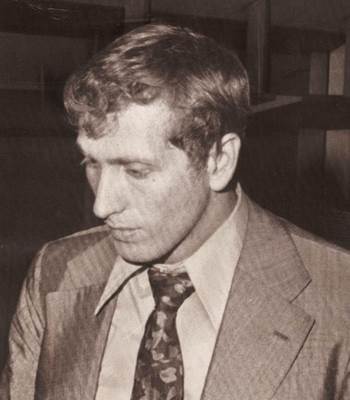
The original AP caption said,

(JFK2) NEW YORK, June 30 -- SERIOUS FISCHER -- A serious-faced Bobby Fischer is shown in a Kennedy Airport coffee shop about midnight, Thursday, as he apparently was preparing to fly to Iceland for his World Championship chess series with Russian champion Boris Spassky. Seconds later Fischer broke away from the group of photographers and reporters and raced out into a driving rain. (AP wirephoto) (jsb60100stf) 1972

The chronology in the table is a short version of the events. For a longer version, see Why The Match Of The Century Almost Didn't Happen (chess.com; PeterDoggers); 'According to Life reporter Brad Darrach, who collected his articles into the brilliant book Bobby Fischer vs. the Rest of the World...'

25 July 2021

Historical Chess Sets

You might think that chess sets would be an important component in The Sociology of Chess (November 2016), but the facts say otherwise. I scrolled through the relevant posts from last few years of this blog and could't find a single example.


Gulag chess set (1:00) • '[Published on] Jun 27, 2021'

The description of the video said only,

Series of videos about the CFR Chess Museum's exhibits.

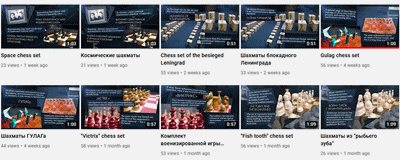
The acronym CFR stands for 'Chess Federation of Russia' and we find related videos on the YouTube channel, CFR Chess Federation of Russia. A snippet of that is shown here:-

The relevant videos are duplicated -- once with Russian text, once with English text -- and the English language Gulag clip is shown in the last thumbnail in the top row. The five videos shown are:-

  • Space chess set
  • Chess set of the besieged Leningrad
  • Gulag chess set
  • "Victrix" chess set
  • "Fish tooth" chess set

There are more after these, all lasting about a minute. Why were these sets chosen? The title page of the Gulag video says,

A special page of chess history belongs to chess sets made in prisons and camps, the Gulag institutions among them.

My guess is that the sets were chosen because of their importance to chess history. Russian chess history alone would be reason enough.

20 October 2020

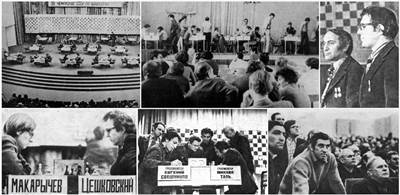
Soviet Era Chess Photos

For the previous post featuring a Flickr photo, Keres' Last Move, I went with the photo that offered the best story. On my short list there was another series of photos, shown in the composite below, that risked offering too many stories.


Photo top left: 1971 USSR Chess Championship © Flickr user Boris Galatiknova under Creative Commons.

That composite shows all but one of the photos that were available at that time from that Flickr user, indicating that the Flickr page is for a new user. Since then, several more photos have been added. Is this the start of a major new source of Soviet era chess photos? Time will tell.

For more about the event in the linked photo, see 1971 USSR Chess Championship (wikipedia.org). It starts,

The 1971 Soviet Chess Championship, held from 15 September to 18 October 1971 in Leningrad, was the 39th edition of the USSR Chess Championship. The tournament was won by Vladimir Savon, [a] little-known International Master.

The other thumbnails in the composite photo are from different years, events, and settings. Two of them show GM Mikhail Tal.

***

Later: The individual photo linked under my composite is one of the photos used on the Wikipedia page. Both photos have the same width and height. Coincidence?

***

Even later: No, it's not a coincidence. Another Wikipedia page, 1985 USSR Chess Championship (wikipedia.org), uses another photo from the Boris Galatiknova collection on Flickr, 52nd USSR Chess Championship 1985 (flickr.com). The previous photo, '1971 USSR Chess Championship', and this photo, '1985 USSR Chess Championship', were both uploaded to Wikipedia by the same Wikipedia user, Scoopbh. As far as I know, Soviet era photos are not covered by international copyright laws, so this activity is perfectly legitimate. What is the source of these scanned photos?

18 October 2020

Keres' Last Move

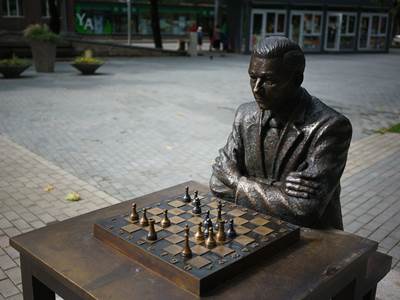
The title of this Flickr photo said only 'Chess player', so I used the photo's description as its title. This reminded me of Two More Chess Statue/Sculptures (October 2016), where I wrote that I was 'always on the lookout for chess statues (aka sculptures)'.


A sculpture of a chess player in Narva © Flickr user Aigred under Creative Commons.

A semi-official page, Statue of Paul Keres, Estonia (visitestonia.com), settles on the word 'statue' and informs,

The statue was installed for the 100th birthday of Paul Keres [...] The statue depicts the game between Keres and Walter Browne in Vancouver in 1975. It mistakenly shows Keres playing with White pieces.

Narva is the town of Keres' birth. Another page, A Chess master from Narva - Picture of Monument to Paul Keres, Narva (tripadvisor.com), calls the work a 'monument' and offers another half-dozen photos including one of a memorial plaque that says,

This chessboard depicts the Grandmaster's last game.

Was it the last position of the last game? The page Walter Shawn Browne vs Paul Keres, 1975 (chessgames.com), gives one more move before White resigns. A comment on the same page says,

The monument to Paul Keres in Narva, Estonia, depicts the position after move 43...Rd1+. The last move of his career.

In another Flickr post featuring Keres, The Last Flickr Friday (May 2018, Flickr tag: Tallinn), I wrote, '[The photo] appears to be an exterior wall plaque, perhaps on the house where Keres lived.' The Keres bio on Chessgames.com says,

Paul Keres was born in Narva, Estonia, where he would reside his entire life.

Paul Keres, 1916-1975.

22 August 2019

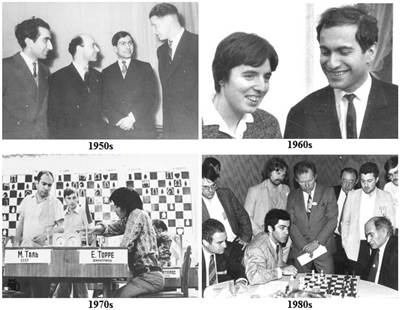
Tal with Other Players

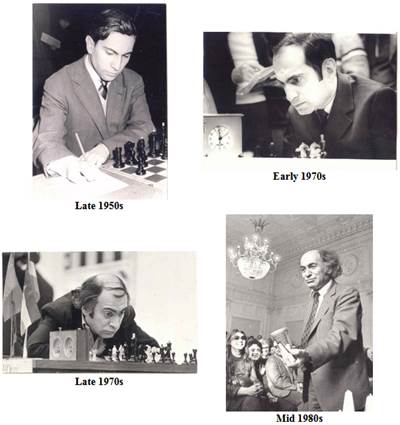
After posting Four Faces of Tal a few weeks ago, I had so many photos left over that I decided to create another composite image before moving on.

I needed help to identify the man standing in the middle of the photo on the bottom right. The photo's description said that he is Alexander Nikitin, Kasparov's trainer.

08 August 2019

26 May 2019

Books on Soviet Chess History

I couldn't find an appropriate video for this month's edition of The Sociology of Chess (November 2016), but I had a good backup idea. While I was preparing last week's post Chess Obsessed II ('The phrase "chess obsessed" once referred to an entire nation.'), I discovered a post on the English Chess Forum, Books on Soviet Chess (ecforum.org.uk; June 2013):-

Could someone personally recommend a publication on the history of Soviet Chess?

Along with literary luminaries like Leonard Barden, Tim Harding, and Richard James, forum members suggested about a dozen titles. I assembled the following list:-

  • Averbakh, 'Centre-Stage and Behind the Scenes'
  • Cafferty & Taimanov, 'Soviet Chess'
  • Eales, 'Chess: 'The History Of A Game'
  • Johnston, 'White King and Red Queen'
  • Kotov & Yudovich, 'The Soviet School of Chess'
  • Linder, 'Chess in Old Russia'
  • Richards, 'Soviet Chess'
  • Soltis, 'Soviet Chess 1917-1991'
  • Sosonko, 'Russian Silhouettes'
  • Spanier, 'Total Chess'
  • Wade, 'Soviet Chess'

More accurately, there are 11 titles on the list, of which I have all but three. A title that wasn't on the list, because it was published in September 2013, is:-

  • Hudson, 'Storming Fortresses: A Political History Of Chess In The Soviet Union, 1917-1948'

It's available as a PDF from a number of sources, and lately I've been reading it to expand my knowledge of Soviet chess history. Its abstract starts,

From the end of the Second World War through the demise of USSR, Soviet chess players dominated world chess. Not only did they control the world champion title after 1948 (except for the Fischer interlude), they also monopolized all other areas of international chess competition. When the Soviets captured the world title in 1948, this was the culmination of a long, carefully cultivated program to foster a chess community in the Soviet Union. The rationale for this initiative, which engaged the attention of the highest levels of the Soviet state, had deep ideological roots.

This dissertation explores the social/political history of chess in the Soviet Union, particularly its utility to Party and State. The story of Soviet chess begins in the Civil War, when chess was enlisted as a training tool for military recruits. After the Bolshevik victory, a very similar rationale was used to promote chess as an instrument for training Party cadre in the burgeoning Communist Party. The same attributes desired in soldiers were also desired in Party activists, and chess was seen as a tool for nurturing these attributes.

Out of curiosity I ran a search on the general subject and came up with the following.


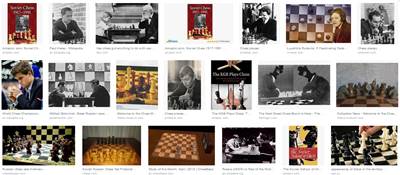
Google image search on 'chess historians soviet'
[Call the rows 'A' to 'C' (from top to bottom) and number the images in each row '1' to '7' (from left to right).]

In the middle of that screen capture ('B5') is another title that deserves to be on the list:-

  • Gulko, Popov, Felshtinsky, & Korchnoi, 'The KGB Plays Chess: The Soviet Secret Police and the Fight for the World Chess Crown'

Since I've read that one as well, I'll spend some time to locate the three other titles that I haven't read.

23 May 2019

Chess Obsessed II

What rhymes with chess? Bless, dress, guess, mess, press, stress -- Yes! Bless this mess? Those are one syllable words. There are even more two syllable words that rhyme, but the word that interests me for this post is 'obsess', as in last week's Chess Obsessed. The motivation for that post was simple:-

I found a half-dozen recent eBay photos from roughly the same period as the item in the 'Hyde' post, couldn't decide which I liked best, and chose the one that I knew most about.

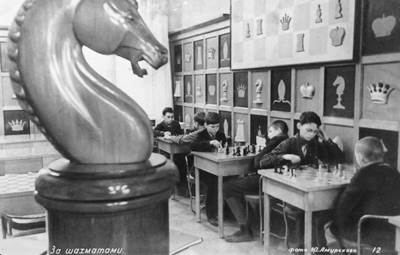
For this post I chose another photo from the same batch, this time on a subject that I would like to know more about.

The description said,

Russia USSR real photo card 1960s Soviet chess club. Boys pioneers. Photo card by Amursky, 1960s. Size 14.5 * 9.7 cm

What would I like to know more about? Chess in the Soviet Pioneer clubs. I started with a reliable source about which I blogged ten years ago:-

Although the word 'Pioneers' doesn't appear in the index of 'Soviet Chess', the phrase 'junior chess' does, and chapter five is titled 'Chess among Women and Juniors'. First, a digression : the relevant passage on junior chess (p.59-60) is immediately preceded by an important fact about Soviet women's chess that is worth keeping in mind:-

From 1938, although republic and city championships continued as before, championships of the U.S.S.R. for women were dropped from the calendar as it was hoped that women would compete in the men's championship. This policy proved misguided, however, as the difference in standard between the sexes was too great, and after the end of the Second World War separate championships for women were again instituted.

Back to junior chess, the chapter continues:-

During the [1930s] the number of schoolboys enrolled in the chess organization increased enormously. In the previous decade, although isolated clubs, most notably in Leningrad, and a few senior players had taken an interest in the younger generation, the general attitude towards enrolling juniors in the chess movement was far from favourable. Later, however, chess clubs were started at Pioneer Houses and often in schools. (The game was never taught as part of the school curriculum.) This work took such rapid root that almost 100,000 school-children competed in the qualifying tournaments for the All-Union junior championships of 1934 and 1936.

Many present-day Soviet grandmasters received instruction in the chess clubs of Pioneer Houses, which remain still the chief centres for junior chess today. Smyslov and Averbakh, for example, were taught at the Pioneer House in Moscow, Taimanov and Spassky in the Leningrad Pioneer House and Bronstein at a similar institution in Kiev. Petrosyan and Nona Gaprindashvili both learnt the game in the Tbilisi Pioneer groups.

One of the dangers facing Western masters visiting the Soviet Union since the mid thirties has been a simultaneous display against Russian schoolboys. The first foreign masters to experience their strength were Lasker, Spielmann and Liliental at the time of the 1935 Moscow tournament, but the most striking result, from the schoolboys' point of view, was a display given in 1951 by the English master Wade, who against thirty Moscow young pioneers scored ten draws and twenty losses.

Poor Bob Wade -- he scored +0-20=10 in a simul against children. The phrase 'chess obsessed' once referred to an entire nation.

14 May 2019

Moscow Panoramas

Just like a few months ago in Postcards from 1935 Moscow (January 2019)...

I'm swamped with other projects and have no time for a post requiring any significant amount of work.

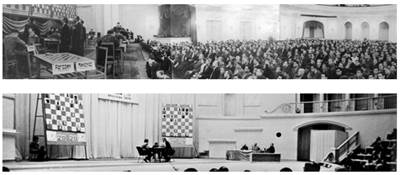
...so let's have some more photos 'Spotted on eBay'.


Top: 12th Soviet Chess Championship, Moscow, IX-X, 1940. For another photo on this blog from the same source, see The 12th Soviet Championship (September 2017)
Bottom: Final candidates match, Moscow, IX-XI, 1974, 1973-75 Candidates Matches (m-w.com)

The top photo 'consists of four photos glued together'. The bottom photo is a single panoramic view.

15 January 2019

Postcards from 1935 Moscow

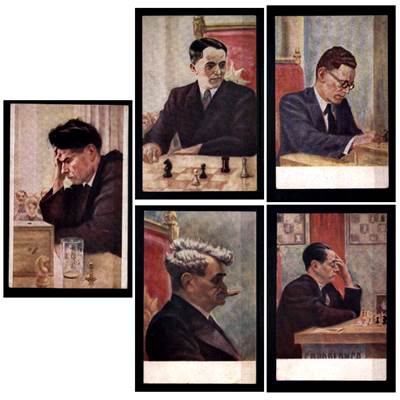
I'm swamped with other projects and have no time for a post requiring any significant amount of work. I spotted a set of five postcards on eBay, some of which I had seen before individually. What caught my attention was additional information about the cards, for example:-

Ultra Rare Vintage USSR postcard 1925s Edit MOOSH Emanuel Lasker CHESS Mikhailov

USSR; 1925s; Size: 14.8 x 10 cm; Circulation: 20 000; Artist: Mikhailov

Unfortunately, the scans were not very good, but when I checked my archive I found the same set of five cards from 2006. Those scans were much better.


Left: Riumin
Others: Flohr, Botvinnik, Lasker, Capablanca

The back of the Riumin card said (in Russian), 'Riumin,N.N.; Artist: Mikhailov,V.V.', gave some additional info about the card's origin, and confirmed the circulation ('tirage'). The cryptic word 'MOOSH' in the description is a direct transliteration of the Russian word 'MOCCX', but I have no idea what it means.

As for the date, which is not indicated on the card, it must be from the Moscow 1935 chess tournament (wikipedia.org). The four players I've indicated in the caption as 'Others' finished in the first four places, with Flohr and Botvinnik tied for 1st/2nd. Riumin finished further down in the crosstable with an even score.

Are there similar cards for any of the other 15 players who participated in the event? I'll add a note if I find any.