Showing posts with label FIDE. Show all posts

06 February 2025

New Players under the FIDE Flag

A couple of weeks ago, I posted this blog's annual discussion of international ratings, FIDE Rating List - January 2025 (January 2025). I ended it saying,

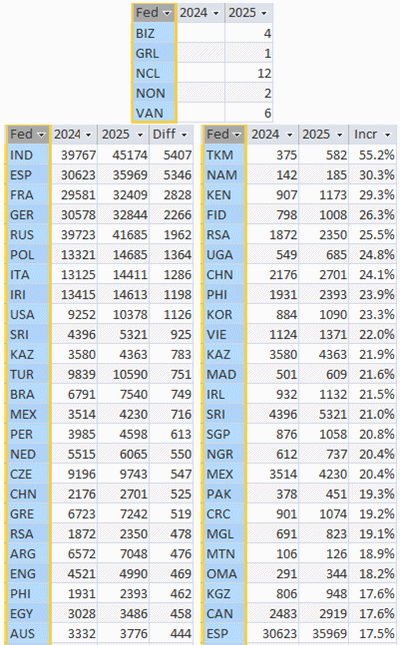
Last year's only followup post, Players under the FIDE Flag (January 2024), might be worth a revisit because FIDE's (FED = 'FID') percentage increase was the fourth highest [2025 over 2024].

Here are the numbers for FIDE again:-

Fed 2024 2025 Incr
FID   798 1008 26.32%

That means the list had 210 more 'FIDE' players (i.e. listed without a national federation) at the start of 2025 than at the start of 2024. The 2024 FIDE Flag post (*) also listed the total number of FIDE players for each of the last five years. Here's a continuation of the same list, adding the count for 2025:-

2023 : 394
2024 : 636
2025 : 766

Why the difference between 1008 players in the first table and 766 players in the second? It's probably because I eliminated players registered only to play on the FIDE Online Arena (FOA). I don't think it was a good idea for FIDE to mix online players with OTB players, but that decision was made some time ago.

Of those 766 FIDE players in 2025, 130 appear to be new FIDE players (766 - 636 in 2024). When I searched for the *names* of new FIDE players in 2025, I found 124. The difference of six players isn't trivial, but I decided to ignore it for now. The 124 new FIDE players in 2025 were listed under the following federations in 2024:-

Fed : Ct
RUS : 114
BLR : 8
FID : 1 [family name changed for a woman; marriage?]
WLS : 1

The table shows clearly that that most of the new FIDE players were from the two federations -- Russia and Belarus -- which have been restricted by FIDE as a consequence of the war in Ukraine. I looked at the rating records of a handful of those players (ratings.fide.com) and discovered that their games were played in Russia and Belarus.

Of the more than 40.000 players on the 2025 list marked with federation RUS or BLR, about 2% also played games in the period covered by the rating list that I used. I don't know why some players are marked 'FID', but most players aren't. Maybe it has something to do with FOA.

(*) Players under the FIDE Flag (January 2024)

23 January 2025

FIDE Rating List - January 2025

This is the tenth consecutive year that I'm following a cookie-cutter approach to look at FIDE ratings for the new year. Following is the step-by-step checklist...

1) Identify last year's post: FIDE Rating List - January 2024 (January 2024).

2) Identify the source of the FIDE data: FIDE Ratings Download:-

STANDARD
TXT format (12 Jan 2025, Sz: 10.81 MB)

3) Compare some basic counts over the past few years. Going back to the start of 2020 gives pre-covid 19 as a reference point. This year I've added counts to show the increase (and one decrease) in the total and inactive counts.

2025: >486K players; >292K marked inactive [+46K +27K]
2024: >440K players; >265K marked inactive [+35K +12K]
2023: >405K players; >253K marked inactive [+28K +25K]
2022: >377K players; >228K marked inactive [+15K +54K]
2021: >362K players; >174K marked inactive [+8K -7K]
2020: >354K players; >181K marked inactive
[...]

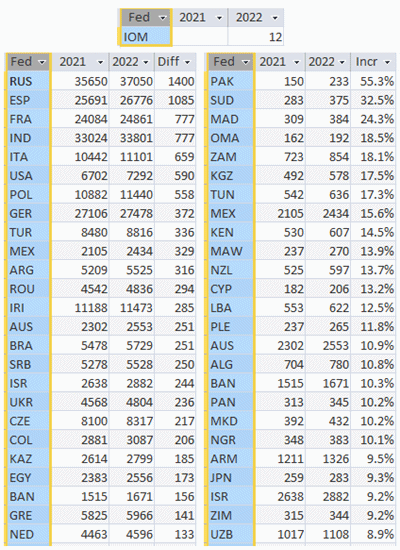
4) Analyze changes in players per federation. The top chart lists new federations in 2025 (BIZ = Belize; GRL = Greenland; NCL = New Caledonia; NON = Gareyev, Timur and Ramirez, Alejandro; VAN = Vanuatu).

The lower charts show federations with the largest increase in number of players (left) and the largest percentage increase (right; for federations with at least 100 players at the start of 2024; NB: TKM = Turkmenistan, NAM = Namibia)

5) Identify ideas for a followup post. Last year's only followup post, Players under the FIDE Flag (January 2024), might be worth a revisit because FIDE's (FED = 'FID') percentage increase was the fourth highest on the right column. Another idea would be to summarize all of the posts I've done through the years on different rating topics. That might be a long list, but I've lost track.

18 January 2024

Players under the FIDE Flag

In a recent post, FIDE Rating List - January 2024 (January 2024), I wondered where to go next with the data. I decided,

One idea is to look at the doubling of players under the FIDE flag ('FID'). To get started, here are counts of 'FID' players for the past five years:-

2020 : 252
2021 : 254
2022 : 263
2023 : 527
2024 : 798

Those numbers total 2094 players, of which 507 were rated 2000 or above. Of course, some of those players were listed as 'FID' for all five years, but I'll come back to that a bit later.

The key to detecting federation transfers is the FIDE ID, a unique code given to all chess players tracked by FIDE. A few years ago, I documented these codes on a page titled FIDE Country and Federation Codes - 'unofficial' (m-w.com; 'Last updated 2015-03-02'). The FIDE ID is shown in the last column of the table on that page. At the bottom of the page are references to blog posts that documented the creation of the page.

Each federation assigns codes to new players using the federation's FIDE ID as the first two or three digits of the player's unique FIDE ID, which is typically seven or eight digits. That means the player's last five digits are assigned autonomously by the federation, perhaps disconnected from any central FIDE database.

When I worked out the codes for the various federations in 2015, there were no FIDE IDs longer than eight digits. Now there are many codes with nine digits. It appears that FIDE assigns those codes when a new player -- previously unknown to FIDE and having no federation -- starts playing on the FIDE Online Arena (FOA). I eliminated 'FID' players with nine digit codes from the total of 2094 'FID' players counted earlier and arrived at new counts for the five years:-

2020 : 164
2021 : 166
2022 : 166
2023 : 394
2024 : 636

That totals 1526 players. I then counted the number of times each player appeared on the lists over the five years. I counted exactly 700 players distributed as follows:-

5 : 144
4 : 11
3 : 9
2 : 199
1 : 337

In other words, there were 144 players who were on the lists for each of the five years and there were 337 players who were on a list for only one year. Of those 337 players, 291 were on the 2024 list (released in January 2024, covering activity in 2023) and 82 were titled players (GM, IM, etc.).

Next stop: Which federations were responsible for those 82 titled players before they became 'FID' players? When I tackle this question, I'll have to keep in mind the European privacy laws that also apply to any chess player who changed federations.

09 January 2024

FIDE Rating List - January 2024

A new year means a look at the first FIDE rating list of the year. I've been doing this for so many years that I repeated that first sentence from last year without consciously copying it. Even better, I have a reliable checklist to follow.

1) Identify last year's post: FIDE Rating List - January 2023 (January 2023).

2) Identify the source of the FIDE data: FIDE Ratings Download (ratings.fide.com).

STANDARD
TXT format (31 Dec 2023, Sz: 9.77 MB)

3) Compare some basic counts over the past few years. Going back to the start of 2020 gives pre-covid 19 as a reference point.

2024: >440K players; >265K marked inactive
2023: >405K players; >253K marked inactive
2022: >377K players; >228K marked inactive
2021: >362K players; >174K marked inactive
2020: >354K players; >181K marked inactive
[...]

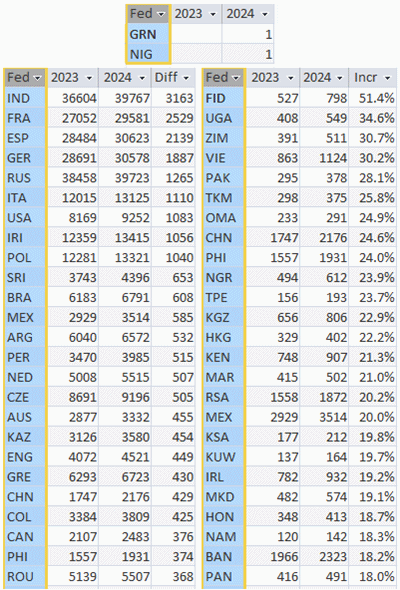
4) Analyze changes in players per federation. The upper chart shows two new federations (Grenada and Niger). No federation had a name change, giving FIDE exactly 200 federations.

The lower charts show federations with the largest increase in number of players (left) and the largest percentage increase (right; for federations with at least 100 players at the start of 2023). In last year's post I noted,

Mexico ('MEX') and Bangladesh ('BAN') are on both charts.

Copy that for Mexico, then add China ('CHN') and Philippines ('PHI'). Bangladesh missed being included this year by only two places on the left chart.

5) Identify ideas for a followup post. In last year's only followup post, FIDE Rating List - Active Players (January 2023), I remembered an idea from 2022:-

One idea is to look at the doubling of players under the FIDE flag ('FID'), as calculated on the right [chart]. This must be a consequence of the war in Ukraine, but should be confirmed.

Will I manage to do it in 2024? To get started, here are counts of 'FID' players for the past five years:-

2024 : 798
2023 : 527
2022 : 263
2021 : 254
2020 : 252

Yes, this confirms that there has been a substantial increase during the past two years. What more can we learn from the rating lists about this?

10 March 2023

Cheating for all Ages

For the last few weeks I've been running a weekly series on Chess.com's Game Review Tools (February 2023). I'll continue with Chess.com, but change the focus. That post mentioned,

[Chess.com] has a good reputation for vigorously enforcing its no-engine policy, even if it leads to controversial decisions.

I'll start with a summary of past posts on this blog that dealt with various aspects of cheating. It's a real mixed bag. Posts marked '(*)' featured Chess.com.

Recent months have seen heavy media interest in the so-called Niemann affair. The entire discussion gets a '(*)' because Chess.com played a leading role.

Another recent, recurring topic has been the controversy surrounding the 1997 match Kasparov vs. IBM's Deep Blue (m-w.com). It provided some precedent for the Niemann affair.

The rest of the posts are listed in unfiltered, reverse chronological order.

The list needs a lot more work. I'll fill in some of the blanks as I continue with the Chess.com series.

17 January 2023

FIDE Rating List - Active Players

A week ago, in FIDE Rating List - January 2023 (FRL), I displayed some preliminary numbers from the current FIDE ratings. The numbers received some attention in Federations with the largest increase in number of players : chess (reddit.com), enough to propel the FRL post to no.3 in the list of 'Popular Posts (Last 12 months)' at the bottom of each page on this blog.

At the end of the FRL post I reminded myself of an outstanding action. A year ago I wrote,

2022: The count of inactive players in 2022 increased three times more than the count of active players. Looks like I should revisit the subject of inactive players.

In this year's FRL post I asked,

2023: This year the inactive numbers stabilized somewhat, but the count of active players increased only [3000] over the count of inactive players. How does this vary over the nearly 200 different federations?

I looked at the subject two years ago in FIDE Rating List - Inactive Players (January 2021). Now I'll go a little deeper.

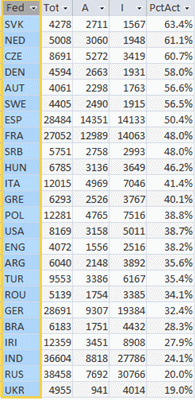
The chart on the left shows some numbers for the largest federations. Let's first have some context.
There are currently 198 different federations with players on the January 2023 FRL. Of those, 134 federations have 100 or more total players ('Tot' on the chart), 60 have 1000 or more, and 24 have 4000 or more, all of which are listed on the chart.

Why 24 federations? Because that's the number I can capture easily from the database query I used to create the chart.

For each federation, the 'A' column shows the count of active players and the 'I' column shows the count of inactive players. The 'PctAct' column shows the percentage of active players over the total number of players. Using the numbers I gave in the previous post...

2023: >405K players; >253K marked inactive

...that leaves 152K active players or 37.5% of the total number of players on the FRL. That's the same ballpark figure shown near the middle of the chart.

In the previous post, India ('IND') showed the largest increase in total number of players from 2022 to 2023. In the current chart, the country is third from the bottom in percentage of active players. This might be due to a high 'churn rate' in Indian chess -or- it might be a consequence of the 2020-22 covid crisis. I wouldn't judge without going deeper into the numbers.

The two countries at the bottom of the current chart are Russia and Ukraine. The current conflict is almost certainly the cause of the low activity, although for different reasons in each country. That brings me to another action from the previous post:-

One idea is to look at the doubling of players under the FIDE flag ('FID'), as calculated on the right [chart]. This must be a consequence of the war in Ukraine, but should be confirmed.

Now I have two reasons to prepare a third post this year.

10 January 2023

FIDE Rating List - January 2023

A new year means a look at the first FIDE rating list of the year. Let's follow the same cookbook instructions used last year.

1) Identify last year's post: FIDE Rating List - January 2022 (13 January 2022)

2) Identify the source of the FIDE data: FIDE Ratings Download (ratings.fide.com).

STANDARD
TXT format (06 Jan 2023, Sz: 8.98 MB)

3) Compare some basic counts over the past few years.

2023: >405K players; >253K marked inactive
2022: >377K players; >228K marked inactive
2021: >362K players; >174K marked inactive
2020: >354K players; >181K marked inactive
[...]

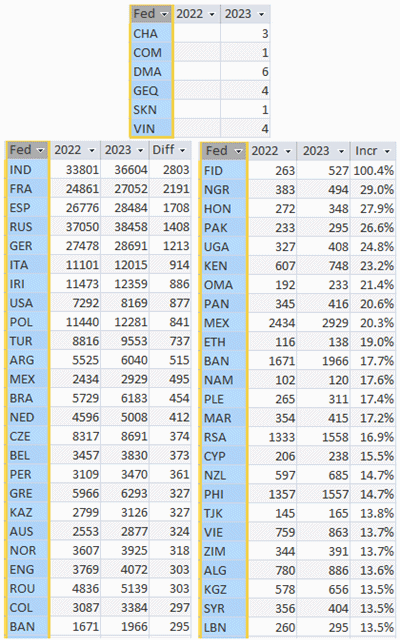
4) Analyze changes in players per federation. The upper chart shows six new federations (Chad, Comoros Islands, Dominica, Equatorial Guinea, Saint Kitts and Nevis, St. Vincent and the Grenadines). No federation had a name change.

The lower charts show federations with the largest increase in number of players (left) and the largest percentage increase (right; for federations with at least 100 players at the start of 2022). Note that Mexico ('MEX') and Bangladesh ('BAN') are on both charts.

5) Identify ideas for a followup post. Last year's post was FIDE Rating List - Women (January 2022). One idea is to look at the doubling of players under the FIDE flag ('FID'), as calculated on the right. This must be a consequence of the war in Ukraine, but should be confirmed. Last year I wrote,

The numbers under point '(3)' above show that the count of inactive players in 2022 increased three times more than the count of active players. Looks like I should revisit the subject of inactive players.

This year the inactive numbers stabilized somewhat, but the count of active players increased only 3K over the count of inactive players. How does this vary over the nearly 200 different federations?

24 July 2022

FIDE's Social Initiatives 2022

Every new release of material from the FIDE Social Commission becomes a natural choice for this blog's monthly post on The Sociology of Chess (November 2016). In the past two years I've used:-

The following video expands on the concepts introduced in those earlier posts.


FIDE Conference on the Social Chess Initiatives in FIDE Member Countries (4:46:50) • 'Streamed live on Jul 2, 2022'

After repeating the title...

FIDE Madrid Candidates • Chess Conference 2022 • Official Side Event of the Candidates Tournament
...the conference starts at around 22:00 into the video. It carries the following description:-
We will exchange experiences and showcase how national chess federations and chess enthusiasts worldwide help people, build community and make changes for the better with the help of chess. Representatives from all continents will participate. One of the program's highlights is the round table for one of FIDE's most important social projects, the INFINITE Chess, which aims to enhance knowledge and awareness about chess for children with ASD.

The introduction is made by Anastasia Sorokina, 'FIDE Vice-President, leader of the FIDE INFINITE Chess Project', and Dana Reizniece-Ozola, 'FIDE Managing Director'. At about 33:30 the same video used in my January 2022 post is shown. For information on the different speakers, see FIDE Madrid Candidates Chess Conference (candidates.fide.com).

Long ago I discussed ASD in Chess and Autism (April 2009; 'April is National Autism Awareness Month'). Although I intended that post to be the first of an annual series, I failed to achieve the goal. For more about the 'Infinite Chess Project', see Chess for children with ASD: Practical materials for teachers and parents (November 2021).

01 March 2022

Yahoos of Madness, Yahoos of Tragedy

When I first started using the word 'Yahoo' as a keyword for chess stories in the mainstream press, I chose the name because I was using Yahoo.com to identify the stories. As that site declined in importance, largely due to a series of bad business decisions, the meaning shifted to the explanation given in the footnote at the end of this post. I continued to use the keyword because it had the positive meaning of

expressing great joy or excitement

as in 'Yahoo! I found a chess story in the mainstream press!'. I knew there was an additional, negative meaning, but I never bothered to determine exactly what it was. I just checked and found:-

mid 18th century: from the name of an imaginary race of brutish creatures in Swift's Gulliver's Travels (1726).

I never imputed that meaning to any of the previous posts in this blog's 'Yahoo' category, but that tradition is about to change. Before gathering the data for this post on February Yahoos, I had already decided on the theme -- Russia's brutal, barbaric attack on neighboring Ukraine and its impact on international chess. I'll come back to that after the usual overview of the past month's Yahoos.

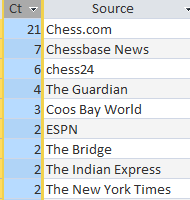
Today Google News gave me exactly 100 chess stories, of which 15 were older stories of the type described in Old Yahoos Don't Always Die (February 2022). Of the other 85 stories, nine sources accounted for at least two stories, as shown in the chart on the left. That leaves 36 sources with a single story.
At this point in the monthly narrative I would normally look at lesser known sources like 'Coos Bay World' or 'The Bridge'. Major sources like 'ESPN' or 'The New York Times' are also good for an informed angle. Instead I'll return to Russia's attack on Ukraine, which was launched on 24 February, and follow the top chess news sites. Of the 21 stories from Chess.com, not a single one is about the war. Ditto the seven stories from Chessbase. Chess24 has one story.

I don't know why Google News returns certain stories among the hundreds of chess stories at its disposition. I assume that it has something to do with popularity, but how the service determines that is a mystery to me. Perhaps one day I'll see the light.

I know from my own research that all three chess news sites had at least two FIDE/Ukraine stories, and Chess24 had three, of which the most recent was the story flagged by Google. Let's look at the three stories from Chess24, all signed Leon Watson:-

On top of the Olympiad action, there are at least three major decisions that FIDE must make regarding its ties to Russia: 1) the connection with its current president, Arkady Dvorkovich, who is a Kremlin insider and Putin crony; 2) the future of Russian corporate sponsors, which are a major source of FIDE's income; 3) the future of Russian players, who are among the best in the world and who always appear in the most prestigious chess events.

On the first point, Dvorkovich is up for re-election later this year. On the second point, Chess24 reported,

FIDE will terminate all sponsorship agreements with Russian or Belarusian sanctioned and/or state-controlled companies.

On the third point,

Russian and Belarusian players [are] banned from displaying national flags at FIDE-rated events and nationals anthem will not be played.

That still leaves plenty of room for further action. I'll come back in a month to see how the situation has evolved.

[Yahoos (mainstream news stories about chess) are derived from Google News top-100 (or so) stories from the past month.]

23 January 2022

FIDE's Social Initiatives 2021

For this month's edition of The Sociology of Chess (November 2016), my first idea was to feature 2021: In Memoriam of Passed Members of our Chess Family (youtube.com) on the 'FIDE chess' channel. The description said,

A video in remembrance of all those members of the chess family who passed away during the year 2021.

Then I realized I didn't have much to add about the subject, except to expand on the comments and to add a few personal memories of people I knew. I decided to look for something else.

A search for the keyword 'Memoriam' on the same channel returned another video that I had overlooked, although it was published on the same day as the 'Memoriam' video. I don't understand why it was returned for the keyword, but I'll take it.


FIDE's Social Initiatives in 2021 (3:44) • '[Published on] Dec 29, 2021'

The description for this video said,

A video devoted to FIDE’s social initiatives, one of the areas where our organization made more progress over the past few months.

This video demands to have the captions transcribed. I'll come back to that if I find the time.

18 January 2022

FIDE Rating List - Women

A day after my recent post on ratings, FIDE Rating List - January 2022 (January 2022), FIDE published Manifesto: The Year of the Woman in Chess (fide.com). What do the FIDE rating lists (FRLs) tell us about women in chess?

First, they tell us which FIDE registered players are women. In fact, they tell us twice. There is one field in the lists called 'Sex', which is set to 'M' or 'F'. There is another field called 'Flag', which includes 'w' if the player is female. I checked the content of the two fields and they match. Where 'Sex = F', 'Flag = *w*', and vice versa. There are undoubtedly legacy reasons for maintaining two fields, but I imagine it's a headache for FRL administration.

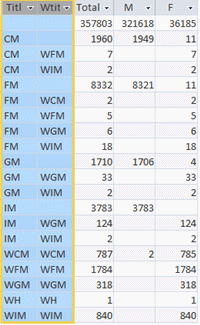
Second, the rating lists tell us which women have titles. There are two relevant fields in the list, 'Titl' and 'Wtitl', the first for all players, the second for women only. The following table shows the distribution of the two titles over all players, both men and women.

The first two columns in the table show various combinations of the two fields; the rest of the columns give a count. For example, the first row counts the number of players who have no title.
The second row counts the number of players who have a 'CM' title (Candidate Master) and no women's title; this includes 11 women. The third row counts players who have both a 'CM' title and a 'WFM' (Women's FIDE Master), and so on.

The pecking order of the titles is 'GM', 'IM', 'FM', 'CM'. The same is true for women's titles.

The titles are (largely) internally consistent. Two players marked 'M' have 'WCM' titles and one player has a 'WH' title, but these are the only inconsistencies I can see.

It would probably be revealing to see the rating ranges -- maximum rating, minimum rating -- for all titles. I recall having done that in the past, so I would first have to locate that post.

Lurking on the horizon is another angle to this discussion. Wikipedia defines Non-binary gender as:-

An umbrella term for gender identities that are neither male nor female -- identities that are outside the gender binary.

I wonder if FIDE has discussed this issue internally. I also wonder what other international sports organizations -- the IOC or FIFA -- are doing about it. It's certain to arise in the not-too-distant future.

16 January 2022

Chess Photos : 'All rights reserved'

In last month's Flickr post, Shallow, Green Chess Photos (December 2021), I wrote,

My short list for this month's featured Flickr photo was as short as a short list can be without being empty : one photo.

This month I was reminded that a short list can be even shorter : zero photos. Not wanting to beat the 'Shallow, Green' idea to death -- I might need to do that next month -- I decided to concentrate on chess albums. One set of albums...

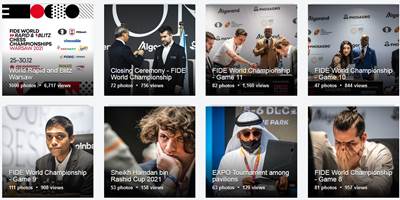
...was chock-a-block filled with a topical theme dear to my heart, the World Championship. The screen capture below shows the world federation's most recent albums. The second thumbnail from the left, top row, is titled 'Closing Ceremony - FIDE World Championship'.

Here are a few more album collections, listed in alphabetical order:-

I easily located several more chess album collections, mostly dealing with big tournaments. I won't list them all; I wouldn't want anyone to feel left out.

I imagine that all of the photos in these albums are marked '© All rights reserved'. That's why they never appear on my short lists. Would it hurt any of the expert photographers who took the photos to license a few under 'Creative Commons'? That would allow other content creators (like me) to share the photos with a larger public.

13 January 2022

FIDE Rating List - January 2022

It's become a new year ritual. Here's the sequence...

1) Locate last year's post. A year ago it was FIDE Rating List - January 2021 (8 January 2021).

2) Access FIDE Ratings Download (fide.com) and download the file that is described something like this:-

STANDARD
TXT format (14 Jan 2022, Sz: 8.33 MB)

3) Load the file into the database that stretches back to 1971 and compare it to recent years:-

2022: >377K players; >228K marked inactive
2021: >362K players; >174K marked inactive
2020: >354K players; >181K marked inactive
[...]

4) Produce a sequence of queries to derive the following charts. It shows one new federation since January 2021, plus two views of increases in the number of players per federation. The chart on the right is restricted to federations with 100 players or more at the start of 2021.

5) Create some additional posts (optional), then hibernate until the following year. Last year I wrote one additional post:-

...The numbers under point '(3)' above show that the count of inactive players in 2022 increased three times more than the count of active players. Looks like I should revisit the subject of inactive players.

07 November 2021

Coffee with Cherubs

In this blog's long-running series on Top eBay Chess Items by Price (March 2010), we've seen just about everything, including cherubs: Chess with Cherubs (July 2013). Of course, 'just about everything' doesn't mean everything.

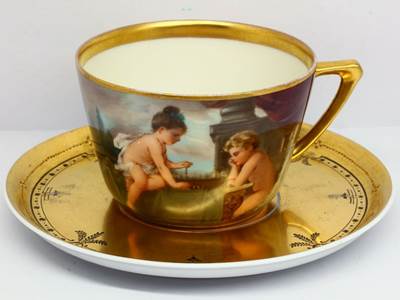
Here's something we haven't seen. Titled 'Antique Dresden Wehsener Hand Painted Playing Chess Scene Cup & Saucer', the item pictured below sold for US $840.00 after three bids from three bidders, on a starting price of $780.00.

The item's description was informative, although I'll use a different order to present the information. It ended,

An interesting and beautiful Dresden cup and saucer set. The cup has a hand painted scene. Depicting a little boy and a little girl playing chess accompanied by beautiful views. The scene has some very fine details, a table covered by green tablecloth with a chessboard and chess pieces on top, the boy sitting on a chair covered by feathers blanket, with red curtain and marble column behind him. The hand painted scene with the beautiful views circle around the exterior of the cup. The surface of the saucer is fully gilded. An interesting and beautiful cup and saucer set.

Before that we had some technical details.

[Date] 1895+ • [Size] The cup: 6.2 cm high /8.5 cm diameter. The saucer: 14.3 cm diameter. • [Condition report] Very good condition with no crack, hairline, restoration or chip. There are gilt wears on the top rim of the cup, two small area on the saucer have gold lost.

The description started with a macro look at the business that produced the cup.

[Factory] Dresden (Richard, Gerhard & Werner Wehsener) Germany. Richard Wehsener started his own business in 1895.His next step was a studio store in the Zinzendorfstrasse. There was great demand for his designs. Even the British Museum and the National-Museum in Washington DC obtained his pieces. Wehsener became known around the world as "Dresdner Handpainting" and "Dresden China".

In 1914 Richard Wehsener, opened the store for his studio store on Prager Strasse; Dresden's famous Prager Strasse, a world-renowned shopping area which was obliterated by World War ll bombing. However, the Wehsener's Porcelain firm survived and is still in business today with Richard Wehsener's descendants although this art of styled of porcelain painting seems to be fading as less are proficient.

The guardian of blogging about chess and coffee is 'Spraggett on Chess' (not for all ages). A recent example, subtitled 'Black Coffee: Always Steamy', was Coffee, Death, FIDE and other Nonsense! (spraggettonchess.com; August 2021). Along with 'Latest Coffee Study', it discussed 'Historic First by a Woman!' (Dora Maar) and 'Trying to keep FIDE honest' (FIDE president Arkady Dvorkovich).

Coffee, yup (with cherubs). Dora Maar, yup (see Dora Maar, Weeping Woman; June 2020). FIDE and Dvorkovich, yup. There are only so many subjects suitable for a chess blog.

13 June 2021

The Tornelo Online Platform

Earlier this month on my World Chess Championship blog, I reported in A New Cycle Is Coping Nicely (June 2021) that 'FIDE has already issued reports on two of the Continental qualifiers'. Quoting Fide.com:-

"The European Hybrid Qualification Tournament for the FIDE World Cup took place from May 24-30 on Tornelo online platform." • "The American Hybrid World Cup Qualifier was an 8-group (16 players in each) knockout tournament taking place from May 22-29. All the games were played online on Tornelo platform from designated venues"

I couldn't recall having encountered Tornelo before and made a mental note to learn more. Thanks to this month's featured video I can check off that mental note. The following video is from YouTube's Tornelo channel.


Business of Chess Events (1:08:39) • '[Published on] Jun 7, 2021'

The clip has no description and no comments, which makes me wonder how people are supposed to find it. The channel's description says,

Tornelo is a a Web-Control Centre for online, hybrid and OTB chess events. We support organisers and arbiters to fully control each step through the full lifecycle of an event: planning to completion. We are an event management system and game server all-in-one.

The FIDE calendar currently lists more than a dozen events that will use the 'Tornelo Platform', many of them youth events. The home page home.tornelo.com says,

We are proud to be the Official Tournament Management Platform of the European Chess Union – the peak body for 54 countries in Europe.

In last month's video post, The $64.000 Question (May 2021), I wrote,

There were so many great videos to choose from this month that I almost had to flip a coin. If this is because of the increased popularity of chess during the covid pandemic, then let's hope it has staying power.

On this month's short list I had 50% more clips than last month. Let the good times roll...

28 February 2021

Corporate Championship, Corporate Responsibility

Last month, in the long running series on The Sociology of Chess (November 2016), I posted on two topics:-

This month I'll continue with FIDE, although the connection with its Social Commission is not clear. Mid-month the world chess organization signalled a new initiative:-

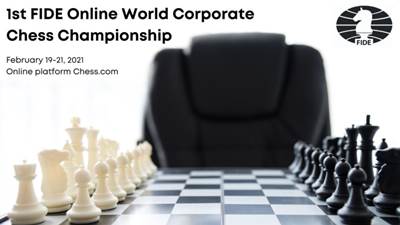
  • 2021-02-15: Superb turnout for FIDE World Corporate Championship (fide.com) • 'We couldn't have dreamed of a better welcome for the inaugural edition of the FIDE Online World Corporate Chess Championship that will be played next weekend (February 19-21). With 284 teams registered from 78 different countries, the event will bring together 1,467 players.'

That FIDE announcement, illustrated by the following image, reads like a press release.

The announcement closed with a significant detail:-

There was no entry fee of any kind for this competition. However, FIDE is organizing a fund-raiser in cooperation with the platform Softgiving, and participant companies are encouraged to donate towards one of three social projects currently being developed by FIDE:
- Chess in Education, programs for underprivileged children,
- Chess for people with Disabilities, and the
- FIDE veterans support program.

Note the key phrase 'social projects'. A few days later FIDE issued a follow-up announcement:-

  • 2021-02-17: FIDE Council approves CSR guidelines (fide.com) • 'The fund-raiser that is organized alongside the World Corporate Championship connects perfectly with a recent decision by FIDE. Last week, the FIDE Council approved our Corporate Social Responsibility guidelines, a document that has now been incorporated into the FIDE Handbook.

The next paragraph in the second announcement was nearly identical to the first paragraph of the FIDE document, FIDE Handbook E. Miscellaneous / 05. Corporate Social Responsibility Guidelines: 'Corporate Social Responsibility (CSR) is a self-regulating operational model that incorporates social and environmental concerns into an organization's planning and operations. The goal is to ensure that all of its activities positively affect society as a whole.' Funding appears to be a key component of the initiative:-

  • 2021-02-18: Fundraising for FIDE Social Projects (fide.com) • 'Chess in education, chess for people with disabilities, or the support fund for distinguished chess seniors? Which social project would you like to support? In connection with the FIDE World Corporate Chess Championship, we have organized a fundraiser. All participant companies have been asked to make a donation towards one of these 3 social projects. But you can also contribute, and your help would be more valuable now than ever before.'

Which came first -- the tournament or the social funding? The tournament and related news was handled by Chess.com:-

For the official site, see World Corporate Chess Championship (fide.com). In this same long running series on 'The Sociology of Chess', I'll continue to track the new initiative.

31 January 2021

FIDE's Social Commission 2020

Getting back to the recent post Spectating the 91st FIDE Congress (January 2021), let's have a follow-up to FIDE's Social Commission 2019? (February 2020), this time without the question mark ('?'). We learn from Commissions (fide.com), that the Social Commission's officers have changed to...

  • Chairman: Klerides, Paris
  • Secretary: Chatelain, Philippe Victor

...plus three councillors and 13 members. Of the 18 commissions listed on that page, 14 have their own web sites. The last to appear, some time during Summer 2020, was the FIDE Social Commission. It describes its 'Mission' as:-

The FIDE Social Commission "SOC" is dedicated to using chess as a tool for social development. SOC advocates for the use of chess as a tool for social change through action as [e.g.] An equalizer for gender, social and economic development. [...]

The 'Members' page still lists the same officers as recorded in my 'Social Commission 2019' post, where the current chairman was at that time the secretary. The 'Reports' page lists a single item, dated September 2019, the First FIDE Social Commission meeting. The three paragraph report starts,

The first FIDE Social Commission meeting was held in Havana, Cuba, on Saturday, 11 May 2019, at Tryb Habana Libre Hotel, during the Capablanca Memorial Festival.

This commission is obviously a work-in-progress and I hope we will hear more about it during the coming year.

24 January 2021

ChessTech2020 Online Conference

In the ongoing series about The Sociology of Chess (November 2016), December is chess conference month. A year ago we had London Chess Conference 2019 (December 2019), and now we have ChessTech 2020.


Chess: Driving Technological Innovations in the 21st Century (16:50) • '[Published on] Dec 13, 2020'

The video description explained,

Keynote speech by Arkady Dvorkovich, President of the International Chess Federation (FIDE), at the ChessTech2020 Online Conference 5-6 December 2020. • Conference organised by ChessPlus Limited. Session hosted by John Foley.

A second video on the same channel continues with questions and answers that followed the presentation: Chess: Driving Technological Innovations in the 21st Century - Q&A (youtube.com). For more about the conference, see ChessTech2020, 5-6 Dec 2020 (chesstech.org), and ChessTech, 5-6 Dec 2020 (chessconference.org). That Chesstech.org page explains,

ChessTech2020 is the premier chess related conference in the world. Its name reflects the topic: Chess and Technology. This is the 8th in the sequence of the London Chess Conference since 2013.

I think I've covered about half of those conferences on this blog. Will the organizers continue to use the online format for the 9th edition?

15 January 2021

FIDE Rating List - Inactive Players

Last week, in FIDE Rating List - January 2021, (FRL) I noted,

The number of inactive players declined, but growth in active play also declined. How to explain this contradiction? I'll look at that in another post.

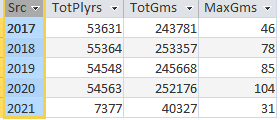
First I looked at the assertion that 'growth in active play declined'. Here's a table that shows some statistics for the last five years.

The three columns show:-

  • the total number of players on the FIDE list that played at least one game,
  • the total number of games played, and
  • the maximum number of games played by a single player.

Remember (1) that each of those five rating lists is from January of the year indicated and, (2) that the lists are produced monthly. The FIDE download page (see last week's FRL post for the link) says that the data shows 'rated games in given period'. I looked at the player corresponding to 31 'MaxGms' in 2021 -- from federation POL, current STD rating 1890 -- and discovered that he played four tournaments that counted in the January 2021 FRL. [NB: the FIDE rating site is very well done.]

The table shows a large drop in all columns from January 2020, i.e. pre-pandemic, to January 2021. Rated play has still not recovered.

Next I looked at the assertion that 'the number of inactive players declined'. Of the 189 federations with inactive players (Flag = 'i') at the start of both 2020 and 2021, 141 had a decrease in the number of inactive players and only one had an increase (of one player).

To allow for the decreased activity during 2020, FIDE must have changed the rule for inactivity and applied it retroactively. According to Resolution of FIDE Council regarding the rating list (fide.com; 2 November 2020):-

The lack of rated events due to the coronavirus pandemic could have led, under the existing regulations, to many players being considered as "inactive". As such, they could have been removed from the rating list. In order to prevent that, the Qualification Commission has made the recommendation to temporarily extend the period required to be considered "inactive" from 12 to 24 months.

As for 'removed from the rating list', I haven't played a rated game since 1990, and I'm still on the list (FIDE ID 2003740). The photo shown on my rating profile is not me, it's Manuel Weeks, but I'll deal with that another time.

12 January 2021

Spectating the 91st FIDE Congress

Chess had a good year in 2020. Thanks to the Switch to Online Chess (June 2020) and Queen's Gambit Mania (October 2020), there were many more fans of the royal game at the end of the year than there were at the beginning.

FIDE, on the other hand, had a not-so-good year in 2020. The bungled Coronavirus Candidates (March 2020) might have been the low point, but the Olympiad fiasco, Splitting a Gold Medal (September 2020), wasn't much higher. Toward the end of the year, FIDE held an online pow-wow, documented in a number of administrative posts:-

That gives me the opportunity to continue with the 'Spectating FIDE' series, last seen in Spectating the 90th FIDE Congress? (February 2020), a month before the covid pandemic started wreaking havoc with the world's traditions, chess or otherwise. Just like in previous years, last year I made a series of posts out of the Congress:-

Supplementing that series were a couple of posts on my World Championship blog:-

Last year the title of the kickoff post ended in a question mark: 'Spectating the 90th FIDE Congress?'. This year I'm sure I'll be doing some serious spectating: no question mark required.