Showing posts with label Mysteries. Show all posts

05 October 2023

'Mystery Painting' in Denmark

Last month I received the following email:-

With reference to your "Chess for all Ages" blog post and your interesting comments regarding the painting "French Cavalier Men Playing Chess", at the end of your post you write:-
"The main mystery remaining now is -- where is the original painting?"
Well, I think it may be in my possession. [See image below.] It measures 90x80 centimerers (35x31 inches) in the frame. And is oil on canvas. Signed bottom right "V YDE".

Short [provenance] is that the father of my wife's mother (1915-1994) was interested in artwork and bought the painting in Germany. Thereby the painting ended in Denmark. - [signed] P.W.

The quote leads to my post 'Mystery Painting' on eBay (June 2017), which has links to two previous posts on the same painting.

I replied,

Thanks very much for your message. In fact, your copy of the painting differs significantly from the 'Taber Prang' version, which I have already concluded is close to the original. In particular, look at the face of the player on the right. I suspect that your version is itself a copy of the original. I can't help but wonder why this painting has survived in so many different versions.

A Google Lens search on P.W.'s version currently returns images attributed to P.H. Andreis, C.W. Towin, and H. Gerard, plus a book review for Chess in Art – Peter Herel Raabenstein (artplugged.co.uk). The book attributes the painting to 'P.H. Andreis 1800-1899'.

05 June 2023

The CCC's Mystery Engine

In last week's post on engine vs. engine events, TCEC FRC6, CCC20 Rapid Finals; Both Underway (May 2023), for the CCC side of the report I noted,

Mystery played five 100-game matches, beating Koivisto, Berserk, and Ethereal; then losing to Dragon and Lc0.

Mystery played its first CCC game in the CCC20 Rapid: Entry League (chess.com). On the CCC's Discord forum, the early discussion was brief:-

Q: Mystery engine? Or is the engine actually called Mystery? • A: Probably a new Chess.com bot.

That's also what I would have guessed, but there's more to the story. The engine, a last minute CCC20 replacement for 'Demolito : Filling out the 12th spot', qualified into the next two 'CCC20 Rapid' stages, Qualifier #1 (chess.com), and Qualifier #2 (ditto). A handful of Mystery's 'Entry League' games were recorded in Mystery chess engine enters in [CCC]?! (ditto).

Fast forward to mid-May and we find Unknown "Mystery" Engine (chess.stackexchange.com). The writer observed,

One of the strangest things is that at 'CCC20 Rapid: Qualifier #2' it performed poorly. But at the same time, in a one-on-one battle with the "Berserker", it won confidently. And now beats "Ethereal", one of the strongest engines.

Someone commented,

Andrew Grant, the tournament director of CCC and author of Ethereal, seems to be the only one who knows Mystery's true identity. He did clarify that it was not a dumbed down version of Stockfish or Dragon as that would be rather lame. It seems to be an older engine (Maybe Laser?) with NNUE added to it but no tablebase support.

A few days later, the subject came up in one of the leading computer chess forums, Mystery engine at CCC (talkchess.com). The originator of the thread used the engine's UCI log to make an educated guess:-

The most obvious candidate would be a new engine developed by Chess.com as a successor of Komodo Dragon after their purchase of KomodoChess. The [UCI] options don't seem to match any known engine found on GitHub.

Some observers say that interest in chess engine events has been declining lately. At worst, the CCC is using the Mystery engine to rekindle interest. At best, it's a marketing strategy to introduce a new engine. I'm sure that we will soon learn much more.

15 May 2023

Stockfish Wins TCEC S24; Engine Mysteries

For this post on the world's top two engine vs. engine competitions, four weeks have passed since the previous post: TCEC S24 Sufi, CCC20 Rapid - Both Underway (April 2023). Here's a summary of the engine action reported at that time:-

TCEC: Stockfish won the 'DivP Playoff' with an undefeated score; LCZero finished second to qualify into the S24 Superfinal (aka Sufi). After 40 games in the 100-game Sufi, LCZero has a slim one point lead. • CCC: The 15-engine OpenBench event, titled 'OpenBench Interlude #8 - All Hands', was won by Berserk. This was followed by the first stage of the 'CCC20 Rapid' event, renamed from 'Newcomers' to 'Entry League', which was followed by 'Qualifier #1' and 'Qualifier #2'.

A lot can happen in a month, but the TCEC and the CCC both leave plenty of trail markers to follow their evolutions. Following is a summary of the past four weeks, including a couple of mysteries.

TCEC: Stockfish beat LCZero +20-16=64 to win the S24 Sufi. How many wins in a row does this make? If we go back to the previous Sufi, TCEC S23, CCC19 Rapid : Stockfish Wins Both (November 2022; 'Stockfish beat LCZero +27-10=63 to win its sixth straight Superfinal'), and add one, we get seventh straight Superfinal.

After the S24 Superfinal, the site conducted the following events (the links are to posts on this blog for the the previous iteration of the same event):-

  • S24 VVLTC Bonus, 'Very Very Long Time Control'; see TCEC More Interludes; CCC19 Bullet Underway (December 2022; 'Stockfish won the VVLTC, then drew the two-game SVVLTC with LCZero')
  • S24 Kibitzer Bonus; LCZero dag-master-[...] beat Stockfish master-[...]. The purpose of this match is a mystery.
  • S24 4k 2, TCEC: 'Engine maximum size is 4 kiB (4096 bytes)'; see TCEC Cup 11 Underway; CCC19 Bullet in Semifinals (January 2023; 'Engine ice4 won the S23 4k tournament ahead of 4ku and three other engines')

The site is currently running the 'S24 4k 2 Final' between 4ku and ice4, the engines that finished 1st and 2nd in the six-engine 'S24 4k 2'. With one game left to play, ice4 has a one point advantage. The next scheduled event is 'FRC 6'.

CCC: After the 12-engine 'CCC20 Rapid Qualifier #2', the site ran two more 'CCC20 Rapid' events, a 12-engine 'Main' and a 6-engine 'Semifinal'. The three engines promoting from 'Qualifier #2' all finished in the bottom half of 'Main', while the top half promoted to the 'Semifinal'. The 'Semifinal' was won by Stockfish, ahead of Lc0 and Dragon. Stockfish qualified for the 'Final', while the other two engines will play a 'Challenger Match' to determine the second finalist.

Before the last two 'CCC20 Rapid' matches, the site conducted a series of 'Mystery' matches. These were described as:-

Mystery vs ... Berserk? Ethereal? Dragon? Lc0....? Until losing.

Mystery beat Koivisto by a wide margin and is currently leading Berserk.

[For further information from the various stakeholders in the engine-to-engine events, see the tab 'TCEC/CCC Links' at the top of this page. • NB: Leela = LC0 = LCzero; Dragon = KomodoDragon]

11 November 2022

Fischer Busted

We're nearing the end of this blog's 'Fischer Friday' series, last seen in Fashionable Fischer (November 2022). This current post has nothing to do with Fischer's 1972 or 1992 matches, and takes its title from an old post Korchnoi Busted (May 2012).

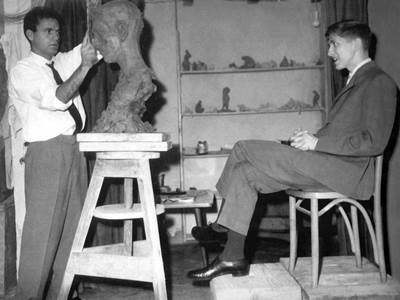
I found the photo on Bobby Fischer by florijanmedjugorje (deviantart.com), and compressed its description to:-

Bobby Fischer visited Yugoslavia in 1961 and posed for Mostar based sculptor Florijan Mickovic in Rudolf Matutinovic atelier in Zagreb, Croatia. Fischer received it in New York from Svetozar Gligoric, Serbian chess grandmaster. Published in year 2005 in Florijan Mickovic monography. • Photographer: Pavao Cajzek

Both sculptors have pages on Wikipedia:-

  • Florijan Mickovic (wikipedia.org) • 'Mickovic (1935-2021) was a Bosnian Croat sculptor living and working in Mostar and Medugorje.'
  • Rudolf Matutinovic (ditto) • 'Matutinovic (1927-2014) was a Croatian sculptor.'

On a normal day, I wouldn't post a single, random photo found on the web, but there's never anything normal about Fischer. That same day I was re-reading the article 'A Half Dozen Unsolved Bobby Fischer Mysteries' by IM John Donaldson. The article is related to a recent post 2022 CJA Awards - Part 3 (October 2022):-

Honorable Mention; Best Story of the Year; 'The Fischer Project'; John Donaldson (author), Ian Spanier (photographer); Chess Life, July 2021

'Unsolved Bobby Fischer Mysteries' was a coda to the 'The Fischer Project'. The last of the six mysteries was:-

6. MISSING SCULPTURE OF BOBBY FISCHER • Bobby posed for the Yugoslav sculptor Florijan Mickovic not long after finishing second at Bled 1961. Two years later Svetozar Gligoric accompanied the finished bust to New York. When Fischer moved to Los Angeles in 1968, he brought it with him. Sometime later the sculpture was put into the ill-fated storage locker.

Fortunately, there was (at least temporarily) a happy ending for this Fischer treasure. When it was put up for auction in early 1999 Bob Ellsworth was able buy it back. Soon after Harry Sneider’s son Rob took it to Budapest, where it was reunited with Bobby. What happened after this is unclear as Fischer did not take it with him to Iceland. It’s possible it ended up with Pal Benko or Janos Rigo and presently resides with one of their families.

Having a photo of the bust helps to identify it. The photo is much larger on the Deviantart page.

08 September 2022

Chess Players Behaving Very, Very Badly

The game:-

The players:-

Plus thousands of comments from chess fans.

***

Later: The reactions:-

Advantage? [TBD]

18 July 2021

Mystery Film

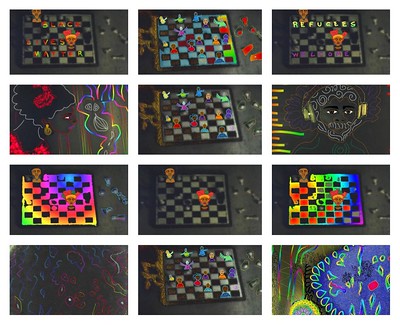
What exactly are we looking at here? The title of the photo isn't particularly helpful.


We are all just Pawns in a game of chess © Flickr user Lacuna Festivals under Creative Commons.

Neither is the description.

My collaborator was a film maker and I am a visual artist. I decided to select still images from the film that I found interesting and add to the reflecting on the overall theme for the exhibition of distance and related issues of displacement and separation.

There were two names attached to the title -- Aleksandra Hewelt and Zita Holbourne -- although a search on each only establishes that the first is the film maker (Polish) and the second is the visual artist (British?). A search on both together leads back to the Flickr photo.

How about the name of the Flickr user, Lacuna Festivals. LacunaFestivals.com informs,

The Lacuna Festivals are an offshoot of The Lacuna Studios. Through the Lacuna Festivals we hope to:-
• Promote quality, contemporary (and sometimes challenging) art to communities isolated from mainland Europe which, therefore have limited access to international, contemporary arts.
• [...]

LacunaStudios.com informs,

The Lacuna Studios shall be residential studio spaces in the Canary Islands, created by and for artists, makers, designers, craftspeople, thinkers, writers, musicians, educators and students from around the world.

Back to the Flickr photo, I'm still not sure what I'm looking at -- 'still images from the film'; what film? -- but I like it.

18 April 2021

More Lessons in Art Appreciation

Jamais quatre sans cinq? Two months ago, in Forcing Me to Think (February 2021), we saw a Flickr photo by J-L. Mazieres of a chess painting. That was already the fourth time I've used an image from M. Mazieres' Flickr channel. On a short list of a half dozen Flickr favorites for this current post, the image shown below was once again the best of the lot.


Modern Art : Profane Art and Present-day Art © Flickr user jean louis mazieres under Creative Commons.

That makes five images from the same channel. The description said,

Louis Robert Carrier Belleuse 1848-1913; Joueurs d'échecs (Chess players) 1879; Besançon Musée des Beaux Arts

That was followed by a link to Wikipédia's Louis-Robert Carrier-Belleuse (fr.wikipedia.org), where we learn that there were several artists in the Carrier-Belleuse family. The Wikipedia link was followed by a long passage first in French, then in English. Once again, just as in 'Forcing Me to Think', I've used the title of the English passage as the title for the artwork itself. Once again, I'm not sure why that passage was used in the description. As for the quality of the image, the photographer explained in a comment (translating from the French),

It was impossible for me to photograph the painting without these reflections, despite all my efforts to render the shadows and the lights. I made an average choice, between the players and their environment.

How he did that is also a mystery to me. There are multiple lessons in art appreciation here, but I'm not the right person to appreciate them.

21 February 2021

Forcing Me to Think

One of the design principles behind this blog is maximum one illustration per post. Sometimes I bend the rule, as in Queen's Gambit Mosaic - Chess Symbols (December 2020), but I usually respect it because it forces me to think about which image works best for a post.

This month I had two images for my Flickr series, both from sources that I've featured before. The first was from Gandalf's Gallery, last seen in Café Life in Montparnasse (March 2020). It was a good choice because it echoed another post, Hands and Heads Not from Wood (September 2012), where I copied an eBay description that said,

Antique and more than probably unique carved wood figures depicting Jewish "Chess Players" (Schachspieler) made after a work of the 19th century famous Jewish artist Isidor Kaufmann.

Now on Flickr was the original painting. I decided not to use it because it's a common chess image that is seen frequently in different settings. Instead I chose to feature the following image.


Modern Art : The Renewal of Forms © Flickr user jean louis mazieres under Creative Commons.

J-L. Mazieres was last seen in Flickr Series Hat Trick (July 2020). The description of his newest example of chess art says,

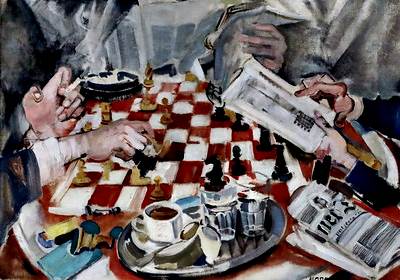
Max Oppenheimer 1885-1954; Le match d'échecs (The chess match) 1925-1930; Wien Musée Léopold

For more about the artist, see Max Oppenheimer (Carolus chess). As for the phrase that I've chosen as the title of the artwork, 'The Renewal of Forms', this repeats a technique seen in an earlier post inspired by Mazieres -- The Original Dutch Masters (June 2019) -- with two long passages, one in French ('Art Moderne : Le Renouvellement des Formes'), the other in English. Why was this passage chosen for the Oppenheimer painting? That is a mystery to be tackled another time.

Neither Gandalf's Gallery, nor J-L. Mazieres specializes in chess art. The artworks that appear under their Flickr names represent diverse subjects and themes. That is undoubtedly another aspect of the same mystery : why chess?

19 May 2019

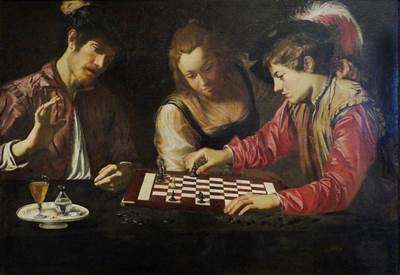
The Real Caravaggio?

For this month's edition of Flickr photos, I had a good choice of interesting photos, one of which was a photo of a painting. I decided to use the painting, because I couldn't remember having seen it before.


Joueurs d'échecs, Le Caravage, 1610 © Flickr user Pierre under Creative Commons.

The description of the photo/painting pointed out (in French) that the chess board is positioned incorrectly, with the corner square white *not* on right. I had a bigger problem with the chess board -- it looks too modern and the slight tilt downward to the right is wrong. I have a plastic folding board in the same colors that looks very much like the board in the painting. This is undoubtedly a coincidence and the similiarity is my imagination playing tricks on me, but it still annoyed me.

Using an image search on 'chess caravaggio' (the artist's name in English), I located a half-dozen copies of the painting, one version of which had a different chess board. The others all had the same funny-looking board seen in the Flickr photo. There were other differences between the two versions, enough to convince me that they were two different paintings.

The Flickr description gives 'Gallerie dell'Accademia di Venezia' as a source. The white patch on the right side might be from a flash and is even more visible in the original (I've cropped out the painting's frame). Which version is hanging in Venice?

09 April 2019

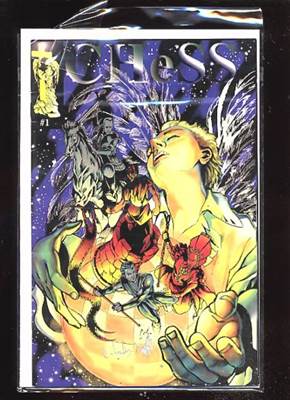
Chess Comics No.8 : Mystery Comic

While I was preparing the recent post on JLA Chess Comics I searched my archive of chess images on the keyword 'comic'. The search returned more than 500 images, many of them having nothing to do with comics except as an unimportant word in the description.

I spent an enjoyable hour researching the more unusual images, but ran into a brick wall with the image shown below. It's from a 2004 eBay auction for which I have nothing more than the description 'Chess #1 Comics Comic VF+ NM'.


'Chess #1 Comics'

The keyword 'chess comics' isn't very useful for locating a specific comic. I turned to the Google service I described in last year's post Search Your Own Images (June 2018), and fed it a copy of the image. It told me,

No other sizes of this image found. Possible related search: picture frame

Fair enough. The black border looks something like a picture frame. I cropped it out and fed the image to the service a second time. This time it said,

No other sizes of this image found. Possible related search: illustration

Now I was facing the brick wall. What to do? Document the problem in a blog post. What to title the post? Let's continue the series last seen in Chess Comics No.7: Punch Animated GIF (May 2014). Maybe something will turn up.

08 March 2018

Stockfish in a Straitjacket?

It was one of those coincidences you can never plan. Near the end of last year Houdini won TCEC Season 10 at the same time that AlphaZero appeared on the scene. I covered both of those significant computer chess events in a single post, Houdini, Komodo, Stockfish, and AlphaZero (December 2017). The first three names are the top three chess engines in the world, of roughly equal strength, but AlphaZero had apparently crushed one of the trio in a match. In my post I wrote,

We can quibble about whether the AlphaZero - Stockfish match was indeed a fair fight -- 1 GB hash size is a severe restriction -- but the final score of +28-0=72 for AlphaZero was more than convincing to all but the most vehement skeptics.

I was reminded of those words while writing my most recent post, TCEC Season 11 in Full Swing. One of the sources I consulted, without referencing it in the post, was TCEC 11: Premier Division starts (chessbase.com; February 2018). The Chessbase site is well known and well respected for its expertise in computer chess and always attracts comments from informed readers. This particular article launched a discussion on why AlphaZero wasn't participating in TCEC Season 11 and whether the AlphaZero - Stockfish match had been too heavily rigged in AlphaZero's favor. The discussion mentioned four factors that could have hurt Stockfish's performance:-

  • Restricted hash size
  • Fast time control
  • No opening book
  • No endgame tablebases

I knew that the first two points were an issue, but wasn't certain if the last two were true. I went back to the Deepmind paper that had announced AlphaZero to the world (titled 'Mastering Chess and Shogi by Self-Play with a General Reinforcement Learning Algorithm') and re-read the relevant section:-

Evaluation • To evaluate performance in chess, we used Stockfish version 8 (official Linux release) as a baseline program, using 64 CPU threads and a hash size of 1GB. [...] The Elo rating of the baseline players was anchored to publicly available values. We also measured the head-to-head performance of AlphaZero against each baseline player. Settings were chosen to correspond with computer chess tournament conditions: each player was allowed 1 minute per move, resignation was enabled for all players (-900 centipawns for 10 consecutive moves for Stockfish and Elmo, 5% winrate for AlphaZero). Pondering was disabled for all players.

Since 'publicly available [Elo] values' depend both on configuring engines properly and on a level playing field, I started to have serious concerns that this controversy was more than a quibble. What did the Stockfish developers think about the match? On Stockfish's Fishcooking forum, in a long thread titled Open letter to Google DeepMind (December 2017), the opening message said,

AlphaZero won the 100 game match against Stockfish very impressively by a total score of 28 wins and 72 draws and 0 [losses]. This translates to an Elo difference of 100. However the details of the match described in your paper show that this match might have been much closer and more interesting had it not been for some IMO rather unfair conditions.

That first post and the subsequent discussion repeated the four complaints from the Chessbase comments listed above, and added,

In the match version 8 of Stockfish was used which is now over a year old. The latest version of Stockfish is over 40 Elo stronger in fast self play.

That makes five significant objections to the conduct of the match. Later in the same Fishcooking thread, TCEC insider Nelson Hernandez wrote,

This "match" was like a boxing match where one fighter had no seconds in his corner, the referee and judges were picked by his opponent, there was no audience to validate what happened in the ring as it happened, and the post-match story was written by the opponent's hirelings. It may well be that Alpha Zero is indeed better than the latest version of Stockfish in fair test conditions. But it is almost criminal to announce very biased test results such as these, thereby rubbishing the work of hundreds of people, in order to gain some PR benefit. What the computer chess community expects is fairness and decency.

The clincher to the above discussion is that three months have passed since Deepmind's bombshell announcement, which made available only ten games from the match. None of the other 90 games have been released for dissection by the experts. AlphaZero might be a better chess engine than Stockfish, but it might also be much worse. If we can't have a match where the Stockfish developers configure their creation for its full strength, let's have the other games from the first match.
21 September 2017

Win a Million Bucks

Seen on Slashdot.org ('News for nerds, stuff that matters'): Solve a 'Simple' Chess Puzzle, Win $1 Million. Sounds good to me! What's the catch?

Researchers at the University of St Andrews have thrown down the gauntlet to computer programmers to find a solution to a "simple" chess puzzle which could, in fact, take thousands of years to solve, and net a $1 million prize. [...] Devised in 1850, the Queens Puzzle originally challenged a player to place eight queens on a standard chessboard so that no two queens could attack each other. This means putting one queen in each row, so that no two queens are in the same column, and no two queens in the same diagonal. Although the problem has been solved by human beings, once the chess board increases to a large size no computer program can solve it.

The catch is in that last sentence, 'the chess board increases to a large size'. As the original article, "Simple" chess puzzle holds key to $1m prize (st-andrews.ac.uk; August 2017), put it,

Once the chess board reached 1000 squares by 1000, computer progams could no longer cope with the vast number of options and sunk into a potentially eternal struggle akin to the fictional "super computer" Deep Thought in Douglas Adams' Hitchhiker’s Guide to the Galaxy, which took seven and a half million years to provide an answer to the meaning of everything.

A related paper, 'Complexity of n-Queens Completion' by Ian P. Gent, Christopher Jefferson, and Peter Nightingale (School of Computer Science, University of St Andrews), published in the Journal of Artificial Intelligence Research 59 (2017) explains everything. But be careful -- you'll need to be a math whiz just to get through the 'Abstract'.


Google image search on 'chess eight queens'

Even the 8-by-8 version isn't that easy to solve. An algorithmic approach of using the Knight's move to place the next Queen -- shown above in the top row, third from left (or bottom row, ditto) -- leaves two Queens on the long diagonal (a8-h1). 'Who Wants to Be a Millionaire?', indeed.

10 August 2017

Prokopljevic's Cartoons

A few weeks ago, in The Fifth Entry, I ended a post about Jovan Prokopljevic with an action.

Several collections of Prokopljevic's cartoons have been published, but I wasn't able to catalog them in the time available for this post. I'll save that for another time.

I tackled the material again today, and again ran out of time. Prokopljevic's cartoons have been published and re-published in so many different editions that I can't get a grip on them. For example, the 13 caricatures of the World Champions, shown as a collage in the 'Fifth Entry' post, have been published as postcards with the Chess Informant logo over a short game by the featured champion and in a book 'Black and White Evergreen' with Informant style annotations of famous games by the champions.

What to write about in this post? I noticed that Prokopljevic's non-chess cartoons are even more well known than his chess cartoons, because they often use political themes. The following is a good example.


Source: Serbian Cartoon Show Banned Ahead of Polls (balkaninsight.com; February 2014) • 'Serbian caricaturist Jovan Prokopljevic says his exhibition was abruptly pulled, apparently because of sensitivities about the March 16 elections.'

The article mentioned,

Prokopljevic has been as a caricaturist for his entire working life. His work includes more than 15.000 cartoons and has won him many domestic and international awards.

How many awards? According to another Serbian source, Jovan Prokopljevic awarded for the 101st time (inserbia.info; March 2013),

Architect Jovan Prokopljevic, one of the most awarded Serbian cartoonists, has recently received his 101st caricature award. Prokopljevic, full-time caricaturist at Serbia’s oldest daily Politika, has won three awards over the last month at international competitions in Iran, China, and Turkey exceeding the number of 100 international and domestic awards.

I might come back to the chess cartoons another day, but I have no reason to believe that I will be more successful.

25 June 2017

'Mystery Painting' on eBay

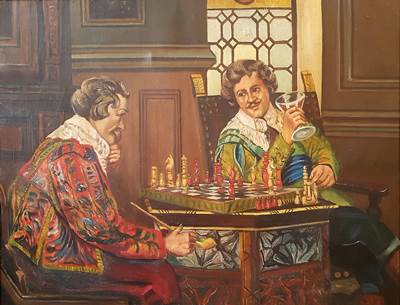
In this long running series on Top eBay Chess Items by Price, I try to avoid repeating featured items, but sometimes it can't be helped. If the painting pictured below looks familiar, it might be because it's been the basis for two previous posts:-

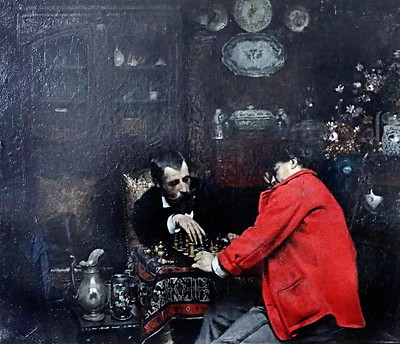
This latest appearance of the painting was titled 'Vintage C.W.Towin, Genre Oil Painting, French Cavalier Men Playing Chess'. It sold for US $455 after 33 bids from eight bidders.

The description said,

After a Google [image] search we found that this mid-20th century oil painting on stretched canvas is a very well executed copy of the famous painting “Chess Players” by the Belgian artist, Alex de Andreis (1880-1929). It depicts two French cavalier men in the middle of an intense chess match. The gentleman to the left is holding a clay pipe in one hand and stroking his beard as he contemplates the next move. His opponent is [sic] a glass of liquor and has a very confident look on his face.

The quality of this 24” by 20” oil painting is excellent and with the exception of some stable craquelar to a few areas, there are no problems or any restorations. The artist has signed the lower right hand corner “C.V.Towin”. This circa 1950s Oil Painting comes in its original 22 3/4" by 26 3/4" gilded frame.

Although the composition is the same as the variations shown in the 'Still a Mystery' post, the details are different. I found this latest variation in another recent auction C. V. Towin (American, 20th Century), 04.06.17, Sold: $153.40 (aspireauctions.com) along with the further explanation,

50. C. V. Towin (American, 20th Century) • 20" x 24" • Chess players. Oil on canvas, signed lower right, framed in carved and gessoed wooden frame, overall 23" x 27". • Condition: Slight craquelure surface, some losses to frame, otherwise very good. • Estimate: $250/500 • Sold with Premium: $153.40 • Closed: Apr 6, 2017

With each new post, the painting becomes less of a mystery. It was probably painted by Alex de Andreis (aka d'Andreis), variously identified as (take your pick):

British, 1880-1929; Belgian, 1871-1929; Belgian, 1871-1939; Belgian/British, 1880-1929

The painting was first copied by the Taber Prang Art Co. (not 'Tabor Prang' as my December 2007 post recorded) and later copied by other artists. The main mystery remaining now is -- where is the original painting?

24 January 2017

'Mystery Painting' Still a Mystery

Start with a random image, say 'Mystery Painting' (from this blog) in the upper left of the composite image below. Locate its detail page on a Google Image search, using something like site:chessforallages... Mystery Painting. Click 'search by image' to get various views of the same random image; NB:

  • 'Find other sizes of this image'
  • 'Best guess for this image'
  • 'Visually similar images'
  • 'Pages that include matching images'

Locate pages with the same image...


UL: Mystery Painting (December 2007)
UR: The Collector : Dating Sets Using Artwork (worldchess.com; by Jon Crumiller; January 2016)
LL: Beauty will save : Chess art-science-sport (viola.bz)
LR: Raymond Keene, 'Chess: An Illustrated History' (Simon and Schuster, 1990, p.23)

...The image on the upper right is an excellent copy, the best I could find. It is the same as the background for the title of the page, which informs,

The next painting, circa 1880, is by P H Andreis, a Belgian artist. Looking closely at the chess set, it is readily identifiable [as a] French Régence pattern chess set. The Régence pattern was very popular in France and surrounding countries in the 19th and 20th centuries.

End of story? Have we identified the mystery painting? No, not quite, because an image search on 'chess artist andreis' finds the painting shown on the lower left. Here the piece is identified as

de ANDREIS, Alex (1880–1929); Cavaliers Playing Chess

Not only is the artist's name different, the painting shows the same composition by a different artist. For example, the pieces in the leftmost corner of the chessboard are noticeably different.

Both images in the top row show less of the painting than the lower left because they have been cropped. I found another example of the painting in a book by GM Keene, showing nearly the full painting as a background object.

So the 'Mystery Painting', although probably by an artist named Andreis, remains a mystery. And we now have two versions of it.

22 January 2017

Which Is the Original?

'Hmm, that looks familiar', I thought when I saw the painting below. It was one of very few items that popped up for this current edition of Top eBay Chess Items by Price. Titled '19thC The Chess Game, Antique O/C Genre Oil Painting, Original Frame, NR', it sold for US $1525 after 59 bids from 23 bidders. But where had I seen it before?

The description started,

If you recognize this painting from a previous listing, you are correct. We sold it and when it was pulled to be shipped, it was accidentally damaged by us. We had two small tears professionally in-painted and have re-listed this auction once again with no reserve!

The previous eBay listing was in November 2016, when the same item sold for US $360 after 38 bids from 17 bidders. The description for both listings said,

Hand painted on stretched canvas, this original 19th century oil painting measures 14” by 17”. It depicts two gentlemen playing a game of chess. The man on the left has a smug look on his face and the man on the right knows he is about to lose the game. The style of the table and the large pewter covered pitcher suggests that this unsigned painting is German. In our black-light photographs you can see two small in-painted restorations to one of the man's hands and under the table. This circa 1880s oil painting comes in its original 17 ½” by 20 ½” painted frame, which has some edge wear.

The 'Top eBay Chess Items' post covering that period was Chess Sculpture at Auction (November 2016; 'sold for US $10.000 after five bids at live auction'), and I'm sure I didn't look at items in the $360 range. Where had I seen the painting before?

After a little searching, I found nearly the same painting in an earlier 'Top eBay Chess Items' post, Who's Really Winning? (March 2012; 'finally selling for US $742'). The frame was different (you'll have to accept my word on that) and there was much more on the wall behind the players, but it was the same composition as the current painting. I like the latest version better.

30 June 2016

Mystery Card Series

While searching through hundreds of Korchnoi photos, as in Composite Korchnoi earlier this month, I was reminded of a longstanding mystery. The card shown on the left is one of a series. How many different cards were produced? When and why were they produced?

In another post, I'll see what I can find.

***

Follow-up: Chess Champion Trading Cards.

22 April 2016

Moscow Chess Museum

I think this was one of the clips shown during breaks of the live broadcast for a recent World Championship. The guide is Dmitry Oleynikov, 'Supervisor of Chess Museum'.


Chess Museum in Moscow (5:22) • 'A glance on the fantastic insides of Russian Chess Federation Museum in Moscow (Gogolevsky Boulevard 14)'

At first I thought it was shown during the 2012 Anand - Gelfand match in Moscow, but a Peter Doggers' article, Russia's First Chess Museum Opens in Moscow (chess.com), is dated 28 September 2014, more than two years after that match. Was it for the second Carlsen - Anand match?

22 December 2015

FIDE's Cradle

Rummaging through 30-year-old chess magazines looking for details on Zonals 1984-1987, I discovered a small photo filler (Europe Echecs 1986-02 p.4) captioned,

Mairie du 9e arrondissement de Paris ou furent signés, en 1924, les statuts constitutifs de la F.I.D.E. Le berceau n'a pas changé.

If your French isn't any better than mine, the photo showed the city hall of the Paris 9th district where the FIDE statutes were signed in 1924 ('the cradle hasn't changed'). There was no need to scan the photo, because better shots are available on the web (and the building still hasn't changed).


Source: Mairie du 9e arrondissement de Paris
or 9e arrondissement de Paris
[fr.wikipedia.org]

Wondering if anyone had already documented this bit of chess history trivia, I discovered a series of three more recent articles, also from Europe Echecs -- see Paris 1924 Création de la FIDE (1), (2), (3) -- signed Georges Bertola.

That's the same Bertola I featured a few years back in Early Chess Magazines, and that makes an easy blog post for a busy holiday season. Not bad for a half hour of rummaging, plus I found plenty of info about the zonal cycle I was researching.

***

In part (1) of the series, Bertola says that FIDE was born on Sunday, 21 July 1924. Kazic's 'International Championship Chess : a Complete Record of FIDE Events' says, 20 July 1924. The page on International Chess Day [Wikipedia] says,

The international chess day is celebrated annually on July 20, the day the International Chess Federation (FIDE) was founded, in 1924.

Did Bertola get it wrong? But he knew it was a Sunday...

***

Later: ...Bertola got something wrong. According to the page for July 1924 (infoplease.com/calendar), 21 July 1924 was a Monday.

22 September 2015

That's Not Bobby!

Today, for the first time since the 2015 World Cup started, I found the time to watch the event on the official site, which featured the fourth round tiebreak matches. Although I found the broadcast format somewhat clumsy, I enjoyed the games, especially the last game between the two remaining Chinese GMs.

The time spent there meant less time available for today's blog post, so I went back into the blog's archive and located a post that deserved a follow-up: LIFE Photos on Google (November 2008). The link to the LIFE material has changed, but the new link is easily determined. The bulk of the photos show Bobby Fischer in some now-famous settings, along with several like this one...


'Chess Champion Bobby Fischer - Hosted by Google'

...Hey, wait a minute! That's not Bobby! The photo's caption says,

Photographer: Carl Mydans
Date taken: 1962

The same caption is given against other, indisputable photos of Fischer. If that's not Bobby -- and it certainly isn't -- who is it?