Showing posts with label Ratings. Show all posts

06 February 2025

New Players under the FIDE Flag

A couple of weeks ago, I posted this blog's annual discussion of international ratings, FIDE Rating List - January 2025 (January 2025). I ended it saying,

Last year's only followup post, Players under the FIDE Flag (January 2024), might be worth a revisit because FIDE's (FED = 'FID') percentage increase was the fourth highest [2025 over 2024].

Here are the numbers for FIDE again:-

Fed 2024 2025 Incr
FID   798 1008 26.32%

That means the list had 210 more 'FIDE' players (i.e. listed without a national federation) at the start of 2025 than at the start of 2024. The 2024 FIDE Flag post (*) also listed the total number of FIDE players for each of the last five years. Here's a continuation of the same list, adding the count for 2025:-

2023 : 394
2024 : 636
2025 : 766

Why the difference between 1008 players in the first table and 766 players in the second? It's probably because I eliminated players registered only to play on the FIDE Online Arena (FOA). I don't think it was a good idea for FIDE to mix online players with OTB players, but that decision was made some time ago.

Of those 766 FIDE players in 2025, 130 appear to be new FIDE players (766 - 636 in 2024). When I searched for the *names* of new FIDE players in 2025, I found 124. The difference of six players isn't trivial, but I decided to ignore it for now. The 124 new FIDE players in 2025 were listed under the following federations in 2024:-

Fed : Ct
RUS : 114
BLR : 8
FID : 1 [family name changed for a woman; marriage?]
WLS : 1

The table shows clearly that that most of the new FIDE players were from the two federations -- Russia and Belarus -- which have been restricted by FIDE as a consequence of the war in Ukraine. I looked at the rating records of a handful of those players (ratings.fide.com) and discovered that their games were played in Russia and Belarus.

Of the more than 40.000 players on the 2025 list marked with federation RUS or BLR, about 2% also played games in the period covered by the rating list that I used. I don't know why some players are marked 'FID', but most players aren't. Maybe it has something to do with FOA.

(*) Players under the FIDE Flag (January 2024)

04 February 2025

Breaking the 3800 Barrier

This is post no.3800 on this blog, meaning that it's time for another 'Breaking the Barrier' post. The previous post, Breaking the 3700 Barrier (February 2024), was a little more than a year ago. At that time I noted,

We have one engine [rated] over 3800 (Stockfish 16), 15 engines over 3700, and (not shown) 11 engines over 3600. [...] See you a year from now for the '3800 Barrier'.

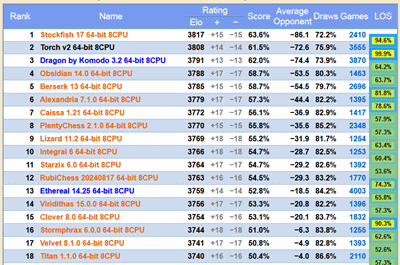
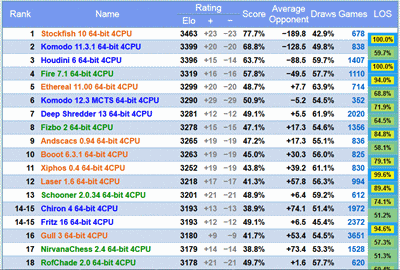
The chart below shows the current ratings of the top engines as calculated by the same source.


CCRL Blitz Rating List (Feb 2025)
(computerchess.org.uk/ccrl)

Now we have two engines rated over 3800 (Stockfish 17 and Torch v2), 29 engines over 3700 (not all shown), and 14 engines over 3600. If I keep posting to this blog at the current frequency, I'll be able to do 'Breaking the 3900 Barrier' in a year. Given that Stockfish, the top engine (rated 3817), has only increased 11 points since last year, I don't expect to see any engines over 3900 anytime soon.

Human players have reached a so-far insurmountable barrier of 2900. Are engines facing a similar barrier of 3900?

23 January 2025

FIDE Rating List - January 2025

This is the tenth consecutive year that I'm following a cookie-cutter approach to look at FIDE ratings for the new year. Following is the step-by-step checklist...

1) Identify last year's post: FIDE Rating List - January 2024 (January 2024).

2) Identify the source of the FIDE data: FIDE Ratings Download:-

STANDARD
TXT format (12 Jan 2025, Sz: 10.81 MB)

3) Compare some basic counts over the past few years. Going back to the start of 2020 gives pre-covid 19 as a reference point. This year I've added counts to show the increase (and one decrease) in the total and inactive counts.

2025: >486K players; >292K marked inactive [+46K +27K]
2024: >440K players; >265K marked inactive [+35K +12K]
2023: >405K players; >253K marked inactive [+28K +25K]
2022: >377K players; >228K marked inactive [+15K +54K]
2021: >362K players; >174K marked inactive [+8K -7K]
2020: >354K players; >181K marked inactive
[...]

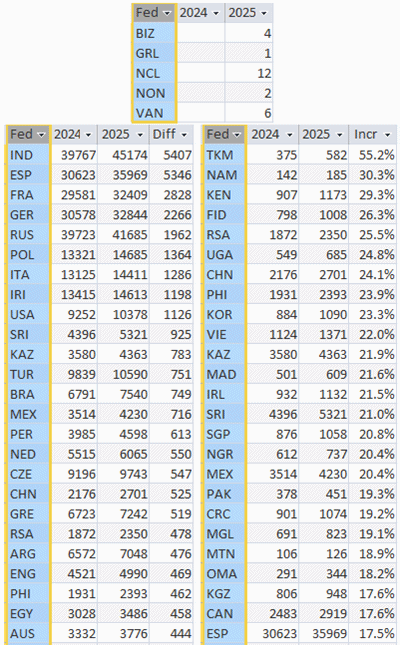
4) Analyze changes in players per federation. The top chart lists new federations in 2025 (BIZ = Belize; GRL = Greenland; NCL = New Caledonia; NON = Gareyev, Timur and Ramirez, Alejandro; VAN = Vanuatu).

The lower charts show federations with the largest increase in number of players (left) and the largest percentage increase (right; for federations with at least 100 players at the start of 2024; NB: TKM = Turkmenistan, NAM = Namibia)

5) Identify ideas for a followup post. Last year's only followup post, Players under the FIDE Flag (January 2024), might be worth a revisit because FIDE's (FED = 'FID') percentage increase was the fourth highest on the right column. Another idea would be to summarize all of the posts I've done through the years on different rating topics. That might be a long list, but I've lost track.

16 January 2025

January 1975 & 2000 'On the Cover'

At the end of the old millennium, 25 years ago, the right side of last month's post, December 1974 & 1999 'On the Cover' (December 2024), announced,

Whether you consider it to be the millennium or just the beginning of a new year, one thing is clear: Chess is still going strong.

At the start of the new millennium, also 25 years ago, it was business as usual.
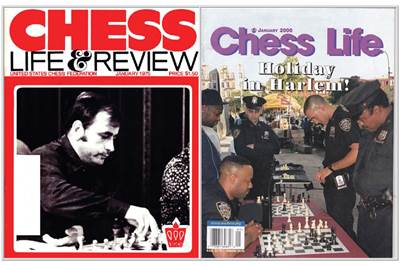

Left: '?'
Right: 'Holiday in Harlem!'

Chess Life & Review (50 Years Ago)

Vlastimil Jansa of Czechoslovakia, winner on tiebreak of the Atlantic Open in New York City, Nov. 28-Dec. 1. See the brief report [inside] and the full story next month. Photo by Nigel Eddis.

The 'brief report' said,

In N.Y., the Atlantic Open had 348 players; winners were Jansa, Matanovic, Bisguier, Zuckerman and Balmazi, with Jansa first on tiebreaks. GM Damjanovic withdrew when he realized that he and the swiss system were incompatible.

As for 'the full story next month', I climbed into my time machine to dive into the next 3-4 issues of CL&R, but came up empty-handed. Maybe something will surface in the next few 'On the Cover' posts. The January 1975 issue of CL&R also contained the 'FIDE International Rating List' with the following details:-

Closed 31 Oct. 1974; effective 1 Jan. 1975; provided by Arpad Elo

The 85 players rated 2500 or higher were also listed in descending order of rating. At the top of the list were:-

No.1 Fischer 2780
No.2 Karpov 2705
No.3 Korchnoi 2665
No.4-6 Petrosian, Polugaevsky, Tal 2645

After the American and five Soviets, the nationalities of the other players were given. The full counts of the nationalities were USA 8, USSR 36, and Other 41. Pachman was listed as 'Stateless'.

GM Jansa was listed in a block of players at no.36-41 rated 2540: Balashov, Gheorghiu, Jansa, Kholmov, Pfleger, and Schmid. His nationality was given as 'Czechoslavakia', where he was the third (of three) from that country after Hort and Smejkal. For an overview of his career, see Vlastimil Jansa (wikipedia.org; 'born 27 November 1942, is a Czech chess player [...] Grandmaster, in 1974').

Chess Life (25 Years Ago)

Holiday in Harlem! That's the most appropriate way of describing the all-day celebration of the opening of the HEAF (Harlem Educational Activities Fund) Harlem Chess Center. The city closed 119th Street and pawns were pushed not only by off-duty, gold-shielded sergeants, but by the likes of Wynton Marsalis, GM Maurice Ashley, New York Congressman Charles B. Rangel, and NYC Parks Commissioner Henry J. Stern. The story begins [inside], but it does not end there. • Cover photo by Brian Killigrew

That was the first of six paragraphs introducing the issue, each paragraph covering a separate topic. The Ashley / Harlem story continued in more than three pages and 18 color, captioned photos.

Maurice Ashley is not one to rest on his laurels. Having completed his goal of becoming a grandmaster, Maurice turned his attention to another passion of his: opening a world-class chess center for kids in Harlem.

On September 25, his passion became a reality as the Harlem Educational Activities Fund (HEAF) held a grand opening for its Harlem Chess Center (HCC) and announced to the world that chess in the inner city is here to stay.

Chess took over Harlem, as 119th Street was closed to traffic and chess games lined the street. The playground of PS190 was turned into a chess-playing area and a large stage was erected for the ceremonial speeches and the great entertainment to come by special guest star Wynton Marsalis and his band.

After the opening speech by HEAF president and Police Atheletic League Board of Directors vice-president Dan Rose, Maurice Ashley spoke to the crowd about wanting to give back to a community that has given him so much. "The center will be wonderful for the community" said Maurice, "My hope is that the idea will not be limited to Harlem, but that it will spread all over the city and eventually, the country." His words were greeted by an enthusiastic audience, filled by people who know how much chess can help a young persons' development.

The only info I could find about the fate of the chess center was on Maurice Ashley (heroic.us). It informed,

From 1991 to 1997 Ashley was the chess director of the Harlem Educational Activities Fund, Inc., where he led teams to three scholastic national championships -- three of his players also won the individual national championships for their age groups. [...] After earning his International Grandmaster title in 1999, Ashley returned to coaching and community action by becoming the first director of the Harlem Chess Center (closed in 2002 due to lack of funds).

Starting 2013, there is evience of a website in harlemchesscenter.org (archive.org).

12 December 2024

December 1974 & 1999 'On the Cover'

What do the Chess Life issues of December 1974 and December 1999 have in common? Yes, they are obviously the next in the 'On the Cover' series last seen in November 1974 & 1999 'On the Cover' (November 2024). On top of that, they were both dominated by rating lists.


Left: '?' (also 'Special Yearbook Issue!')
Right: '1999... 2000... and still going strong!'

Chess Life & Review (50 Years Ago)

Anatoly Karpov: if he beats Korchnoi, and if Fischer and FIDE cannot resolve their differences, he will be World Champion in 1975. Match games continue [inside].

Karpov's previous cover appearance was May 1974 & 1999 'On the Cover' (May 2024; 'Anatoly Karpov and Tigran Petrosian, winners of their quarterfinal candidates matches.') Everyone who knows anything about modern chess history knows what happened in 1975. I suppose we'll see the story unfold in next year's 'On the Cover' posts.

The December 1974 CL&R was 108 pages. Of those, 70 were allocated to the '1975 USCF Yearbook', and of those, 52 were allocated to the rating list. The Karpov - Korchnoi match, the inspiration for the cover, was a single page, with only raw game scores for games 11-21.

Chess Life (25 Years Ago)

No, we will not enter into the argument as to when the millennium arrives. We do knows that the end of December 31, 1999, will usher in a new year. Appropriately, the babe (2000) is playing the decisive Rg7+ against the old man (1999). The artist, Jose Angel Pardo, of Orlando, Florida, notes "That was the winning move I played in the first game I was ever able to beat my father."

Whether you consider it to be the millennium or just the beginning of a new year, one thing is clear: Chess is still going strong. Of our 86,000 members, fully 74,000 played at least one rated game of chess between October 1998 and October 1999. We've separated the Annual Rating List from the rest of the magazine and included a few items we hope you will find useful throughout the new year. And that includes a comprehensive listing of all changes to the Official Rules of Chess, 4th Edition.

Again we see a rating list. Of the 128 pages in the December 1999 CL, 49 were allocated to the list. Interspersed throughout the list were a number of interviews by Jerry Hanken, including one with 13-year old Lawrence Trent for the World Open and another with 8-year old David Howell. The same Howell, now a GM, commentated for FIDE on the recent World Championship match between Ding Liren and Gukesh.

There was more to the 'On the Cover' introduction for the same December CL. It continued,

Transition is never easy or particularly palatable for many. The Executive Board, in closed session, passed an enigmatic resolution to terminate the contract of Michael Cavallo as our Executive Director. I say enigmatic not as a judgement as much as a statement of fact.

After four paragraphs on the same subject I still didn't have a clue why this was newsworthy for the general CL readership. There is a ton of relevant information in the rgcp archive at groups.google.com, e.g. search?q=Cavallo, but who has the time to plow through it? For a previous cover illustration by Jose Angel Pardo, see September 1974 & 1999 'On the Cover' (September 2024).

01 February 2024

Breaking the 3700 Barrier

The post from earlier this week, The AI Generator (January 2024), was no.3700 on this blog, which means it's time for another 'Breaking the Barrier' post. In the previous post for the series, Breaking the 3600 Barrier (April 2023), I wrote,

Getting back to the 'CCRL Blitz Rating List' there are currently 17 engines rated over 3600. Based on that same list, it looks like we're already good for a 'Breaking 3700' post seven months (or so) from now, which should have at least two engines.

Make that nine months -- because I'm slowing down -- and let's have a look at the latest CCRL rating list.


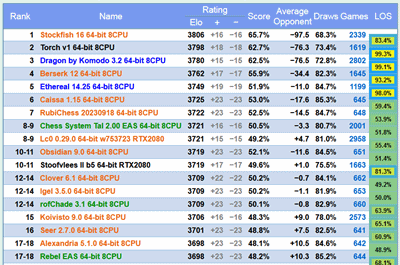
CCRL Blitz Rating List (Feb 2024)
(computerchess.org.uk/ccrl)

Now we have one engine over 3800 (Stockfish 16), 15 engines over 3700, and (not shown) 11 engines over 3600. It looks statistically strange to have more engines rated 3700 than 3600, but that's what the numbers say. See you a year from now for the '3800 Barrier' -- unless my slowdown grinds to a halt.

18 January 2024

Players under the FIDE Flag

In a recent post, FIDE Rating List - January 2024 (January 2024), I wondered where to go next with the data. I decided,

One idea is to look at the doubling of players under the FIDE flag ('FID'). To get started, here are counts of 'FID' players for the past five years:-

2020 : 252
2021 : 254
2022 : 263
2023 : 527
2024 : 798

Those numbers total 2094 players, of which 507 were rated 2000 or above. Of course, some of those players were listed as 'FID' for all five years, but I'll come back to that a bit later.

The key to detecting federation transfers is the FIDE ID, a unique code given to all chess players tracked by FIDE. A few years ago, I documented these codes on a page titled FIDE Country and Federation Codes - 'unofficial' (m-w.com; 'Last updated 2015-03-02'). The FIDE ID is shown in the last column of the table on that page. At the bottom of the page are references to blog posts that documented the creation of the page.

Each federation assigns codes to new players using the federation's FIDE ID as the first two or three digits of the player's unique FIDE ID, which is typically seven or eight digits. That means the player's last five digits are assigned autonomously by the federation, perhaps disconnected from any central FIDE database.

When I worked out the codes for the various federations in 2015, there were no FIDE IDs longer than eight digits. Now there are many codes with nine digits. It appears that FIDE assigns those codes when a new player -- previously unknown to FIDE and having no federation -- starts playing on the FIDE Online Arena (FOA). I eliminated 'FID' players with nine digit codes from the total of 2094 'FID' players counted earlier and arrived at new counts for the five years:-

2020 : 164
2021 : 166
2022 : 166
2023 : 394
2024 : 636

That totals 1526 players. I then counted the number of times each player appeared on the lists over the five years. I counted exactly 700 players distributed as follows:-

5 : 144
4 : 11
3 : 9
2 : 199
1 : 337

In other words, there were 144 players who were on the lists for each of the five years and there were 337 players who were on a list for only one year. Of those 337 players, 291 were on the 2024 list (released in January 2024, covering activity in 2023) and 82 were titled players (GM, IM, etc.).

Next stop: Which federations were responsible for those 82 titled players before they became 'FID' players? When I tackle this question, I'll have to keep in mind the European privacy laws that also apply to any chess player who changed federations.

09 January 2024

FIDE Rating List - January 2024

A new year means a look at the first FIDE rating list of the year. I've been doing this for so many years that I repeated that first sentence from last year without consciously copying it. Even better, I have a reliable checklist to follow.

1) Identify last year's post: FIDE Rating List - January 2023 (January 2023).

2) Identify the source of the FIDE data: FIDE Ratings Download (ratings.fide.com).

STANDARD
TXT format (31 Dec 2023, Sz: 9.77 MB)

3) Compare some basic counts over the past few years. Going back to the start of 2020 gives pre-covid 19 as a reference point.

2024: >440K players; >265K marked inactive
2023: >405K players; >253K marked inactive
2022: >377K players; >228K marked inactive
2021: >362K players; >174K marked inactive
2020: >354K players; >181K marked inactive
[...]

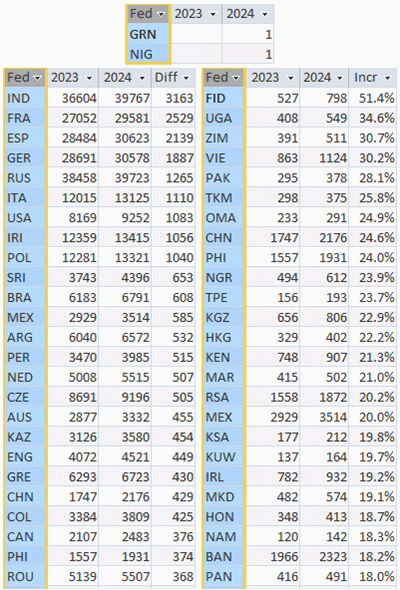
4) Analyze changes in players per federation. The upper chart shows two new federations (Grenada and Niger). No federation had a name change, giving FIDE exactly 200 federations.

The lower charts show federations with the largest increase in number of players (left) and the largest percentage increase (right; for federations with at least 100 players at the start of 2023). In last year's post I noted,

Mexico ('MEX') and Bangladesh ('BAN') are on both charts.

Copy that for Mexico, then add China ('CHN') and Philippines ('PHI'). Bangladesh missed being included this year by only two places on the left chart.

5) Identify ideas for a followup post. In last year's only followup post, FIDE Rating List - Active Players (January 2023), I remembered an idea from 2022:-

One idea is to look at the doubling of players under the FIDE flag ('FID'), as calculated on the right [chart]. This must be a consequence of the war in Ukraine, but should be confirmed.

Will I manage to do it in 2024? To get started, here are counts of 'FID' players for the past five years:-

2024 : 798
2023 : 527
2022 : 263
2021 : 254
2020 : 252

Yes, this confirms that there has been a substantial increase during the past two years. What more can we learn from the rating lists about this?

07 December 2023

December 1973 & 1998 'On the Cover'

Last month's post about U.S. chess magazines 50 and 25 years ago, November 1973 & 1998 'On the Cover' (November 2023), had an arty portrait on the right. This month's post has a different sort of art.


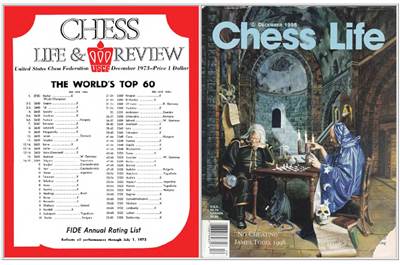
Left: 'The World's Top 60; FIDE Annual Rating List; Reflects all performances through July 1, 1973'
Right: '"No Cheating", James Todd, 1998'

Chess Life & Review (50 Years Ago)

Professor Elo's latest calculations. See [inside] for the complete list.

'Inside' had a two and a half page alphabetical list of rated players. The introduction said,

The following list, approved by the FIDE Congress at Helsinki. Finland, in September 1973, is the official list by which FIDE categories of international tournaments are determined. The list is revised annually, the next will be approved in June 1974. We thank Professor Arpad Eto for providing a copy for Chess Life & Review.

I have a copy of the list on my own domain. For background, see FIDE Historical Ratings 1971-74 (January 2008; 'The 1974 file is missing almost all women.'). For the list itself, see FIDE historical ratings (m-w.com). The file, 1973.zip, lists women, although they are missing on the CL&R pages.

Chess Life (25 Years Ago)

You won't find "No Cheating" in "The Art of Chess Calendar" (2999A, $10.95). However, if you like the work of James Todd, it doesn't matter where you come across his efforts -- in the USCF catalog (page C21) or on the cover of Chess Life, or at his website: jtstudio.com

The web site, JT Studio, is still active. Todd's work has been seen before on the 1996 side of May 1971 & 1996 'On the Cover' (May 2021; 'James Todd - What Price Victory'). The calendar and catalog references in the introduction relate to an insert distributed with the October 1998 CL. The text promoting the calendar said,

The Art of Chess Calendar • This 16 month calendar is filled with stunning chess artworks. James Todd, who has won numerous awards including Artist of the Year in 1992 by the St. Lotus Ad Assoc., is one of the most talented chess artists we've ever seen. The imagination and detail inherent in all Todd's works are sure to impress and please you with each new month of the coming year.

The lead story inside the December 1998 CL was a report by GM John Fedorowicz on the 1998 Olympiad.

04 April 2023

Breaking the 3600 Barrier

The post from a couple of days ago, Baffling eBay (April 2023), was post no.3600 on this blog. That means it's time for another 'Breaking the Barrier' post, last seen in Breaking the 3500 Barrier (October 2022). In that '3500' post I wrote

If I ever do a 'Breaking 3600' post, I now have two CCRL rating lists to consult, but I'll cross that bridge when I come to it.

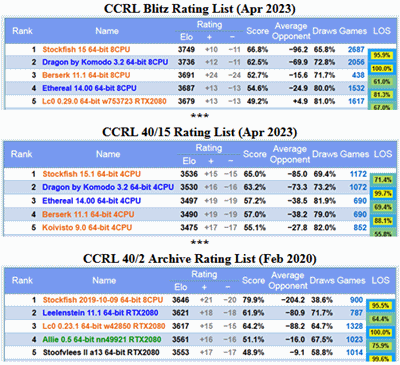
I am now standing in front of that bridge -- OK, sitting in front of it -- and I see that there are four CCRL rating lists. Shown below are the top five engines from three of the lists. Note that the third list is over three years old.


www.computerchess.org.uk/ccrl

Stockfish is the top engine on each of the lists, with a 3749 'Blitz' rating, and a 3536 '40/15', i.e. 'Rapid', rating. In the '3500' post I commented on the 200 point difference between the 'Blitz' and 'Rapid' ratings and am just as clueless now as I was then. In the same post I commented on the claim 'Carlsen breaks 2900 barrier':-

Given that Chess24.com is a defacto Magnus Carlsen fan club and that the record involved a '2900 Tour Rating' -- whatever that is -- the whole thing looks suspicious. TBD: Review for 'Breaking the 3600 Barrier'.

GM Carlsen's FIDE rating page Carlsen, Magnus (ratings.fide.com), shows him going over 2900 for both blitz and rapid ratings, but not for the standard rating. His current FIDE standard rating is 2853, making him the only player currently over 2800. GMs Nepomniachtchi and Ding Liren, the two players who will soon be playing for the title of World Champion, are rated no.2 and no.3 on the FIDE list at just under 2800.

Getting back to the 'CCRL Blitz Rating List' there are currently 17 engines rated over 3600. Based on that same list, it looks like we're already good for a 'Breaking 3700' post seven months (or so) from now, which should have at least two engines.

24 March 2023

Ding Liren's TWIC Debut

In last week's Friday post, Ding Liren's Climb to a Title Match (March 2023), I wrote,

We interrupt this series on 'Cheating @ Chess.com' to follow an important detour. [...] Before past title matches I've used a few posts to learn something about World Champion Carlsen's challenger for a particular match.

As I pointed out in the same post, 'GM Nepomniachtchi was Carlsen's challenger in the previous title match' and one of the posts I wrote then was Nepo's TWIC Debut (June 2021). I discovered there that young Nepo was keen on youth tournaments. See, for example:-

World Youth Championships (Nepo):-
TWIC 365; 2001-11-05 : U12 16-24
TWIC 420; 2002-11-25 : U12 1-2
TWIC 469; 2003-11-03 : U14 3
TWIC 523; 2004-11-15 : U18 15-27
TWIC 560; 2005-08-01 : U16 2-3

It turns out that Ding Liren's early events -- the only tournaments he played outside China before mid-2009 -- were events in which Nepo participated. Ding's earliest tournaments match Nepo's first four 'World Youth Championships', where Ding was competing in a lower age group because he was two years younger than Nepo.

World Youth Championships (Ding):-
TWIC 365; 2001-11-05 : U10 8-12 [Caruana 17-27]
TWIC 420; 2002-11-25 : U10 1-2 [Caruana 4-8]
TWIC 469; 2003-11-03 : U12 5-7 [Caruana?]
TWIC 523; 2004-11-15 : U12 1-2 [Caruana, Wesley So 7-15]

I added the info in brackets because Ding is three months younger than Fabiano Caruana, who participated in three of the same events & age groups as Ding. Each time, the Chinese player finished higher than the American. The 2003 event is unclear ('Caruana?') because TWIC listed only the top-10% (or so) finishers in each age group.

***

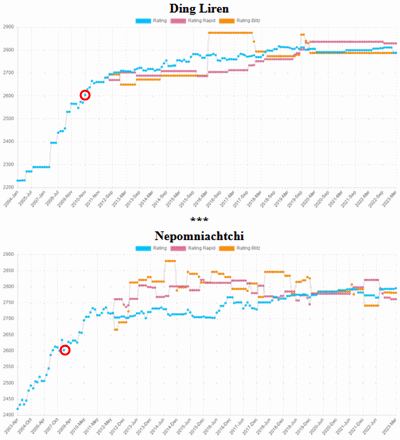
The following composite chart is from FIDE's 'Rating Progress Chart' for both competitors in the forthcoming 2023 Nepomniachtchi - Ding Liren Title Match (m-w.com). For a more readable view of the same data, see:-


Ding Liren - Wikipedia : 'Born: 24 October 1992'
Ian Nepomniachtchi - Wikipedia : 'Born: 14 July 1990'

The data points circled in red correspond to each player's 18th birthday. Ding was listed at 2604, Nepo at 2602.

17 January 2023

FIDE Rating List - Active Players

A week ago, in FIDE Rating List - January 2023 (FRL), I displayed some preliminary numbers from the current FIDE ratings. The numbers received some attention in Federations with the largest increase in number of players : chess (reddit.com), enough to propel the FRL post to no.3 in the list of 'Popular Posts (Last 12 months)' at the bottom of each page on this blog.

At the end of the FRL post I reminded myself of an outstanding action. A year ago I wrote,

2022: The count of inactive players in 2022 increased three times more than the count of active players. Looks like I should revisit the subject of inactive players.

In this year's FRL post I asked,

2023: This year the inactive numbers stabilized somewhat, but the count of active players increased only [3000] over the count of inactive players. How does this vary over the nearly 200 different federations?

I looked at the subject two years ago in FIDE Rating List - Inactive Players (January 2021). Now I'll go a little deeper.

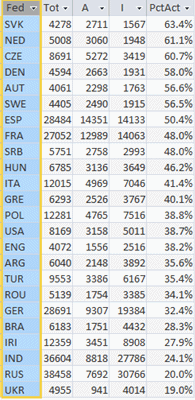
The chart on the left shows some numbers for the largest federations. Let's first have some context.
There are currently 198 different federations with players on the January 2023 FRL. Of those, 134 federations have 100 or more total players ('Tot' on the chart), 60 have 1000 or more, and 24 have 4000 or more, all of which are listed on the chart.

Why 24 federations? Because that's the number I can capture easily from the database query I used to create the chart.

For each federation, the 'A' column shows the count of active players and the 'I' column shows the count of inactive players. The 'PctAct' column shows the percentage of active players over the total number of players. Using the numbers I gave in the previous post...

2023: >405K players; >253K marked inactive

...that leaves 152K active players or 37.5% of the total number of players on the FRL. That's the same ballpark figure shown near the middle of the chart.

In the previous post, India ('IND') showed the largest increase in total number of players from 2022 to 2023. In the current chart, the country is third from the bottom in percentage of active players. This might be due to a high 'churn rate' in Indian chess -or- it might be a consequence of the 2020-22 covid crisis. I wouldn't judge without going deeper into the numbers.

The two countries at the bottom of the current chart are Russia and Ukraine. The current conflict is almost certainly the cause of the low activity, although for different reasons in each country. That brings me to another action from the previous post:-

One idea is to look at the doubling of players under the FIDE flag ('FID'), as calculated on the right [chart]. This must be a consequence of the war in Ukraine, but should be confirmed.

Now I have two reasons to prepare a third post this year.

10 January 2023

FIDE Rating List - January 2023

A new year means a look at the first FIDE rating list of the year. Let's follow the same cookbook instructions used last year.

1) Identify last year's post: FIDE Rating List - January 2022 (13 January 2022)

2) Identify the source of the FIDE data: FIDE Ratings Download (ratings.fide.com).

STANDARD
TXT format (06 Jan 2023, Sz: 8.98 MB)

3) Compare some basic counts over the past few years.

2023: >405K players; >253K marked inactive
2022: >377K players; >228K marked inactive
2021: >362K players; >174K marked inactive
2020: >354K players; >181K marked inactive
[...]

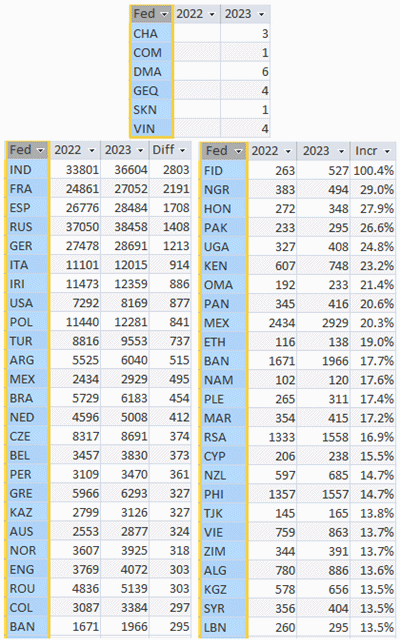
4) Analyze changes in players per federation. The upper chart shows six new federations (Chad, Comoros Islands, Dominica, Equatorial Guinea, Saint Kitts and Nevis, St. Vincent and the Grenadines). No federation had a name change.

The lower charts show federations with the largest increase in number of players (left) and the largest percentage increase (right; for federations with at least 100 players at the start of 2022). Note that Mexico ('MEX') and Bangladesh ('BAN') are on both charts.

5) Identify ideas for a followup post. Last year's post was FIDE Rating List - Women (January 2022). One idea is to look at the doubling of players under the FIDE flag ('FID'), as calculated on the right. This must be a consequence of the war in Ukraine, but should be confirmed. Last year I wrote,

The numbers under point '(3)' above show that the count of inactive players in 2022 increased three times more than the count of active players. Looks like I should revisit the subject of inactive players.

This year the inactive numbers stabilized somewhat, but the count of active players increased only 3K over the count of inactive players. How does this vary over the nearly 200 different federations?

14 October 2022

Historic Photo, Historic Game

In last week's post for the 'Fischer Friday' series, Roger Cohen, Foreign Correspondent (October 2022), I noted that the 1992 Fischer - Spassky Rematch was a tale of two matches:-

The first match, which had little to do with chess, was about Fischer's sudden return to chess after 20 years of self-imposed retirement. Was he still capable of playing at the highest level? Was Spassky? The second match, which started with the third game, was all about chess.

One journalist was eminently qualified to cover both matches, establishing her own reputation at the same time. We've seen her once before on my World Championship blog in Meet Cathy Forbes (May 2011). The British WIM wrote a couple of stories that have been published in at least two places: the book 'Meet the Masters', introduced in that post, and the March 1993 issue of Chess Life magazine, available online via Chess Life and Chess Review Archives.

The biggest difference between the book and the magazine was a photo that appeared in the book. Although other photos in the book were attributed, this one wasn't.


'Bobby Fischer: preparing for an historic game.'
(p.56; Cathy Forbes is on the right)

The photo relates to the following story which took place when the match moved from Sveti Stefan to Belgrade:-

I stayed up most of the Sunday night planning my questions for Monday's closing press conference. Questions to Mr. Robert Fischer were written on a special form. I was agonizing over my third question -- originally conceived as a joke -- when Grandmaster (Problem Solving) Marjan Kovacevic insisted, "Keep it. I like it. It's a brave question, one we would all like to ask."

"These questions are from Woman International Master Cathy Forbes ... No.3: May I play a game of chess with you?" Fischer looked down from the podium at me. "What's your rating?" Trying not to shake too visibly, I caught his eye and replied, "2125". Bobby smiled -- "Well, we'll think about it." Everyone laughed.

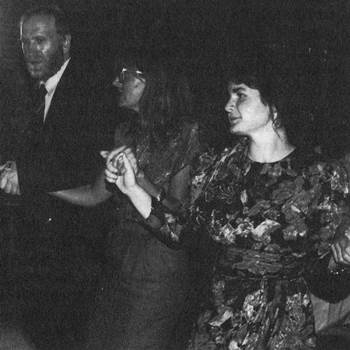
With the score at 5-2, Bobby was in a good mood. At the convivial closing party, he was even persuaded to dance to the stirring strains of local folk melodies [see photo]. Unexpectedly, but happily fortified by several powerful brandies, I was summoned to his table by a "Bobbyguard."

"We'll play a game - just quickly", he said.

That game is available on Cathy Forbes vs Robert James Fischer, 1992 (chessgames.com). It is the only published game where Fischer played against a woman. For more about the match from the same source, see 1992 Fischer - Spassky (ditto).

What were the best games of the match? On my page 1992 Fischer - Spassky Rematch; Highlights, game 1 has one gold star, game 11 has two. Although this is anecdotal at best, it's a starting point for further investigation.

03 October 2022

Breaking the 3500 Barrier

Another seven-plus months, another 100 posts. Yesterday's post, Chess and Italian Design (October 2022), was no.3500 on this blog. That means it's time for a follow-up to Breaking the 3400 Barrier (February 2022). If you haven't seen the series before, the number 3400 also refers to a chess rating. We had to abandon humanity at Breaking the 2900 Barrier (April 2019), because according to the accepted rating agencies, no one has ever achieved that level.

Not too long after the 'Breaking 3400' post, I had another off-week engine post, Stockfish Breaks All the Barriers (April 2022). There I wrote,

I'll come back to this current post if I ever need to do a 'Breaking 3500' post.

So here we are. Believe it or not, a 3500 rating means we're approaching the current limit for engines. In the 'Breaking 3400' post I noted,

The ratings for [TCEC] S18 were considerably higher than for S19 and subsequent TCEC seasons. Not knowing how to resolve this problem, I turned to another source for engine ratings, the CCRL.

Looking at that page CCRL Home (computerchess.org.uk/ccrl) again, I see there are two lists:-

  • CCRL Blitz (1; Stockfish 15 64-bit 8CPU; 3745 rating)
  • CCRL 40/15 (1; Stockfish 14 64-bit 4CPU; 3534)

The difference between a 37xx rating and a 35xx rating corresponds to the drop from TCEC S18 [37xx] to TCEC S19 [35xx]. I suppose that TCEC switched CCRL rating lists between S18 (finishing in July 2020) and S19 (October 2020). Or something like that.

That July-October 2020 time frame happened to coincide with the introduction of Stockfish NNUE, which saw a dramatic increase in the Fish's rating. If it wasn't rated 3500 before that period, it certainly was after. If I ever do a 'Breaking 3600' post, I now have two CCRL rating lists to consult, but I'll cross that bridge when I come to it. At the end of the 'Breaking 3400' post, I mentioned,

'Magnus Carlsen targets all-time rating record of 2900' (theguardian.com; Leonard Barden; January 2022). When I come back in 6-7 months for 'Breaking the 3500 Barrier', I'll check the World Champion's progress.

Reports last month proclaimed, e.g. Magnus Carlsen breaks 2900 barrier in Julius Baer Generation Cup win (chess24.com; Leon Watson). The article started,

Magnus Carlsen is the Julius Baer Generation Cup champion and the first player to break the 2900 Tour Rating after crushing the "Indian Iceman" Arjun Erigaisi in today’s final.

Given that Chess24.com is a defacto Magnus Carlsen fan club and that the record involved a '2900 Tour Rating' -- whatever that is -- the whole thing looks suspicious. TBD: Review for 'Breaking the 3600 Barrier'.

22 July 2022

'Only an IM'

Last week's Fischer Friday post, Drawing for Colors in 1972 (July 2022), centered on an event two days after Fischer arrived in Iceland. Let's rewind the clock to two days before he arrived.

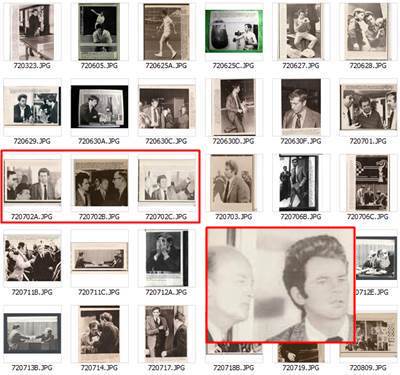
The photo below is adapted from Fischer Wirephotos I (March 2016). I've highlighted in red three consecutive wirephotos that all show Spassky with the same man. Who was he?

The larger photo highlighted in red is a cropped version of the third wirephoto. Its caption explained,

(NY4) REYKJAVIK, Iceland, July 2 -- SO FAR STILL CHAMPION -- Boris Spassky of Russia, present World Chess Champion, holds thumb up outside his hotel in Reykjavik, Sunday. Challenger Bobby Fischer of the United States has so far failed to arrive in the Icelandic capital for the championship match that had been scheduled to start Sunday. Officials gave Fischer until Tueday at noon to show up or else risk forfeit. At left is Jivo Nei, a Soviet chess master. (AP Wirephoto via cable from Reykjavik) (See AP AAA Wire Story) (lsk12300pw) 1972 (REY2)

'Jivo Nei, a Soviet chess master' is better known as Iivo [or Ivo] Nei. He has a Wikipedia page, Iivo Nei. It starts,

Iivo Nei (born 31 October 1931 in Tartu) is an Estonian chess master.

The first comment on his Chessgames.com page, Iivo Nei, speculates on his role in Spassky's team:-

He wasn't there for his chess talent -- he was only an IM -- and instead was there for his talent with a tennis racket. He was Spassky's "physical trainer".

Only an IM? The first of the historical rating files in my database -- see FIDE Historical Ratings 1971-74, on my World Championship blog (January 2008), for links -- lists players' titles along with their ratings. Of the 592 players on the first list, 83 were GMs and 178 were IMs. Fifty years ago, the strongest IMs were among the top-100 players in the world.

My recent post, According to Darrach, Day by Day (July 2022), gave a chronology covering the first half of July 1972. For the day of the captioned wirephoto, the chronology says,

Sun, 02 Jul • Scheduled match start, Iceland; Euwe postpones 1st game for two days • p.092

That chronology stopped at the third game, played 16 July 1972. [NB: later changed to the fourth game, the first game that was not overshadowed by off-board antics.] The date of this post, 22 July, was the off-day before the dramatic sixth game, when the match was tied at 2-1/2 points for both players.

***

Later: Re 'Fifty years ago, the strongest IMs were among the top-100 players in the world', On the first FIDE rating list in 1971, Fischer was no.1 at 2760, Spassky no.2 at 2690. IM Iivo Nei was no.82 at 2495. A group of six players, five IMs and one untitled, was tied for no.100 at 2480.

04 April 2022

Stockfish Breaks All the Barriers

Two weeks ago the off-week engine post was Stockfish Sparkles (March 2022). This post continues with the Stockfish theme.


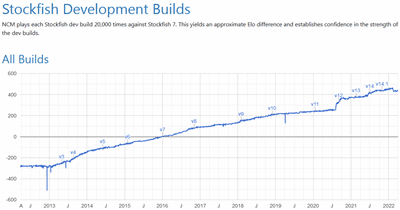
NCM Stockfish Dev Builds
(nextchessmove.com)

The small print above the chart is self-explanatory:-

NCM plays each Stockfish dev build 20,000 times against Stockfish 7. This yields an approximate Elo difference and establishes confidence in the strength of the dev builds.

Another recent off-week engine post was Breaking the 3400 Barrier (February 2022), where I reckoned that Stockfish broke that rating milestone around March 2019. According to the NCM chart above, Stockfish is currently playing 200 Elo above its March 2019 strength.

The Fish blew past the 3500 mark when it switched to NNUE evaluations. That corresponds to a post on this blog from the same period: Stockfish NNUE = +90 Elo (August 2020). I'll come back to this current post if I ever need to do a 'Breaking 3500' post.

21 February 2022

Breaking the 3400 Barrier

Yesterday's Flickr post, 1.Nf3 in Zalaegerszeg (February 2022), was post no.3399 on this blog, making this off-week engine post the perfect spot for the follow-up to Breaking the 3300 Barrier (August 2021), my most recent periodic look at century milestones in chess ratings. In that '3300 Barrier' post I calculated that the interval between 'barrier' posts was seven months, so we're slightly ahead of schedule.

My first idea for this current post was to look at the ratings of engines from important TCEC/CCC events, but I encountered an anomaly. For TCEC S21, last seen on this blog in TCEC Stockfish Wins S21; CCC Romance Continues (August 2021), the top three engines in the semifinal event were rated:-

S21 - Division P
1 Stockfish 2021061923 • 3632
2 LCZero 0.28.0-rc1_69146 • 3614
3 KomodoDragon 2747.00 • 3582

Those ratings were higher than for the top three in S20, which were higher than S19. For S18, last seen in Stockfish Wins TCEC S18; Leela Wins CCC14 (July 2020), the top three were:-

S18 - Division P
1 Stockfish 202005232210 • 3796
2 LCZero v0.25.1-sv-t60-3010 • 3809
3 AllieStein v0.7_dev-net_14.3 • 3761

In other words, the ratings for S18 were considerably higher than for S19 and subsequent TCEC seasons. Not knowing how to resolve this problem, I turned to another source for engine ratings, CCRL Home (computerchess.org.uk/ccrl). The top three engines there are currently:-

1 Stockfish 14 64-bit 4CPU • 3541
2 Dragon by Komodo 2.6 64-bit 4CPU • 3527
3 Fat Fritz 2 (in SF) 64-bit 4CPU • 3517

And when did engine ratings break 3400? Older CCRL results are available in Archive.org. The oldest results, from March 2019, are captured in the following image.


Source: Wayback Machine

The highest rating is 3463 for Stockfish, with the next two engines just under 3400. That's the closest I got to answering my question.

As for the human contingent, Magnus Carlsen targets all-time rating record of 2900 (theguardian.com; Leonard Barden; January 2022). When I come back in 6-7 months for 'Breaking the 3500 Barrier', I'll check the World Champion's progress.

18 January 2022

FIDE Rating List - Women

A day after my recent post on ratings, FIDE Rating List - January 2022 (January 2022), FIDE published Manifesto: The Year of the Woman in Chess (fide.com). What do the FIDE rating lists (FRLs) tell us about women in chess?

First, they tell us which FIDE registered players are women. In fact, they tell us twice. There is one field in the lists called 'Sex', which is set to 'M' or 'F'. There is another field called 'Flag', which includes 'w' if the player is female. I checked the content of the two fields and they match. Where 'Sex = F', 'Flag = *w*', and vice versa. There are undoubtedly legacy reasons for maintaining two fields, but I imagine it's a headache for FRL administration.

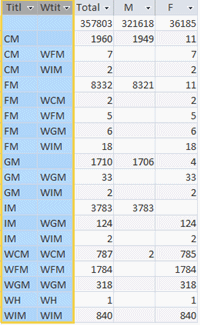
Second, the rating lists tell us which women have titles. There are two relevant fields in the list, 'Titl' and 'Wtitl', the first for all players, the second for women only. The following table shows the distribution of the two titles over all players, both men and women.

The first two columns in the table show various combinations of the two fields; the rest of the columns give a count. For example, the first row counts the number of players who have no title.

The second row counts the number of players who have a 'CM' title (Candidate Master) and no women's title; this includes 11 women. The third row counts players who have both a 'CM' title and a 'WFM' (Women's FIDE Master), and so on.

The pecking order of the titles is 'GM', 'IM', 'FM', 'CM'. The same is true for women's titles.

The titles are (largely) internally consistent. Two players marked 'M' have 'WCM' titles and one player has a 'WH' title, but these are the only inconsistencies I can see.

It would probably be revealing to see the rating ranges -- maximum rating, minimum rating -- for all titles. I recall having done that in the past, so I would first have to locate that post.

Lurking on the horizon is another angle to this discussion. Wikipedia defines Non-binary gender as:-

An umbrella term for gender identities that are neither male nor female -- identities that are outside the gender binary.

I wonder if FIDE has discussed this issue internally. I also wonder what other international sports organizations -- the IOC or FIFA -- are doing about it. It's certain to arise in the not-too-distant future.

13 January 2022

FIDE Rating List - January 2022

It's become a new year ritual. Here's the sequence...

1) Locate last year's post. A year ago it was FIDE Rating List - January 2021 (8 January 2021).

2) Access FIDE Ratings Download (fide.com) and download the file that is described something like this:-

STANDARD
TXT format (14 Jan 2022, Sz: 8.33 MB)

3) Load the file into the database that stretches back to 1971 and compare it to recent years:-

2022: >377K players; >228K marked inactive
2021: >362K players; >174K marked inactive
2020: >354K players; >181K marked inactive
[...]

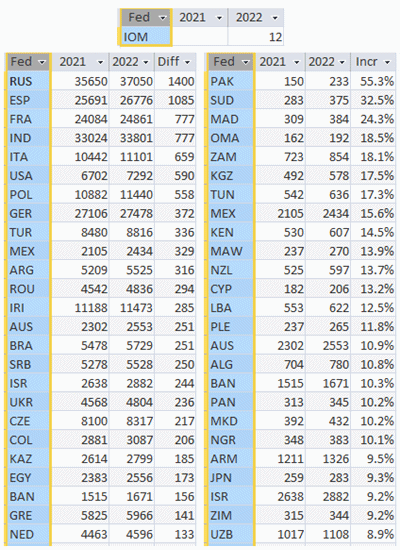
4) Produce a sequence of queries to derive the following charts. It shows one new federation since January 2021, plus two views of increases in the number of players per federation. The chart on the right is restricted to federations with 100 players or more at the start of 2021.

5) Create some additional posts (optional), then hibernate until the following year. Last year I wrote one additional post:-

...The numbers under point '(3)' above show that the count of inactive players in 2022 increased three times more than the count of active players. Looks like I should revisit the subject of inactive players.