Showing posts with label Blog Tools. Show all posts

27 January 2025

Chess Graffiti

In Chess Guy Likes to Talk (January 2025), I wrote,

For the third time in less than a year, the monthly featured Flickr post contains two keywords: Shoreditch graffiti.

While working on that post I discovered a new resource, an example of which is shown in the following image.


Online Graffiti Generator - Graffiti Empire
graffiti-empire.com

That example was constructed using the first offered 'font' plus the default 'style'. I cropped signatures to the left and right of the main image. The white stars/sparkles appear to be placed at random; the rest is repeatable.

What else could I use it for? Beats me, but maybe I'll think of something.

04 November 2024

Where Was I?

Over the last six months my blogging has dropped to minimum activity -- five posts a month on this blog, one post a month on my chess960 blog, and nothing at all on my World Championship blog (WCCB). I would like to improve that.

Starting in April, external factors having nothing to do with chess took over my free time, but they have now subsided considerably. It's time to increase the frequency of posts.

Recent posts on this current blog are a continuation of ongoing series that I've been doing for many years. Two shorter term series were interrupted and could be restarted:-

The last post on my WCCB blog was:-

With a new World Championship match to start at the end of the month, it's high time to reactivate the blog. On top of that I have more than five months of bookmarks to wade through. Consider this post a checkpoint to measure future progress.

19 April 2024

CFAA's CMP : Blogs

After two posts on my experience with Google's CMP -- CFAA's CMP Earnings and Visitors (both April 2024; CMP = Consent Management Platform for ads) -- I decided,

I don't mind losing the ad revenue. [...] This latest chart, however, shows that the CMP change is making visitors stay away. [...] It looks like Google's Adsense will have to go.

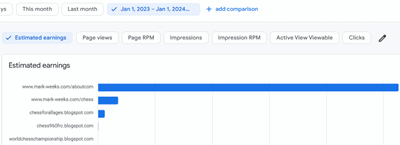
That will take some time to do, but in the meantime I have another decision to make. My Google account's CMP and associated ads also appear on my blogs. The following chart shows the impact of the blogs' ads on total earnings.


google.com/adsense : full year 2023

The first line shows earnings from m-w.com/aboutcom (the 'Chess for All Ages' site), the second line from m-w.com/chess (the 'World Chess Championship' site), and the third line from this blog that you're reading (CFAA). The last two lines are for my other chess blogs.

The first line says that over 90% of earnings are coming from the CFAA site. Of course, I knew that already, but it always helps to quantify relationships.

Re the three blogs, although their 'earnings' are negligible, I've never done them for the money. They're more of a hobby than anything else. If they get visitors, that's great; if they don't, there's no harm done. Through the years that I've been keeping them up-to-date, the daily numbers of visitors have fluctuated substantially and depend on a number of factors over which I have little control.

Bottom line: I'll keep Adsense on the blogs. That will help me stay up-to-date with online ad technology and trends. The online space evolves so quickly that what is true today is no longer true tomorrow and vice versa.

12 April 2024

CFAA's CMP : Visitors

In the previous post, CFAA's CMP : Earnings (April 2024; Google's CMP = Consent Management Platform for ads), I noted,

Although [ad] earnings declined significantly over the last six months, what about page views? I'll look at that metric in a follow-up post.

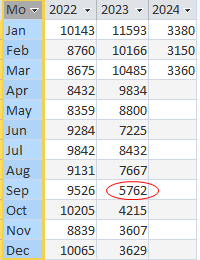
I also noted that earnings declined more than 90% after I implemented the change that Google had imposed. The following chart shows monthly visitor counts -- as recorded by my site's ISP -- over the past two full years 2022 and 2023, plus the first three months of 2024.

Worse and worse! The red circle indicates the month that I implemented CMP on my personal domain (m-w.com).

Sep 2023 was down 40% over the previous year and Oct 2023 was down 60%, as were the following two months. The first three months of 2024 were down 70%.

I don't mind losing the ad revenue. I was mainly taking advantage of the ads to cover site server costs. This latest chart, however, shows that the CMP change is making visitors stay away. That is something up with which I shall not put! (to quote Churchill)

It looks like Google's Adsense will have to go.

05 April 2024

CFAA's CMP : Earnings

In the previous post, CFAA's CMP : Another Look (March 2024), I noted,

My preliminary analysis says there are rough waters ahead. So what happened?

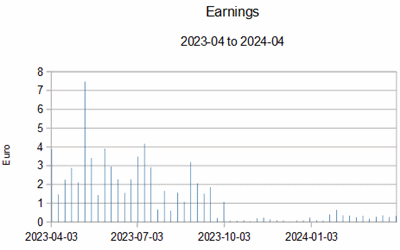
The following chart shows earnings from my resources generated by Google ads over the past year. I implemented Google's CMP near the end of September 2023 ('2023-10-03' on the chart).

There is a sharp contrast between the six months preceding that date and the six months following. (Missing from the chart is the end date, around '2024-04-03'.) The ratio of the total earnings in the first six months to the total in the last six months is about ten to one.

Although earnings declined significantly over the last six months, what about page views? I'll look at that metric in a follow-up post.

29 March 2024

CFAA's CMP : Another Look

It's been six months since I adapted my domain mark-weeks.com to incorporate Google's CMP. I documented the change in a series of Friday posts that ended with CFAA's CMP : Wrapup (September 2023; CMP = Consent Management Platform). How well has that change worked? I'll come back to the subject in a new series of Friday posts.

My preliminary analysis says there are rough waters ahead. So what happened? Has Google lost its touch?

22 September 2023

CFAA's CMP : Wrapup

For the past month I've been running a series on actions provoked by Google's Adsense. Here are the relevant posts:-

In that last post, I wondered,

What happens if a visitor to my site doesn't grant consent? No ad is shown. Since I routinely use two different devices, I'll grant consent on one and withhold it on the other. That way I'll be able to monitor both sides of Google's consent management.

It turns out that wasn't a useful strategy. I automatically delete cookies when I close a browser. The consent appears to be stored in a cookie, so I routinely lose the consent cookie and have to go through the process each time I access my own site. [NB: Confirm this.] In that same post, I also wondered,

What's next? I need to improve my own privacy policy to answer the questions that Google says I'm answering. To do that, I'll summarize the current series and point to that summary.

The most important question is 'How can I change my choice of consent?'. Since Google is constantly tinkering with its software, I'll describe the procedure as it is today. After going through the consent procedure, the following image attaches to the left side of a page on my site.
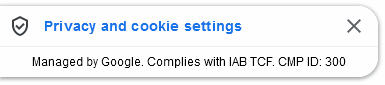
That's what it looks like near the bottom of the page. To re-open the consent procedure, click on the blue text. Near the top of the page, the image collapse into the icon displayed in the upper left (a check mark on a shield). Clicking the icon expands to the image shown above. This procedure is sure to change in the future, but I'll try to keep up with it.

As for CMP on my blogs, I'll follow Google directives for them. All of the blogs are managed using Google's services. For the moment, ads aren't being displayed on this current blog or on my two other chess blogs (WCCB, C960; accessible via my Blogger.com profile). The non-chess blog is showing ads. Since ad revenue is near zero on all of the blogs taken together, I really don't care if no ads are displayed.

***

Later: On my page, World Chess Championship : Site map, under the first section, titled 'Privacy statement', I added a link to this blog post. That statement applies equally to another large portion of my domain, the pages accessed via Welcome to 'Chess for All Ages'.

One other non-trivial change is worth mentioning. The old version of the 'Site map' ended with:-

For more information on Internet and Web privacy, see www.truste.org.

That site now returns the message, 'can’t connect to the server at www.truste.org'. What happened to it? A Google search points to TrustArc (wikipedia.org), which starts,

TrustArc Inc. (formerly TRUSTe) is a privacy compliance technology company based in Walnut Creek, California. The company provides software and services to help corporations update their privacy management processes so they comply with government laws and best practices. Their privacy seal or certification of compliance can be used as a marketing tool.

Archive.org stops showing the truste.org domain at the end of 2017. Whatever the reason for the name change, with comply/compliance we're all talking the same language. When a powerful government talks, nobody walks. They run. Even Google runs.

15 September 2023

CFAA's Consent Management

For the current Friday series, I closed the previous post, Adsense and CFAA's CMP (September 2023; CMP = Google's Consent Management Platform), in a holding pattern:-

After adding the logo, my GDPR message was accepted. As I was preparing this post for publishing, the message still wasn't showing on my pages, so maybe I did something wrong. I'll come back to it for next Friday's post.

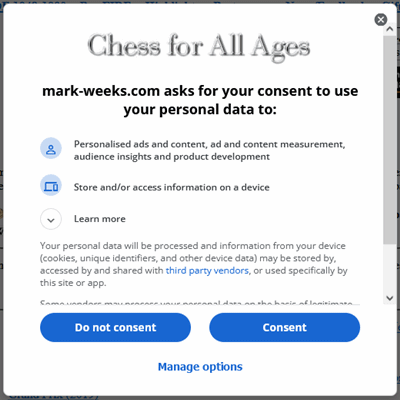
I had indeed done something wrong. I was watching the top level page for my domain which doesn't display an ad. The Adsense code to display an ad is the trigger for the consent message. When I accessed a page with an ad, I saw the following popup message.

The message is the tip of an iceberg. The text reads like this:-

mark-weeks.com asks for your consent to use your personal data to:

* Personalised ads and content, ad and content measurement, audience insights and product development devices [sic; the phrase needs verbs]
* Store and/or access information on a device

Learn more

Your personal data will be processed and information from your device (cookies, unique identifiers, and other device data) may be stored by, accessed by and shared with third party vendors, or used specifically by this site or app.

Some vendors may process your personal data on the basis of legitimate interest, which you can object to by managing your options below. Look for a link at the bottom of this page or in our privacy policy where you can withdraw consent.

[Do not consent] [Consent]

Manage options

I looked at all of the hidden text and discovered a few important points.

  • 'Learn more' expands to a series of four questions. The first question is 'How can I change my choice?'. The answer says, 'View our privacy policy to learn more' and points to my page World Chess Championship : Site map. The first section there is a 'Privacy Statement', but this is the first I learned that this page has to explain 'How can I change my choice?'. I need to address that.

The answers to two other questions discuss 'legitimate interest', which seems to be some sort of legal override of the whole consent process. Back to the popup message:-

  • The mention of 'third party vendors' expands to a single question: 'What third party vendors can access my data?'. The answer is a list of (currently) 203 vendors. By any reckoning, that's a lot of vendors.

The last line of the popup message is the most important.

  • 'Manage options' opens another section of the popup that starts, 'You can choose your data preferences. This site or app wants your permission to do the following: [...]'. The first 16 consents are for 'TCF vendors' (referring to 'the IAB Europe Transparency and Consent Framework') followed by a single consent for the 'Site or app' (that means my site). This is followed by 'Vendor preferences', where each of the 203 vendors presents a cookie policy, a link to its privacy policy, and perhaps a statement of 'legitimate interest'.

What happens if a visitor to my site doesn't grant consent? No ad is shown. Since I routinely use two different devices, I'll grant consent on one and withhold it on the other. That way I'll be able to monitor both sides of Google's consent management.

What's next? I need to improve my own privacy policy to answer the questions that Google says I'm answering. To do that, I'll summarize the current series and point to that summary.

08 September 2023

Adsense and CFAA's CMP

Last Friday's post, Adsense and the CMP (September 2023), established a plan:-

Google's permanent page on the subject [...] sets a deadline: 'Beginning January 16, 2024, publishers and developers using Google AdSense, Ad Manager, or AdMob will be required to use a Consent Management Platform (CMP) [...]'. The page contains a list of 'Google-certified CMPs' that currently has 50 names with a link for each name. Only one of the 50 names was even vaguely familiar to me, 'Google consent management solutions', so no prize for guessing which one I chose to investigate further. [...] That leads to the next stage of the adventure, which I'll cover in the next Friday post.

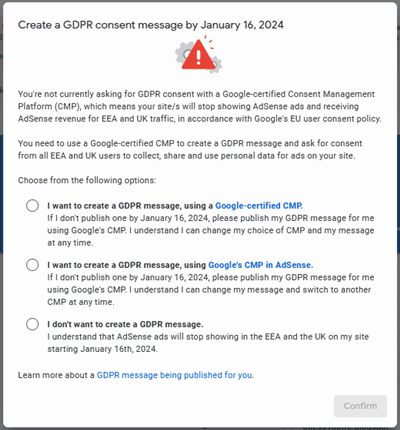
That 'next Friday post' is today's post. When I signed into Adsense to continue the adventure, I received a new notification on CMPs, shown below.

Since I had already started to create a GDPR consent message for the previous post, I chose the second option and CONFIRMed. Now I was nagged a second time with the message:-

Notifications: Remember to publish your GDPR message using a Google-certified CMP to continue showing AdSense ads on your site in the EEA and the UK. If you don't publish it by January 16, 2024, we'll publish one for you.

This was the first time I knew that Google would 'publish one' for me. If I had known that earlier, I probably would have gone that route. Instead, I accessed my stored message and published it. I received an error message:-

Your message is almost ready to publish. You need to add a logo to publish your message.

My domain has two main sites (linked near the top of the right sidebar), both with a different logo. The CFAA portion of the site generates the most Adsense revenue, so I used the following logo. It's based on the logo for the CFAA pages, but respecting Google's CMP requirements.

After adding the logo, my GDPR message was accepted. As I was preparing this post for publishing, the message still wasn't showing on my pages, so maybe I did something wrong. I'll come back to it for next Friday's post.

01 September 2023

Adsense and the CMP

In last week's Friday post, Adsense and the GDPR (August 2023), I wrote,

Ads are related to cookies. It's been eight years since the last time I looked at the European cookie monster. [...] Since then, the European Union has introduced the GDPR, which stands for General Data Protection Regulation (wikipedia.org). The CMP requirements are a response to the GDPR. What does that entail for small web sites like mine? I'll look at that in the next post.

A few months ago Google introduced a new requirement.

The two phrases in italics link to two more explanatory pages -- from blog.google and iabeurope.eu -- but first let's make sure we understand the acronyms:-

  • EEA : European Economic Area (wikipedia.org)
  • UK : United Kingdom (aka Britain)
  • IAB : Interactive Advertising Bureau

Google's permanent page on the subject is New Google consent management requirements for serving ads in the EEA and UK (for publishers; support.google.com). It sets a deadline:-

Beginning January 16, 2024, publishers and developers using Google AdSense, Ad Manager, or AdMob will be required to use a Consent Management Platform (CMP) that has been certified by Google and has integrated with the IAB's Transparency and Consent Framework (TCF) when serving ads to users in the EEA or the UK.

The page contains a list of 'Google-certified CMPs' that currently has 50 names with a link for each name. Only one of the 50 names was even vaguely familiar to me, 'Google consent management solutions', so no prize for guessing which one I chose to investigate further. Its link went to a page titled, About Privacy & Messaging (support.google.com). The 'Get started' message instructed,

To access your Privacy & Messaging page, sign in to your AdSense account and click Privacy & Messaging in the AdSense sidebar.

That leads to the next stage of the adventure, which I'll cover in the next Friday post.

25 August 2023

Adsense and the GDPR

In last Friday's post, Adsense on CFAA++ (August 2023), I concluded with:-

Adsense is once again increasing the volume of its commanding voice: 'New Consent Management Platform [CMP] requirements for serving ads in the EEA and UK'. • TBD. Watch this space...

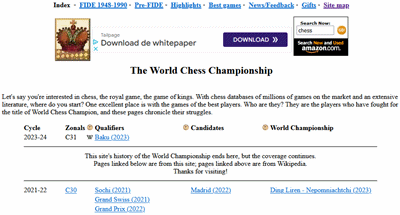
My WCC index page, shown below, is a typical example of how I handle ads across the site.


Index : World Chess Championship

The ad ('Download de whitepaper'; that's Dutch, believe it or not) appears between the site 'logo' and the link to Amazon. The small right-pointing triangle on the left side of the ad, leads to a page titled About this ad (adssettings.google.com). The small 'x' beneath the triangle removes the ad.

Ads are related to cookies. It's been eight years since the last time I looked at the European cookie monster. At that time I wrote two posts:-

Since then, the European Union has introduced the GDPR, which stands for General Data Protection Regulation (wikipedia.org). The CMP requirements are a response to the GDPR. What does that entail for small web sites like mine? I'll look at that in the next post.

18 August 2023

Adsense on CFAA++

Earlier this year, in TGIF on CFAA (June 2023), I wrote,

Some of my blog posts are basically notes to myself. This is one of them.

This current post is another. To parrot the thought process introduced in the TGIF post,

I took three weeks off at the beginning of July and have been scrambling since then to get my blogs back on track. Although you can't see it easily from the dates on the posts, I wrote 21 posts in 25 days and am now caught up.

In addition to the actions mentioned in the TGIF post, I need to catch up with new actions from Google ('Your wish is my command, master!'). The last time I did this was documented in Party Cookies (October 2022; 'Earlier this year I ran a series of four posts about living with Google's Adsense').

Adsense is once again increasing the volume of its commanding voice: 'New Consent Management Platform requirements for serving ads in the EEA and UK'. • TBD. Watch this space...

25 November 2022

Wayback to Smartchess

Earlier this month on my 'World Chess Championship Blog', I posted Smartchess Interviews Karpov (November 2022). I noted,

A footnote to the interview mentioned that it first appeared on Smartchess Online in September 1997. I tried to find the original interview via the Wayback Machine, but failed. Smartchess.com appears to have been built using techniques that are incompatible with Wayback assumptions.

It turned out that the Wayback obstacle is easily overcome. Don't try to open its links in new tabs, then everything works. Starting with the web.archive.org link given in the 'Interviews Karpov' post, I followed...

'SmartChess Online' -> 'Back Issues of SmartChess Online' -> The SmartChess Archive for 'September 1997' -> 'Publisher's Message' -> 'Ron Henley's Mail Bag'

...and was rewarded with the press photo pictured below.


"Best Wishes!" - D.T.

For more on this blog from the chess-playing 45th U.S. president, see Donald Trump, Chess Master (October 2022). As for the Smartchess Karpov interview in September 1997, a page '"Karpov On The Net" by FIDE World Champion GM Anatoly Karpov' presented 'Two From Biel [1997]', two games annotated by Karpov. Another page, '"In Conversation With..." by Rachel Landry', who was Karpov's interviewer, had a different interviewee:-

GM Gabriel Schwartzman is a University of Florida student with a perfect grade point average, a successful businessman, a respected chess journalist and commentator, a licensed chess coach, the 1996 U.S. Open Champion and, as if all that isn't enough, he can checkmate you in six languages! At the age of twenty, Gabriel is a seasoned veteran of chess. He began playing at two years old and at seventeen, he was awarded the title of International Grandmaster.

Other columnists in the same issue were GM Walter Browne, GM Gabriel Schwartzman, GM Michael Rohde, NM Irina Krush, GM Ron Henley, NM David Koval, GM Alexei Shirov, GM Andras Adorjan, and FM Asa Hoffmann. That makes a lot of chess history to sort through.

The first issue of 'SmartChess Online' was dated August 1997 and the last was dated August/September 2003, a total of 45 issues. At some time in 2005, the site started redirecting to ClassicalGames.com. My 'Interviews Karpov' post had a second follow-up:-

In his interview with Smartchess, Karpov mentioned a couple of video series he was developing for Smartchess's 'WWW Chess Superstore'. I've featured two of these in posts on my main blog [...] How many more of these videos are still available on Youtube?

I started to look into that question, but ran out of time. The first problem is how to catalog them.

13 October 2022

Party Cookies

Earlier this year I ran a series of four posts about living with Google's Adsense:-

It's time for another post in the series. Lately I've been receiving emails from Google informing me about 'First-party cookies support for personalization'. Here's a sample email text:-

Last year, we launched first-party cookies from Google to help you increase your revenue with features like frequency capping. Now, we're updating first-party cookies to also support personalization. • What does this mean? • First-party cookies for personalization help to show personalized ads to your users when third-party cookies aren’t available, which may increase your revenue.

By now, everyone knows what cookies are, but what are 'first-party cookies' and 'third-party cookies'? A Google AdSense help page, Ad serving settings, explains,

First-party cookies • Cookies are small text files downloaded to a user's browser that can be used to store user information and preferences. Cookies are either first-party (associated with the domain the user is visiting) or third party (associated with a domain that's different from the domain the user is visiting). Google may use first-party cookies when third-party cookies are not available.

Allow first-party cookies • Choose whether or not you want to allow first-party cookies from Google on your site. Allowing first-party cookies from Google may increase your revenue because it enables features like frequency capping on ads and allows ads with a frequency cap to serve on your site.

Use first-party cookies for personalization • Choose whether or not you want to allow first-party cookies for personalization on your site. First party cookies for personalization help to show personalized ads to your users when third-party cookies aren’t available, which may increase your revenue. You can only use these cookies for personalization if you’ve turned on the Allow first-party cookies option.

The concept of 'frequency capping' sounds like a good thing. Otherwise you might get the same ad every time you look at a post on this blog (or on any of my other resources that use AdSense).

The concept of 'personalized ads', however, sounds like an attempt to get around a lack of third-party cookies. If they aren't available, there's probably a reason. Maybe someone has simply turned them off.

Long story short -- I left 'first-party cookies' on, but turned 'first-party cookies for personalization' off. Finally, what about 'second-party cookies'. Are they a thing? This page, Breaking down First, Second, and Third Party Cookies (mmaglobal.com; 'MMA is the only marketing trade association that brings together the full ecosystem of marketers, martech and media companies working collaboratively'), says,

Second-party cookies are cookies that are transferred from one company to another company via some sort of data partnership. For instance, an airline could sell its first-party cookies (along with other first-party data such as names, email addresses, etc.) to a trusted hotel chain to use for ad targeting. In theory, this enables brands to exchange data with each other in instances that mutually benefits both parties.

So in theory I could exchange first-party cookies with other chess resources and we could all make big bucks (snort!). The main problem is that Google AdSense manages the cookies, not me. I have no idea how to access them. All in all, it's better that way.

21 August 2022

Fun with Flickr Search

A couple of months ago, in Caissartistic License (June 2022), I wrote,

For this month's Flickr Favorite, I had two photos on the short list, neither of which I understood. Since I couldn't decide between them, I used both.

It's a nice dilemma to have and this month I had similar. This time it wasn't for two photos; it was for two paintings. And it wasn't for a lack of understanding; it was for choosing between a Ukrainian artist and a Russian artist. What to do? I used Flickr's search function on the photographer -- keyword 'chess', of course -- and came up with the following composite image.


Alexey Solodovnikov, "Young chess player", 1951 © Flickr user Yulia Mi under Creative Commons.

The caption is for the painting in the upper left corner of the composite. The associated Flickr.com link leads to the Ukrainian artist, further identified as 'Alexey Solodovnikov (Ukraine, 1928-2017)'.

The painting by the Russian artist, 'Nikolai Krutov (Russia, 1953)', is also in the top row, third from the left. For that Flickr.com link, follow the link for the Ukrainian artist, click on the photographer's name, and use the search function.

The first painting in the bottom row, by Gustav Wentzel, was seen in a previous Flickr Favorite post, Attention to Detail (January 2018), although by a different photographer. The other five paintings in the composite are new to me, at least as far as I can remember, which is not very far. A search for 'chess' on the Flickr photographer featured in 'Attention to Detail' yields 11 results, some of them well known chess paintings.

08 August 2022

GM Sadler Tweets About TCEC

The last time I referenced GM Matthew Sadler on this blog was for the post Engines Forced to Play Like Us (November 2021). At that time I noted,

Along with GM Larry Kaufman, GM Sadler is one of the strongest human players participating actively in the world of chess engines.

It turns out that he's also a prolific Twitter user. Is there any way to focus on his tweets about the TCEC? It turns out there is:-

Nice trick. I can probably use it elsewhere as well.

01 May 2022

A Year of Anniversaries

This year we'll be seeing some big chess anniversaries:-

Those links are to my own pages, showing that I have at least passing familiarity with the subjects. Starting with Kasparov - Deep Blue this month, I expect we'll see the pundits out in force to remind us of the importance of each of those historical matches.

On a more personal note, I'll see a couple of significant anniversaries myself:-

  • 70 years prowling the third stone from the sun
  • 50 years playing correspondence chess
  • 25 years documenting the World Chess Championship (m-w.com; WCC site)
  • 16 years blogging

That last item might seem out of place, but the blogging anniversary is today. The number 16 -- which, as every computer person knows, is 10000 base 2 -- is just as significant to computers as 100 base 10 is to humans. Through the years I've noted the anniversary of the blog on several occasions:-

This might well be the last blog anniversary. A few years ago I announced, The End of Daily Blogging (September 2019). As the following table shows, the number of posts last month was about half of what it was the year that I made that announcement.

Posts in April (count):-
- 2018 April (19)
- 2019 April (22)
- 2020 April (12)
- 2021 April (15)
- 2022 April (11)

The previous tally of personal milestones across my own web resources was 2500 / 20 / 500 (August 2017). Later this year I'll be closing down the WCC site, probably after the next title match -- 'C30' using my method of counting the WCC cycles since FIDE took over. Will he play or won't he play? Carlsen that is. I'm as curious as the next person to find out. After that, it's time to put the whole thing to sleep. We will always have Wikipedia, won't we!

11 February 2022

Show Ads Everywhere, Out!

Let's see, where was I in this Google Adsense adventure? I ended last week's post Ads for Zonals, Out! (February 2022) with a test on this CFAA blog:-

I changed from 'Only show ads in the sidebar' to 'Show ads below posts and in the sidebar'. I'll come back in a week to see how this worked out.

I didn't have to wait a week. The results appeared after an hour or so. They weren't what I was expecting.

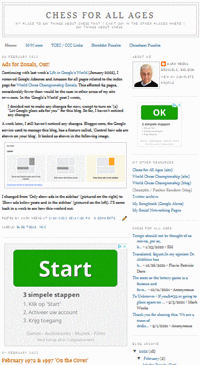
The screen capture on the left shows this blog after I wrote the 'Ads for Zonals' post, which is visible to the left of my profile face. There's a green 'OK' ad on the sidebar and a similar ad beneath the post. Both ads were for the same service -- I neglected to determine what it was -- and the same ad appeared under another post further down the page. Not very pretty, is it.
I switched this blog back to 'Only show ads in the sidebar', then switched my non-chess blog (linked in my profile) to 'Show ads below posts and in the sidebar'. That gives me the opportunity to track its evolution without annoying visitors to this blog.

I still have a few Adsense actions from the post Life in Google's World (January 2022). I'll explore those some other time.

04 February 2022

Ads for Zonals, Out!

Continuing with last week's Life in Google's World (January 2022), I removed Google Adsense and Amazon for all pages related to the index page for World Chess Championship Zonals. This affected 64 pages, considerably fewer than would be the case in other areas of my site m-w.com. In the 'Google's World' post I wrote,

I decided not to make any changes for now, except to turn on '(a) "Let Google place ads for you"' for this blog. So far, I haven't noticed any changes.

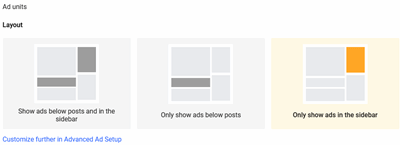
A week later, I still haven't noticed any changes. Blogger.com, the Google service used to manage this blog, has a feature called, 'Control how ads are shown on your blog'. It looked as shown in the following image.

I changed from 'Only show ads in the sidebar' (pictured on the right) to 'Show ads below posts and in the sidebar' (pictured on the left). I'll come back in a week to see how this worked out.

28 January 2022

Life in Google's World

I finished my previous post, Google, Again! (January 2022), saying,

Given (1) that Google is nagging me to use new services, (2) that I need to reconsider the use of 'matched content', (3) that I need to decide if I want to continue to run such large ads, and (4) that there are other Google issues to be addressed (not mentioned here), I'm going to tackle Google issues over the next few posts.

For bullet (1), the 'new services' are:-

(a) 'Let Google place ads for you', and (b) 'Let Google choose the best ad sizes for you'

It turns out that (a) can be applied independently to my five different resources: one site (m-w.com) and four blogs (including this one). As for (b), it applies to all five resources at the same time under a global parameter called:-

Ad units: Ad size optimization setting; Let Google optimize your ad units on mobile

That means it affects only mobile ads. On top of these considerations, m-w.com uses two separate styles that have to be considered separately: one style for 'The World Chess Championship' and one for 'Chess for All Ages'. I decided not to make any changes for now, except to turn on '(a) "Let Google place ads for you"' for this blog. So far, I haven't noticed any changes.

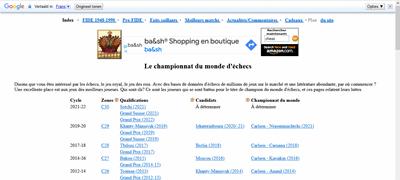
For bullets (2) and (3), there is nothing urgent, so I moved on to (4). The top 'other issue' is shown in the following screenshot from the index page on my World Chess Championship site (linked in the sidebar).

That blue bar at the top of the page with the Google logo to the left is apparently related to a feature called 'Site translation' further down the page. The bar appears every time the page is opened or refreshed, whether or not 'Site translation' has been invoked. In this screenshot, I've asked for a translation into French.

The language used in the blue bar is Dutch -- probably because I live in a Flemish region of Belgium -- and I can't change it. It has a mouseover message that I don't understand and that I can't translate easily. The irony!

I first noticed the bar last year and wondered if the page would be better off without it. I don't know how it got there and I don't even know what it's called. More effort is required.

That makes lots of questions without many answers. And that's life in Google's world.