14 May 2021

USCF Awards 1991

The title of this post is the logical next stop after last week's post USCF Awards 1990 (May 2021). The following table uses the same format as the table developed for the 'Awards 1990' post, with one enhancement. The top half of the table shows the awards listed in the 2013 USCF Yearbook. The bottom half, headed 'Amended', lists corrections identified for this post.

Year Award Winner(s)
1991 DISTINGUISHED SERVICE AWARD Harry Sabine, Yasser Seirawan
1991 KOLTANOWSKI AWARDS Gold: Ted Field; Silver: Neil Falconer
1991 MERITORIOUS SERVICE AWARD Imre Konig, George Leighton
1991 OUTSTANDING CAREER ACHIEVEMENT AWARD Mike Goodall, Ira Lee Riddle, Fjola Vandenburg
1991 SPECIAL SERVICE AWARD Larry Evans, Lev Alburt
1991 U.S. CHESS HALL OF FAME INDUCTEES John Collins,
Amended
1991 KOLTANOWSKI AWARDS Gold: American Chess Foundation, Ted Field (Interscope Group); Silver: Neil Falconer
1991 U.S. CHESS HALL OF FAME INDUCTEES John Collins, Arthur Dake

The first mention of awards is from the May 1991 Chess Life (CL)

CHESS NOTES : Policy Board Notes • The Policy Board, which meets quarterly to oversee USCF affairs, faced a full agenda in its February 2-3 meeting in San Diego. [...] In recognition of major accomplishments, the Board gave Jack Collins the title of "Chess Teacher of the Century" and awarded GM Lev Alburt the Special Service medal for his success in finding corporate sponsorship for the World Championship in New York.

From that excerpt we learn that (1) the USCF Policy Board was responsible for selecting award winners, and (2) the awards could be decided at any time during the year. We also learn that Jack [John] Collins received the title of "[U.S.] Chess Teacher of the Century".

The second mention of awards is from the November 1991 CL. In the article '1991 U.S. Open : Lifetime of Memories', author Thomas Hailey included a section:-

KASPAROV DELIVERS • The most popular of all events held in conjunction with the Open was the Awards Luncheon held at tHe half way point in the schedule, drawing a capacity crowd of 290, the largest awards luncheon in Open history

GM Arthur Dake, who also played the last week in the Open, and "Chess Teacher of the Century" John Collins were both inducted into the Chess Hall of Fame. After the inductions and usual awards were handed out (see accompanying story), the audience came to its feet in a standing ovation for the keynote speaker — World Champion Garry Kasparov.

He told the audience the key to chess future is the growth of chess in the U.S. and the importance of chess as an educational tool and in attracting new players for the future. He said he was in Los Angeles to help raise money for the next world championship to be played in Los Angeles in 1993. He then fielded questions from the audience.

Note that Arthur Dake's name was missing from the 2013 Yearbook, an error which was introduced the first time the yearbook was published in 1995. That accounts for one line in the 'Amended' section of the table. As for 'see accompanying story', we skip ahead to the January 1992 CL. In 'An Affair To Remember' by CL Editor Glenn Petersen, we learn,

Every year at the U.S. Open, an Awards Banquet is held during the Delegate's Weekend. It is a time set aside to honor our own for their financial support, dedication, volunteerism, and career achievements.

While World Champion Garry Kasparov stole the headlines as the Keynote Speaker at the Los Angeles Awards Banquet last August, others were recognized for their contributions to chess.

The Koltanowski Medals (Gold and Silver) are awarded for financial sponsorship at the national and local levels. The Gold was awarded to the American Chess Foundation for its continuous and generous support of USCF programs, and to Ted Field (Interscope Group) for his sponsorship of the New York half of the 1990 World Championship. The Silver Koltanowski Medal was awarded to Neil Falconer for a lifetime of sponsorship in the San Francisco Bay area, in scholastic programs as well as for international competitions (most recently, the Pan-Pacific Invitational).

Another Bay area resident, Mike Goodall, was also honored. He and Ira Lee Riddle of Warminster, Pennsylvania, received Outstanding Career Achievement Awards. Distinguished Service Awards were received by GM Yasser Seirawan and Harry Sabine. Meritorious Service Awards were presented to Judge George N. Leighton and IM Imre Konig.

The Awards Banquet also gave USCF members a chance to meet, greet, and honor the most recent Hall of Fame inductees, GM Arthur Dake and John Collins. Special Service Awards were granted to GM Lev Alburt and GM Larry Evans. Last but not least, an award was presented to Jerry Hanken and Paul Shannon, representing the Southern California Chess Association, for organizing the 1991 U.S. Open in Los Angeles.

The paragraph on the Koltanowski awards accounts for the other line in the 'Amended' section of the table. Back to the list of awards and award winners, I was totally or mostly unfamiliar with more than half of the winners. For which exploits did they receive awards from the USCF? Thanks to the web and to Google, I now know why. If I find the time, I'll attach my findings to this post. As for 'USCF Awards 1992', there's always a next year.

10 May 2021

TCEC S21 Starts; CCC 'Eco Mini-Matches'

Two weeks ago we had secondary events running in both world class, ongoing engine vs. engine competitions. I reported the situation in TCEC 'VSOB'; CCC 'ECO Mega-Matches' (April 2021), summarized here:-

TCEC: KomodoDragon won 'Swiss 1' with 15.5 points out of 22 games. After 'Swiss 1', the site conducted tests. '!next' says, 'Now !VSOB 20 Stockfish-LCZero and QL/L4/L3 testing, will switch between these occasionally...' • CCC: 'They came, they played, they left ... they're bots.' The site is currently running 'Eco Mega-Match 2 (part 2)'.

A week ago we had an off-week post looking at two of those events -- one TCEC, one CCC -- in more depth: VSOB 20; ECO_FULL (May 2021). What's the situation today?

TCEC: Apparently, 'QL/L4/L3 testing' has just ended. An article dated yesterday, TCEC S21 starts today (chessdom.com), started by saying,

Season 21 of the Top Chess Engine Championship starts today at 17:00 UTC. A total of 46 engines will embark on a quest for glory in the most prestigious computer chess event.

The secondary news in that article is that Chessdom.com is back with a new look and a new attempt at keeping up-to-date. I'll look at the site more closely in an off-week post.

CCC: 'Eco Mega-Match 2' finished with the following results:-

  • Part 1 (2012 games): Stockfish 52.8% - Lc0 47.2%
  • Part 2 (ditto): Stockfish 52.0% - Lc0 48.0%

The site is currently running a series of matches, each one with the title 'Eco Mini-Match'. The results of the first two matches were:-

  • Stockfish Classic vs Leela (800 games): Lc0 55.9% - Stockfish Classic 44.1%
  • Dragon vs Stockfish Classic (795 games): Dragon 55.7% - Stockfish Classic 44.3%

Stockfish Classic is the pre-NNUE version of Stockfish; Dragon's full name is Komodo Dragon (or KomodoDragon). A third match is underway, titled 'Eco Mini-Match: Leela vs Dragon', pitting the winners of those two mini-matches against each other. Only in computer chess can an 800 game match masquerade as a 'mini-match'.

[For further information from the various stakeholders in the engine-to-engine events, see the tab 'TCEC/CCC Links' at the top of this page. • NB: Leela = LC0 = LCzero]

09 May 2021

The $64.000 Question

There were so many great videos to choose from this month that I almost had to flip a coin. If this is because of the increased popularity of chess during the covid pandemic, then let's hope it has staying power. I finally chose a video that explained the evolution of that popularity. It's a story that will never get old.


A New Era Of Chess - How Did A Medieval Game Conquer Twitch? (11:41) • '[Published on] Apr 20, 2021'

The description of the clip said,

Hikaru Nakamura, Alexandra & Andrea Botez, Anna Cramling, Andrew Tang -- these may not be the names you typically associate with esports.

We've seen all of those names on this blog, except Andrew Tang. I'll let Wikipedia make the introduction; Andrew Tang (wikipedia.org):-

Andrew Tang (born November 29, 1999) is an American chess player. He was awarded the title Grandmaster by FIDE in 2018. He is known online for his bullet, hyperbullet, and ultrabullet (one-minute, 30-second, and 15-second chess, respectively) skills, even playing blindfolded, and is a popular streamer.

The first comment, by the channel itself, Akshon Esports, asks,

How do you foresee the chess scene evolving in the future as it becomes increasingly incorporated into the world of streaming and esports?

That could well be the $64.000 question.

07 May 2021

USCF Awards 1990

In my current Friday series, I ended last week's post, USCF Awards 1988-89 (April 2021), saying,

Next stop in the saga of USCF Awards: 1990-91, except I haven't found a 1990 list published in CL. If I continue to come up empty-handed, I'll look at the yearbooks.

Empty-handed I am. In the first post in the series, U.S. Chess Cities of the Year (March 2021), I mentioned that my original working list of awards came from the 2013 USCF Yearbook. The following table shows the 1990 awards listed by that yearbook.

Year Award Winner(s)
1990 COMMITTEE OF THE YEAR Tournament Direction Certification Committee
1990 DISTINGUISHED SERVICE AWARD Steve Doyle
1990 KOLTANOWSKI AWARDS Gold: Arnold Denker, Helen Warren
1990 OUTSTANDING CAREER ACHIEVEMENT AWARD Roger Blaine, Lee Hyder, Russell Miller
1990 SPECIAL SERVICE AWARD Denis Barry
1990 U.S. CHESS HALL OF FAME INDUCTEES Hans Berliner

What does the 1991 yearbook say about the 1990 awards? In a word: nothing! Although the USCF's first yearbook (the '1982 Chess Yearbook') appeared in the April 1983 issue of Chess Life (CL), the awards weren't added to the yearbook until 1995. They covered the previous year, 1994.

The 1990 awards that appeared in 1995 were incomplete. Two were missing:-

  • SPECIAL SERVICE AWARD
  • COMMITTEE OF THE YEAR

They must have been added to the yearbook for a later edition, but I didn't take the time to look. I'm just glad they were added.

04 May 2021

May 1971 & 1996 'On the Cover'

Just like last month's April 1971 & 1996 'On the Cover' (April 2021), our covers from 50 and 25 years ago feature chess in the USA on the left and artwork on the right. As usual, there's more to the two cover stories than that.


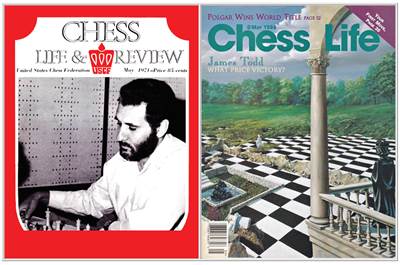
Left: ?
Right: 'Polgar Wins World Title; James Todd - What Price Victory'

Chess Life & Review (50 Years Ago)

International Grandmaster Larry Evans, who has recently won both the National Open (story [elsewhere]) and the Louis Statham Masters and Experts Tourney at Lone Pine, Cal. Larry's latest book, 'Modern Chess Brilliancies', just published, will be reviewed in CL&R.

The last time we saw GM Evans in this series was May 1970 & 1995 'On the Cover' (May 2020), where Evans was a co-winner of the 1970 National Open. The report on the 1971 event 'The National Open: Evans Wins on Tiebreak' by George Koltanowski, Tournament Director, started,

Would the weather hold? Would the Lone Pine tournament, immediately following the National, hurt attendance? These and many other problems beset the spark-plug of the National Open, Harvey Presly, who is the assistant promotion manager of John Ascuaga's Nugget in Sparks, Nevada, and a real chess fan.

It is one of the shortest and strangest tournament reports -- Did the weather hold? -- I have ever seen for a national tournament. It didn't say when it was held (7-12 March 1971, according to pre-tournament publicity) or give any kind of synopsis of the final rounds. It only said,

Larry Evans had the most Median points [whatever those were] and won the trophy (prize money was shared, each of the top seven getting $270)

It then listed only the draws/losses for five of the top seven players. For the record, the other six were Svetozar Gligoric, Walter Browne, William Martz, Jim Tarjan, John Grefe, and Roy Ervin (also top expert). You have to work out for yourself that the top scores were all 6.5-1.5. The most discussed topic in the report was the Nugget venue. On the same page, the announcement for the 1971 U.S. Junior Open (NB: not the 'Closed') received more print space.

As for Lone Pine, Koltanowski mentioned, 'The Lone Pine event may have hurt, but only slightly.' The paragraph about the cover and the two (unfavorable?) mentions by Koltanowski are the only references I could find to the first Lone Pine event in the decade long series. Why was it overlooked?

Chess Life (25 Years Ago)

"What Price Victory" indeed. An empty realm. This is just one of the original oil paintings by James Todd, using chess as a theme. We hope you enjoy the spread, as much as we enjoyed putting it together.

Congratulations and adulations are due Zsuzsa Polgar on her victory over Xie Jun. Xie Jun has been a fine Women's World Champion, and it is a shame that there has to be a loser. Zsuzsa, now residing in Rego Park, New York, with her husband Jack Shutzman, has already applied for American citizenship.

Congratulations and adulations are also due Garry Kasparov for his victory over Deep Blue. While not a world championship, the match certainly generated world caliber interest, which was properly reflected in all the media, for more than a week.

Brickbats and barbs to FIDE for accepting a bid from Iraq to hold the Kamsky - Karpov World Championship match in Baghdad. As a sporting event, such a match would not violate the United Nations' economic sanctions against Iraq. And our own State Department concedes that the Kamsky's can travel anywhere they want since they are still using Russian passports. However, the Treasury Department, which interprets the U.S. Sanctions against Iraq, admits that the Kamsky's may have a little problem if they try to return to this country. They may lose their "Green Card" (permanent residency) status, and any monies they might win. The USCF has asked FIDE to select another site.

This is the third cover in the last four editions of 'On the Cover' to feature artwork on the 1996 CL side. The two-page spread titled 'James Todd' by Jim Todd featured nine of Todd's chess paintings, including the cover painting. It started,

My father taught me both how to play chess and how to paint. While we continued to paint to- gether through-out the time I lived at home, our chess relationship ended when the burden of his losses became too great for him to bear. Of course, I didn't know at the time that the two activities would combine to make up a significant part of my life as an artist; indeed, I didn't know as a child that painting would become my career, although 1 have devoted myself to developing my technique and exploring various media since the age of 10.

The other three stories mentioned in the 'On the Cover' paragraphs were all milestones in World Championship history. Polgar's book 'Queen of the King's Game' listed 'Jacob' Shutzman as co-author.

03 May 2021

VSOB 20; ECO_FULL

In last week's engine post, TCEC 'VSOB'; CCC 'ECO Mega-Matches' (April 2021), I gave myself an action:-

[VSOB] sounds like a good topic for an off-week post. [...] I'll look at available info for the ECO Mega-Matches when I look at VSOB. This follows the principle that opposites attract.

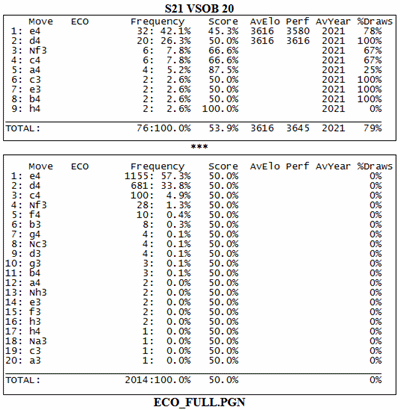
Last year I wrote an entire post on VSOB in VSOB PGN (January 2020; 'VSOB stands for "Viewer Submitted Openings Bonus"'). The most recent VSOB event is in the TCEC Archive at S21 - Viewer Submitted Openings Bonus 20 (tcec-chess.com/archive; PGN available from top menu bar under 'Download'). I downloaded the 76 games, loaded them into SCID, and produced the table of first moves shown in the top of the following image.


As for 'ECO Mega-Matches', the PGN is at Eco_full (mediafire.com; 'File size: 248 KB; Uploaded: 2021-04-22'). I downloaded the file, but hesitated when I saw that each PGN game had incomplete headers. Here's the first entry in the file:-

[ECO "A00"]
[Opening "Polish (Sokolsky) opening"]
1. b4 *

That caused no problem for SCID, which produced the table shown in the bottom of the image. The analysis shows that the ECO_FULL.PGN file contains 2014 ECO variations. More than half of the variations start 1.e4.

I wanted to take the analysis further, but ran out of time for this post. Will I find the time to continue? My experience on follow-ups says, 'No!'.

02 May 2021

Not for Blitz or Bullet

It's the first Sunday of a new month and that means another episode of Top eBay Chess Items by Price (March 2010). As usual, I started by reviewing eBay's chess items that sold in the previous month -- April 2021 for this current post -- in descending order by price.

Chess clocks frequently appear on the initial short list for 'Top eBay Chess Items', but rarely make the final cut. Although important as a chess accessory, there's not much to add about them. The previous post featuring a clock was Double Dutch Clocks (October 2013).

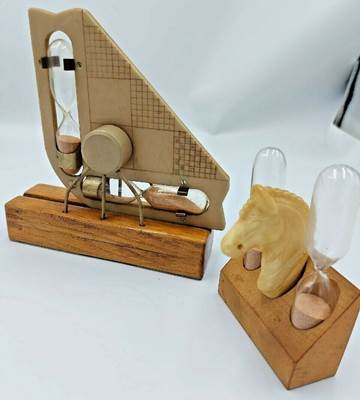
The item pictured below was titled 'Rare vintage hourglass for playing chess in the USSR'. It sold for around 600 US$, 'Best offer accepted'.

The description added,

Vintage clock for playing chess. Additional flasks for quick rearrangement. The vertical clock counts down the time, the horizontal one is stopped. With a slight movement of the recruit, everything is the opposite.

The 'additional flasks' must be the two hourglasses to the left and right of the chess Knight's head. According to another photo showing a ruler, the clock mechanism on the left is 16 cm wide; the reserve holder on the right is 8 cm wide. I can't imagine that the hourglasses hold much sand.

A search for similar clocks led to How do we appreciate time? A history of chess clocks (chess.com). There I learned,

The first major chess [clock?] revolution began in 1852, when a quasi-unknown writer named Andrew Cantab wrote an article in which he argued that each player should have limited time for the entire game. Moreover, he proposed a solution: the introduction of hourglasses with sand. [...] The propaganda was successful, and the hourglass was officially introduced to a tour for the first time in 1861, at the match between Anderssen and Kolisch, in London. The agreed playing time was 24 moves in two hours.

Going back to my post Tabulating the Rabbit Hole (June 2019; 'chart shows periodicals published by country and by year'), there are plenty of potential references from 1861. That might make a compact follow-up project.