28 August 2018

A Year of Yahoos?

It might seem like a year of Yahoos, but the current monthly series of chess in the mainstream press, last seen in July Yahoos, started with October Yahoos (October 2017). That makes this month's August Yahoos the 11th straight month of Yahoos.

2018-08-10: 9-Year-Old Chess Prodigy Will Be Allowed To Remain In U.K. (yahoo.com). The Yahoo stub pointed to the original story from NPR.org, which started

The United Kingdom has decided to allow a 9-year-old chess prodigy to remain in the country, after his father's work visa expired and his family faced deportation back to India. Shreyas Royal is "very delighted" with the news, his father tells NPR by email. Shreyas has lived in the U.K. since he was 3 and has played chess since he was 5. Now, within his age bracket, he is the top chess player in England and one of the top 10 globally.

For the BBC version of the same story, see Shreyas Royal: Child chess prodigy's family can stay in UK (bbc.com).

2018-08-17: Kevin Love on LeBron James: ‘He’s playing chess and everyone else is playing checkers’ (yahoo.com). This second Yahoo is hardly worth mentioning -- the only mention of chess (or of checkers) is the headline -- but it gives me the opportunity to point to another old post, A:'Playing Checkers' vs. B:'Playing Chess' (October 2014).

27 August 2018

A Leela Surprise in the Nimzo Indian

In this series on AI engines, I closed the previous post, The NNs Depart TCEC S13, with,

For many observers, the main interest in TCEC's lower divisions was the participation of the two NNs, Leela and DeusX. Once both engines were eliminated, interest shifted to which engine will finish first for the season.

Let's finish the current series with a video. The following is from YouTube's kingscrusher, who says,

My name is Tryfon Gavriel, I run www.chessworld.net. FIDE Candidate Master, British Regional Master. Reached peak ECF rating of 212 (equivalent to about 2350 USCF) in July 2014, and 216 rapid (within rank top 50).

He has also been one of Leela's biggest supporters since the engine first appeared on the scene. Of his many Leela videos, this one has the highest view count.


A remarkable top secret chess opening discovery! Leela Chess 395 vs Gull 3 - Nimzo Indian (5:56) • 'Published on Jul 2, 2018'

The video's description starts,

Game quality tags: amazing, awesome, astonishing, brilliant, classic, crushing, dynamic, elegant, exceptional, excellent, exciting, fabulous, famous, fantastic, [...]

For Kingscrusher's source of inspiration on recent Leela games, see a post in the Leela forum, More Leela games needed (for commenting).

26 August 2018

Best Blind Players of India

We've already seen a video from ChessBase India (January 2018) in our long-running series on The Sociology of Chess (November 2016). For the previous post in the series, Fiske's 'Chess in Iceland' (July 2018), I featured a book ('The island of Iceland is an anomaly and a marvel') and in this post I'll feature another video, again from ChessBase India.


What chess means to the best blind players of India (10:33) • 'Published on Jul 20, 2018' [International Chess Day]

The clip is at times difficult to understand, but the message from the players is clear. Chess has helped them reach levels of personal achievement that would have been difficult without the game. The description idientifies the players:-

The national visually challenged team is present in Sofia, Bulgaria for the World Team Championship 2018. We ask the players Kishan Gangolli, Soundarya Kumar Pradhan, Ashvin Makwana, Aryan Joshi and Subhendu Patra about what chess means to them. We also have Charudatta Jadhav in the video, the IBCA and AICFB president who has played a key role to spread blind chess in the country.

IBCA is the International Braille Chess Association (ibca-info.org):-

FIDE is the apex body for chess amongst the sighted. Similarly the International Braille Chess Association (IBCA) is the apex body of chess for the blind and visually impaired and is in turn affiliated to FIDE. The main purpose of IBCA is to promote chess for the blind and visually impaired across the globe.

AICFB is the All India Chess Federation for the Blind (aicfb.org):-

The AICFB is affiliated to the International Braille Chess Association (IBCA), and through this affiliation has been able to integrate India with the rest of the blind chess playing world. AICFB is also affiliated to All India Chess Federation (AICF) which is recognized by Government of India.

According to Chess-results.com, the event was the 'VIII IBCA World Team Chess Championship for blind and visually impaired, Bulgaria, Sofia 20-31.07.2018' The India team finished 8th out of 16 teams:-

In nearly every post about the 'The Sociology of Chess', ChessBase India has at one candidate on the video short list, usually several candidates. I'm sure we'll see one of them again.

24 August 2018

Verifying HTTPS

I hope this is my last post about migrating my web site to HTTPS. In the previous post, Testing HTTPS, I wrote,

I have a number of other tasks to perform:-
(A) Investigate why the security certificate (issued by Let's Encrypt 'Free SSL/TLS Certificates') is only valid for three months, to 15 October 2018.
(B) Examine the impact on the site's stat logs.
(C) Flag the HTTPS change to Google search.

(A) Certificate: From How It Works - Let's Encrypt - Free SSL/TLS Certificates:-

The objective of Let’s Encrypt and the ACME protocol is to make it possible to set up an HTTPS server and have it automatically obtain a browser-trusted certificate, without any human intervention. This is accomplished by running a certificate management agent on the web server. [...] There are two steps to this process. First, the agent proves to the CA that the web server controls a domain. Then, the agent can request, renew, and revoke certificates for that domain.

The key word there is 'renew'. I'll come back to the subject in mid-October, and I hope it won't require a blog post.

(B) Stats: The first thing I noticed was the size of the daily logs, which started getting larger the day I activated HTTPS across the site. Is this related or just a coincidence? When I examined the log file for that day I saw some files logged twice -- once with a 301 redirect code and a small file size followed by a 200 code and a large file size -- indicating that a redirect had occurred. My own activity ('Testing HTTPS') was traceable, which gave me an anchor point. The stat summaries showed a huge number of 301 redirects, which were negligible in previous months. Will this decline over time, as external requests include the HTTPS, or will it be constant? Since the files are aggregated by month, it will take a few months to see the effect.

(C) Google search: I was happy to see that Google search results include the HTTPS, outlined in red in the following image.


Google search: 'site:mark-weeks.com'

One casualty of the migration was Google Adsense. The ads are missing, e.g. on the index page for the World Chess Championship, and the browser warns of mixed content. The code that calls an ad currently uses 'HTTP'. If I want the ads back I'll need to change the code on all pages, but it might be better to replace Adsense with something else in that space.

All things considered, I was happy with the results of the migration to HTTPS. What will Google force me to do next to keep the site operational?

23 August 2018

A Flawed Seven-piece Study

In my previous post Seven-piece Tablebase on Lichess, I noted the 'first free 7-piece tablebase' and took the service for a test drive. The example that I used was from Averbakh's book on Queen endgames, specifically a section with four positions of the type Q+2P:Q+P where there are no passed Pawns. I ended the post saying,

I'll continue to look at other Q+2P:Q+P endgames and will post anything unusual that I find. I'll also look at other endgame sources to investigate the accuracy of their analysis.

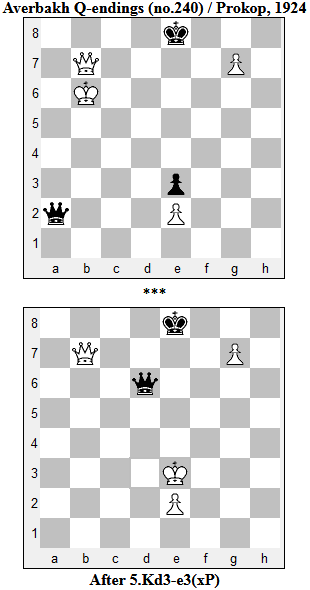
The next section in Averbakh's book covers Q+2P:Q+P where the strong side has a passed Pawn. I fed all six examples to the Lichess tablebase and discovered that Averbakh's analysis was correct on five of them. The exception was a study by F.Prokop, shown in the top diagram, Black to move.

The study continued 1...Qb2+ 2.Kc5! (a temporary Queen sacrifice) 2...Qe5+(*) 3.Kc4 Qf4+(*) 4.Kd3 Qd6+(*) 5.Kxe3, arriving at the bottom diagram. Here the Averbakh/Prokop analysis continued with three candidate moves, all of which lead to a win for White. The most interesting for me is 5...Qg3+ 6.Qf3 Qg1+ 7.Kf4 Qh2+ 8.Kg4 Qg1+ 9.Kh3 Qxg7 10.Qa8+ Kf7 11.Qb7+ Kf6 12.Qxg7+ Kxg7 13.Kg4, because it shows a common theme in Q+P:Q endgames. The strong side trades Queens to arrive in a position with K+P:K, where the Kings are far apart and distant opposition plays a leading role. A similar idea is behind 2.Kc5!.

In the bottom diagram, the tablebase indicates a fourth move, 5...Qh6+, which it says is the only move leading to a draw. It appears that Black has a perpetual check with this move. The variations branch off into so many sub-variations, that it is impossible to follow all of the key moves. I'll just have to trust the tablebase on this.

In the main variation starting 1...Qb2+, what do the asterisks '(*)' mean? They identify moves that the tablebase indicates are the only move leading to a draw; other moves lose. The tablebase also says that there is an alternate solution in the diagrammed position: 1...Qe6+ also draws.

In a footnote, Averbakh indicated that the top diagram was in fact an intermediate position in Prokop's study, because the previous moves were flawed. With so many branching variations in Queen endgames, it's not surprising that both the original analysis and the subsequent correction were flawed.

21 August 2018

Seven-piece Tablebase on Lichess

Almost since its beginning, this blog has taken an interest in chess tablebase technology, where endgames with a limited number of pieces are solved perfectly. The latest news opens an entirely new channel of investigation: 7-piece Syzygy tablebases are complete (lichess.org; 'Use the world's first free 7-piece tablebase on Lichess!'). The announcement started,

Congratulations to Bojun Guo (aka noobpwnftw) and Ronald de Man (aka syzygy) for completing the first free 7-piece tablebase and generously sharing it with the world! Lichess now provides online access on the analysis board and in studies, practice against tablebases, a public API, and a mirror for downloading the full tablebase files.

For the accompanying discussion, see General Chess Discussion / 7-piece Syzygy tablebases, with more links to other resources.

Six-piece tablebases are useful but somewhat limited. When we exclude the two Kings that are present in every position, we are left with four pieces, which are not sufficient for evaluating many positions where the stronger side has the advantage of a Pawn. Six-piece tablebases are most interesting for positions with unbalanced material, like R+P:B+P. With seven-piece tablebases, we suddenly have a tool for examining positions like R+2P:R+P, which are notoriously difficult to analyze.

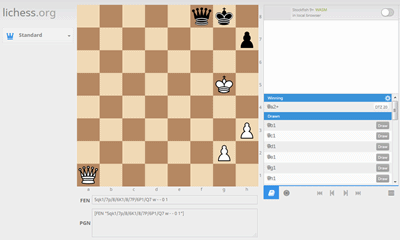
Lately I've been interested in Queen endgames, because their outcomes -- win or draw? -- are difficult to predict during a game. Their analysis often goes beyond the horizons of current engine technology. Here's a simpler, well-known 19th century position from Averbakh's book on Queen endgames. It shows the Lichess interface.

Averbakh Q-endings (no.234) / Horwitz and Kling, 1851

White to move
Lichess: 5qk1/7p/8/6K1/8/7P/6P1/Q7 w - - 0 1

The key move is 1.Qa2+. The Queen climbs a ladder on the a1-h8 & a2-g8 diagonals to force a won K+P endgame. For more about Averbakh, see Averbakh's R+P vs. B+P Endgames (September 2017).

I'll continue to look at other Q+2P:Q+P endgames and will post anything unusual that I find. I'll also look at other endgame sources to investigate the accuracy of their analysis. In the meantime, I'd like to give a big thanks to Stefan Meyer-Kahlen for the resource that I've been using for the last ten years or so: All 6 men chess endgame databases available online (shredderchess.com).

20 August 2018

The NNs Depart TCEC S13

In last week's post, Battles of the Chess NNs, for this blog's current series on the Top Chess Engine Championship (TCEC), I signed off with:-

Both Leela and DeusX qualified from TCEC S13 division four to division three, another quadruple round robin with eight engines competing. As I write this, that event has reached the second stage. The engine Ethereal has a large lead over six engines (including the two NNs) which are bunched together, vying for the second qualifying place into division two.

A few days later the organizers announced, Ethereal chess engine wins the gold at TCEC Div 3:-

Ethereal, the chess engine by Andrew Grant, is the winner of TCEC Div 3. After three months of rapid development, Ethereal came stronger than ever and outwitted the competition in the division finishing 22,5/28 -- full 6,5 points ahead of competition.

Here's a copy of the final crosstable:-

What about that tie for 2nd/3rd? Both Leela (lc0) and Arasan finished with 16.0/28, Leela having the better SB. The second NN, DeusX, finished in fifth place with a minus score, 13.5. The announcement continued,

The second qualification spot was highly contested through the division. Pedone was off to a good start, but somewhere in the second half of the event it lost the advantage and was overcome by Arasan. Fixes in the cooling and power usage of the GPUs helped Leela lift off after round 20. It managed to get an impressive 5,5/6 after the GPU fix, but later could not defeat Arasan in the direct match. Arasan, with better tiebreak over Leela, climbs back to the division where it competed last season.

The TCEC rules specify,

Tiebreaks • If necessary, tiebreaks can be used to determine advancement. For all Divisions (not the Superfinal), the first tiebreak criteria is the "crash" tiebreak, meaning that if an engine has crashed once or more during the Division, it will fail qualification versus another engine that has not crashed if both of them has the same amount of points. In case of still being tied, then the direct encounter between the tied engines decides. The next criterion is the greatest number of wins, then the greatest number of wins with black. The Sonneborn-Berger is the next criteria. If they are still tied, then the tournament organizers will decide which engine gets the promotion.

I gather from this explanation that the '"crash" tiebreak' played no role. Since the minimatch between the two engines ('direct encounter') was +1-0=3 in Arasan's favor, it qualified into division two. Some Leela supporters hoped that both engines might go through, but what good are rules if they're not enforced?

For many observers, the main interest in TCEC's lower divisions was the participation of the two NNs, Leela and DeusX. Once both engines were eliminated, interest shifted to which engine will finish first for the season. Most bets are undoubtedly on Stockfish to win for the third consecutive time.