29 October 2018

Happy 10th Anniversary, Stockfish!

In last week's post, Talking About Chess Engines, I noted,

The two stars of the chess engine world are Stockfish and Leela. [...] Both engines are open source and both have forums where their many fans can discuss current trends. I really should spend some time on both forums to catch up with their technical developments and just might do that.

The last time I spent time on Stockfish's FishCooking forum was Stockfish in a Straitjacket? (March 2018), so I had tons of material to review. It was time well spent. One thread informed,

  • 2018-07-23: Stockfish 10th Anniversary • 'Is there any chance for next Stockfish 10 to be released 2 November 2018 as of 10 years of Stockfish first release back in 2008 and for name to be "Stockfish 10th anniversary"?'

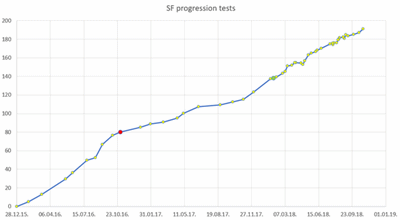
The name of choice for the commemorative release was 'Stockfish X', but with only a few days to go, it doesn't look like anything special is going to happen. Another thread pointed to a series of graphs showing Stockfish's recent rating progress. This particular graph shows progress since the end of 2015, nearly 200 rating points.


Fishtest/wiki: Regression Tests

As I write this, Stockfish is playing the TCEC Season 13 final against Komodo and is leading +5-1=36, with another week or so to reach the match target of 100 games. The TCEC gives the engines' current respective ratings as 3519 and 3475.

The conventional wisdom is that people shouldn't play important chess games on their birthdays. I doubt that it matters much to engines.

28 October 2018

Chess and the Behavioral Sciences

We're approaching the second anniversary of the series on The Sociology of Chess (November 2016), and I still haven't introduced what appears to be the most important work related to the subject, Players and Pawns (uchicago.edu), by Gary Alan Fine, subtitled 'How Chess Builds Community and Culture':-

A chess match seems as solitary an endeavor as there is in sports: two minds, on their own, in fierce opposition. In contrast, Gary Alan Fine argues that chess is a social duet: two players in silent dialogue who always take each other into account in their play. Surrounding that one-on-one contest is a community life that can be nearly as dramatic and intense as the across-the-board confrontation.

This video, from the American Folklore Society, might have nothing to do with chess, but it does serve as an introduction to the author and his work.


Gary Alan Fine, "The Folklore of Small Things: Tiny Publics and Realms of Local Knowledge" (1:48:09) • 'Published on Jun 19, 2017'

The description of the video says,

Gary Alan Fine (Northwestern University and the Center for the Advanced Study of the Behavioral Sciences), delivered the 2010 Francis Lee Utley Memorial Lecture of the AFS Fellows at the American Folklore Society Annual Meeting in Nashville, Tennessee on Friday, October 15.

Abstract: "To understand contemporary society folklore requires a robust theory of how small groups motivate the creation and retention of tradition. The establishment, ordering, and expansion of any culture depend on groups with shared pasts and futures, that are spatially situated, and that depend on common references. Folk cultures arise from interaction scenes, linked to a field of activity. Within complex societies, specialized groups fulfill a set of instrumental tasks within a complex division of labor. As a result many group cultures are linked to the presence of knowledge specialists: experts who serve as brokers for external, lay publics. These groups constitute epistemic communities linked to focused knowledge realms, achieving essential societal ends in the absence of general knowledge."

While writing this post I only watched the introduction to the lecture. Once it's posted, I'll watch the rest. If there is anything about chess, I'll mention it in a follow-up paragraph.

26 October 2018

GPU Specifications

In Catching Up with Leela, I glossed over a technical point:-

If you're not familiar with GPUs like 'K80 / P100 / V100 / etc.', it's enough to know that they are three evolutions of graphic processors, the number crunchers that all [neural networks] rely on for their numeric intensive computations.

That might have been 'enough to know' for that post, but I wanted to know more. I eventually found Wikipedia's Nvidia Tesla:-

Nvidia Tesla is Nvidia's brand name for their products targeting stream processing or general-purpose GPU. Products use GPUs from the G80 series onward.

The evolution of GPUs starting around 2007 is laid out in a matrix of technical specs titled 'Specifications and configurations', and includes the three models mentioned in the 'Catching Up' post. To learn more about those specs I located a video.


Graphics Card Specs: The Basics (8:09) • 'Published on Aug 16, 2016'

The video's description explains,

Reviews and benchmarks are the most important thing to look at when buying a new graphics card. But if you ARE curious as to what these specs mean, here's a video!

The emphasis in the video is on gaming, but the connection with AI is clear enough. I'll look at that in my next post.

25 October 2018

Goodbye Google+, Hello Twitter

So you think Google Plus is worthless? Well, you're wrong. Five years ago, after Google forced me to use it (I forget why, but it must have had something to do with this blog), it started to serve as the archive for the blog posts from my various blogs. Shown here is a screen capture of its current look (as I see it).
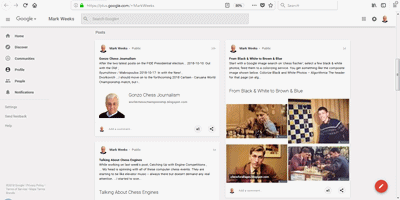

plus.google.com/+MarkWeeks

The upper left link is yesterday's post from my World Chess Championship blog, Gonzo Chess Journalism; the upper right link is the previous post on this Chess for All Ages blog, From Black & White to Brown & Blue. If you scroll down a page or two, you'll see Kasparov Discusses the Showdown, the most recent post on my Chess960 (FRC) blog.

Google is planning to close its Google Plus service. I mentioned this in a recent post about another Google service, A Free Google Service?:-

As for the 'Google Privacy Policy', an incident from earlier this month revealed Google's real policy. See, for example, 'Google+ to shut down after coverup of data-exposing bug' (techcrunch.com), for one report: 'A security bug allowed third-party developers to access Google+ user profile data since 2015 until Google discovered and patched it in March, but decided not to inform the world.'

I don't know when Google Plus will close, but Google doesn't waste time when it takes action. What to do? The archive is useful whenever I have to look at a recent post on a device other than my main laptop. Since Google updates it automatically every time I publish a new post, it takes very little work to maintain. In another post earlier this month, The CCL Was Hacked, I wrote,

Along with dozens (hundreds?) of other chess related items, they [CCL on Facebook] publish posts from this blog and from my World Chess Championship blog. A couple of weeks ago my blog statistics told me that the blog feeds had stopped.

After the CCL returned to service, it took some time to get the feed working again. In brief, I stopped using my own dlvr.it account -- as described in Site Stats and Images (June 2017) -- and switched to a CCL service. Since my free dlvr.it account lets me send blog posts to only one target ('Socials' the dlvr.it service calls them), I could use it for something else. That 'something else' will be my Twitter account, which I opened in 2009 and which has been dormant ever since:-

Mark Weeks (@bemweeks) on Twitter

In effect, my Twitter account will serve as an archive. The 'View my complete profile' link in the sidebar of all my blogs currently points to my Google Plus page. That link is generated by Google's blogger.com and blogspot.com. I can't change it. What will Google use next as a profile?

***

Later: Re the comment in the main post...

Five years ago, after Google forced me to use Google+ (I forget why, but it must have had something to do with this blog), it started to serve as the archive for the blog posts from my various blogs.

...I scrolled to the bottom of my Google+ archive and found the earliest:-

The second post was:-

That post said,

I realized that Blogger.com, the service that maintains this blog, was trying to force me to upgrade to Google Plus (whatever that entails). I had seen similar messages before, always presented at a bad time, like when I had something more urgent to do. This time, since I was completely blocked, I was forced to follow through with the upgrade, finally receiving the message, 'You are now using a Google+ profile on your blogs'.

What Google wants, Google gets. So why was Google+ such a flop?
23 October 2018

From Black & White to Brown & Blue

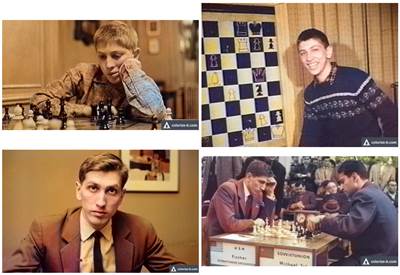
Start with a Google image search on 'chess fischer'; select a few black & white photos; feed them to a colorizing service. You get something like the composite image shown below.


Colorize Black and White Photos – Algorithmia

The header for that page (on algorithmia.com) says,

Colorize Photos • Use Deep Learning to Automatically Colorize Black and White Photos

A little later, the page says,

We're excited to introduce cloud hosted deep learning models on Algorithmia. The Colorful Image Colorization microservice is a computer vision algorithm trained on a million images from the Imagenet dataset.

Does the Imagenet dataset consist mainly of brown & blue photos? The USA and USSR flags in the photo on the bottom right might be the reason why that image shows a few other colors.

22 October 2018

Talking About Chess Engines

While working on last week's post, Catching Up with Engine Competitions, ...

My head is spinning with all of these computer chess events. They are starting to be like elevator music -- always there but doesn't demand any real attention.

...I started to wonder, 'What are the engine experts saying about these recent tournaments and about other events?' The two stars of the chess engine world are Stockfish and Leela -- Stockfish because it is winning everything in sight, Leela because it is based on an emerging technology and is improving rapidly. Both engines are open source and both have forums where their many fans can discuss current trends:-

  • FishCooking (groups.google.com/forum/fishcooking)
  • LCZero (groups.google.com/forum/lczero)

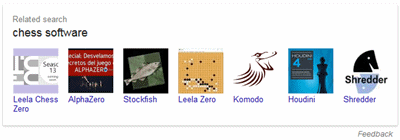
I really should spend some time on both forums to catch up with their technical developments and just might do that. In the meantime, using a relevant search, I identified a few other online forum resources and looked for recent conversations. Google gave me a logo-laden 'Related search':-


Google search on 'stockfish leela tcec'

Here are a few conversations in descending order of what I estimate to be the site's interest in the subject:-

The interest from Reddit.com is somewhat surprising, although the site shows up increasingly in chess related searches. Why so little interest from Chess.com? Perhaps they see their own CCCC tournament as a rival to the TCEC. Note also their interest in the ICGA 'World Championship', which gets little attention these days from the engine community.

On a related subject, following up my post Chess Programming Wiki (July 2018), the resource is now available at Chessprogramming Wiki (chessprogramming.org). I won't adjust any of my previous links to the site, because it's enough to know that the destination pages are available.

21 October 2018

Chess and Cubofuturism

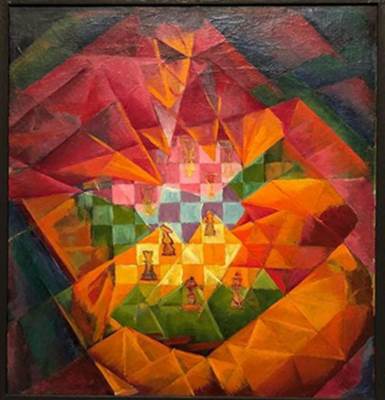
How is a chess player connected to the chess board? Most people would probably say through the head, but this painting suggests that there are also connections through the chest and through the hands.


Chess player by Otto Möller (1921) © Flickr user Marcel under Creative Commons.

The description added the hashtags --

#art #chess #berlin #painting

-- and linked to an Instagram page with a nearly identical title and description, Marcel on Instagram: “Chess player...". For more than a million chess images from Instagram, see #chess hashtag on Instagram. The introduction to a German Wikipedia page, Otto Möller (painter), translates to:-

Otto Möller (1883-1964) was a German painter, graphic artist and drawing teacher. In his work Möller went through various styles, such as Impressionism, Expressionism, Cubofuturism and New Objectivity. His reputation he achieved as a representative of the Berlin November Group and Expressionist of the second generation.

I'm not sure what Cubofuturism means, but the painting certainly reminds me of the Google image search on 'chess cubism' that I used in Chess and Art Movements (December 2017).