31 March 2019

Drawing the Gender Line

A fifth weekend this month gives me the opportunity for an immediate followup of last weekend's post Chess and Gender Lines. I ended that post saying,

This topic is one of the most awkward that chess has to offer and I need to gird my loins before wading further into it.

This isn't the first time I've addressed the topic. As far as I can remember, the first time was an About.com article, Elsewhere on the Web : Women in Chess (March 2005), still available on Archive.org. There I discussed 'Birth of the Chess Queen' by Marilyn Yalom, followed by Jennifer Shahade, Susan Polgar, and the 'ongoing chess controversy : Why have women players not been able to achieve the same results as men?'.

The subject isn't a one-way street. Criticism across gender lines cuts in both directions. A few years ago I wrote a post on this blog, Chess Players Aren't 'A Barrel of Laughs' (August 2017), where some 'Dear Abby' advice ended with:-

A chess game resembles a war in that it consists of attack and defense, whose object is making the "King" surrender. On second thought, it could be a good training ground for marriage.

That advice was probably tongue-in-cheek, but it's still insulting to men. The heart of the 'Gender Lines' post was a video titled, 'Is Chess Sexist?'. One commenter said,

Is chess sexist? Yes, the King is portrayed as a weak submissive male, while the Queen's domain and power are unlimited. The poor King may only move one spot any direction, the Queen's movements are unbounded.

Although that idea exaggerates the rules, it also contains a large dose of truth. For more about the gender aspect, I turned to the January post in my 'Sociology of Chess' series. There I introduced the book 'Players and Pawns' by Gary Alan Fine. On page 164, in a section titled 'The Girl and the Game', the author writes,

Perhaps the first question that an outside observer asks when visiting a chess tournament is, where are the girls? Where are the women? In so many areas of American life that were once dominated by men, women are edging toward parity: medicine, law, fiction, even politics. Wherever elites gather, there are women. Extreme gender disparity is rare.

I do not explain why women are underrepresented, but I will discuss why women are said to be underrepresented. The evidence of that underrepresentation is clear. No woman has won the world championship, no major tournament has a female champion, and only about 1 percent of all of the world's grandmasters are women.

After more facts and statistics, the author continues,

To understand the role of women in chess, it is worth noting that many of the top players -- Bobby Fischer and Garry Kasparov among them -- have a low opinion of female players. Not only are women not good at chess, but by nature they will never be good, some believe. Of course, one could also dig up antique quotations about female doctors or novelists. This view stands in contrast with research that indicates biology plays a small role in ability. While women and men might have different cognitive skills, with male skills benefitting chess ability, the more sociological view is that opportunity structures matter more. Analyses of life histories of players, as well as surveys, support the opportunity-structure theory. Boys enter chess in greater numbers, and those who are successful continue. Boy culture dominates.

After some anecdotal evidence comes a series of key observations.

One of the main passages is the father-child relationship, often the father-son relationship. If fathers are less inclined to teach their daughters, the parental bond is lost. In schools girls face other obstacles. An ethnographic study of a mixed-gender chess club in elementary school found that girls dropped out at a much higher rate than by because of hostility, criticism, and distaste for the aggression of the games. In second-grade talk, boys are "really mean" or, later, they are "so annoying". Despite support from the club organizer, these girls felt that the boys didn't want them there. Male chess players have the dual reputations of being nerds and boors. Perhaps chess, unlike medicine, is too trivial to be worth the bother. As anthropologist Margaret Mead remarked, "Women could be just as good at chess, but why would they want to be?"

That Margaret Mead quote, which is again insulting to male chess players, is followed by a section titled 'Nerds and Boors'. It starts,

To understand sexism I begin at the pinnacle. Bobby Fischer, who could read the board, even if he was less proficient at reading the world, commented in 1962, "They're all weak, all women. They're stupid compared to men. They shouldn't play chess, you know."

The Fischer quote is well known. Other grandmasters, Kasparov among them, have said similar, although not in language as direct as Fischer. The latest in the series of demeaning sentiments by grandmasters came from former World Championship challenger Nigel Short, and we can be sure that there will be future statements from other players. If men want women to enjoy chess and to respect chess players, why are the men so unchivalrous? Maybe they're afraid of the competition.

29 March 2019

Chess Player’s Chronicle

Continuing with investigations into early chess periodicals available via Google Books, in last week's post, Le Palamede, I wrote,

After 'Berliner Schachzeitung', my second effort concentrated on 'Palamède'.

My third effort concentrated on 'The Chess Player’s Chronicle'. Once again, I'll use Di Felice's 'Chess Periodicals, 1836-2008' as a starting point.

617. Chess Player’s Chronicle (The) [England] (1841–1862) Vol.1 (1841)–Vol.13 (1852); Second Series Vol.1 (1853)–Vol.4 (1856); Third Series Vol.1 (1859)–Vol.4, no.43 (July 1862). Monthly. Editors Howard Staunton (1841–54); R.B. Brien (1854–56). Publisher R. Hastings (1841–52, 1853–56), J.H. Starie (1859–62). London. England. Illus., 22 cm. Magazine. General. English. Note Vol.1 (first series) has title British Miscellany and Chess Player’s Chronicle (The). Editor of third series not given in the text. Superseded by Chess Player’s Magazine (The).

It's not immediately clear what differentiates the three series, but here is the same information in tabular form:-

  • 1st series: Vol.1 (1841) – Vol.13 (1852);
  • 2nd series: Vol.1 (1853) – Vol.4 (1856);
  • 3rd series: Vol.1 (1859) – Vol.4, no.43 (July 1862).

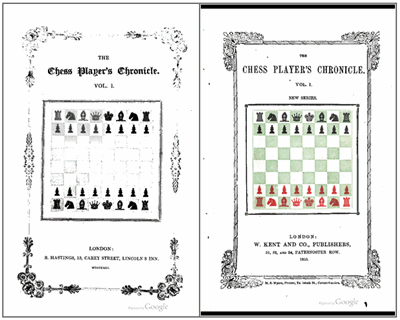
The first series covers 12 years, but includes 13 volumes. It appears there were two volumes issued in the first year. The following image shows the title pages for the initial volumes of the first and second series.


Left: S01V01, 1841; Right: S02V01, 1853

After locating the 21 volumes (13 + 4 + 4) on Google Books, my next task was to classify the content. Di Felice's description says, 'Monthly', but this seems not to describe the real frequency. The first three volumes (S01V01-V03) are composed of a series of 16-page publications, numbering around 26 per volume. Each publication starts with a composed problem, followed by game scores and text articles. As with all of the early periodicals I've looked at, dates are given infrequently, meaning that other clues are necessary to ascertain the time of publication. Di Felice's book mentions a few other incarnations of Chess Player’s Chronicle.

  • 619 The Chess Player’s Magazine (1863–1867)
  • 621 The Chess Player’s Quarterly Chronicle (1868–1871)
  • 618 The Chess Player’s Chronicle [England] (1872–1900)

I'll look at those another time.

28 March 2019

March Yahoos -- A Viral Story

The drought is over. In last month's post, February Amazon Yahoos, I wrote,

For the third consecutive month, my Yahoo news feed served no chess news. [...] Maybe we'll see some mainstream coverage of chess in March, but I'm not optimistic.

I should have been more optimistic. A great story, which was picked up by most major news services, appeared twice in the same Yahoo news feed. The first appearance was a featured story at the top of the feed, captioned, 'Homeless refugee chess champion goes viral'.

2019-03-18: Homeless 8-year-old refugee wins New York State chess championship, inspiring viral fundraiser (yahoo.com). The story started,

Tanitoluwa Adewumi just said checkmate. Despite learning the game a little over a year ago, the 8-year-old boy -- homeless refugee from Nigeria -- was crowned the New York State Primary Chess Champion in the kindergarten-to-third-grade bracket of the 52nd New York State Scholastic Championships. The elementary school student, better known as "Tani," went undefeated at the championships, where he outsmarted opponents from top private schools with pricey chess tutors.

The story attracted more than 1500 comments, many of them about immigration policy in the U.S. Most of the comments were supportive of the boy's achievement, but some were downright mean.

2019-03-19

As shown in the screenshot above, the second story appeared above other, similar stories, The photo is from Tani's GoFundMe page.

2019-03-18: Homeless 8-year-old boy wins New York State chess championship (yahoo.com; AOL.com) 'The 8-year-old refugee, whose family fled northern Nigeria in 2017 in fears of Boko Haram's attacks on Christians like themselves, first learned how to play chess at Manhattan's P.S. 116.'

Tani plans to play in the USA's national elementary championship in May. His participation might mean that the tournament will attract far more than the usual media attention.

26 March 2019

Palamede Portraits

In last week's post, Le Palamede, I introduced the world's first chess periodical.

All 11 volumes from the two series are available via Google Books, although the last two volumes of the first series are combined into a single PDF file.

The seven volumes of the second series, which started in 1841, were prefaced with portraits of distinguished French players of the period. The first of those volumes was further distinguished by not having a portrait. Edward Winter, in Chess Statues and Sculpture, (chesshistory.com) explained,

C.N. 5176 added that at the start of its 1842 run, in a note entitled 'Portrait', Le Palamède stated that no picture of Labourdonnais had existed and that when the master died Deville took a plaster cast of his head. Marlet then undertook a portrait of Labourdonnais.

No portrait:-

  • 1841 Labourdonnais

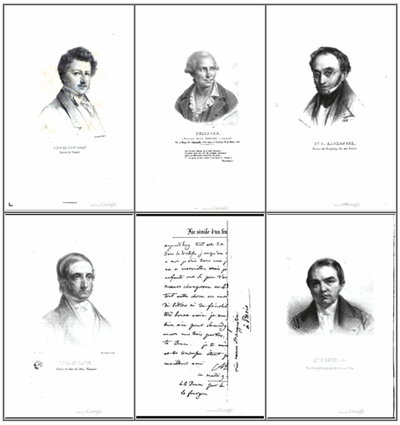
The portraits for the following six volumes are shown in the following composite image.

Left to right, top to bottom:-

  • 1842 St.Amant
  • 1843 Philidor
  • 1844 Alexandre (author of the Encyclopedia of Chess)
  • 1845 Calvi (author of a Chess Course)
  • 1846 Philidor's handwriting
  • 1847 Devinck (president of Cercle de Paris)

Philidor and St.Amant are familiar names to students of chess history. The others might be less familiar, but all three are present on Wikipedia:-

The first two Wikipedia articles appear to be based on the corresponding entries in 'The Oxford Companion to Chess'. Calvi's 'Chess Course' ran for five years in Palamède.

25 March 2019

TCEC S15 Div3 Finishes; CCC7 Starts

Another Monday, another look at the top-two ongoing engine competitions. I'll summarize last week's report, TCEC S15 Div4 Finishes; Stockfish Wins CCC6, with:-

TCEC: S15 division 3 is currently underway. [...] The AI/NN engine AllieStein (Allie + Stein) was one of the two qualifying [from division 4]. • CCC6: According to reports on other sites, the site is preparing CCC7. In the meantime, it is conducting the 'Bongcloud Bonus (10|10)'.

TCEC: This week's situation is an echo of last week's: S15 division 2 is currently underway. The AI/NN engine AllieStein was one of two qualifying from division 3. With the event nearing the 3/4 mark, AllieStein is in second place.

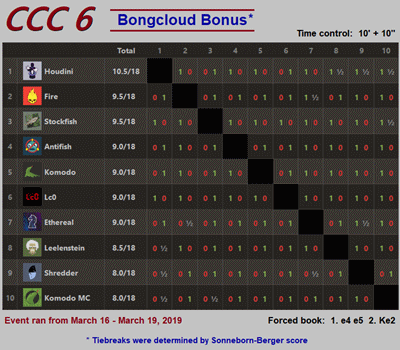
CCC: The Bongcloud event, a thematic opening tournament using 1.e4 e5 2.Ke2 as the first moves, finished as expected. White managed to draw a few games, which determined the final ranking shown in the following diagram. Chess is a game of logic and 2.Ke2 is a weak attempt to defy that logic. All other things being equal, poor moves lead to a loss.

Chess.com issued a report on CCC6:-

The same report outlined the plan for CCC7.

The CCC7 field includes the "big four" engines of Stockfish, Lc0, Houdini and Komodo, and adds three more neural-network engines that are expected to challenge for the finals in Antifish, Leelenstein and Allie.

That makes four AI/NN engines: Lc0, Antifish, Leelenstein and, Allie. The report continued,

Stage one of CCC7 is a 24-player round-robin, where each engine will play every other engine three times as White and three times as Black. The top four engines from stage one will advance to a 100x round-robin final stage.

Four AI/NN engines, four places in the CCC7 final stage. This is an event worth watching.

[For further information from the various stakeholders in the engine-to-engine events, see the tab 'TCEC/CCC Links' at the top of this page.]

24 March 2019

Chess and Gender Lines

The last two posts in this series on The Sociology of Chess (November 2016) have been about a book, 'Players and Pawns' (January 2019; Gary Alan Fine), and about a drawing, Dagmar and Strange Ebbesen (February 2019; 'chess as an accessory to legend'). It's time for a video. The recent Cairns Cup provided plenty of material.

For the first time, the Saint Louis Chess Club will host the Cairns Cup, an elite level tournament for the top female players from around the world. Inspired by its mission to further promote the game of chess to women and girls, the Chess Club aptly chose the name Cairns Cup in honor of co-founder Dr. Jeanne Sinquefield’s maiden name. Fans can look forward to a chess tournament similar in style to the prestigious Sinquefield Cup with the ten best female players from around the world competing in the Chess Club’s world-renowned facility for the $150,000 prize fund.

That introduction is from 2019 Cairns Cup (uschesschamps.com; why that domain?). For the tournament results see Cairns Cup 2019 (theweekinchess.com):-

The 1st Cairns Cup was a women's tournament in Saint Louis that took place 5th to 15th February. 2019. [...] Valentina Gunina drew against her closest rival Alexandra Kosteniuk in the final round to take clear first place.

Youtube channel Saint Louis Chess Club released dozens of videos related to the event.


2019 Cairns Cup: Is Chess Sexist? (10:03) • 'Published on Feb 15, 2019'

The video's description explained,

Before the 2019 Cairns Cup, IM Tania Sachdev and WGM Jennifer Shahade discuss sexism in chess and why gender lines exist in the game,

This topic is one of the most awkward that chess has to offer and I need to gird my loins before wading further into it. In the meantime, other videos about the Cairns Cup from the same channel can be found via Youtube search STLChessClub query=cairns.

22 March 2019

Le Palamede

After Berliner 'Schachzeitung', where...

I discovered that various 19th century chess periodicals were available via Google Books. My first effort concentrated on 'Schachzeitung'.

...my second effort concentrated on 'Palamede'. From Di Felice, 'Chess Periodicals, 1836-2008':-

1778. Palamède (Le) : Revue Mensuelle des Échecs et Autres Jeux (1836–1847) Vol.1 (1836)–Vol.4 (1839); New Series Vol.1 (1842)–Vol.7 (1847). Monthly. Editors Joseph Mery and Louis Charles Mahé de La Bourdonnais (1936–39), Pierre Charles Fournier de Saint-Amant (1842–47). Publisher Au Bureau de la Revue. Paris. France. Illus., ports., cm.21.5 x 14, and from 1842 cm.24.5 x 16.5. Magazine. General. French. Subtitle varies "Revue Mensuelle des Échecs," "Revue Mensuelle des Jeux."

La Bourdonnais' death in December 1840 was undoubtedly related to the gap between the series. All 11 volumes from the two series are available via Google Books, although the last two volumes of the first series are combined into a single PDF file. From Wikipedia's Le Palamède:-

Le Palamède was the world's first periodical devoted to the game of chess. It was founded in France in 1836 by Louis-Charles Mahé de la Bourdonnais, who is often considered to have been an unofficial world chess champion. It ceased publication in 1839, but was revived in December 1841 by Pierre Charles Fournier de Saint-Amant, who continued publishing it until the end of 1847.

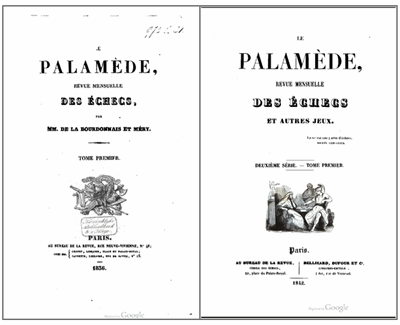
The Wikipedia page uses an illlustration similar to the one I created for this post.


Left: S01V01, 1836; Right: S02V01, 1842

What does Palamede mean? From Wikipedia's Palamedes (mythology):-

In Greek mythology, Palamedes was the son of Nauplius and Clymene. He joined the Greeks in the expedition against Troy. Pausanias in his Description of Greece says that in Corinth is a Temple of Fortune in which Palamedes dedicated the dice that he had invented.

Wikipédia's page in French, Palamède (mythologie), expands on the dice theme:-

Palamède est l’inventeur mythique du jeu d’échecs, de l’arithmétique, des jeux de dés et des signaux de feu servant à transmettre un message; et Théophraste dit Palamède inventeur des lettres et des chiffres. => 'Palamède is the mythical inventor of the game of chess...'

The first time I visited the Royal Library (Koninklijke Bibliotheek; KB) in The Hague, the stack for the chess collection was open to the public. I picked up the bound copies of Palamède, flipped through them, and thought how useful it would be to have the time to examine them in depth. Afterwards the chess collection was closed to the public, but much of its content became accessible through Google Books. Will I now find the time to examine the Palamède volumes?