29 September 2020

Splitting a Gold Medal

Last month's summary of mainstream chess news, Top News / Tournaments in August (August 2020), included this small item:-

I identified the top five events in each weekly edition of Mark Crowther's 'The Week in Chess' (TWIC). [...] It's curious that the Olympiad received top-five billing only once in August. In TWIC 1346 ['24th August 2020'] it was listed at no.21 out of 23 events.

If I had waited a few more days, I could have cherry picked dozens of Olympiad stories from major news sources, all similar to the following.

I also spotted a segment on BBC World News. It was subsequently captured for Youtube's channel, FIDE chess.


BBC reports on the Online Chess Olympiad (3:15) • '[Published on] Aug 31, 2020'

The piece included a discussion with a behind-the-scenes insider:-

Nick Barton, Director of eSports and Events at Chess.com, who together with the International Chess Federation [FIDE] set up the Olympiad. He's in Houston, Texas.

For the accompanying BBC story, see:-

The story coontinued,

An online version of the Chess Olympiad contest is being held for the first time this year because of coronavirus. India appealed after two of its players lost connection to their games and forfeited on time.

The FIDE decision to declare joint winners, made by FIDE President Arkady Dvorkovich, was roundly criticized on all sides. A few days earlier the event had incurred another blow when Armenia, in a match against India, lost a game on a server disconnect. Armenia withdrew from the event in protest.

28 September 2020

TCEC S19 Preparing Sufi; CCC15 Still Halted

Two weeks ago, in the previous report on two long-running series of engine vs. engine competitions, I noted 'this post might turn out to be one of the shortest in the series'. To summarize that post, TCEC S19 DivP Chugging Along; CCC15 Halted (September 2020), making it even shorter:-

TCEC: The Premier Division (DivP) has reached the fifth of eight all-play-all rounds. • CCC: Because of technical problems, the CCC15 'Round 2' matches were halted about half way through. The site is currently running a series of CPU-only exhibition events.

This current post promises to be equally short.

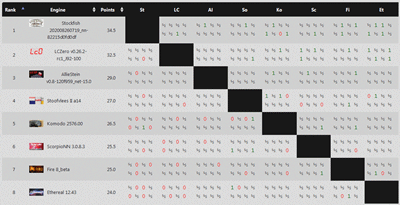
TCEC: DivP is the equivalent of the Candidates tournament in the FIDE World Championship cycle. It finished with the results shown in the following crosstable.

Stockfish and LCZero finished 1st/2nd to qualify into the S19 final match (aka Superfinal, aka Sufi). Stockfish won the eight-game mini-matches against all seven of the other competitors, including a +1-0=7 score against LCZero, losing only one game, to Komodo, along the way. LCZero was +5-1=1 in mini-match play, drawing the match with third place Alliestein after all eight games were drawn.

The Sufi should start this week. TCEC planning says it will last about 17 days.

CCC: There is no news on the technical problems affecting the GPU engines.The only information on the site informs,

!next • Four rounds of CCRL Ratings Standardization, 200 games each.

For more about the the Computer Chess Rating Lists, see CCRL (chessdom.com). The CCC is currently conducting the second of the four rounds. I could find no explanation of what is meant by 'Ratings Standardization'. Since the matches involve two engines, I suppose the goal is to verify that the results of the 200-game matches are close to the expected score calculated by the CCRL rating difference between the two engines.

[For further information from the various stakeholders in the engine-to-engine events, see the tab 'TCEC/CCC Links' at the top of this page. • NB: Leela = LC0 = LCzero]

27 September 2020

Quantum Chess and AI

Soft science, meet hard science. Or, more specifically, Sociology of Chess (November 2016), meet Quantum Chess.


Introduction to Quantum Chess - Quantum Summer Symposium 2020 (13:53) • '[Published on] Sep 3, 2020'

The video is from Youtube's TensorFlow channel, which describes its subject as 'an open-source machine learning framework for everyone.' The video description says,

Megan Potoski, Chris Cantwell, and Doug Strain introduce Quantum Chess as a fun tool for quantum education. This presentation was recorded on Day 1 of Google's Quantum Summer Symposium 2020 (July 22, 2020).

The description also links to a Symposium 2020 video playlist. A few years ago, in a post titled Quantum Chess (February 2017), we saw one of the current presenters in a video titled 'Christopher Cantwell - Quantum Chess: Making Quantum Phenomena Accessible'. In the current video, Cantwell referrs several times to 'iswap'. A Google search on 'quantum iswap' leads to Quantum logic gate (wikipedia.org). The page starts,

In quantum computing and specifically the quantum circuit model of computation, a quantum logic gate (or simply quantum gate) is a basic quantum circuit operating on a small number of qubits. They are the building blocks of quantum circuits, like classical logic gates are for conventional digital circuits.

Although the Wikipedia page doesn't use the term 'iswap', Google sends us there anyway. Google knows everything about everything.

25 September 2020

A Cascade of Chess Variants

I ended last week's post, Nine Chess Variants, saying,

GM Kramnik's latest ideas might promise a wealth of new material related to AI/NN.

Before tackling that, I would like to finish reviewing a related video on Youtube's Chess.com channel.


DeepMind Roundtable with GM Vladimir Kramnik, IM Danny Rensch, and the DeepMind team (1:49:21) • 'Streamed live on Sep 18, 2020'

The description says,

Chess.com hosts a round-table discussion with GM Vladimir Kramnik, IM Danny Rensch and researchers of Deepmind discussing their latest paper in which AlphaZero explores chess variants.

During the past week, Chess.com also released software to play many of the variants: AlphaZero (And Other!) Chess Variants Now Available For Everyone.

Six new variants, including four from the recent AlphaZero paper, are now available for all Chess.com members to try.

The page includes brief explanations of the variants. Four endorsed by GM Kramnik -- No Castling, Capture Anything, Sideways Pawns, and Torpedo -- plus three others gives seven new variants, not six. Was 'No Castling' previously available? Kramnik introduced it in December 2019.

My priority objective would be to eliminate the usefulness of tablebases (TB). Some of the variants would require new TBs to be constructed, but I don't see any that would do away with TBs entirely -- maybe 'Fog of War'?

24 September 2020

2020 CJA Awards - Part 1 bis

After last week's post 2020 CJA Awards - Part 1, I had hoped to wrap up Part 2 today, but the CJA site is currently out of service. It displays the message shown below.

In Part 1, I quoted an email from the CJA that said,

Our webmaster has arranged for us to move to a site that will allow us many more options. [...] We will have the new website in a couple of weeks and this should allow us to make the awards much more available to the general public.

As for me, I decided,

Although the award announcements are accessible on a couple of other sites, I'll allow a little more time for the move to Chessjournalism.org.

The CJA site was formerly hosted on Wix.com, which is the source of the message shown above. The new host will be Weebly.com. A week ago, the future host was showing pages from the new site, including the 2020 CJA awards. Now it redirects to the same message from Wix.com. A DNS problem? To be continued...

22 September 2020

Chess Is Not a Sport!

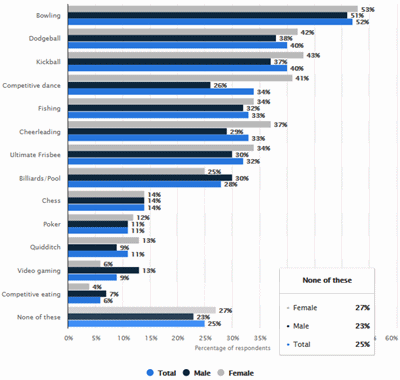
But bowling is, at least according to more than 50% of respondents to a survey. Chess as a sport received a 14% rating from both men and women. In the most recent monthly featured video on this blog, A Fast Paced History of Chess (September 2020), I mentioned a statistics site I hadn't seen before and transcribed some commentary from the clip:-

The web site 'Statista' values the worldwide boardgaming industry at $7.5 billion. And it's not exactly a new thing -- the same web site values the industry around the game of chess, more than a millennium old, at around $190 million.

A search of the site using my favorite keyword returned 50 Statista chess search results. Along with questions like 'Share of adults in the U.S. that think chess is a game of chance' (you have to register with the site to find out), the most relevant was probably, 'Which of the following activities, when participated in competitively, would you consider to be a sport?'. Here is the chart returned in answer to the question.


Source: Activities considered to be a sport 2014 (statista.com)

Of the 13 activities listed on the chart, chess is 9th, behind billiards/pool, but ahead of poker, quidditch [NB: ?], video gaming, and competitive eating [NB: ??]. Several notes to the chart are particularly relevant:-

Release date: January 2015
Region: United States
Age group: 18 years and older
Special properties: All adults who enjoy watching sport

For more about the service, see Statista (wikipedia.org).

21 September 2020

Stockfish NNUE Dev

Six weeks ago, when I posted Stockfish NNUE = +90 Elo (August 2020), I wrote,

I hope some kind, understanding soul will eventually produce something like 'NNUE for Dummies'. There is a lot to keep track of here.

For this post I took some time for another search on a good introduction. After all, with so many people looking into NNUE, many of them must need basic knowledge. Youtube is often a good start for tutorial material, but the NNUE videos it suggested were about experts analyzing a game where one of the engines used NNUE.

More promising was Stockfish NNUE - The Complete Guide (yaneu.com). Excluding the resources in Japanese, it still offers many good leads. One obvious choice that I had managed to overlook was the 'Discord for Stockfish' page, specifically #general-nnue-dev. Who could explain NNUE better than the people who had been its early adopters?

Discord isn't for everyone. If you're not interested in a subject technically, it's probably over your head, which has been my general experience with it. Having only dabbled with it in the past, I was faced with a steep learning curve. First, here's a Q&A extracted from the NNUE FAQ. The last question was the most informative to me:-

Q: Is NNUE an opening book? • A: No. It is purely an algorithm for the evaluation function. Classical handcrafted evaluation functions are terrible in the opening.

Why the emphasis on openings? Perhaps because it's the phase of the game where evaluation functions are weakest. I've looked at engine evaluation several times in the past:-

Since I use engines for practical play, I'm well aware of their strengths (lots of these) and weaknesses (few of these, but they exist). Back to the NNUE FAQ:-

Q: What makes NNUE run much better with traditional AB/minimax engines on CPU? • A: The neural net used for evaluation is very sparse compared to UCT/MCTS engines on GPU, and the code is optimised for modern CPU instruction sets with vector intrinsics, both which allow for much faster calculations of the evaluation function necessary for AB/minimax search on the CPU.

Q: Is NNUE a library like Fathom for Syzygy tablebases? • A: No, each engine developer will have to manually port NNUE to their code base, or write the algorithm from scratch.

Q: Is NNUE related to Leela Chess Zero? • A: No. NNUE is descended from linear neural networks used by shogi engine developers since the early 2010s, while Leela Chess Zero is descended from the convolutional neural network based go engine Leela Zero, which itself is based upon Deepmind's AlphaGo Zero from 2017.

Q: Is it possible to train a NNUE net from zero like the T10 Leela nets? • A: Yes. Although the neural nets are typically trained with the help of the evaluation of the engine used for training, the lambda parameter in the training indicates how much the evaluation is used to help train a neural net, and setting lambda equal to zero means no evaluation is used to help train the net.

Q: Does this make NNUE zero? • A: No, because there is chess knowledge handcrafted into the various neural net architectures used in NNUE themselves.

Q: What is the most commonly used architecture used for NNUE? • A: Halfkp. 'k' stands for 'king', 'p' stands for 'piece', and 'half' refer's to the player's own king: put all together, 'halfkp' refers to the fact that the position of the player's own king and the relationship between the player's own king and every other piece on the board gets encoded into the first layer of the neural net.

Long story short : NNUE gets to the essence of handcrafted evaluation functions. Those FAQ explanations lead to as many questions as they answer, often a sign of being headed in the right direction. I'll come back to the subject after I've had some time to orient myself. I hope the time will be well spent.