10 October 2018

Chess Informant R+2P vs. R+P

After the previous post on Reuben Fine's 'Basic Chess Endings' (BCE), Fine 1 - Tablebase ½, what's next for R+2P vs. R+P endgames? Chess Informant (CI) comes to mind with both the 'Encyclopaedia [Encyclopedia] of Chess Endings' (ECE) and the endgame section of the 'Informant' periodical.

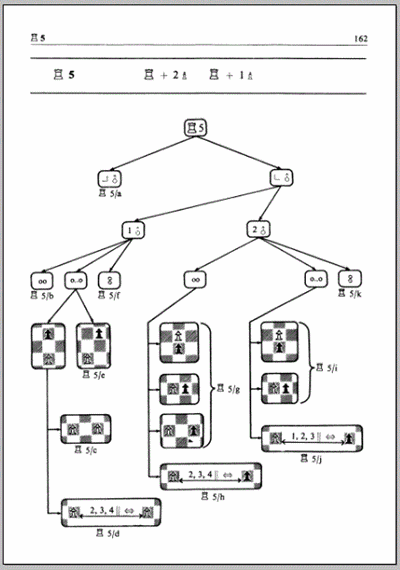
Some years ago I discussed both products in Chess Informant Endgames (March 2012), which included a copy of the table of contents for the ECE volume on Rook endings The structure of that volume's chapter devoted to R+2P:R+P is shown below (p.162).

The short left branch ('5/a') of the upside-down tree is for endgames with no passed Pawn. The branch below it (the 'middle' branch) is for endgames where the stronger side has one passed Pawn, while the right branch shows endgames with two passed Pawns. Both of those long branches are divided into sections where the side with two Pawns has connected, disconnected, or doubled Pawns. Those sections are further divided into subsections according to the relationship with the opponent's lone Pawn. It looks simple enough, but it took me some time to understand the symbols. The same system was adopted in Informant 39 (1985H1) and thereafter.

08 October 2018

Carlsen's PGN 2017-18

In last week's post, Carlsen's TMER 2017-18, I promised,

I still have a few actions to accomplish before I can merge the updates into the main TMER. [...] I'll try to finish these for my next post.

I accomplished about half the work, which mainly involved preparing and checking the PGN for individual events. I updated the page on my site, Magnus Carlsen's Tournament, Match, and Exhibition Record (TMER; 2000-), with the info. On the way, I made two decisions for naming conventions on the PGN files. Here are examples of both:-

  • B8X-CHCM: 2018-01 PRO League Group Stage 2018; Chess.com
  • B8B!BAER: 2018-02 Fischer Random Rapid/Blitz 2018; Baerum

The first shows an example of league play ('X'), which usually spans several months. The second is an example of a PGN file containing only chess960 games ('!'). For one event I have no games: the Third Annual Lichess Meetup and Hackathon (lichess.org; February 2018). Carlsen played the event impromptu and it seems the games were not recorded. If they surface, I'll add them.

For my next post in the Monday series, I'll return to the subject of engine-to-engine competitions, last seen in A Leela Surprise in the Nimzo Indian (August 2018). I need to catch up with two tournaments: TCEC season 13 and Chess.com's Computer Chess Championship (CCCC).

07 October 2018

'Ain't No Luck in Chess'

October's selection for Top eBay Chess Items by Price (March 2010), was titled '100 Bullets #45 p.4 - Chess in Prison - 2003 art by Eduardo Risso'. It sold for $500.00, 'Buy It Now'.

The description simply repeated the title and added,

Size: 11.5" x 17" page mounted 15 1/4 x 20 3/4 matting

The dialog on the page -- between an old guy and a young guy -- goes like this:-

Nice move, young blood. You been learnin' something finally.

Uh-huh. I been studyin' yo' ass, old head. How many games we play?

Hun'red.

An' how many I won?

You ain't.

So maybe it's time I got lucky.

Lucky? Ain't no f**king luck in chess, loop. Either you got the skills an' the patience to outmaneuver an' anticipate yo' opponent...

...Or you ain't. Checkmate. One-oh-one to none.

And the last frame signs off with the old guy saying,

Yo' loopy loop...

In Eduardo Risso, Wikipedia informs,

Eduardo Risso (born 23 November 1959) is an Argentine comics artist. In the United States he is best known for his work with writer Brian Azzarello on the Vertigo title 100 Bullets, while in Argentina and Europe he is noted for his collaborations with Ricardo Barreiro and Carlos Trillo. He has received much acclaim for his work

That reference to 100 Bullets leads to another Wikipedia page,

100 Bullets is an American comic book published by DC Comics under its Vertigo imprint. Written by Brian Azzarello and illustrated by Eduardo Risso, the comic book ran for 100 issues and won the Eisner Award and Harvey Award.

Chess has had a long relationship with comic art. For previous posts, see Chess Comics No.7: Punch Animated GIF (May 2014), and No More Yahoos? (February 2016).

05 October 2018

Restoring Adsense

Continuing a saga started with migrating my site to secure pages, Verifying HTTPS (August 2018):-

One casualty of the migration was Google Adsense. The ads are missing, e.g. on the index page for the World Chess Championship, and the browser warns of mixed content. The code that calls an ad currently uses 'HTTP'. If I want the ads back I'll need to change the code on all pages, but it might be better to replace Adsense with something else in that space.

First I had to catch up with the latest announcements from Google:-

Then I had to solve a number of technical problems involving batch transfer using FTP. The result is shown below, where the ad is a generic place-filler to 'Download PDF - Free'.


Index : World Chess Championship

Re 'it might be better to replace Adsense with something else', that's still possible, but replace it with what? In the meantime, while restoring Adsense, I added the functionality to load the ads asynchronously. I'm not sure what difference it makes, but I'm sure I'll find out.

After this short series that has little to do with chess, it's time to return to the main subject. There are still a number of issues involving Google, but none of them are urgent (until Google decides otherwise).

04 October 2018

Fine 1 - Tablebase ½

Let's go back to Chess and Impressionism (September 2018), where I wrote,

After my first idea for today's post ran into trouble when I ran out of time (a follow-up to last week's 'A Remarkable Tool', if you're curious) [...] I'll try to return to 'A Remarkable Tool' in another post.

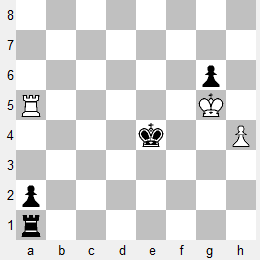
In the post A Remarkable Tool, I aimed Lichess's seven piece tablebase at an endgame of the type R+2P vs. R+P. After documenting some flawed analysis, I then tackled the same class of endgame in Reuben Fine's 'Basic Chess Endings' (BCE). Fine's analysis was 100% accurate on every position I looked at until I 'ran out of time'. Continuing with Fine during the next session, I discovered the following position. (Use the link under the diagram to follow the analysis on Lichess.)

BCE no.363

Lichess: 8/8/6p1/R5K1/4k2P/8/p7/r7 w - - 0 1

Fine wrote,

To blockade the Pawn with the [defending] Rook is less favorable. It is relatively best to have the Rook behind the Pawn. In that event, the defender draws if his King can find a haven behind the Pawns, but loses if he cannot. As a rule the King can find a safe spot only if the two remaining Pawns are on the same file.

No.363 (Steinitz - Gunsberg, 9th match game, 1890-91) is typical. Against the threat of the removal of the Black Rook with check White is defenseless, for on 1.Kh6 g5! compels him to expose his King.

Fine's logic looks straightforward, but there is a neat twist hidden in the position. After 2.Ra4+ (the only move) 2...Kd5 3.Ra5+ (ditto) 3...Kc6, the move 4.hxg5 is an error. White should sacrifice a second Pawn with 4.Ra3 (4.Ra8 leads to the same idea), entering a Rook endgame two Pawns down, where the extra Pawns are a- & h-Pawns. This is known to be drawish.

Indeed, after 4...gxh4, White has a series of forced moves that lead to a draw: 5.Rc3+ Kd5 6.Rc2 Ke4 7.Kh5 Kf3. Now follows, for example, 8.Rb2 h3 9.Kh4 (forced) 9...h2 10.Rxh2. Black can try other attacks, but White always has a counterattack. After rejecting 1.Kh6, Fine continued,

Consequently the only hope lies in driving the Black King as far away from the K-side as possible, giving up the Rook for the RP, and taking one's chances on the ensuing R vs. P ending. This stratagem is bound to be unsuccessful here because the Black King is too near.

He gave 1.Ra4+ Kd5 2.Ra5+ Kc6 3.Ra6+, and Black wins. He again overlooked 3.Kh6, which after 3...g5, reaches the same position as in the line after 1.Kh6.

None of this is meant to belittle Fine. BCE was a landmark chess book and much of the analysis has withstood the test of time. This post is meant instead to demonstrate the kind of subtleties that are available in the common R+2P vs. R+P endgames.

02 October 2018

October 1968 'On the Cover'

I started last month's September 1968 'On the Cover', by asking,

In this blog's monthly 'On the Cover' series, when was the last time the same chess personality featured on the covers of both American chess magazines 50 years ago? It turns out that it was exactly two years ago, in September 1966, when Spassky was so honored. [...] This month, 50 years ago, Larry Evans became the first person to appear solo on the cover of both magazines.

To merit that honor, GM Evans had become U.S. Champion for the third time. This month's covers from 50 years ago featured the U.S. Open Champion, Bent Larsen of Denmark. The last time we saw him in this series was November 1967 'On the Cover', when Chess Review used the same photo (and as I noted, already for at least the second time).


Left: 'Bent Larsen : U.S. Open and Canadian Open Champion'
Right: 'A New U.S. Champ'

Chess Life

The Chess Life (CL) report, 'Mike's Peak' by George Koltanowski (Tournament Director) was unusual. While browsing the issue of CL the first time, I failed to notice that it was indeed the tournament report. It started,

Whoever arranged the 69th Annual U.S. Open Chess Championship deserves a special medal! Snowmass-at-Aspen sounded very intriguing. The great question was ... HOW DOES ONE GET THERE? Easy, just get to Aspen and from there you take a shuttle bus.

After rambling through numerous anecdotes of the same sort, the report finally reached a list of winners. It continued,

Bent Larsen took first prize and the championship trophy with great ease, scoring ten wins and only two draws (with Pal Benko and Robert Byrne). He was unruffled all the time, and only the game with James Sherwin seemed to cause him some annoyance.

Chess Review

The Chess Review report was more straightforward.

United States Open • Bent Larsen of Denmark imparted a definitely international flavor to the U.S. Open, and also won it. (Can we use him on our Olympiad team?) He was held to draws only by Pal Benko of New York and Robert Byrne of Indianapolis and thus scored 11-1. Benko, not so long ago from Hungary, and Walter Shawn Browne, who has applied for Australian citizenship, further flavored the Open internationally by tying for second and third at 9 1/2 - 2 1/2. Byrne, Larry Kaufman of Silver Spring, Maryland, and Dr. Anthony Saidy of Los Angeles tied for fourth, fifth and sixth at 9-3.

Canadian Open • Larsen also scored a near sweep in the Canadian Open at Toronto. Fifteen-year-old Ken Rogoff of Rochester, New York, staged a sensation by nicking him for a draw. But Larsen went on to win (more details, next issue).

CL carried another report, 'Observation Point' by Miro Radojcic, subtitled 'The Match That Never Was'. TMTNW? Exactly six years ago day for day, in Another Fictitious Match (October 2012), I posted a short series about another TMTNW, the 1975 Karpov - Fischer title match: 1975 Fischer forfeits to Karpov.

In October 1968, Radojcic would not have been discussing that 1975 match. He was talking about 1968 Spassky - Larsen, played in May 1968 at Malmo, Sweden, one of the semifinal matches in the series of 1967-69 Candidates Matches, eventually won by Spassky. TMTNW here meant Larsen starting the match with three straight losses to Spassky. Larsen was not a match player, he was a tournament player, and 1968 was the best tournament year of his career.
01 October 2018

Carlsen's TMER 2017-18

Continuing with Carlsen's Record 2017-18, I improved the table displayed in that post and added it at the end of my page about Magnus Carlsen's Tournament, Match, and Exhibition Record (TMER; 2000-). I still have a few actions to accomplish before I can merge the updates into the main TMER:-

  • Complete the 2018 Sinquefield Cup and check for any events GM Carlsen played since that event.
  • Add missing data.
  • Isolate the chess960 games.
  • Add the new PGN to the master file.

I'll try to finish these for my next post.