21 May 2020

Breaking the 3100 Barrier

I thought I was done with the 'Breaking the Barrier' posts, last seen in Breaking the 3000 Barrier (September 2019). Then this remarkable Chess.com video surfaced this week.


The Strongest Computer Chess Engines Over Time (2:15) • '[Published on] May 20, 2020'

It appeared a few days after post no.3100 on this blog -- Businessman vs. Mother Nature -- and gave me the opportunity to doublecheck the info from Breaking the 2900 Barrier (April 2019):-

I've marked the 2900 crossover point with a red star. The engine under the star is Shredder 8.0 and the year was 2003 or thereabouts. As for 'Breaking the 3000 Barrier', the same chart points to Rybka 1.2 a few years later.

Back to the video : after IBM's Deep Blue pops to the top of the chart at 2712 in 1996, it hits 2853 in 1997. It stays at the top until Hiarcs overtakes it end-2003. Hiarcs rises to 2896 -- now don't blink or you'll miss it -- where it is immediately overtaken by Rybka at 3003 in mid-2004. Rybka breaks 3100 end-2005.

The more than 500 comments against the video (NB: right-click the embedded video for its original address) are probably worth a browse, but I'll look at those another time. As for the source of the data, a note says,

The primary data source is the SSDF list as collected from online sources and publications in the ICCA Journals (later named ICGA).

This is followed by rating derivations for Deep Blue, AlphaZero, and Leela. I'm sure the methodology is controversial, which makes it even more interesting.

18 May 2020

CCC Formats

In last week's engine post, TCEC: Stockfish Wins Cup 5, S18 Underway; CCC14?, I wrote,

During 13 seasons, the CCC has never settled into a standard format. What will CCC14 bring?

That reminded me of an earlier post, CCC13 Shapes (March 2020), where I gave myself a possible future action:-

While it might be useful to summarize all of the different CCC formats since the first season (CCC01), I'll have to limit this post to the two most recent seasons. [CCC11 (October 2019) & CCC12 (January 2020)]

The first step was to locate the different posts on this blog that gave the format for a particular CCC season. This was easy with the help of TCEC/CCC 2019 Q1-Q3 Summary (October 2019). The first two posts in that summary were dated the beginning of last year:-

2019-01-07: TCEC S14 Underway
2019-01-14: Chess.com CCC3 Underway

That means the ten months from January to October covered eight CCC seasons, from CCC3 to CCC10. I extracted relevant format info for each of those seasons. This info is not detailed enough to document the actual format used, but it's a start. Many of the posts link to Chess.com articles where the formats are described in more detail.

2019-07-29: TCEC S16 Leagues; CCC9/CCC10 • '[CCC10:] Qualification (13 engines), Quarterfinal (12), Semifinal (6), and Final (2).'

2019-06-03: TCEC S15/S16; CCC8/CCC9 • '[CCC9:] Engines are 1. Stockfish 2. Lc0 3. Allie 4. Laser 5. Xiphos 6. Andscacs 7. Dark Queen Lc0 8. Rofchade 9. Wasp 10. Rubichess 11. Winter 12. Stoofvlees 13. KMC 14. Ethereal 15. Fire 16. Komodo 17. Houdini 18. Leelenstein • There will be 4 stages, qualification/quarterfinal/semifinal/finals'

2019-04-22: TCEC S15 DivP Nears Finish; CCC8 Half-Way • '"CCC 8: Deep Dive is live now, featuring 24 of the world's top chess engines playing at a rapid time control of 15 minutes plus a five-second increment per move." CCC8 uses an escalation format, meaning that the engines enter the competition in reverse order of strength -- last ranked starts first, first ranked last -- and play full mini-matches against each of the engines that have already started play.'

2019-03-25: TCEC S15 Div3 Finishes; CCC7 Starts • 'The [Chess.com CCC6] report outlined the plan for CCC7. [...] That makes four AI/NN engines: Lc0, Antifish, Leelenstein and, Allie. The report continued, [...] Four AI/NN engines, four places in the CCC7 final stage. This is an event worth watching.'

2019-02-18: TCEC S14 Final, CCC5/-6; Part 2/2 • 'CCC6 is currently underway. The rules say, "Qualifiers (5|2) - escalation, 3 rounds, 16 engines, top 8 qualify, SF, Lc0, Komodo & Houdini get buys [sic; 'byes'] • Playoffs (10|10) - 12 engines, 3 rounds, top 8 plus SF, Lc0, Komodo & Houdini, book ON • Finals (10|10) - 2 engines, 200 games, book ON"'

2019-02-11: TCEC S14 Final, CCC5/-6 • 'CCC5 was underway at the time of last week's 'Head Scratching' post. Stockfish emerged the winner, 2.5 points ahead of Lc0, which was 4.5 points ahead of third-placed Lc0-dev. Stockfish then played Lc0 in a 100 game match, which finished yesterday.' • 'Another command ('!CCC6') informs, "Nightbot: CCC 6: The Winter Classic; Classical (standard) games with the eight best engines. Time control: 30/10 classical; Engines: 8; Stages: 1 main, 1 final between top two engines; Stage 1 format: 4x RR (escalation); Stage 1 games: 112; Stage 1 duration: 7 days; Finals games: 100"'

2019-02-04: TCEC/CCC Head Scratching • 'The 'Stockfish Wins [CCC4]' article says, "Lc0 also managed the impressive feat of scoring dead even with Stockfish head-to-head in the tournament, at +3-3=14 in their 20 games together. Lc0 was the only engine to score a win against Stockfish in the event. These two engines began a 100-game bonus match, in progress now, which at press time Stockfish was leading comfortably at 35.5/66."' • 'The Escalation event (labeled 'CCC5') is a round robin format where the lowest rated engines play each other in the early rounds and the highest rated engines start play in the later rounds.'

2019-01-28: Stockfish, Leela et al • Chess.com issued a report on CCC3 S3 [...] along with details about CCC4. • 'CCC4 (S1?) is already underway with Stockfish in the lead.'

2019-01-21: Results: TCEC S14-P / CCC3 S3 • 'CCC3 stage three (the final stage) [has] finished play.'

2019-01-14: Chess.com CCC3 Underway • 'From now on, I'm going to call the events CCC1/CCC2/CCC3/..., unless the name changes again. Another complication, more like a detail, is that the tournaments since CCC1 have been split into three stages. Since CCC3 is currently underway, that means there have been two previous CCCs, right? No, there have been three. Here are my posts on each of the first three [CCCC, CCC1, CCC2]

2018-11-19: Update on Two World Champions • 'CCC 3: Rapid Redux, an all-new championship event with the 16 top engines in the world and a time control of 30 minutes per game plus five seconds increment per move.'

2018-10-15: Catching Up with Engine Competitions • CCC01 & CCC02

2017-12-04: Engine-to-engine, Head-to-head • 'The newcomer was Chess.com's Computer Chess Championship. The announcement, preliminary results, and final results are all stuffed into a single article, which first appeared in September, but carries the date of its last update: 2017-11-16 [CCCC]'

Like most people, I think of a 'season' as lasting three months, four seasons in a year. Then there are specific seasons that happen once a year, like a football season or a TV season. In CCC, we've seen ten seasons in less than a year and a half, 17 months to be exact. That's ten seasons, each with a different format -- makes you wonder, doesn't it.

17 May 2020

Businessman vs. Mother Nature

Two adversaries on opposite sides of a controversial issue is a common theme in chess art. This cartoon was in two Flickr groups: Global Climate Change and Saving Earth ('group/s0s').


Di00015 business-vs-nature chess playing no game illustration by frits ahlefeldt © Flickr user Frits Ahlefeldt under Creative Commons.

The description said,

Businessman playing chess with Mother Nature.

While the image in this post is certainly worth featuring, the short list for my Flickr posts seems to be shrinking gradually. Is it because artists and photographers are more concerned than ever about protecting their work -or- because Creative Commons licenses aren't well known? Earlier this week, in a post titled FIDE Newsletters++ on my World Championship blog, I was disappointed to see that the photos in FIDE’s albums on Flickr were marked '© All rights reserved'. Releasing some of FIDE's wonderful photos for limited, prescribed use would help everyone who is promoting chess.

Another issue raised by the image above is how to locate other chess images that depict the generic topic 'opposite sides of a controversial issue'. I can't think of a search query to do this. Maybe something will pop into by subconscious mind later.

15 May 2020

The FIDE Charter : Discussions

Last week's post, The FIDE Charter, was based on a long extract of the minutes for the 90th FIDE Congress, Extraordinary General Assembly (EGA), which was held at the end of February. As long as that post was, there was one piece missing, which I marked '[Discussion]'. Later I extracted five main points from the EGA discussion:-

  • New Member Federations must be a country recognized by the UN and the IOC.
  • Presidents and delegates of the Federations need to have been members of that Federation for two years.
  • The Council [is] entitled to approve the rules related to the title and rating system, while the [General Assembly] will still have the power to approve everything the Council proposes.
  • The reason for the creation of a Zonal Council: the purpose of a Zonal Council is related to the development program and budget.
  • The [current] elected bodies of FIDE will stay until the end of their term; Executive Board will be renamed as Zonal Council; current elected Commissions will be extended to two more years.

Those points are mainly quotes from the original minutes. As far as I can tell, the 'Council' and the 'Zonal Council' are two different groups. (NB: I should have taken this analysis a step further, by checking the wording of the final, published charter on these five points, but I didn't.) While I was looking for further discussions on the charter, I discovered a 16 page PDF presentation covering the main talking points.

FIDE CHARTER : Time for change

20200228_FIDE Charter FINAL.pdf

One particularly useful slide in the presentation, titled 'THE NEW FIDE', defined the functional groups within a hierarchy:-

GENERAL ASSEMBLY
An organ with the highest authority in FIDE
COUNCIL
A strategic and oversight FIDE body, with law-making and executive functions
PRESIDENT
An official FIDE representative in all external relations, manages day-to-day activities
ELECTED COMMISSIONS
Professional and independent organs for specific FIDE tasks
MANAGEMENT BOARD
An executive and operational body that assists the President in the day-to-day management of FIDE activities (without any legislative competencies)

I hoped to find more discussion on the forums of English-speaking FIDE federations, but came up with less than I expected. First, here's a report from the American federation: USChess at FIDE Extraordinary General Assembly (uschess.org; 'USChess Executive Director Carol Meyer reports from Abu Dhabi'), including a long comment by 'Allen Priest, President, USChess'. See also a short discussion started by the same 'President, US Chess': FIDE Extraordinary General Assembly (uschess.org/forums; February 2020). An earlier thread on the same forum presented some of the main discussion points: FIDE announces extraordinary General Assembly (ditto; December 2019). That last link is only available to members of USChess.

As for the forums of other federations, most of the discussion must have been offline or through back channels away from public view. Or maybe the charter just wasn't as controversial as might have been expected.

11 May 2020

TCEC: Stockfish Wins Cup 5, S18 Underway; CCC14?

The previous report on the two world class engine-to-engine competitions that I review every two weeks marked a milestone : Leela Beat Stockfish in TCEC S17 & CCC13 Finals. I ended it saying, 'The crown for top chess engine has passed firmly from the traditional, hand-crafted A/B CPU engines to the 21st-century, self-learning AI/NN GPU engines.' As for the details,

TCEC: LCZero beat Stockfish with an S17 final score of +17-12=71 (52.5-47.5). TCEC Cup 5 is well underway and has reached the semifinal stage. • CCC: Lc0 beat Stockfish with a CCC13 final score of +19-7=174 (106.0-94.0). Since CCC13 ended, the Chess.com organizers have been running a series of exhibition events.

Referring to both of those ongoing competitions, I noted,

I haven't yet seen any plans for TCEC S18 or for CCC14. I imagine they'll be available, maybe the events will even be underway, by the time of my next report in two weeks.

That 'next report' is now, so let's have an update.

TCEC: In TCEC Cup 5, Stockfish beat Komodo +2-0=1 in the first semifinal match. After four draws in the second semifinal between LCZero and AllieStein, the tiebreak rules came into force:-

In case of an equal score after these four games, tiebreakers will be played out at the end of the Cup round. Tiebreakers consist of additional game-pairs; a decisive pair of tiebreaker games decides a match.

LCZero prevailed in the second of the 'additional game-pairs'. Stockfish beat LCZero +1-0=3 in the final, while AllieStein beat Komodo +2-0=2 in the consolation match.

The following chart shows the many stages of TCEC S18. The link under the chart leads to the larger, original version.


TCEC Season 18 - TCEC wiki
(wiki.chessdom.org)

The Qualification League finished with the engines Counter and Asymptote qualifying into League 3, which is currently underway. For an explanation of the color-coded stages shown in S18, follow the link under the chart for 'TCEC Season 18 Rules'.

CCC: The series of exhibition events continues. At the time of my post two weeks ago, the CCC site was running an event called 'Chesse Gambetts (5|2)', which has since disappeared from the archive. When I checked a week ago, the active event was 'Bullet Match: Stockfish Test (1|1)'. At the time of today's post, the current event is 'ECO MegaMatch! (1|1)' with 1080 games played out of 2099 scheduled (an odd number of games for a match!?).

Can the CCC continue as a viable platform for engine competition? The list of PGN files is only current through 7 March, the Discord tournament results are through 3 May, and the 'CCCC Club' is moribund. A brief Discord conversation from 4-5 May explains,

Q: When will CCC14 start? • A: The Bullet Match, will be in a day or two probably. CCC14 will be worked on during/after that. But as with CCC11, CCC12, CCC13, there will almost certainly be huge delays.

During 13 seasons, the CCC has never settled into a standard format. What will CCC14 bring?

[For further information from the various stakeholders in the engine-to-engine events, see the tab 'TCEC/CCC Links' at the top of this page. • NB: Leela = LC0 = LCzero]

10 May 2020

An Influential Organization

What's the most influential chess organization in the world today? No, it's not FIDE. And it's certainly not US Chess (although the Saint Louis Chess Club comes into consideration). The most influential chess organization is Chess.com. Their most recent 'State of Chess.com' video covered:-

  • Monthly Reviews
  • Coming Soon
  • Premium Arena
  • Titled Players
  • Fair Play/Proctoring
  • Q/A
  • Final Thoughts

While other organizations might have slicker online interfaces -- Lichess and Chess24 come to mind -- Chess.com is involved in organizing World Championship events. Here's a discussion of their recent activity.


State of Chess.com Quarter 1, 2020 | Host IM Danny Rensch (2:11:40) • '[Published on] Apr 28, 2020'

If two hours is more than you can spend on a single non-instructional chess video, two of its main segments are available standalone:-

Given the current push to online chess -- with substantial assistance from the coronavirus Covid-19 -- the discussions of cheating are particularly relevant.

08 May 2020

The FIDE Charter

The last post stemming from Minutes of the 90th FIDE Congress (April 2020) is on a subject to which I never paid much attention while it was being drafted and discussed : the FIDE Charter. For a summary of the charter, let's first turn to Fide.com, The new FIDE Charter: What is it? (March 2020):-

One of the main decisions at the recent 90th Extraordinary General Assembly was the approval of the new FIDE Charter, that replaces the old FIDE Statutes and came into force on March 1, 2020. But what does this change implies, and why it was required?

This reform was needed because the previous FIDE Statutes were severely outdated. There was a pressing need to renew them in order to turn FIDE into a more modern, transparent, democratic and efficient institution, in full compliance with International Olympic Committee stands. The main rules of our organization have a fundamental role in making this possible, clarifying the system of FIDE rules and regulations, defining the principles of FIDE, establishing clear management structures, improving the role of the independent Elected Commissions, and updating the role of Zonal Presidents.

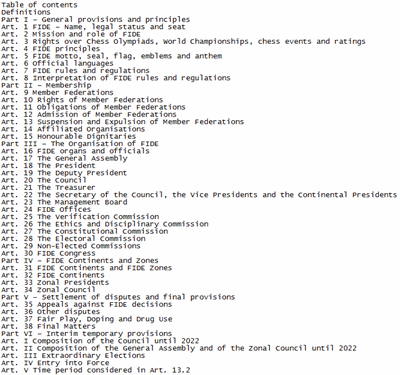
The following image captures the 'FIDE Charter - Table of contents'.

Since the purpose of the 90th FIDE Congress and its Extraordinary General Assembly (EGA) was to approve the charter, I extracted relevant portions from the minutes. It's perhaps too long for most people, especially those who aren't interested in chess politics, but it was the best way to force myself to read it!

90th FIDE Congress; FIDE Extraordinary General Assembly; Abu Dhabi, UAE; 28th February 2020; MINUTES

1. FIDE President address [...]

We did our best to be transparent and open in what we are doing, including the communications with the Federations and the chess players. The work on the Charter, which started a few months ago, was a very good signal of this. The proposed version of the new Charter was published and sent to all Federations, which then sent their own recommendations. [...]

One of the main items of today EGA Agenda was the changes to the FIDE Charter, which involved much work and study in order to make FIDE official documents more modern and consistent with the latest IOC practices. The draft of the new Charter has been presented to the IOC in order to receive their opinions and comments. We tried to develop a more democratic system which will allow the National Federations to play a more important role in FIDE activities. The draft of the Charter was sent to all National Federations a few months ago and all the comments received from the Federations were incorporated into the version of the Charter presented now at the EGA. The main ideas include regulating the hierarchy of documents, professional and transparent management, clear rights and responsibilities of Member Federations, fixing the commercial rights of FIDE, new system of disputes resolution. [...]

4. New FIDE Charter

Annex 2.1. is the draft of FIDE Charter, which was sent to all the Federations and was approved unanimously by the PB. [The TOC shown above is from that document.]

Mr. Dvorkovich illustrated the key points of the reform of the FIDE Charter, which were considered necessary to make FIDE a more modern, efficient and transparent democratic organization which would work in fully accordance with the IOC principles. The new structure of FIDE was clearly illustrated, focusing on the responsibilities and rights of each body of FIDE: GA, Council, President, Elected Commissions, Management Board. A clarification of the hierarchy of legal acts adopted by FIDE was also established. The role of the independent elected commissions was improved, and the role of the Zonal Presidents was updated.

Mr. Dvorkovich clarified the hierarchy of the FIDE bodies: the GA is the highest body of FIDE and can take any decision. There is a clear list of decisions that only the GA can take, including the approval of the Charter itself and of the most important regulations, including financial and electoral regulations. The GA is also the only body which can decide on the full membership of new Federations, on elections and other issues described in the Charter.

The Council is elected by the GA and adopts all other regulations not listed in the Charter and takes decisions on all strategic matters of FIDE functioning, including financial matters and tournaments. The President reports to the Council and annually to the GA and manages day-to-day activity of FIDE and represents FIDE in all its external relations.

The elected commissions are independent, take decisions about ethics, constitutional matters, elections and verification issues. The other bodies cannot intervene in the decisions of the elected commissions. They should work in a professional way, their members should have sufficient experience to resolve those matters.

The Management Board is not an independent body. It supports the President in day-to-day activities and reports directly to the FIDE Council. It is an operational body that follows the instructions of the GA and the Council.

To ensure transparency, a vote of no confidence was introduced in the regulations. The GA can decide on no confidence regarding both the President and the Council.

In the existing version of the Statute, less than a half of the PB members were elected independently of the President. To ensure democracy, in the proposed Charter, more than 50% of the voting Council members are elected by the GA without the direct influence of the President. The Treasurer and the Secretary are also elected by secret ballots.

The GA has more powers as compared to the current Statute. It deals with all major issues, including the election, the budget and the vote of no confidence. It can overrule any decision of the President and the Council.

The abolition of proxies was established not only for the elections, but for any other matters. The Presidents and the delegates can represent only one Member Federation and should be really affiliated to their country (having citizenship or residence or working experience in the elected bodies of their Member Federation).

It was decided that the Council should consist of 15 members, working on a full-time basis. It has both executive and legislative functions, which means that all matters which are not regulated by the GA can be resolved by the Council. It defines strategic plans and policies, approves the draft of the FIDE budget, ratifies the decisions taken by the President and supervises the activities of non-elected commissions. The World Champions are invited to each Council meeting, but they do not have voting rights.

It was also decided that the President cannot serve as President for more than two terms, including the current term. The President represents FIDE officially and have the following main functions: to sign contracts, to assume obligations for FIDE, to maintain good relationships between FIDE and the National Federations.

The Management Board is a new body. Actually, it already exists, but without any formally approved functions. The new Charter clearly established its functions. It is an executive, operational and administrative body with full-time working staff with the aim of making FIDE a more efficient organization. The MB is appointed by the Council.

The independence of the Elected Commissions’ members represented another important aspect of the proposed new Charter. It was decided that they should not be elected at the same time as the FIDE President to preserve the political independence of their election. Starting from the next election, qualification requirements for the Elected Commissions’ members will be introduced.

The functions of the Ethics Commission were expanded. This body becomes now the “Ethics and Disciplinary Commission”, with seven instead of five members. The reason for this is that FIDE needs professional people who will also analyse and investigate specific matters, rather than just gather occasionally to take decisions.

A fixed hierarchy of documents was established to clarify the system of FIDE rules and regulations. There will be no other rules or regulations in FIDE. FIDE Handbook will be refreshed to have a clear set of documents regulating the activity of FIDE. It is reminded that all documents must be published on FIDE website in order to become operational.

Mr. Rivello, who could not attend the Congress due to the coronavirus epidemic in Italy, participated to the Congress through a Skype call in order to answer any eventual questions about the Charter draft. Mr. Rivello reported about the work of the Task Force charged with the drafting of the new Charter.

[Discussion]

The EGA proceeded with the voting through the open vote system. The new Charter was approved and comes into force on March 1st, 2020. The vote results were: 112 votes in favour, 1 abstention and 1 voted against.

Of particular importance to anyone interested in top level chess is the stipulation that 'the President cannot serve as President for more than two terms'. This will avoid a recurrence of the 23-year period (1995-2018) that Kirsan Ilyumzhinov served as FIDE President. Like any other organization, chess administration routinely needs new blood to avoid becoming ossified.