18 September 2020

Nine Chess Variants

Remember the post Non-random, Non-castling (December 2019)? It went something like this:-

Former World Champion Vladimir Kramnik has an idea: '[VK and DeepMind] tasked AlphaZero with exploring a variant that prevented either side from castling, trying different opening moves from both sides.'

If you don't remember that post, it's probably because you don't follow my chess960 blog, where it appeared. GM Kramnik resurfaced this month with a slew of similar ideas. You can explore them in New AlphaZero Paper Explores Chess Variants (chess.com):-

In a new paper from DeepMind, this time co-written by 14th world chess champion Vladimir Kramnik, the self-learning chess engine AlphaZero is used to explore the design of different variants of the game of chess, with different sets of rules.

While I was writing this current post, Chess.com updated their page to announce:-

On Friday, September 18 at noon Pacific time (21:00 Central Europe) Chess.com is hosting a round-table discussion streamed live on Chess.com/TV with GM Vladimir Kramnik, IM Danny Rensch and researchers of Deepmind discussing their latest paper in which AlphaZero explores chess variants.

Since that discussion will take place after my bedtime, I'll come back to it next week. It's been a while since I last ran a series on AI/NN, like these:-

  • 2018-07-27: Chess Piece Recognition • 'Let's return to the series last seen in The Limits of Image Recognition (June 2018).'
  • 2019-03-08: Closing an AI/NN Chapter • 'It's finally time to close the AI/NN series that I've been running for the last five months.'
  • 2019-09-13: Beyond AlphaZero • 'For the last two months, I've used this blog's Friday post to wander around topics relevant to AlphaZero.'

GM Kramnik's latest ideas might promise a wealth of new material related to AI/NN.

17 September 2020

2020 CJA Awards - Part 1

It's been more than a month and a half since I discussed the 2020 CJA Award Entries (July 2020), and at least a month since I would have liked to discuss the awards themselves. I split last year's post '2019 CJA Awards' into two parts -- Part 1 and Part 2 (both August 2019) -- first to discuss the process, then to discuss the awards. I have to do the same this year.

My '2020 Award Entries' post was fairly critical of the CJA award process:-

To sum them up in a word -- it looks like a 'botch'.

In past years, any criticism of the award process was taken as a personal affront by the award winners, as though I had criticized their own work. I was half expecting to get a similar response this year, so I was pleasantly surprised to receive a conciliatory email from Joshua Anderson, President of the CJA Awards. He wrote,

I thought I would reach out to you concerning your post and address some of the various points that you raised.

About my observation that there were two categories of nomination -- USchess and non-USchess -- he wrote,

The awards actually had three groupings, though due to some technical difficulties there was a bit of a delay in getting the entries from America Chess Magazine, listed. They are up now.

Indeed they are visible on the same page I linked in the previous post : CJA 2020 Awards [Entries] (chessjournalism.org). As for the other glitches I mentioned, Anderson explained,

The website will be moving in a few weeks as our new webmaster and the current platform do not mesh well, so our webmaster has arranged for us to move to a site that will allow us many more options. [...] Was it a down year? Yes, we were a little light in entries and there were definitely some communication breakdowns as our new webmaster and I had a couple of little miscommunications that routinely happen when you have new people coming into positions. [...] We will have the new website in a couple of weeks and this should allow us to make the awards much more available to the general public, so when you come back in 2021, you should be able to find things much as you did the previous couple years where you can access the entries, etc.

Having spent my adult life in Information Systems, those are explanations that I understand and accept, especially coming from a volunteer organization like the CJA. Although the award announcements are accessible on a couple of other sites, I'll allow a little more time for the move to Chessjournalism.org.

14 September 2020

TCEC S19 DivP Chugging Along; CCC15 Halted

In our fortnightly look at the two top engine vs. engine competitions, this post might turn out to be one of the shortest in the series. First let's summarize the situation from two weeks ago, as reported in TCEC S19 DivP Started; CCC15 in Brackets (August 2020):-

TCEC: Fire and ScorpioNN qualified from League 1 (L1) into the Premier Division (DivP), which will run for almost three weeks. The top two engines will qualify into the final match. • CCC: CCC15 uses a straightforward bracket structure starting with a preliminary round-robin equivalent to 12-game mini-matches. Stockfish won the preliminary event ('Round 1') by a significant margin. The 'Round 2' matches are underway.

Now let's skip ahead to today's post and review the current situation.

TCEC: DivP has reached the fifth of eight all-play-all rounds. Stockfish and LCZero have the same score, giving them a comfortable lead over the next group of engines. The schedule seems to have slipped since my previous report, but the event should finish before the next report in two weeks.

CCC: Because of technical problems, the CCC15 'Round 2' matches were halted about half way through. The explanation is:-

!next • CCC's GPU server is out of service. It went offline after reporting a host of issues: GPU fan issues, CPU VCC issues, bad DIMM, temperature issues with the CPU and GPU. [...] We don't know details of when it will be back in service.

The site is currently running a series of CPU-only exhibition events.

[For further information from the various stakeholders in the engine-to-engine events, see the tab 'TCEC/CCC Links' at the top of this page. • NB: Leela = LC0 = LCzero]

13 September 2020

A Fast Paced History of Chess

This video, from Youtube channel 'The History Guy' (subtitled 'History Deserves to Be Remembered'; currently 853K subscribers), starts,

Playing games is big business. According to 'Business Insider', the worldwide video gaming industry earned about $120 billion in revenue in 2018. The web site 'Statista' values the worldwide boardgaming industry at $7.5 billion. And it's not exactly a new thing -- the same web site values the industry around the game of chess, more than a millennium old, at around $190 million. A 2012 survey found that some 605 million people in the world still play chess on a regular basis.

Although that last statistic is often called into question, let's forget about it for a moment and watch the clip.


A Brief History of Chess (14:07) • '[Published on] Sep 4, 2020'

The video's description repeats that last statistic, then launches into the history.

A 2012 survey found that 605 million people play chess regularly, nearly 1500 years after the game was first played. The names of the pieces and the moves may have changed, but the rules that developed over a millennium and a half represent a culmination of many cultures and players that helped to develop the Game of Kings. The forgotten history of the game of chess deserves to be remembered.

Forgotten history? The video is a fast paced summary of chess's development that crams dozens (hundreds?) of facts into a little more than ten minutes.

In last month's featured video on this blog, Chess Movie 2020 (August 2020), I summarized some of the many comments. I could have done the same for the more than 800 comments against 'A Brief History', but time ran out. Maybe later...

07 September 2020

CCC PGN III

A couple of weeks ago, in the post CCC PGN II (August 2020), I tried to make sense of the large collection of engine vs. engine games held in the CCC PGN archives. Various efforts have been made to keep track of the files, each of which corresponds to an event conducted by the CCC. [It's been so long since I last expanded the acronym that I had to look it up. CCC stands for Chess.com's 'Computer Chess Championship'.]

The latest effort was a file in XLSX format. In the 'CCC PGN II' post, I took a look at it and noted,

The XLSX data is also useful for a number of other tasks. First, it can be used to crosscheck the older archives mentioned in the original 'CCC PGN' post. Second, I can use it to catalog the CCC-live weekly snapshots that I've been taking for the last year or so. [...] I didn't have time to complete either of those two other tasks. I'll try to do that another time

On the first point, I found:-

129 files in the older archive 'CCC Archive 3/6 - Pastebin.com' [2020-03-06], and
145 files in the newer archive 'XLSX data'

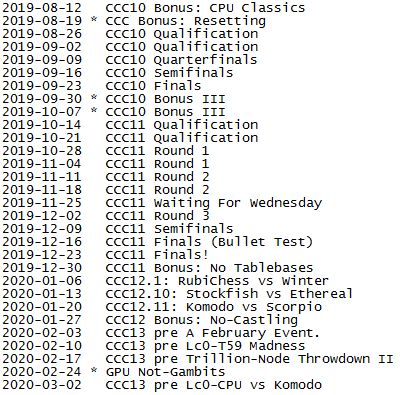
The difference of 16 files is explained by three duplicate file names in the newer archive plus 13 files not included in the older archive. As for the second point, the catalog of my own 'CCC-live weekly snapshots' is shown in the following chart. The asterisks ('*') indicate an event that I couldn't find in the XLSX data; this might be an error on my part.

The first line corresponds to the PGN file:-

CCC10 Bonus: CPU Classics
https://cccfiles.chess.com/archive/tournament-34341.pgn

The last line corresponds to my post TCEC S17 L1 Finished; CCC13 Announced (March 2020). Why does CCC have so much trouble maintaining an index of PGN files for its ongoing series of events? Maybe they don't think it's important. If they would simply publish the list of new PGN files at the end of a CCC season -- currently CCC15 -- people who are interested in the files (like me) could take it from there.

06 September 2020

Square Off Chess Set

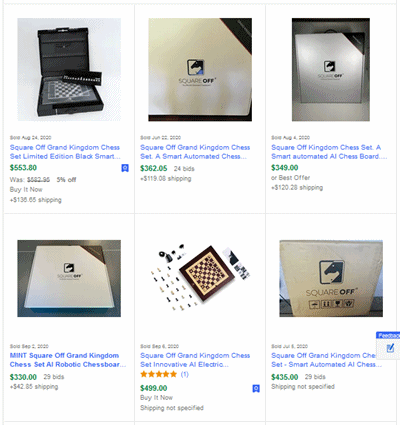
While I was developing my short list for this month's edition of Top eBay Chess Items by Price (March 2010), I noticed a large number of similar items. The following screen capture shows the top six of those items.

The item in the top left is titled 'Square Off Grand Kingdom Chess Set Limited Edition Black Smart Automated AI'. It sold for US $553.80, 'Buy It Now'. Its title is a straightforward concatenation of the phrases used in its description:-

Square Off • Grand Kingdom Chess Set • Limited Edition • Black • Smart Automated AI Chess Board • Board Measures 24" x 19"

At the present time (it hasn't always been this way), eBay includes the shipping cost in its calculation of 'Top Items by Price', and I noticed a large number of auctions -- not just the Square Off items -- with the shipping cost reaching three digits. The 'Square Off Black' added $136.65 shipping, and the next two items in the image were:-

  • 'Square Off Grand Kingdom Chess Set. A Smart Automated Chess Board. BRAND NEW'; $362.05 + $119.08 shipping
  • 'Square Off Kingdom Chess Set. A Smart automated AI Chess Board'; $349.00 + $120.28 shipping

What exactly is this 'Square Off' set? Its web site, World's Smartest Chessboard | Square Off, lists four attributes...

  • Automated; ('your opponent’s piece moves on its own')
  • Connected; ('globally connected game-play')
  • Intelligent; ('20 levels of difficulty to challenge this chess set’s built-in AI')
  • Handcrafted; ('intricately carved pieces')

...and three contact addresses: two in India plus one in the USA. The 'Grand Kingdom Set' lists for US $469, and the 'Kingdom Set' for US $399, both with 'Free Shipping'. A note mentions that the engine is Stockfish 10.

Why the big interest on eBay? A blog connected to the web site has more articles on running a company than on playing chess. I suppose that eBay is a marketing tool to gain more widespread exposure. After all, it got my attention.

01 September 2020

September 1970 & 1995 'On the Cover'

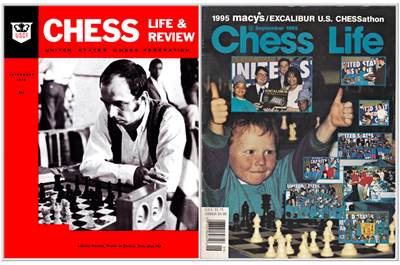
Last month's 'On the Cover' post, August 1970 & 1995, featuring the top American chess magazine from both 50 and 25 years ago, 'celebrated two tournaments that were open to the amateur player'. This month we see a mixture of elite and amateur events.


Left: 'Lubomir Kavalek. Winner at Caracas.'
Right: '1995 Macy's / Excalibur U.S. Chessathon'

Chess Life & Review (50 Years Ago)

Don't Walk -- Run by Lubosh Kavalek • What does it mean to be a "runner" in chess? There are many kinds of grandmaster in the world. Some think that good prizes can be won by winning a few games and, by playing to avoid risk, drawing the rest. This is the "middle class" of grandmaster. But what happens if they lose a few games? Then their idea doesn't work. One should try to win every game. It is a little risky because of the possibility of losing, but if you do well you can be first in many tournaments, like Bobby Fischer, Bent Larsen and Victor Korchnoi. When you try to win every game and gain many points, then you are a runner. My time for running was at Caracas -- I just arrived there and ran.

I was happy when the USCF offered me the opportunity to represent the United States at the international tournament in Caracas June 19 - July 12. I thought that I must replace my Czechoslovakian flag as the Czech Chess Federation has protested against me twice already (in San Juan 1969 and Wijk aan Zee 1970). Most chess players run from one tournament to the next. When you are in that situation and have no country to go home to, you feel all at sea. But when I came out of the sea to Caracas and saw the American flag on my chess table, I know I was firmly on the ground.

Wikipedia's page Lubomir Kavalek explains,

When Soviet tanks rolled into Prague in August 1968, Kavalek was playing in the Akiba Rubinstein Memorial in Poland, in which he finished second. Kavalek, who had always hated Communism, decided to defect to the West rather than return to Soviet-dominated Czechoslovakia.

Kavalek finished first in Caracas, a full point ahead of Oscar Panno and Leonid Stein. He identified Lubomir Kavalek vs Anatoly Karpov; Caracas 1970 (chessgames.com) as his best game from the event.

Chess Life (25 Years Ago)

Not only was June 10th at Grand Central Terminal a great day for the media, but the 4th annual CHESSathon, sponsored by title sponsors Macy's and Excalibur, also provided a field day for photographers. as witnessed by what we believe to be an award-winning photograph of five-year-old Noah Belcher.

A few years ago I posted about the initial event in The First USCF Chessathon (September 2014). The four page story on the 1995 Chessathon, filled with color photos like those on the CL cover, was perhaps overshadowed by a second story introduced as a 'NEWS FLASH':-

The PCA is thrilled to announce that the 1995 Intel World Chess Championship will be held at the Observation Deck of the World Trade Center! Garry Kasparov and Vishy Anand will slug it out each Monday, Tuesday, Thursday and Friday at 3 PM starting September 11th and continuing until one player reaches 10 1/2 points. General admission $9.00 (plus $6.00 Observation Deck ticket), King Room VIP seating $75 per session. Tickets are limited, so order today!

This was followed by a second part of the 'On the Cover' introduction:-

WORLD CHAMPIONSHIP • The story broke in Germany, and was quickly reported on the Internet. The PCA World Championship match between Garry Kasparov and Viswanathan Anand will be held at the World Trade Center Observation Deck in New York City, beginning September 11th.

From the other side of the world, FIDE Challenger Gata Kamsky received word from FIDE Secretary Casto Abundo that no bids had been received for the Karpov — Kamsky match, as of the deadline of July 1st. FIDE suggested that the federations of the two participants split the organization (and cost) of the match.

As the result of a joint FAX from Karpov and Kamsky, FIDE President Campomanes has extended the bidding deadline until 17:00 hours. (Switzerland Time), September 15, 1995, conditioned on the match being organized and finished in 1995.

The acronym PCA refers to the Professional Chess Association. For more about the organization, see my page World Chess Championship : FIDE/PCA Chronology.