12 October 2020

TCEC S19 Sufi 75% Finished; CCC15 Still Halted

Two weeks have passed since our last look at the world's foremost engine vs. engine competitions. Although the title of that post, TCEC S19 Preparing Sufi; CCC15 Still Halted (September 2020), told the whole story, let's start with the usual summary.

TCEC: In Premier Division (DivP), Stockfish and LCZero finished 1st/2nd to qualify into the S19 Superfinal. • CCC: There is no news on the technical problems affecting the GPU engines.

The keywords in the title of that post -- TCEC Sufi & CCC Halted -- are just as relevant for this current post.

TCEC: After 75 games of the 100 game match, Stockfish leads LCZero by +11-7=57. Extrapolating to 100 games gives a final score of +15-9=76. The most recent 25 games went +6-3=16 for Stockfish. For the record, the full names of the two engines are:-

  • Stockfish 202009282242_nn-baeb9ef2d183
  • LCZero v0.26.3-rc1_T60.SV.JH.92-190

In a future post, I'll try to parse those names.

CCC: There is still no news on the technical problems affecting the GPU engines, which I first reported four weeks ago. The report from two weeks ago mentioned the site was running matches for 'CCRL Ratings Standardization'. Now it is running 'CCRL Calibration'.

Last year the site also ran into technical problems, which I reported in TCEC S16 L1; CCC10 GPU Blues Continue (August 2019). It took about three weeks to resolve those problems.

[For further information from the various stakeholders in the engine-to-engine events, see the tab 'TCEC/CCC Links' at the top of this page. • NB: Leela = LC0 = LCzero]

11 October 2020

An Existential Crisis?

After this introduction...

Hello and welcome to week seven of chess month in which our team shines a light on two player games. Today we're looking at all the fun you can have with a chess board -- so this should be a short video!

...you might guess that anything can happen. And that's also what you'd expect from a Youtube channel that calls itself 'Shut Up & Sit Down'. Did he say 'chess tickles'?


Nine Easy Ways to Make Chess Fun (13:58) • '[Published on] Sep 23, 2020'

The 'Nine Easy Ways' are chess variants, including bughouse. Why variants?

If we can just put down the worthy analogies for a second, and if we can make an effort to cut through the choking cultural fog that billows off of the chess set and makes it quite hard to judge, as a game we're left with an uncomfortable truth, which is simply that playing chess is a bummer.

With nearly 100.000 views, the video attracted over 500 comments, many of them discussing other chess variants or board games. Coming on top of GM Kramnik's Nine Chess Variants (September 2020), we might conclude that chess is facing some sort of an existential crisis -- another casualty of the coronavirus.

08 October 2020

The Th??e of Chess

In last week's post, October 1970 & 1995 'On the Cover' (October 2020), with artist Samuel Bak represented on the October 1995 Chess Life, I mentioned,

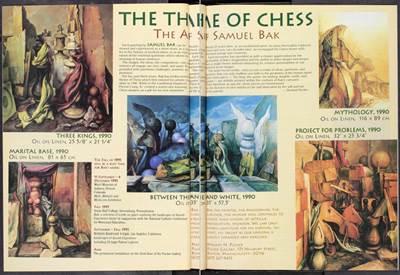
The two page feature on Samuel Bak included five color photos of the artist's chess paintings, a list of four concurrent exhibitions, and an appreciation by Bernard Pucker, whose gallery had set up a permanent exhibition.

If you happen to have a scanned copy of that issue of CL, available from the resource I promoted last year in US Chess CL Archive (November 2019), the two page Bak feature looks like the following image.

The thin white line down the center of the image separates the left page from the right page, where both pages were folded sloppily for the scanning process. You would probably never guess that the title of the article is 'The Theme of Chess'. In my post on the 'CL Archive' I mentioned,

Unfortunately, the document scans aren't first rate -- many pages are skewed and/or clipped on the side of the magazine fold, and the text is often too light, making it difficult to read -- but who's complaining?

Ten months later I'm complaining (just a little bit). Luckily I have paper copies of CL going back to 1992, so I have access to good copies of all articles from that time on. Pity the poor researcher who needs to read the text hidden by the page fold. Why go to the trouble of scanning hundreds of magazines, tens-of-thousands of pages without some quality standards?

[NB: While I was checking how far back my paper copies started, I noticed that the January 1992 cover of CL also featured Samuel Bak. The three page spread inside the magazine included nine works not repeated in the October 1995 CL.]

06 October 2020

Armenian Gin Fizzle

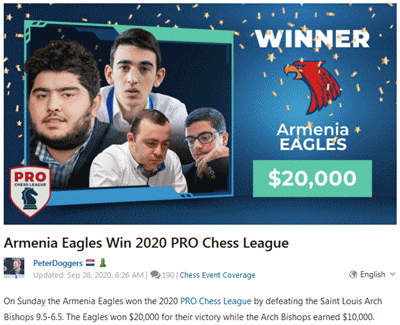
One of the most maddening aspects of internet and web technology is how resources appear and disappear from one day to the next. 'Here today, gone tomorrow', as they say. When future chess historians look for the page captured in the following image, originally published 27 September 2020, what will they find?


'Armenia Eagles Win 2020 PRO Chess League'
(chess.com)

The first paragraph informed,

On Sunday the Armenia Eagles won the 2020 PRO Chess League by defeating the Saint Louis Arch Bishops 9.5-6.5. The Eagles won $20,000 for their victory while the Arch Bishops earned $10,000.

Later we learned,

It was 36-year-old GM Tigran L. Petrosian—the only player of the four who played in three consecutive league seasons—who became the Man of the Match. The namesake of Armenia's world champion in the 1960s scored a stunning 3.5/4 against four players who are rated at least 100 higher than him in standard chess.

For the record, 'Armenia's world champion in the 1960s' was Tigran V. Petrosian (1929-1984). What did his 2020 namesake -- shown in a white shirt in the photo above -- have to say about his stellar PRO Chess League performance?

Asked about his secret, Petrosian didn't have a particularly child-friendly first reply when he (jokingly?) revealed that he had been drinking gin during the match. But he continued: "I'm a retired chess player, but I like blitz and rapid. Usually, I'm not playing bad in this kind of stuff, so I am happy that I could help my team."

The last trace of that page in Google's cache was 1 October 2020. On that same day, we learned, Saint Louis Arch Bishops 2020 PRO Chess League Champions; Armenia Eagles Disqualified (chess.com):-

The Saint Louis Arch Bishops are the winners of the 2020 PRO Chess League championship. The Armenia Eagles have been disqualified from the 2020 season due to fair play violations. After a thorough investigation, Chess.com's Fair Play team determined that GM Tigran L. Petrosian, who played for the Armenia Eagles, violated fair play regulations during games in both the semifinal and final matches that took place on September 25 and 27, respectively.

To learn the fate of Petrosian, his team, and the three teams previously placed 2nd-4th for the 2020 season, see that linked article. The year 2020 now has another reason to be remembered as a bad year.

05 October 2020

Stockfish NNUE - Three Early Threads

Continuing with Stockfish NNUE Dev (September 2020), I closed the post saying,

Long story short : NNUE gets to the essence of handcrafted evaluation functions. [...] I'll come back to the subject after I've had some time to orient myself. I hope the time will be well spent.

First, here's a Discord search term for locating the discussion on a specific day. This particular expression goes to early discussions of Stockfish NNUE development:-

in: #general-nnue-dev during: 2020-06-06

Those discussions lead to a Talkchess thread that started a week earlier: Stockfish NN release - NNUE (talkchess.com).

So a year [ago] somebody ported Shogi NN called NNUE (efficiently updateable neural network backwards) to SF10 as a proof of concept. He released the binaries and instructions after I asked him a few days ago.

Another discussion leads to the Stockfish Fishcooking forum, also from end-May: Time for NN eval?:-

Talkchess.com: 'Stockfish NN release - NNUE'; Maybe we should try to take a look at this?

To go back even further, it helps to be familiar with Hisayori Noda (chessprogramming.org):-

Hisayori Noda, a Japanese mathematician, computer scientist, and computer Shogi and chess programmer, who introduced NNUE to Stockfish, yielding in Stockfish NNUE.

The Chessprogramming wiki also gives a diagram of NNUE's architecture for evaluation, aka HalfKP.
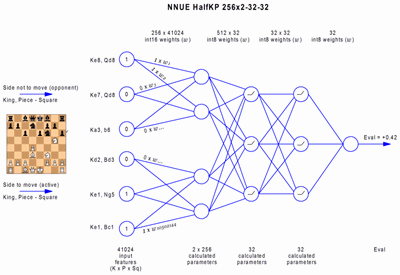

Source: Stockfish NNUE (chessprogramming.org)

So there we have it: a specific NN architecture, a record of its early training & validation on chess positions, its integration into Stockfish, and samples of its early games against other engines. It's extraordinary how quickly the NNUE concept evolved.

***

Later: After I wrote the post, I spent some time trying to decipher the title of the chart, 'NNUE HalfKP 256x2-32-32', which refers to the structure of the four layers shown in the chart. The number 41024 is explained in the link to Chessprogramming.org under the chart:-

41024 = 64 * 641.
64 comes from the number of the cells where King may exist.

641 = 64 * 5 * 2 + 1.
64 here comes from the number of the cells where a piece other than King may exist.
5 is the number of piece types other than King.
2 is the number of colors, White and Black.
1 is a captured piece.

As for 'HalfKP', I found an explanation in the Stockfish Discord group (11 June):-

KP is combination of own King - piece position [plus] combination of opponent King - piece position. • HalfKP is combination of own King - piece position only.

This leads to questions that I wasn't able to answer. The Chessprogramming chart shows both 'Side to move' and 'Side not to move'. Since both Kings are on distinct squares, are both Kings included in the 64*641 array? If so, why call it 'HalfKP'? If not, where is the opposing King in the 64*5*2 array? I hope this will become clearer as I increase my understanding of NNUE.

Another question regards the big 64*641 array. Why not use a smaller '769 = 64 * 6 * 2 + 1' array? Is there some advantage to isolating the King in a higher level array where all cells but one are zero? The most important factor in creating the network is the large number of training positions that have known evaluations attached to them.

One other point worth mentioning: the acronym 'crep' is sometimes mentioned as an enhancement. It refers to 'castling rights, en passant', which are also attributes of many chess positions.

04 October 2020

French or Italian?

Of all the auction items featured in this blog's long running series on Top eBay Chess Items by Price (March 2010), my favorites involve artwork. According to my informal selection rules, I should pick an item from the previous month, i.e. September 2020, but the item shown below ended on 1 October and none of the alternatives on my short list were particularly interesting. I'm also hoping that the rest of October will offer other items for the next eBay post.

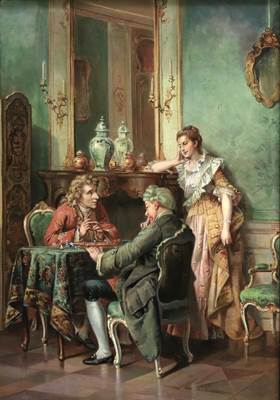
Titled '19th century large French / Italian oil canvas - elegant figures playing chess' the painting sold for GBP 820.00, 'Approximately US $1,060.63' according to eBay. It attracted 28 bids from 16 bidders.

The item description repeated the title and added,

A lovely large French or Italian oil on canvas depicting elegant figures playing a game of chess in an interior. The work is very well painted and in good condition. The work is not signed so we have no idea who painted it but its a quality piece.

Title: "The Chess Game" • Signature: No visible signature • Provenance: Private UK collection • Medium: Oil on canvas • Size: c. 23 x 16 inches unframed; 29 x 22 inches framed • Condition: Very nice for age - ready to hang

I closed the previous eBay post on artwork, Georgian Player, Regency Set (May 2020), questioning the 'four figure price for a portrait by an unsigned, unknown artist'. I could ask the same question for any painting. I could also ask what features of the painting point to 'French or Italian'.

01 October 2020

October 1970 & 1995 'On the Cover'

It's that time of the month again, when we look at the covers of U.S. chess magazines from 50 and 25 years ago. At first sight it's not obvious, but both of this month's covers have an element in common: Boston.


Left: 'Bent Larsen, Winner of U.S. Open in Boston. Pal Benko was second and Robert Byrne third. Details next month.'
Right: 'The Theme of Chess; Red Wing, 1990; Samuel Bak'

Chess Life & Review (50 Years Ago)

Let's skip ahead to the November 1970 issue of CL&R for the tournament report: 'Larsen Wins 71st U.S. Open - 303 Players Set New Record, by George Koltanowski, Tournament Director'.

A new record of 303 entries was set in the latest edition of the United States Open Championship, held in Boston, Massachusetts, August 9-22, 1970. The way the U.S. Chess Federation is growing, one can expect to see thousands participating in the U.S. Open in future years. The tournament was successful, too, in terms of strength -- there were 5 international grandmasters, 20 national masters, over 40 Experts among participants from all over the world.

Koltanowski wrote unusual tournament reports. For the 1970 U.S. Open, he gave more column space to the organization of the tournament than to the winners. Half of his report consisted of anecdotes about GM Kavalek, who finished in a tie for places 8-18.

A few month's earlier, in July 1970 & 1995 'On the Cover' (July 2020), Larsen also appeared on CL's cover. For his previous appearances, start with December 1968 'On the Cover' (December 2018).

Chess Life (25 Years Ago)

The two page feature on Samuel Bak included five color photos of the artist's chess paintings, a list of four concurrent exhibitions, and an appreciation by Bernard Pucker, whose gallery had set up a permanent exhibition. The appreciation started,

Each painting by Samuel Bak can be viewed and experienced as a short story; as a chapter in the history of modern times; or as an exploration of the essential questions which inform the meaning of human existence. [...] For the past three years, Bak has re-discovered the theme of Chess which first entered his artistic vocabulary in 1946. While in the Landsberg Displaced Person Camp, he created a watercolor featuring Chess imagery as a gift for his new stepfather.

As for the lead paragraph in this current post -- 'element in common' -- what does Boston have to do with Bak? For starters, the Pucker Gallery is located in Boston. On top of that, the page Samuel Bak (puckergallery.com), tells us that the artist resides in Weston, Massachusetts, which happens to be a town just west of Boston. For another post about Samuel Bak on this blog, see Bak to Basics (January 2016).