31 December 2018

Kasparov's 1997 Team

At the beginning of the month, in 'Defending the Human Race?', I mentioned the official programs for the 1996 and 1997 matches that Garry Kasparov played with IBM's Deep Blue. The two programs include many details about the matches collected into a single place.

I particularly liked the page about 'Kasparov's Team' in the 1997 program, because it confirmed facts about the relationship between Kasparov and Frederic Friedel that I learned in last week's post, Words Matter. Here's an image capture of that page.
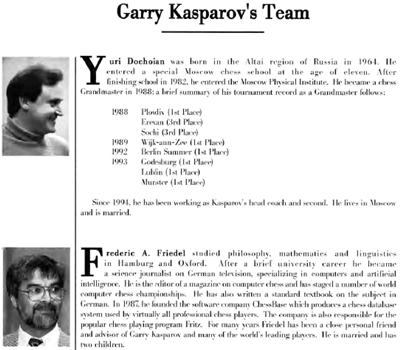
And here's a text version of the same page.

Yuri Dochoian [Dokhoian] was born in the Altai region of Russia in 1964. He entered a special Moscow chess school at the age of eleven. After finishing school in 1982. he entered the Moscow Physical Institute. He became a chess Grandmaster in 1988; a brief summary of his tournament record as a Grandmaster follows:

1988 Plovdiv (1st Place), Erevan (3rd Place), Sochi (3rd Place)
1989 Wijk-ann-Zee (1st Place)
1992 Berlin Summer (1st Place)
1993 Godesburg (1st Place), Lublin (1st Place), Munster (1st Place)

Since 1994, he has been working as Kasparov's head coach and second. He lives in Moscow and is married.

---

Frederic A. Friedel studied philosophy, mathematics and linguistics in Hamburg and Oxford. After a brief university career he became a science journalist on German television specialising in computers and artificial intelligence. He is the editor of a magazine on computer chess and has staged a number of world computer chess championships. He has also written a standard textbook on the subject in German. In 1987, he founded the software company Chessbase which produces a chess database system used by virtually all professional chess players. The company is also responsible for the popular chess playing program Fritz. For many years Friedel has been a close personal friend and advisor of Garry Kasparov and many of the world's leading players. He is married and has two children.

Similar, brief biographies of other match contributors are also found in the 1997 program.

The Deep Blue Team
- Chung-Jen [C.J.] Tan
- Feng-Hsiung Hsu
- Murray Campbell
- A. Joseph Hoane
- Jerry Brody
- Joel Benjamin

The Commentators
- Michael Valvo
- Maurice Ashley
- Yasser Seirawan

The Match Officials
- Match arbiter: Carol Jarecki
- Appeals Board: Ken Thompson and Monty Newborn

The Wikipedia pages for Kasparov's team are surprisingly skimpy -- Yury Dokhoian & Frederic Friedel -- and the related foreign language pages are not much deeper. Friedel's pages identify the computer chess magazine as Computer-schach & Spiele and the German language version leads to a separate Wikipedia page for the publication. Perhaps more information is available there related to Friedel's having 'staged a number of world computer chess championships'. There is no question that he was an important early promoter of the technology.

30 December 2018

FIDE's Social Commissions 2018

A month of five Sundays with posts scheduled for only four of those Sundays gives me the opportunity to run a second post on The Sociology of Chess (November 2016). Instead of a video, like in last week's Biggest Lesson of Chess, let's go back to Spectating the 89th FIDE Congress and look at the two social commissions. Their reports for the Congress were issued with the minutes as:-

  • Social Action Commission (SAC) - Annex 56, and
  • Social Projects Commission (SPC) - Annex 63

This is not the first time I've covered the two commissions. For the previous reports, see:-

Along with the chairperson, Beatriz Marinello (USA), the minutes of the SAC list five Americans in attendance. By coincidence, the first of those names is Sam Sloan, who issued his own series of reports on the Congress and the concurrent Olympiad, as we saw in Gonzo Chess Journalism (October 2018). Sloan mentioned the SAC meeting in

2018-09-30: Batumi Chess Olympiad 2018 Round Six Press Report • 'I spent almost the whole day attending FIDE meetings at the Sheraton Hotel where some shocking facts came out. First was a meeting for the Social Action Commission chaired and founded by Beatriz Marinello. It is devoted to bringing children into chess to help with their intellectual development. One of the members is Robert Katende of Uganda who taught and trained Phiona Mutesi, whose life was made into a Hollywood movie, The Queen of Katwe. Phiona is here at the Olympiad but she took a rest day today.'

None of the 'shocking facts' had anything to do with the SAC meeting, where half the time was spent on how to encourage girls to become involved in chess. The main speaker on the subject ('how to bridge the big gaps that exist between girls and boys.') was Carol Meyer (also USA), the Executive Director of the U.S. chess federation since October 2017. Attached to the SAC minutes is a 16 page brochure titled 'Social Action Commission Booklet'. It starts,

The FIDE Social Action Commission created and supports programs that have a positive impact on many lives. Using chess as a platform to empower teachers in communities, as well as providing support that will help children to develop life skills and promote positive social development we are helping make a difference.

About half of that brochure also covers girls in chess, leaving little doubt where the focus of the commission lies. The last page of the brochure points to some relevant resources, like the commission's web site, sac.fide.com, which has not been updated in over a year; Chess Educators; and Lens Ethics.

The minutes of the SPC, chaired by Darcy Lima (BRA), are less compelling, but deal with issues that are much wider than the chess community. The three main topics are chess in prisons, chess & autism, and chess & substance abuse. On the second point, the minutes said, 'The final conclusion [of a two year study] can be summarized as':-

The people mentally impaired show difficulties in understanding the rules for social life. The study concluded that chess game teaches that the rules, which are used in the game, can be used in the society, thus these people are able to have more success in the relationship established with family members and the society as well.

As I noted in a recent post, FIDE Commissions 2018, the two commissions (SAC & SPC) appear to have been merged sometime after the 89th Congress. Nothing is mentioned in the List of Decisions of Q4 2018 Presidential Board (November 2018), and I could find no confirmation anywhere else. I hope that their work will continue in some form or other. They provide a ready answer to the question asked by many outside the chess community: 'What use is chess in the grand scheme of everyday life?'.

28 December 2018

Talking About AlphaZero

It's been three weeks since we learned that AlphaZero Is Back!. When the news first broke, what was the reaction from the community of chess engine developers? Taking a few pointers from a recent post, Talking About Chess Engines (October 2018), I checked with the groups behind Stockfish and Leela. First, here's the Stockfish reaction (groups.google.com/fishcooking):-

You might expect a deeper look from the Leela (LC0) crowd, but the reaction was also considerably understated (groups.google.com/lczero):-

  • 2018-12-06: New AlphaZero 2018 Papers (Discussion) • 'Based on AlphaZero 2018's 1000 game matchup between Stockfish 8, AZ 2018 is only +52 Elo to Stockfish 8, which means it is weaker than Stockfish 9.'

  • 2018-12-07: A new blog post!, points to AlphaZero paper, and Lc0 v0.19.1 (blog.lczero.org) • 'The paper contains additional details that were missing in the original preprint from one year before. There were some aspects that were implemented in Leela differently from AlphaZero, and I'm sure we'll find some more.'

The most detailed discussion was on neutral ground (talkchess.com) with participants from the Stockfish & Leela communities, from DeepMind, and from other (mostly) knowledgeable experts:-

As for specific talking points, there were many -- too many to cover in a single blog post.

27 December 2018

Old December Yahoos

Last year, in December Yahoos (December 2017), we had a record number of chess news stories picked up by the mainstream press and redistributed via the Yahoo news service:-

  • 2017-12-06: Google's AlphaGo AI can teach itself to master games like chess (yahoo.com; Engadget)

  • 2017-12-20: People Think The New World Chess Championship Logo Is 'Pawnographic' (yahoo.com; HuffPost)

  • 2017-12-24: Chess federation says Israel excluded from Saudi-hosted match (yahoo.com; Reuters)

This year, December 2018, we have zilch. The last time this happened, in A Year of Yahoos! (September 2018; 'there were no Yahoos for the month'), I fell back on Google News for an end-of-month news roundup. I repeated the exercise for December and found echoes of all three stories from a year ago:-

  • 2018-12-26: One Giant Step for a Chess-Playing Machine (nytimes.com); 'The stunning success of AlphaZero, a deep-learning algorithm, heralds a new age of insight — one that, for humans, may not last long.'

  • 2018-12-11: The Sharp Game (theringer.com); 'The unpredictable champion Magnus Carlsen and a YouTube-trained, Twitch-streaming generation of young fans has revived one of our oldest games. Is the next great chess boom here?'

  • 2018-12-26: Saudi loss is Russian gain under ex-Kremlin chess boss (theguardian.com); 'The last-minute deal to move the 2018 King Salman World Rapid and Blitz Chess Championship capped a year of growing international pressure on Riyadh. Long before the murder of Jamal Khashoggi, the country was condemned in chess circles for denying visas to Israeli players in 2017.'

One other story caught my attention, because it is a rare, in-depth look at a world class player by the mainstream press:-

With that human interest piece, let's close the 2018 Yahoo series. What will the 2019 Yahoos bring?

25 December 2018

A Cropped Christmas

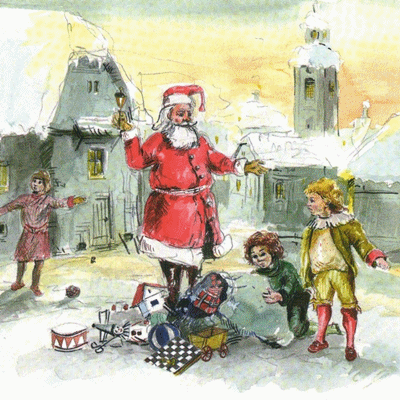
Of the 400 chess images I collected from eBay this past year, a handful were suitable for the blog's annual Christmas post. The caption, stuffed with search keywords, gives all of the info I have on the card.


'Santa Claus on the Village Square with Children and Presents, Chess, Christmas, Postcard. Unused.'

Add this cropped image to the gallery of Christmas cards seen last year in Merry Christmas 2017!

24 December 2018

Words Matter

After the 1985 event discussed in last week's post, 'I walked from one machine to the next', there is one more event from Kasparov vs. the Early Engines that I want to discuss. The reason for that is to correct an earlier statement I made on this blog.

In his book Deep Thinking, Kasparov mentioned the event twice. I've already given a full excerpt of the first mention in another post on a related subject, Null Moves, so I'll just repeat the first two sentences.

In 1992, I played a long casual blitz match against one of this new generation of PC programs, one that would go on to become nearly synonymous with PC chess engines. Fritz was published by ChessBase, which explains the sardonic German nickname.

The second mention was a little later in the book:-

I had played quite a few games against Fritz's predecessor in an informal blitz match in Cologne in December 1992. Frederic Friedel says I played thirty-seven games against his beloved pet, as I poked and prodded it like a lab animal, pointing out when it made a particularly good move or chose a weak plan. It was far from the savage beast it would become, but it wasn't tame either. I lost nine times with a couple of draws, winning around thirty of the games.

Calling this anecdote an 'event' is a stretch, but I can't think of another word. A wrong word led to an error in an earlier post, Searching for Fritz (June 2015), where I wrote,

Kasparov was routinely hired to promote important milestones in the evolution of Fritz.

A sharp-eyed visitor to the blog flagged the following reminiscence by Frederic Friedel in How I did not become a billionaire (medium.com; June 2018):-

There were other ideas in subsequent years, none of which worked out really. Well, one of them did: in 1985 I was visited in Hamburg by a young chess grandmaster who was on the path to World Championship. Garry Kasparov and I spent a number of evenings discussing computers and how they could help professional chess players study the game. We worked out the design for a “chess database” which he entreated me to build. I was not a programmer, but as fate would have it, a few months later I met a young physics student, Matthias, who had actually started implementing such a system.

We founded a company together and launched a chess database software company, ChessBase, which Garry, now a legendary World Champion, supported for more than ten years. He provided ideas and encouragement, but also promotion and endorsements, ads and PR events. Of course we paid him handsomely for these services: a total of $0.00. Garry doesn’t take money from members of his family, which I had nominally become. Today ChessBase has around thirty salaried employees (plus many free-lance contributors) and has completely cornered the market.

For a (partial?) list of those promotional events, see the 'Searching for Fritz' post. Along with the 'Billionaire' article, Frederic Friedel has written about many other subjects for Medium.com in a column titled 'The Friedel Chronicals'. Some of those writings also relate to chess history.

Long story short: 'Garry doesn’t take money from his family'. Got it!

23 December 2018

Biggest Lesson of Chess

For this month's video on The Sociology of Chess (November 2016), I had a selection of interesting clips. The runner-up was The Atlantic's Last Chess Shop in New York City:-

I came here to get a PhD in American literature, and here I am, with pictures of American writers on the wall -- a chess vendor.

Since Imad Khachan and his Chess Forum were already featured in three posts during the last year -- see 'Chess Is Serious Business' (January 2018) for the most recent -- I went with the following video from the Daily Show with Trevor Noah.


Maurice Ashley - Reveling in the Ultimate Thinker’s Game as a Chess Grandmaster (5:27) • 'Published on Nov 20, 2018'

The description said,

Chess Grandmaster Maurice Ashley explains why chess players stay in shape, remembers trash-talking while playing in Brooklyn and reveals the biggest lesson you can learn from the game.

What's the biggest lesson? 'That the other person is more important than you are.' How many chess GMs would agree with that?

***

Later: At one point in the clip, Ashley says to Noah, 'You trashed chess on this show before'. Here's a link to the sequence: The Daily Show - Chess News Roundup ('Published on Mar 20, 2015').