10 March 2019

Mesmerized by Ratings

Maybe it's the music, but this video is about as mesmerizing a chess video as I've ever seen.


Top 20 Best Chess Players Ranking History, 2000-2019 (10:13) • 'Published on Feb 25, 2019'

With more than 94.000 views, 1200 likes, and 378 comments, the subject obviously hit a pleasure center. The description said,

In this video we rank the best chess players in the world according to their FIDE chess ratings from 2000-2019. This list includes famous chess players like Magnus Carlsen, Garry Kasparov [and] Fabiano Caruana.

Of the many notable comments, I liked this one best (besides 'I still adore Mikhail Tal and Rashid Nbdshbfheqrdinov'):-

There are three types of players in this list...
1. Absolute domination
2. Longevity
3. Sudden rise and fall

Kasparov starts out at no.1. At about 1:50 (a year after his retirement) he drops off the chart completely, replaced first by Topalov, then by Anand, then Topalov again. Carlsen appears at about 3:00 and, after a brief tussle with Anand, stays there. He's been there for nine years and could easily be there for another nine.

08 March 2019

Closing an AI/NN Chapter

It's finally time to close the AI/NN series that I've been running for the last five months. It started with a look at Leela (aka LCzero, LC0).

That was interrrupted by a staged sequence of promotions that started during the 2018 Carlsen - Caruana match (London, XI, 2018), in DeepMind's backyard.

The conversation first turned to AlphaZero itself...

...then turned to a well-timed book about AlphaZero.

Finally I examined a component of the emerging engine technology that I hadn't previously understood.

Because the AI/NN chess engine evolution is destined to continue, I can follow it via two world class engine-vs-engine competitions, seen earlier this week in TCEC S14/S15; CCC6 S2. I now want to jump from the 21st century to the 19th century. The same technologies that are driving the evolution of chess engines are also opening doors into the past.

07 March 2019

Poetic Versatility

The hardest aspect of daily blogging is coming up with the inspiration for each post. Sometimes the ideas just come from elsewhere, like magic.

Greetings from Australia, Mark. - I am a chess player and published poet, who likes to be rather incognito. If you like my chess poems below, feel free to publish them on your blog or wherever. - Good wishes from Bob Cowley.

No need to embellish the poems with unnecessary verbiage. Here is the first one.

Chess
pieces dance
in changing patterns;
drama, intrigue and mystery
for those who know

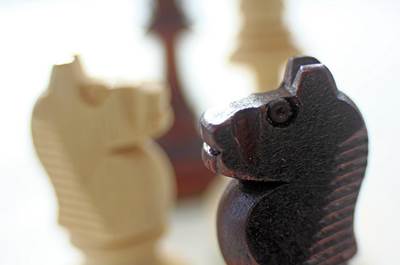
Since the web is a visual medium, I needed an image. This is a suitable task for Creative Commons.


Opposing Pieces © Flickr user Kate Russell under Creative Commons.

My Australian correspondent sent three poems. Here are the other two.

Good chess players
can their clarity
at the board
pierce life's fogs
away from it?
they wonder also

Veteran chess
too old to play well?
the abyss looms -
but wait;
a lucky escape
and maybe persistence
can still find treasure

Last week, in 'On Anderssen', I used a 19th century German poem to make a point. Poetry, like photography, is amazingly versatile.

05 March 2019

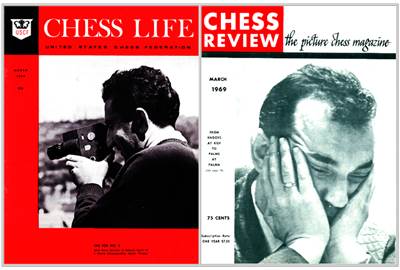
March 1969 'On the Cover'

From the March 1964 'On the Cover' ('What was happening in the U.S. chess press 50 years ago?') through last month's February 1969 'On the Cover', this post marks the fifth anniversary of the monthly 'On the Cover' series.


Left: 'Shooting(?) for No.3; Tigran Petrosian Meets Boris Spassky in Moscow April 14; ?? World Championship Match Victory'
Right: 'From Knocks at Kiev to Palms at Palma'

The Chess Life photo caption is partially obscured by what must have been the mailing address label. I imagine the caption had something to do with the camera that Petrosian is holding.

Chess Life

[Burt Hochberg:] Let me describe my first impression of the World Champion. He had earlier that day bought a book of endgame studies ("2,500 Finales," by Kasparian). He was sitting at the table examining the book, flipping through the pages. He stopped, his eye caught by a position, and after studying it for a moment, his head would start bouncing from side to side, in the manner of a man listening to a rhythmic and familiar piece of music. All the while, the fore-finger of his right hand was "conducting" the "music." After a couple of minutes of this, he would frown and nod his head in approval or appreciation, and then resume flipping the pages.

Petrosian's physical appearance came as something of a surprise. Although I knew he was shorter than average, I was not expecting a man of such obvious physical power. He is rather broadly and thickly constructed, with powerful arms and hands, and an I-can-take-care-of-myself aura.

Chess Review

[Dr. Petar Trifunovich:] The Tournament at Palma de Mallorca has become an annual and has already acquired world-wide renown. It takes place at the end of November and the first half of December which sets it in line for the timely awarding of the Oscar in chess [reported in same issue]. Quite aside from that factor, however, the tournament bids to become one of the greatest and most attractive chess events of the year. And it is no exaggeration to say that, though as a tradition the tournament is hardly ancient, the chess world is so accustomed to it that it would be considered a catastrophe if the event ceased to be promulgated. [...]

Viktor Korchnoy [Korchnoi] lived up to his first name. He scored fourteen points out of a possible seventeen, eleven victories, six draws and not a single loss. His was a veritable triumph! And it was for him so much more important in that it came immediately after his defeat in the match with Spassky. His main rivals in the fight for first place, Larsen and Spassky, he eliminated in direct meetings toward the end of the tournament, in the fourteenth and fifteenth rounds.

Fifty years ago, the international chess calendar coalesced around the World Championship, just as it does today. Korchnoi's 'defeat in the match with Spassky' refers to the final match of the 1967-69 Candidates Matches ('Kiev, IX, 1968'), where he lost to Spassky +4-1=5.

04 March 2019

TCEC S14/S15 Interlude; CCC6 S2 Wrapping Up

Getting back to the top-two chess engine competitions of our time, the title of last week's post, Stockfish Wins TCEC S14; CCC6 S2 Underway, summed up the situation well enough. What has happened in the intervening week?

TCEC: Chessdom issued reports on the results of S14:-

After the finish of S14, while S15 preparation was underway, the site conducted three short competitions. The first event was a 48-game three-way match that lasted a day or so. It finished with the result Stockfish 17.5/32, Leelenstein 16, Antifish 14.5. According to the site's Nightbot chat,

Leelenstein aka Dr. Leelenstein, aka The Doctor, is a 20x256 SE net built using games from CCRL, Sergio's 40 block variant, and T30. Novelties: TP + GGT + SGDR • AntiFish is a Neural Network [...] designed to exploit weaknesses within Stockfish. The hope is that one day AntiFish can be used to improve Stockfish itself.

The second event was a 240-game four-way round robin featuring the four top engines: Houdini, Komodo, Leela (LCZero), Stockfish. I couldn't find a final crosstable for the event, although the final PGN is available in the TCEC archive (see the 'TCEC/CCC Links' tab at the top of the page for references). This event was documented better in the archive than the preceding 48-game three-way match, which is also missing the final PGN.

The third event was a 100-game match between Stockfish and Leela that lasted about three days. I couldn't find any trace of this event in the archive, but one post-match reference in the Leela forum, Leela - Stockfish "no opening book" match results, said, 'Final result: Leela 56, Stockfish 44. Leela: +16-4=80'. What 'no opening book' means is anybody's guess. It appears to have favored Leela substantially.

The TCEC has so far issued one announcement about the new season, due to start this week:-

  • 2019-03-02: Allie+Stein, the new neural network entering TCEC S15 (chessdom.com) • 'Season 15 is about to start and one more neural network is going to enter TCEC. This is a combined project by Adam Treat and his Allie and Mark Jordan and his Leelenstein. The new engine is called Allie+Stein, a unique engine by the TCEC rules that will start its quest for top positions and climb of the ladder from Division 4'

Both AI/NN engines, Allie and Leelenstein, competed in CCC6 stage 1, with markedly different results.

CCC: As for CCC6 stage 2, the event is nearing completion with Stockfish in a comfortable lead. It will face the second placed engine in a 200-game match.

03 March 2019

Cats Attacking Royalty

This latest edition of Top eBay Chess Items by Price (March 2010) marks the ninth anniversary of the series. It appears that I've managed to get this far without a single post featuring cats. I imagine that's because cats and kittens playing chess are a common theme and most artwork based on the theme sells on eBay for less than $100.

A few years ago we saw The Kitten Theme (January 2016), where the kittens were only a detail in the work. A few years before that we had Moonwhisker Chess (December 2014) in the old Flickr Friday series. In the ongoing fight btween cats and dogs, neither has the upper hand on this blog.

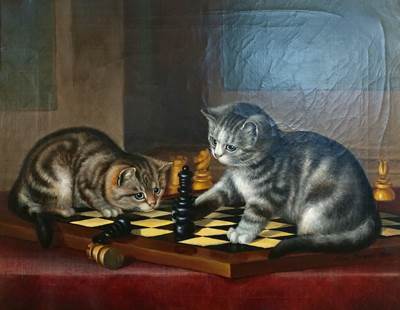
Titled 'Nora Chease - Two Tabby Cats Playing Chess! - 19th century oil panting - 1881', the painting shown below initially listed for US $2000. It sold for between $1300 and $1500, 'Best offer accepted'.

The description of the auction repeated the title and added,

Oil painting on canvas -- Signed and dated
Frame size 27 x 32"
Canvas size 16 x 19"
In excellent condition

A Google image search on 'Nora Chease' picks up other examples of the same work, including Exquisite Nora Chease - Two Tabby Cats... (decaso.com; once listed for $2900, 'This product is no longer available') with the same picture frame. I couldn't find any biographical info about the artist, except that she was British. She also liked painting animals.

01 March 2019

MCTS Data Flow

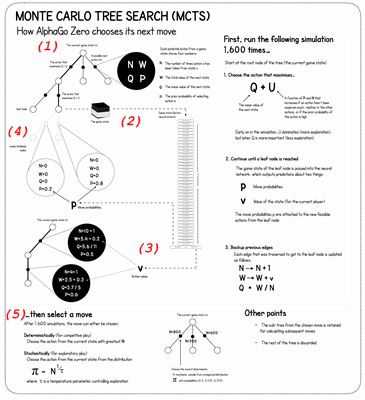
In last week's post, Monte Carlo Tree Search (MCTS), I featured a video to explain the fundamental concepts of MCTS. Here's a diagram that takes the explanation several steps further. Note that it's based on AlphaGo Zero, but the concepts apply largely to AlphaZero as well.


Extracted from:
AlphaGo Zero Cheat Sheet
(applied-data.science; big PNG: 8333 x 7500)

I added the red numbers in parentheses to connect the left portion of the diagram, an inverted tree structure ('How AlphaGo Zero chooses its next move'), with the right portion, a step-by-step explanation of the left portion ('First, run the following simulation 1600 times...'). The following text is (mostly) copied from the 'cheat sheet'.

(1) Start at the root node of the tree (the current game state). Choose the action that maximizes 'Q + U'. Continue until a leaf node is reached

(2) The game state of the leaf node is passed into the neural network [NB: the tall stack of blocks; explained elsewhere on the 'cheat sheet'], which outputs predictions about two things:-
      • P - Move probabilities
      • V - Value of the state

(3) The move probabilities (P) are attached to the new feasible actions from the leaf node.

(4) Backup previous edges. Each edge that was traversed to get to the leaf node is updated.

'After 1600 simulations'

(5) The move can either be chosen:-
      • Deterministically (for competitive play)
      • Stochastically (for exploratory play)

Values like 'N', 'W', 'Q', and 'P' are explained in the notes to the diagram. After studying the diagram, I felt that I was finally starting to understand the basic concepts of MCTS. How do they work with AlphaZero? That will require further study.