30 May 2019

May Amazon Yahoos Crumble

In last month's end-of-the-month Yahoo post, April Yahoos -- Much Ado About Nothing?, I wrote,

I'm once again reduced to pecking at crumbs just like in previous months. The only chess reference I spotted while browsing mainstream news headlines is shown in the following screen capture.

This month I had a stream of crumbs, shown below. They brought memories of Yahoo ghosts of blogging past:-

  • 2019-01-31: January Amazon Yahoos • 'The Yahoo news service picked up zero chess stories from the mainstream press. There was, nevertheless, one chess-related item in my news feed.'
  • 2019-02-28: February Amazon Yahoos • 'Of celebrities and sports, there was plenty to choose from; of chess there was nothing. Is the problem perhaps an overall deterioration in the Yahoo news feed itself?'

Deterioration in the Yahoo news feed, probably. An unwanted -- let's call it creepy -- coupling of my Yahoo habits with my Amazon habits, definitely.
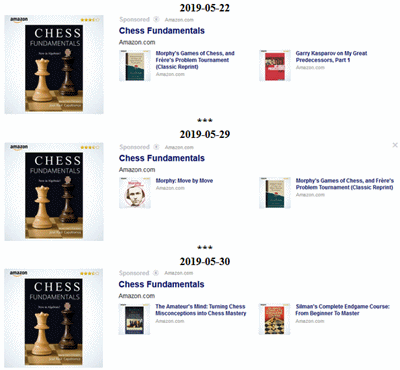

'Sponsored --$-- Amazon.com'

The reappearance of Amazon Yahoos was provoked by my work on the post:-

While I was preparing that post, I looked at one -- let me emphasize that: ONE! -- book about Morphy on Amazon. I don't remember exactly what book it was, but it was a modern edition of a 19th-century book. I spent ten seconds looking at it, said to myself 'That's interesting', and moved on to another aspect of Morphy's career. The book might have been the second one shown in the ad dated '2019-05-22', titled 'Morphy's Games of Chess, and Frère's Problem Tournament (Classic Reprint) Paperback – April 5, 2018; by Paul Charles Morphy (Author)' on Amazon.

Yes, after writing that last paragraph I'm certain that was the book I looked at, because what I found interesting was that Morphy had written a book. I hadn't known that. The same book is the third shown in the ad dated '2019-05-29'. Amazon/Yahoo showed me the first ad 3-4 times over the next day, left me alone for a week, then reappeared with the second ad. The third book in the first ad is Kasparov's 'My Great Predecessors, Part 1', and the second book in the second ad is Zenon Franco's 'Morphy: Move by Move'. Why Kasparov? Probably because there's a section about Morphy in his book. The third ad, which appeared this morning, dropped the Morphy theme and offered two books by Jeremy Silman. Why Silman? I have no idea.

Ditto for the first book in all three ads: Capablanca's 'Chess Fundamentals'. I have no idea why Amazon keeps pushing this book. I used to own a copy, gave it to someone, and now have a PDF copy. As an aside, the Amazon product page says it has 138 pages, while the last page in my PDF version is page 61. Whatever the real number of pages is, I won't be buying it from Amazon. Let's see how long the ads continue.

As another aside, I bought 'Predecessors, Part 1' with earnings from Amazon's affiliate program. At one time, around the year 2000, my earnings from that program were enough to buy a book from time to time. Nowadays if I earn five cents a year from the program it's a windfall. I could say more about the Amazon affiliate program, but today is not the right time or place.

If there is one chess story I would like to have seen in the mainstream press during the month of May, it was the first event in this year's Grand Prix series. I'll cover that soon on my World Chess Championship Blog, so I'll say no more about it here.

28 May 2019

Google Obsessed

This post should have been a follow-up to Chess Obsessed and Chess Obsessed II, but instead I got side-tracked by Google nagging me for the umpteenth time. This time it was a problem with Adsense. That's the Google service that puts ads on my pages, like this blog or my website. The latest message said,

Earnings at risk - One or more of your sites does not have an ads.txt file. Fix this now to avoid severe impact to your revenue.

Speaking honestly, there isn't much revenue to impact severely. The ads basically pay the cost of the domain ISP and serve as a check that things are running normally. No ad impressions means there's a problem somewhere and I check the numbers once a week.

The procedure to create the file is explained on the page Declare authorized sellers with ads.txt (support.google.com). I followed the instructions, so now it's up to Google to tell me if I followed them correctly.

***

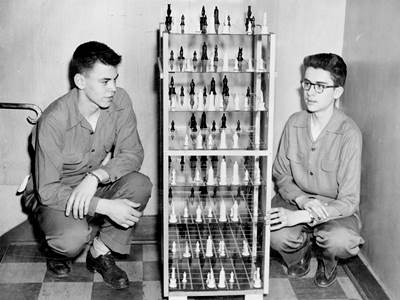
After that detour, I still had some time to prepare Chess Obsessed III. The last photo I picked for the mini-series is shown below.

The eBay description said,

1954 Original Photo THREE DIMENSIONAL CHESS Mankato Teachers College Game; size is 8" x 10"

That's certainly a straightforward (and unusual) implementation of 3D chess. If pieces are allowed to move up and down from board to board, I can't imagine what the rules would be. The setup could also be used by two players for an eight board simul against each other. For another post on the same subject, see How About a Game of 3D-Chess? (November 2017).

27 May 2019

Leela Wins TCEC S15; Stockfish Wins CCC8 Finals

In last week's post, TCEC S15 and CCC8 Finals Both Underway, we left our two major engine-vs-engine competitions in full swing. To summarize that post:-

TCEC: With just over half of the S15 superfinal games played, Leela leads Stockfish by 27.5-24.5 (+8-5=40). • CCC: In the final stage, with about two-thirds of the games already played, the order of the four engines is Stockfish, Leela, Leelenstein, Houdini. The point spread between each successive place is almost enough to guarantee that this will be the final standing.

In the meantime, both competitions crystallized around clear winners.

TCEC: It ain't over 'til it's over, but the S15 superfinal is effectively over. Leela leads Stockfish by seven games with six games still to be played; the current score is +14-7=73. It's been more than three months since S14 ended, which I documented in Stockfish Wins TCEC S14; CCC6 S2 Underway (February 2019; also links to TCEC winners for S10-S13): 'the final score +10-9=81 in Stockfish's favor'. Last month, in TCEC S15 DivP Underway; Leela Wins CCC7 Final (April 2019), I commented,

CCC7 marked the symbolic end of the dominance of the traditional, handcrafted, alpha-beta engines. The passing of the baton to a new generation needs to be confirmed by a TCEC victory for an AI/NN engine, but that is a question of 'when', not 'if'.

The baton has now been passed. For future TCEC/CCC competitions, I expect that more AI/NN engines will join the race and that the alpha-beta engines will struggle to maintain the pace.

CCC: CCC8 finished in the order predicted last week: Stockfish, Leela, etc. A final report on the event, Stockfish Strikes Back, Tops Lc0 In Computer Chess Championship (chess.com), said,

Lc0 defeated Stockfish in their head-to-head match, four wins to three. Lc0 also won its head-to-head matches with the other two finalists. But Stockfish performed better in the four-engine round-robin to take back the title by beating up on the two weaker engines.

The Chess.com report continued,

The four finalists will join a field of 18 total chess engines for the next event, CCC9: The Gauntlet, which will begin after the CCC8 bonus games (live now). CCC9 will try a new format with four stages of increasingly powerful engines. Strong engines will be seeded into stages two and three, but will still play in the preliminary rounds to challenge a varied field, including some new entrants to the Computer Chess Championship.

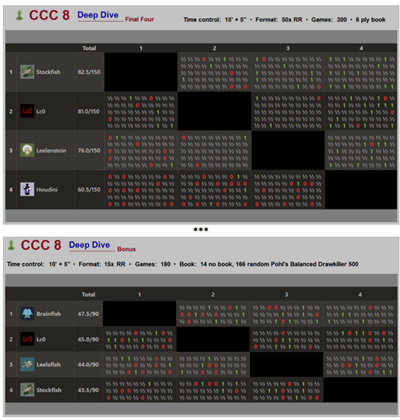
In the meantime, the CCC8 Bonus also finished, won by Brainfish. The following chart shows the final crosstables for the two CCC8 events that finished during the past week.


Top: CCC8 Final; Bottom: CCC8 Bonus

In next week's post I expect we'll have news about TCEC S16 and more details about CCC9. Since we're at a transition point for both competitions, it's a good time to decide whether I want to continue these weekly reports.

[For further information from the various stakeholders in the engine-to-engine events, see the tab 'TCEC/CCC Links' at the top of this page. • Leela = LC0 = LCzero]

26 May 2019

Books on Soviet Chess History

I couldn't find an appropriate video for this month's edition of The Sociology of Chess (November 2016), but I had a good backup idea. While I was preparing last week's post Chess Obsessed II ('The phrase "chess obsessed" once referred to an entire nation.'), I discovered a post on the English Chess Forum, Books on Soviet Chess (ecforum.org.uk; June 2013):-

Could someone personally recommend a publication on the history of Soviet Chess?

Along with literary luminaries like Leonard Barden, Tim Harding, and Richard James, forum members suggested about a dozen titles. I assembled the following list:-

  • Averbakh, 'Centre-Stage and Behind the Scenes'
  • Cafferty & Taimanov, 'Soviet Chess'
  • Eales, 'Chess: 'The History Of A Game'
  • Johnston, 'White King and Red Queen'
  • Kotov & Yudovich, 'The Soviet School of Chess'
  • Linder, 'Chess in Old Russia'
  • Richards, 'Soviet Chess'
  • Soltis, 'Soviet Chess 1917-1991'
  • Sosonko, 'Russian Silhouettes'
  • Spanier, 'Total Chess'
  • Wade, 'Soviet Chess'

More accurately, there are 11 titles on the list, of which I have all but three. A title that wasn't on the list, because it was published in September 2013, is:-

  • Hudson, 'Storming Fortresses: A Political History Of Chess In The Soviet Union, 1917-1948'

It's available as a PDF from a number of sources, and lately I've been reading it to expand my knowledge of Soviet chess history. Its abstract starts,

From the end of the Second World War through the demise of USSR, Soviet chess players dominated world chess. Not only did they control the world champion title after 1948 (except for the Fischer interlude), they also monopolized all other areas of international chess competition. When the Soviets captured the world title in 1948, this was the culmination of a long, carefully cultivated program to foster a chess community in the Soviet Union. The rationale for this initiative, which engaged the attention of the highest levels of the Soviet state, had deep ideological roots.

This dissertation explores the social/political history of chess in the Soviet Union, particularly its utility to Party and State. The story of Soviet chess begins in the Civil War, when chess was enlisted as a training tool for military recruits. After the Bolshevik victory, a very similar rationale was used to promote chess as an instrument for training Party cadre in the burgeoning Communist Party. The same attributes desired in soldiers were also desired in Party activists, and chess was seen as a tool for nurturing these attributes.

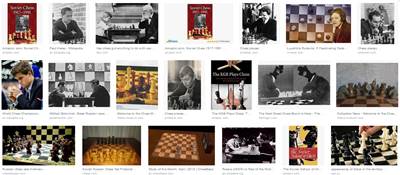
Out of curiosity I ran a search on the general subject and came up with the following.


Google image search on 'chess historians soviet'
[Call the rows 'A' to 'C' (from top to bottom) and number the images in each row '1' to '7' (from left to right).]

In the middle of that screen capture ('B5') is another title that deserves to be on the list:-

  • Gulko, Popov, Felshtinsky, & Korchnoi, 'The KGB Plays Chess: The Soviet Secret Police and the Fight for the World Chess Crown'

Since I've read that one as well, I'll spend some time to locate the three other titles that I haven't read.

24 May 2019

D.W.Fiske Bio

Some of what we know about Paul Morphy's heyday, the period from 1857 to 1859, is due to the work of Daniel Willard Fiske. Last year he was the subject of a post on this blog in:-

Fiske returned over the past week in two posts:-

The 'Images' post was based on Fiske's book 'Chess Tales & Chess Miscellanies'. The book starts with a one page biography of Fiske, dated January 1912.

[Readers of "Chess Tales" who are not familiar with the career of the author may be interested in the following biographical note.]

Daniel Willard Fiske was born in Ellisburgh, N.Y., November 11, 1831, and died in Frankfort-on-the-Main, September 17th, 1904. He was educated at Cazenovia Seminary and at Hamilton College, but left the latter institution before graduation to go abroad and study the Scandinavian languages. He passed two years at the University of Upsala, Sweden, and returned to New York in 1852, taking a place in the Astor Library, where he remained until 1859. He was General Secretary of the American Geographical Society, 1859-60.

In 1857 the American Chess Monthly was founded, which he edited in conjunction with Paul Morphy, 1857-60; and compiled the "Book of the First American Chess Congress," held in New York, 1857. He had been connected with the United States Legation, Copenhagen, 1850-51; and became Attaché to the United States Legation, Vienna, 1861-62, under Motley. Later he was connected with the Syracuse Daily Journal, and in 1867 was on the staff of the Hartford Courant.

In 1868 he traveled abroad, visiting Egypt and Palestine, when he received a call to be Professor of North-European languages, and Librarian, at Cornell University. He was an ardent member of the Psi Upsilon Fraternity. Iceland he visited in 1879. His marriage to Miss Jennie McGraw occurred in 1880. In 1883 he resigned his offices at Cornell and took up his permanent residence in Florence, Italy.

Mr. Fiske's miscellaneous writings were numerous and varied, and reprints of the more important will appear later. His valuable book collections, which were presented to the Cornell University Library, related to Dante, to Tetrarch, to Icelandic History and Literature, and to the Rhaeto-Romanic language. Besides the great collections which have enriched Cornell University, that institution has also received from his estate a fund for the uses and purposes of the Library, of more than half a million dollars.

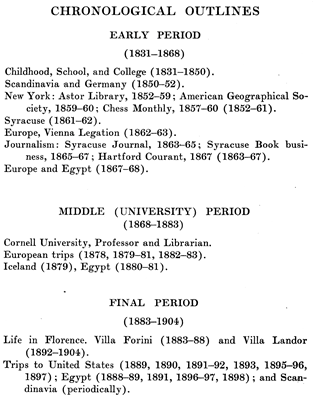
A similar, expanded biography can be found in 'Willard Fiske, Life and Correspondence: A Biographical Study' (1925) by Horatio Stevens White. The book also compresses the path of Fiske's life into a single page, titled 'Chronological Outlines', shown below.

It is curious that Morphy's heyday coincided with the period in Fiske's life where his main interest was chess, 'Chess Monthly, 1857-60 (1852-61)'. I've always had a special interest in Fiske, because he was associated with my alma mater, Cornell University. It is also curious that he lived/worked in Hartford CT, Copenhagen, and Frankfurt, three cities where I've lived and worked. What provoked him to lose interest in chess?

23 May 2019

Chess Obsessed II

What rhymes with chess? Bless, dress, guess, mess, press, stress -- Yes! Bless this mess? Those are one syllable words. There are even more two syllable words that rhyme, but the word that interests me for this post is 'obsess', as in last week's Chess Obsessed. The motivation for that post was simple:-

I found a half-dozen recent eBay photos from roughly the same period as the item in the 'Hyde' post, couldn't decide which I liked best, and chose the one that I knew most about.

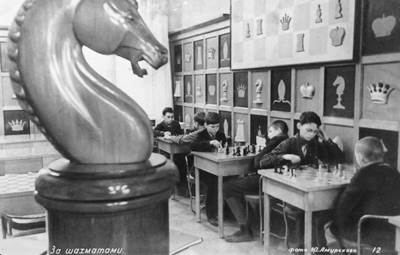
For this post I chose another photo from the same batch, this time on a subject that I would like to know more about.

The description said,

Russia USSR real photo card 1960s Soviet chess club. Boys pioneers. Photo card by Amursky, 1960s. Size 14.5 * 9.7 cm

What would I like to know more about? Chess in the Soviet Pioneer clubs. I started with a reliable source about which I blogged ten years ago:-

Although the word 'Pioneers' doesn't appear in the index of 'Soviet Chess', the phrase 'junior chess' does, and chapter five is titled 'Chess among Women and Juniors'. First, a digression : the relevant passage on junior chess (p.59-60) is immediately preceded by an important fact about Soviet women's chess that is worth keeping in mind:-

From 1938, although republic and city championships continued as before, championships of the U.S.S.R. for women were dropped from the calendar as it was hoped that women would compete in the men's championship. This policy proved misguided, however, as the difference in standard between the sexes was too great, and after the end of the Second World War separate championships for women were again instituted.

Back to junior chess, the chapter continues:-

During the [1930s] the number of schoolboys enrolled in the chess organization increased enormously. In the previous decade, although isolated clubs, most notably in Leningrad, and a few senior players had taken an interest in the younger generation, the general attitude towards enrolling juniors in the chess movement was far from favourable. Later, however, chess clubs were started at Pioneer Houses and often in schools. (The game was never taught as part of the school curriculum.) This work took such rapid root that almost 100,000 school-children competed in the qualifying tournaments for the All-Union junior championships of 1934 and 1936.

Many present-day Soviet grandmasters received instruction in the chess clubs of Pioneer Houses, which remain still the chief centres for junior chess today. Smyslov and Averbakh, for example, were taught at the Pioneer House in Moscow, Taimanov and Spassky in the Leningrad Pioneer House and Bronstein at a similar institution in Kiev. Petrosyan and Nona Gaprindashvili both learnt the game in the Tbilisi Pioneer groups.

One of the dangers facing Western masters visiting the Soviet Union since the mid thirties has been a simultaneous display against Russian schoolboys. The first foreign masters to experience their strength were Lasker, Spielmann and Liliental at the time of the 1935 Moscow tournament, but the most striking result, from the schoolboys' point of view, was a display given in 1951 by the English master Wade, who against thirty Moscow young pioneers scored ten draws and twenty losses.

Poor Bob Wade -- he scored +0-20=10 in a simul against children. The phrase 'chess obsessed' once referred to an entire nation.

21 May 2019

Images of Morphy

In last week's post, Paul Morphy, Annotator, I mentioned the book 'Chess Tales & Chess Miscellanies' by Daniel Willard Fiske (1912). Fiske died in 1904, and the publication of 'Chess Tales' was the work of its editor, Horatio S. White. My copy of the Google Books scan shows both White's bookplate and his handwritten inscription ('Literary Executor for the Willard Fiske Estate'). The book is a collection of about 30 reprints, mainly from Chess Monthly (see another post from earlier this month, Five Volumes of 'Chess Monthly') plus a few other sources. The book's 'Introduction' explains its genesis.

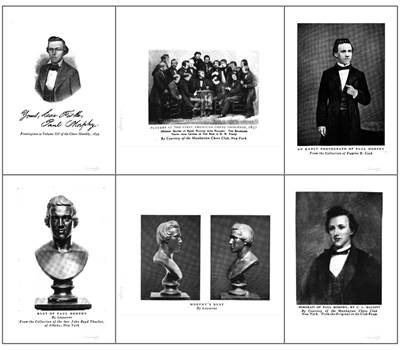
The chapter titled 'Paul Morphy' contains six pages with images of Morphy. I collected these into a single composite image, shown below.

All of the image pages were captioned. Top row, left to right:-

(Signed: 'Yours, dear Fiske, Paul Morphy')
Frontispiece to Volume III of the Chess Monthly, 1859

PLAYERS AT THE FIRST AMERICAN CHESS CONGRESS, 1857
[MORPHY SEATED AT RIGHT PLAYING WITH PAULSEN. THE BEARDLESS
YOUTH NEAR CENTRE OF TOP ROW IS D. W. FISKE]
By Courtesy of the Manhattan Chess Club, New York

AN EARLY PHOTOGRAPH OF PAUL MORPHY
From the Collection of Eugene B. Cook

Bottom row, left to right:-

BUST OF PAUL MORPHY
By Lequesne
From the Collection of the late John Boyd Thacher,
of Albany, New York

MORPHY'S BUST By
Lequesne

PORTRAIT OF PAUL MORPHY, BY C. L. ELLIOTT
By Courtesy of the Manhattan Chess Club
New York. From the Original in the Club Room

All of these images can be found elsewhere. Take, for example, the image in the center of the top row ('PLAYERS AT THE FIRST AMERICAN CHESS CONGRESS'), attributed to Matthew Brady. From 'Paul Morphy: Pride and Sorrow of Chess' by David Lawson (2010, p.77):-

During the time of the Congress, Matthew Brady, the well-known photographer, took several pictures of Morphy, singly and with other members of the Congress, and it was announced in the Chess Monthly of July 1858 that there would be published

"a lithographic Picture embracing Likenesses of about Twenty of the most eminent Chess Players in the United States—the same being an exact Copy of the group as arranged and Photographed by Mr. Brady of New York. In the foreground is represented the figures of Messrs. Morphy and Paulsen in the act of playing their memorable Match, with Judge Meek of Alabama as Arbitrator and the rear is made up of leading Chess Players watching with intense interest the progress of the Game."

The photo to the right of the top row is also attributed to Brady. The bust was mentioned in the 'Paul Morphy, Annotator' post (Fiske: 'the bust of Morphy constitutes the best likeness obtainable -- all those appearing in books are caricatures'). The last image in the bottom row was painted by Charles Loring Elliott (wikipedia.org; 1812–1868). For more images of Morphy, see Visions of Morphy (chess.com; batgirl; March 2016).