09 June 2019

Armageddon in Norway

The short list for this month's video post was awash in instructional videos featuring Armageddon games. Here's one from Youtube's PowerPlayChess channel, last seen on this blog in Top-10 Games 2018 (January 2019).


Armageddon - The two bishops of the apocalypse - Ding Liren vs So | Norway Chess 2019 (15:25) • 'Published on Jun 5, 2019'

The description says,

Grandmaster Daniel King examines the game Ding Liren vs Wesley So from the Altibox Norway Chess 2019.

A convenient link goes to Altibox Norway Chess - Regulations 2019, where we learn:-

If there’s a draw in the classical game [120 minutes on the clock with an increment of 10 seconds after move 40] then the players will move on to Armageddon after all classical games are over. White pieces will continue with white in Armageddon. With this, there will be a winner in each game due to the fact that the player with the black pieces in the Armageddon game will win if the game ends in a draw.

The time control is unusual for Armageddon games:-

White has 10 minutes and Black has 7 minutes with an increment of 3 seconds per move, starting from move 61.

The scoring is also unusual:-

Players will get following points per round:
* Victory main game: 2 points
* Loss main game: 0 points
* Draw main game & victory Armageddon: 1.5 points
* Draw main game & loss Armageddon: 0.5 points

For more about the Armageddon format, see Leonard Barden 's Chess: Armageddon divides fans while Magnus Carlsen leads again in Norway (theguardian.com). If the Armageddon experiment works, expect to see more of the same in other tournaments. If it doesn't work, future pundits will point to the Norway tournament to explain why not.

07 June 2019

19th Century Chess Culture

While looking into what came After 'Le Palamede' ...

The first French periodical doesn't even bring us to the 1851 London tournament. What publications appeared afterwards? [...] I managed to find all of the above on Google Books.

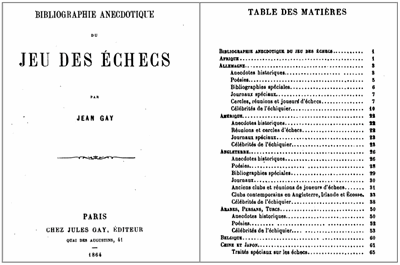
...Google kept suggesting other French chess publications from the same era. Most of the suggestions were primers about how to play chess, but one of them was more interesting: 'Bibliographie anecdotique du jeu des échecs' by Jean Gay (1864). That title translates to something like 'Anecdotal Bibliography of the Game of Chess'.


Left: Title page; Right: Table of contents (1/3)

I started to flip through it and realized that it was a catalog of chess culture in the mid-19th century. The book is organized by country. Germany ('Allemagne') takes up 19 pages, the U.S. ('Amérique') 4 pages, England ('Angleterre', i.e. Great Britain) 24 pages, while France gets a whopping 89 pages. After the countries, there are 20 other topics ('Variétes') that take up almost 70 pages.

The material for individual countries is further divided into topics like historical anecdotes, clubs, periodicals, and celebrities. It would be easy to get lost in this material, so I'll try to limit myself to another post or two out of the 300 pages.

Who was Jean Gay? Collectors exchange (chess-museum.com), says,

Jean Gay was a professional bibliographer and book seller in mid-19th century Brussels -- same as his father Jules -- who edited most of his bibliographies in Paris. In toto, the bibliography of works edited by the Gays lists 82 editions! -- a lot of them are what today would be called erotic or pornographic literature of their days

The copy of the chess book on sale carried a price of $1400. Before discovering that paragraph, I wasn't aware that 'professional bibliographer' was a career choice.

06 June 2019

Carving Walrus Ivory

There's a chess story getting attention this week: Lewis chessmen piece bought for £5 in 1964 could sell for £1m (theguardian.com).

A small walrus tusk warrior figure bought for £5 in 1964 -- which, for years, was stored in a household drawer -- has been revealed as a missing piece from one of the true wonders of the medieval world with a possible value of £1m.

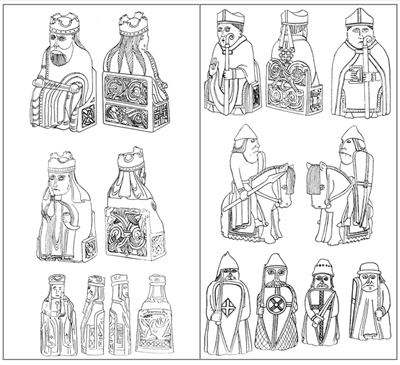
I've often wondered whether the Lewis pieces were indeed chess pieces. First, I wanted a good photo of a complete set, but discovered that most of the available photos are replica Lewis chess sets. The British Museum has some excellent photos of the original pieces, e.g. Image gallery: The Lewis Chessmen, but the best image I found was an old illustration.

H.J.R. Murray, 'A History of Chess' (1913/1962, p.760-761)

(Left) Top row: King; Bottom rows: Queens
(Right) Top to bottom: Bishops, Knights, Rooks

Murray introduced the topic with a summary of the pieces' discovery.

The Lewis chessmen were discovered in 1831 in a sand-bank at the head of the Bay of Uig, on the west coast of the island of Lewis, one of the outer Hebrides. There is no circumstantial account of the discovery, but it appears that they were found in a small chamber of dry-built stone, resembling an oven, about 15 feet below the top of the sand-bank.

The chessmen were exhibited by Mr. Roderick Ririe at a meeting of the Society of Antiquaries of Scotland, April 11, 1831, but before the members had raised the money to purchase them Mr. Kirkpatrick Sharpe stepped in and bought 10 of the pieces, while the remaining 67 chessmen, 19 tablemen, and a buckle were bought for the British Museum.

On the dispersion of Mr. Sharpe's collection, the Lewis chessmen, now 11 in number, Mr. Sharpe having obtained another one from Lewis, were purchased by Lord Londesborough, and at the sale of the latter's collection in 1888 they were purchased by the Society of Antiquaries for the Scottish National Museum.

All the game-pieces, as well as the buckle, are carved of walrus-ivory. The 78 chessmen comprise 8 Kings, 8 Queens, 16 Bishops, 15 Knights, 12 Rooks, and 19 Pawns, of which 2 Kings, 3 Queens, 3 Bishops, a Knight, and 2 Rooks are now at Edinburgh.

Not everyone believes that the pieces are chess pieces. Geoff Chandler explains,

At an unknown date, an unknown ship is sheltering from a storm in a bay on the Isle of Lewis. Onboard, an unknown cabin boy seizes his chance to escape from the ship, sneaks into the Captain’s cabin, steals a sack containing 128 carved walrus pieces (four chess sets) and swims ashore. [...]

That excerpt is from Not Even From Lewis, Mate (textualities.net); 'I am totally convinced the "Lewis Chessmen" are not chess pieces'. Chandler calls them 'gaming pieces'. If he's right, would they still sell for £1 million?

04 June 2019

June 1969 'On the Cover'

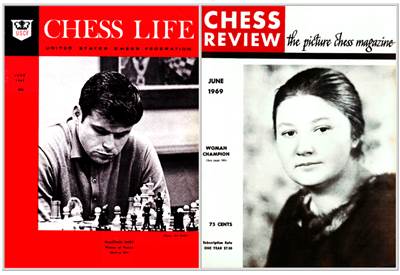
Is chess more for young people or for old people? Considering the cover stories of two American chess magazines 50 years ago, I might be tempted to say 'young people', but I'll stick with 'For All Ages'.


Left: 'Vlastimil Hort, Winner at Venice'
Right: 'Woman Champion'

Chess Life

Anthony Saidy wrote the tournament report corresponding to the cover story, titled 'We Open in Venice'. I already quoted it in April 1969 'On the Cover', so I'll just repeat the first paragraph.

Vlastimil Hort, 25-year-old Czech International Grandmaster, romped undefeated to an easy victory in the 3rd annual International Venice Tournament, March 5-23. The "baby" of the event took the sole lead with four straight wins, had 7 points after 8 rounds and coasted to a final tally of 11.5-3.5.

It's an elementary observation that 25 + 50 = 75. Chessbase did a story at the beginning of the year, Vlastimil Hort turns 75 - an interview (January 2019). The site has also been running a series of 'Hort stories'; see tag=Vlastimil+Hort (chessbase.com).

Chess Review

While Champion Nona Gaprindashvili and Challenger Alla Kushnir (see April issue) are battling for the world title, let's reflect for a moment on the first Wonsan World Champion of Chess (and the first woman to hold a verified master's title). Here on our cover is Miss Vera Menchik at 21 soon after she had won the world title as she appeared at Hastings in 1927. The "Vera Menchik Chess Club," a list of masters who lost to her, became quite lengthy and studded with notables.

Is it sexism that the CR cover doesn't mention Vera Menchik by name? Or was she really so little-known at the time? If so, then chess history has made giant strides since 1969. For a previous post on this blog, see More Menchik (April 2013).

03 June 2019

TCEC S15/S16; CCC8/CCC9

Through some sort of statistical fluke, last week's post, Leela Wins TCEC S15; Stockfish Wins CCC8 Finals, was a report on the season finales of the world's top two engine-to-engine competitions. The key points in that post were:-

TCEC: The S15 superfinal is effectively over. Leela leads Stockfish by seven games with six games still to be played; the current score is +14-7=73. • CCC: CCC8 finished in the order predicted last week: Stockfish, Leela, etc. The Chess.com report continued, 'The four finalists will join a field of 18 total chess engines for the next event, CCC9: The Gauntlet.'

Gazing into the blogger's crystal ball, I also made a prediction for this week's post:-

In next week's post I expect we'll have news about TCEC S16 and more details about CCC9. Since we're at a transition point for both competitions, it's a good time to decide whether I want to continue these weekly reports.

Looking first at TCEC S15/S16 and CCC8/9, what has happened during the intervening week?

TCEC: The last six games of the S15 superfinal finished with six draws, giving Leela a final score of +14-7=79. The TCEC organizers marked the occasion by publishing a report on the event that immediately preceded the superfinal, which I reported three weeks ago in Leela Wins TCEC Cup 3; CCC8 S1 99% Finished. Here are the main conclusions of the TCEC report:-

  • 2019-05-30: TCEC Cup 3 report (chessdom.com) • 'Leela confirmed that its win in TCEC Cup 2 was no fluke and it retained the title. Neural networks do finally seem to be coming through with genuine advances, at Deep Mind (Hassabis, 2019) and elsewhere, but troublingly it is not obvious why they work and when they go wrong.'

The superfinal conclusion was mostly overlooked or ignored by the major chess news sites. I found only one report:-

  • 2019-06-02: A new age in computer chess? Lc0 beats Stockfish! (chess24.com) • 'In the 15th Superfinal of the Top Chess Engine Championship (TCEC) – the unofficial computer chess World Championship – the self-learning Leela Chess Zero beat the previous best engine in the world, Stockfish 10.'

I expect to see a trickle of other reports in the forthcoming weeks. What is the TCEC doing now?

!bonus: TCEC ALL STARS ALLTIME CHAMPIONS BONUS; Featuring winners of TCEC Seasons 1 thru 15 = 14 engines (S1 and S2 had same winner). Next: Rapid bonus with engines from Div P and Div 1.

You might expect the bonus event to show the TCEC winners of recent seasons finishing ahead of the winners from early seasons, and that is exactly what is happening. The only surprise after 16 games for each engine is that Leela is trailing the four versions of Stockfish that won seasons 11 through 14.

CCC: Since the 'CCC8 Bonus' that I mentioned in the previous post, the CCC has been running a series of exhibition events. The results are stored in discordapp.com (see the 'further info' note below) and the data from the events is available via a little drop-down arrow on the 'live' page (ditto), but I have no idea what purpose the events served. CCC9 is in a testing stage. The plans are:-

!ccc9: Engines are 1. Stockfish 2. Lc0 3. Allie 4. Laser 5. Xiphos 6. Andscacs 7. Dark Queen Lc0 8. Rofchade 9. Wasp 10. Rubichess 11. Winter 12. Stoofvlees 13. KMC 14. Ethereal 15. Fire 16. Komodo 17. Houdini 18. Leelenstein • There will be 4 stages, qualification/quarterfinal/semifinal/finals. Opening books for all stages • TC [time control] is 5+2 for all stages except finals which is 10+5

Perhaps by next week's post, CCC9 will already be underway. That brings me to the final topic for today's post: 'it's a good time to decide whether I want to continue these weekly reports'.

Sparked by my interest in using chess engines for analysis, I've been covering the TCEC since TCEC Season 7 (March 2015). My coverage of the next few seasons was limited to the final match, but I found it increasingly difficult to understand an individual season by only looking at it every once in a while. There are many engines involved and they all have a story.

This difficulty was compounded when I added the CCC to the mix in Catching Up with Engine Competitions (October 2018). After spending too much time to catch up at the end of each TCEC/CCC tournament, I hit on the idea of catching up once a week on a regular basis, starting with TCEC S14 Underway (January 2019).

Five months later, the weekly engine post has almost been reduced to a formula. I'm happy to have been recording the technological evolution from traditional engines to AI/NN engines, a trend which will probably accelerate into a revolution. I'm also happy to note that visitor interest in these posts is about the same level as for other posts on the blog. The downside of the weekly survey is that I haven't had time to explore the AI/NN technology in more depth. The quote I used earlier ('it is not obvious why they work') confirms there is much new ground here.

What to do? I'll continue with the weekly post, but try to take an occasional detour to look at the underlying technological trends. The Leela camp is the obvious place to start, but the Stockfish camp is also keeping tabs on the competition in their usual professional way. The future is bright for chess engines.

[For further information from the various stakeholders in the engine-to-engine events, see the tab 'TCEC/CCC Links' at the top of this page. • NB: Leela = LC0 = LCzero]

02 June 2019

Cards for Chess Champions

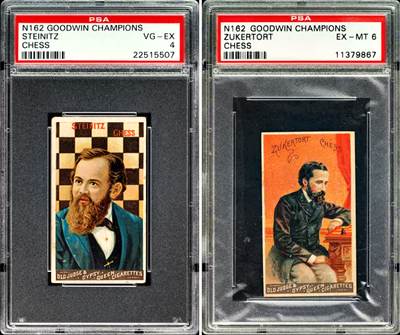
I've seen these cards many times on eBay, but I never thought they were suitable material for Top eBay Chess Items by Price (March 2010). It just proves how little I know about collectibles.

The auction for the card on the left was titled '1888 N162 Goodwin Champions Steinitz CHESS PSA 4 VGEX (PWCC)'. It sold for US $1009 after 14 bids from 10 bidders. The card on the right, '1888 N162 Goodwin Champions Zukertort CHESS PSA 6 EXMT (PWCC)', sold for $1525 after 21 bids from 11 bidders. Both cards had a starting price of $0.99.

The codes 'PSA 4 VGEX' and 'PSA 6 EXMT' in the titles indicate their grades. There is more information about grades on, e.g., 1888 Goodwin Champions (N162) Steinitz Chess (psacard.com). The code 'PWCC' in the title is the name of the auction house.

The backs of both cards list other 'Champions' in the series. There are three chess players : the two shown here plus 'Capt. Mackenzie', George Henry Mackenzie (wikipedia.org).

31 May 2019

After 'Le Palamede'

After collecting mid-19th century chess periodicals for four countries, I had one significant gap to address. In Le Palamede (March 2019), I documented that French publication with:-

From Di Felice, 'Chess Periodicals, 1836-2008' [NB: The first number ('1778') is Di Felice's internal reference.]:-

1778. Palamède (Le) : Revue Mensuelle des Échecs et Autres Jeux (1836–1847)

The first French periodical doesn't even bring us to the 1851 London Tournament. What publications appeared afterwards?

1946. Régence (La) : Journal des Échecs, Rédigé par Une Société d’Amateurs (1849–1851) Vol.1, no.1 (Jan 1849)–Vol.3, no.12 (Dec 1851). Monthly. Editor Kieseritsky. Publisher Café de la Régence. Paris. France. Illus., 20 cm. Magazine. General. French.

After 1849–1851, there was a gap of several years.

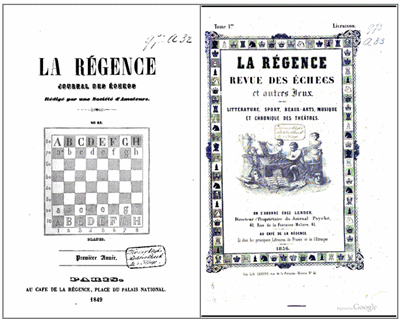
1947. Régence (La) : Revue des Échecs et Autres Jeux (1856–1857) Vol.1, no.1 (Jan 15, 1856)–Vol.2, no.1 (Jan 15, 1857). Frequency unknown. Editor Arnous de Rivière. Publisher Café de la Régence. Paris. France. Diagrs., 28 cm. Magazine. General. French.

The cover pages of the two different series are shown in the following composite image. The 1856 cover is probably off-center because of a scanning problem.


Left: 1849; Right: 1856

After 1856–1857, there was another gap.

1699. Nouvelle Régence (La) : Revue Spéciale des Échecs (1860–1864) Vol.1 (1860)–Vol.5, no.4 (Apr 1864). Monthly. Editor Paul Journoud. Publisher Café de la Régence. Paris. France. Diagrs., 23 cm. Magazine. General. French. Note Vol.1 has title Régence (La): Revue Spéciale des Échecs. Replaced by Palamède Français (Le).

Paul Journoud (wikipedia.org) was to edit other publications. Wikipedia says, 'He was an editor of several chess periodicals: La Régence (1860), La Nouvelle Régence (1861–1864), Le Palamède Français (1864), and Le Sphinx (1865–1867).'

1779. Palamède Français (Le) : Revue des Échecs et des Autres Jeux de Combinaison (1864–1865) Vol.1, no.1 (Sept 1864)–Vol.2, no.15 (Nov 1865). Monthly. Editors Paul Journoud, Ladislav Maczuski. Publisher C. Lahure. Paris. France. 24 cm. Magazine. General. French. Note Replaces Nouvelle Régence (La).

Le Palamède Français started some months after its predecessor, La Nouvelle Régence, and overlapped its successor, Le Sphinx.

2528. Sphinx (Le) : Journal des Échecs (1865–1867) Vol.1, no.1 (Apr 15, 1865)–Vol.2, no.18 (Dec 15, 1867). Fortnightly, later 10 issues per year. Editor Paul Journoud. Publisher Imp. Vallée. Paris. France. Illus., cm. 22 x 13. Magazine. General. French. Note Replaced by Philidorien (Le).

The next periodical in the chain, Le Philidorien, lasted only a few months.

1828. Philidorien (Le) : Petite Encyclopédie des Échecs (1868) No.1 (Apr 1868)–no.6 (Sept 1868). Monthly. Editor C. Sanson. Publisher P. Lebrige-Duquesne. Paris. France. Magazine. General. French. Note Replaces Sphinx (Le): Journal des Échecs.

I managed to find all of the above on Google Books. I don't know whether the copies are complete or internally consistent, but I'll find out when I use them for further reference.