31 January 2021

FIDE's Social Commission 2020

Getting back to the recent post Spectating the 91st FIDE Congress (January 2021), let's have a follow-up to FIDE's Social Commission 2019? (February 2020), this time without the question mark ('?'). We learn from Commissions (fide.com), that the Social Commission's officers have changed to...

  • Chairman: Klerides, Paris
  • Secretary: Chatelain, Philippe Victor

...plus three councillors and 13 members. Of the 18 commissions listed on that page, 14 have their own web sites. The last to appear, some time during Summer 2020, was the FIDE Social Commission. It describes its 'Mission' as:-

The FIDE Social Commission "SOC" is dedicated to using chess as a tool for social development. SOC advocates for the use of chess as a tool for social change through action as [e.g.] An equalizer for gender, social and economic development. [...]

The 'Members' page still lists the same officers as recorded in my 'Social Commission 2019' post, where the current chairman was at that time the secretary. The 'Reports' page lists a single item, dated September 2019, the First FIDE Social Commission meeting. The three paragraph report starts,

The first FIDE Social Commission meeting was held in Havana, Cuba, on Saturday, 11 May 2019, at Tryb Habana Libre Hotel, during the Capablanca Memorial Festival.

This commission is obviously a work-in-progress and I hope we will hear more about it during the coming year.

28 January 2021

A Database of Yahoos

As another month nears its end, we take another look at any chess stories that have been adopted by the mainstream press during the month. Last month we had A Yahoo Backstory (December 2020), and this month we have ... zilch. In fact, most months we have zilch and that's when I turn to Google News for inspiration.

This month Google News was also uninspiring. Stories about online chess were again popular, but nothing surfaced that hasn't been seen before. I decided to take a different approach. First I scraped the news screen to collect the story headlines and their sources. Then I loaded the scraped file into a database. Then I analyzed the result.

All in all, Google News listed 70 different news stories. The image on the left shows a count of the stories provided by each source, where those stories numbered at least two for a particular source. The top three sources -- Chess.com, USchess.org, and Chessbase News -- all traffic exclusively in chess news; the next three are mainstream news organizations that often follow important chess stories. Those six sources account for 37 stories, leaving 33 other sources with a single story.

Of the 39 stories coming from non-chess sites, eight were inspired by the Netflix ‘Queen’s Gambit’ series. Only one story from the three chess sites was similarly inspired. For an example of real chess news, the chess sites had five stories about the Tata tournament at Wijk aan Zee, while the non-chess sites had four, which was more than I expected to find.

As for stories about streamers, the chess sites had three, the non-chess sites one: This chess teacher quit his full-time job to become a streamer: 'It's become [the primary source of income]' (yahoo.com). And that is a real Yahoo.

Don't forget that all of these numbers are based on what Google News considers to be top chess news. Pogchamps rated four stories, all from Chess.com (of course).

25 January 2021

Engine Scaling

Two weeks ago, in the post CCC Hardware Upgrade (January 2021), I referenced a thread on the Talkchess forum, CCC has serious hardware update! (talkchess.com). That thread went further than a discussion of the CCC's hardware. It addressed the key question about what performance gains can be expected from an upgrade in hardware. As one commenter put it,

Both [CCC & TCEC] have massive hardware. Will it change any results? If you notice even on much smaller hardware, the [relative] ranking of the engines does not really change. And this is also what I am seeing in my testing.

It's a good point, but it wasn't the only point of the thread. We all know that if a single processor executes faster, an engine will perform better because it analyzes more positions and variations in the same amount of time. But what happens when you add a second processor of the same speed? Or a third and fourth?

The concept is called 'scaling'. How does the performance of an engine scale as it runs on increasingly more cores? During the past ten years we learned that the traditional engines -- Stockfish, Houdini, Komodo, et al -- scale well. They analyze significantly faster, with huge gains in playing strength.

After Stockfish 12 (aka Stockfish NNUE) was released last year, an earlier Talkchess thread, CCRL flawed testing : SF12 above SF12 8CPU (talkchess.com), observed that Stockfish 12 showed no improvement running on eight cores instead of a single core. As the title of that thread suggests, the first post assumed that the phenomenon was caused by inadequate CCRL test procedures. Other commenters suggested that it might instead be a characteristic of NNUE engines: they don't scale well, perhaps not at all.

As another commenter to 'Serious Hardware Update!' noted,

I don't see the point in this huge hardware. The results are probably the same on 32 cores, and I'd guess none of the authors have tested their engines on this level of hardware. Better quality chess however you define that, maybe, but you also probably increase the draw rate as well.

And more cores give you less and less real speed because of diminishing returns, as you can only effectively subdivide the search of the engine so many times. What is a bigger benefit in the new hardware is the improved IPC [Instructions Per Cycle? Interprocess Communications?] and frequency of each core.

I doubt that's the last word on 'massive hardware'. As with most everything in technology, it's two steps forward and one step back.

24 January 2021

ChessTech2020 Online Conference

In the ongoing series about The Sociology of Chess (November 2016), December is chess conference month. A year ago we had London Chess Conference 2019 (December 2019), and now we have ChessTech 2020.


Chess: Driving Technological Innovations in the 21st Century (16:50) • '[Published on] Dec 13, 2020'

The video description explained,

Keynote speech by Arkady Dvorkovich, President of the International Chess Federation (FIDE), at the ChessTech2020 Online Conference 5-6 December 2020. • Conference organised by ChessPlus Limited. Session hosted by John Foley.

A second video on the same channel continues with questions and answers that followed the presentation: Chess: Driving Technological Innovations in the 21st Century - Q&A (youtube.com). For more about the conference, see ChessTech2020, 5-6 Dec 2020 (chesstech.org), and ChessTech, 5-6 Dec 2020 (chessconference.org). That Chesstech.org page explains,

ChessTech2020 is the premier chess related conference in the world. Its name reflects the topic: Chess and Technology. This is the 8th in the sequence of the London Chess Conference since 2013.

I think I've covered about half of those conferences on this blog. Will the organizers continue to use the online format for the 9th edition?

18 January 2021

TCEC S20 Sufi Underway; CCC Back in the Saddle

Continuing the long series on the two most visible engine vs. engine competitions, at the end of the previous super-short post, TCEC S20 Reaches DivP; CCC Testing, I wondered, 'How will I summarize it for the next post in two weeks?' Like this:-

TCEC: S20 L1 finished with Ethereal and rofChade qualifying into Premier Division (aka DivP), which is currently underway. • CCC: The 'testing and showcase of engines new to CCC' mentioned in the previous report has evolved into 'testing and showcase of new engines at CCC and of the new hardware rig'.

Last week I expanded on the CCC's 'new hardware rig' in CCC Hardware Upgrade. Let's look at today's situation for both the TCEC and the CCC.

TCEC: S20 DivP finished with LCZero and Stockfish in a dead heat and an identical score, +24-4=28. That result includes +2-2=6 in their head-to-head mini-match. The following crosstable shows the final result for all eight engines.


TCEC S20 - Division P

The same engines that qualified from S20 L1 finished in the last two places, which should relegate them to S21 L1 for the next season. LCZero and Stockfish have already started duking it out in the final match, which is tied at one win each, and which is scheduled to run until the end of the month.

CCC: After a four month break for technical problems that started in CCC15, the CCC is back with 'CCC Rapid 2021: Qualifiers'. The site's 'Info' tab lists a total of six events for 'CCC Rapid 2021':-

Qualifiers; eight engines
NNUE League; eight engines
Main League; eight engines
NN vs Classic; Stockfish, Leela, three engines from 'NNUE League', five from 'Main League'
Elite Round; Engines #1 to #6 from the "NN vs Classic" event
Finals; Engines #1 and #2 in the elite round

The six events will run for about three months. Some past CCC events, like CCC6, have finished in less a month.

[For further information from the various stakeholders in the engine-to-engine events, see the tab 'TCEC/CCC Links' at the top of this page. • NB: Leela = LC0 = LCzero]

17 January 2021

Observing a Game in the District

It's a question that arises from time to time on this blog. Is the subject of the following photo a statue/sculpture, as in Keres' Last Move (October 2020), or something else, as in Posing for Euros (March 2017)?


Sylvia Watches Chess Match, Washington DC © Flickr user Observe the District under Creative Commons.

The photo had no description and no tags, so no help there. The only clue was an album with the same name as the photographer, 'Observe the District'. The photos in that album were all unretouched shots of objects and places in D.C., and that was enough help to identify the players in the photo: From Wikipedia's The Chess Players (sculpture):-

The Chess Players is an outdoor 1983 sculpture by Lloyd Lillie, installed in John Marshall Park in Washington, D.C., United States.

As for the chess set, other photos consistently show the same board, pieces, and position, which are not those shown here. Have they been ripped out/off?

15 January 2021

FIDE Rating List - Inactive Players

Last week, in FIDE Rating List - January 2021, (FRL) I noted,

The number of inactive players declined, but growth in active play also declined. How to explain this contradiction? I'll look at that in another post.

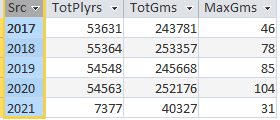
First I looked at the assertion that 'growth in active play declined'. Here's a table that shows some statistics for the last five years.

The three columns show:-

  • the total number of players on the FIDE list that played at least one game,
  • the total number of games played, and
  • the maximum number of games played by a single player.

Remember (1) that each of those five rating lists is from January of the year indicated and, (2) that the lists are produced monthly. The FIDE download page (see last week's FRL post for the link) says that the data shows 'rated games in given period'. I looked at the player corresponding to 31 'MaxGms' in 2021 -- from federation POL, current STD rating 1890 -- and discovered that he played four tournaments that counted in the January 2021 FRL. [NB: the FIDE rating site is very well done.]

The table shows a large drop in all columns from January 2020, i.e. pre-pandemic, to January 2021. Rated play has still not recovered.

Next I looked at the assertion that 'the number of inactive players declined'. Of the 189 federations with inactive players (Flag = 'i') at the start of both 2020 and 2021, 141 had a decrease in the number of inactive players and only one had an increase (of one player).

To allow for the decreased activity during 2020, FIDE must have changed the rule for inactivity and applied it retroactively. According to Resolution of FIDE Council regarding the rating list (fide.com; 2 November 2020):-

The lack of rated events due to the coronavirus pandemic could have led, under the existing regulations, to many players being considered as "inactive". As such, they could have been removed from the rating list. In order to prevent that, the Qualification Commission has made the recommendation to temporarily extend the period required to be considered "inactive" from 12 to 24 months.

As for 'removed from the rating list', I haven't played a rated game since 1990, and I'm still on the list (FIDE ID 2003740). The photo shown on my rating profile is not me, it's Manuel Weeks, but I'll deal with that another time.