30 September 2018

The Sociology of Chess960

Move over chess -- make some space for chess960! I ended last month's post on The Sociology of Chess (November 2016) with,

In nearly every post about the 'The Sociology of Chess', ChessBase India has at one candidate on the video short list, usually several candidates. I'm sure we'll see one of them again.

I could have followed-up that post, Best Blind Players of India, with one of a dozen videos about the impact of Indian chess, but this month another topic beckons.

On one of my other blogs, 'Chess960 (FRC)', where the 'FRC' stands for 'Fischer Random Chess', I documented an exhibition event from last month, Champions Showdown, St. Louis:-

Twenty games times five matches means 100 games of chess960 played by some of the best chess players in the world.

Here's a video from the sponsor of the event, the Saint Louis Chess Club, where the players discuss some high level aspects of Fischer's greatest invention.


2018 Champions Showdown: Thoughts on Chess960 (3:19) • 'Published on Sep 13, 2018'

The description said simply,

The players express their feelings on the chess960 variant before their chess960 matches. (USChessChamps.com)

In the three minute clip, GM Maurice Ashley asks three questions:-

0:00 'What is it that makes chess960 so much fun?'
1:00 'What are the special challenges of playing chess960?'
2:00 'Is chess960 the future?'

Before signing off, I have a quibble with the description. In Top 10 Myths About Chess960 (May 2012), myth number two is 'It's a variant of traditional chess'. It's not a variant; it's an evolution. Traditional chess is a subset of chess960.

28 September 2018

Google Adsense in 2018

Now that I've caught up with the Google Search Console and Google Search Coverage, I can continue with the topic introduced in the 'Search Console' post:-

Before fixing the Adsense problem, I decided to catch up on the many Google notices I've received since the beginning of the year, at least a half-dozen significant emails from Google.

It turns out that more than a few of those emails had to do with Adsense, which is Google's service for matching advertisers to web pages. In March 2018, I received an email titled, 'Introducing the new AdSense Auto ads'. It said,

If you’re looking to increase your revenue potential and save time, we have a solution for you. We’ve brought the power of machine learning to AdSense Auto ads - a new way to place ads automatically on your site. Auto ads balance revenue and user experience by delivering the right ad at the right time to your visitors. You can use Auto ads independently or with your existing Google ads. Google scans the pages on your site, finds potential ad placements, and shows new ads when they’re likely to perform well and provide a good user experience.

I've never associated ads with 'a good user experience' -- it's generally the exact opposite -- but I'm always interested in whatever Google has to say on a subject. The email pointed to an Adsense resource that said, 'Auto ads use machine learning to make smart ad placement decisions on your behalf.' It started by asking what sort of ads I want and gave me a choice of six:-

In-page ads:
* Text & display ads : A simple way to get banner ads on your page. Google will choose the size, placement, and style of ads you show.
* In-feed ads : Native ads that flow naturally inside a feed (for example, a list of articles or products) offering a great user experience. [*]
* In-article ads : Native ads that fit seamlessly in between the paragraphs of your pages for an enhanced reading experience.
* Matched content : Native ads that combine ads with content recommendations from your site, designed to increase overall user engagement. [*]

Overlay ads:
* Anchor ads : Mobile ads that stick to the edge of the user's screen and are easily dismissible
* Vignette ads : Full-screen mobile ads that appear in between page loads on your site, also easily dismissible.'

The two that I've marked '*' are 'Currently only available for mobile.' For more about the functionality, see Ad code implementation : About Auto ads (support.google.com/adsense). That page carries a couple of illustrations that look like the following.

'The following examples show you how a page with an existing ad unit might look before and after Auto ads have been set up:'
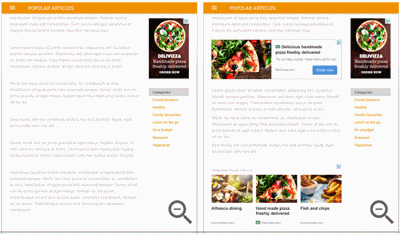
Right, got it. The ads will take up half of the display. I'll pass on that. In July I received another, related email titled, 'Could your ads work better with your content?' It said,

Native ads match the look and feel of your site, flow with your content and unlock new revenue potential.

The email pointed to another Adsense resource that asked, 'What type of ad would you like to create?' Along with good old 'Text & display ads', which is what I've used since starting with Adsense, it offered three choices, along with the following help:-

The right side of the image above shows 'In-article' and 'Matched content' ads. I've used matched content ads for nearly two years and posted about them in Mixed 'Matched Content' (January 2017). Once again, I'll pass on the others.

All of these choices might be too heavy for me, but if I needed ad revenue to provide additional income, I would certainly try them. I'm sure many sites are happy with the possibilities.

27 September 2018

A Year of Yahoos!

No, not really. For last month's question, A Year of Yahoos?, I calculated,

That makes this month's August Yahoos the 11th straight month of Yahoos.

This month should be September Yahoos, but there were no Yahoos for the month, meaning that no chess stories were picked up by mainstream news and featured in Yahoo News for the current month. What to do?

Luckily, I have a convenient fallback -- last seen in July Yahoos (July 2018) -- which is to switch to Google News. Their service returns the headlines for 100 chess stories that they judge to have been significant over the past month. I started to select a couple of Google News stories and ended up with the following list:-

That first link is from St. Louis Public Radio, as are the rest, proving once again that St. Louis has a strong claim to be the USA's chess capital. I first looked for stories to complement a recent post on my chess960 blog, Champions Showdown, St. Louis (chess960frc.blogspot.com), found the two listed above, and then noticed that there were other good stories from the same source. The publication dates and the 'On Chess' titles indicate that the stories are from a weekly series.

***

In the absence of September Yahoos, I created a new category, Showing posts with label Yahoos, and added relevant posts. I expected to find about 20-25 old posts and was surprised to discover double that number. I could have added Flickr posts to the new category -- Flickr is, after all, a service of Yahoo -- but decided against it as this would have meant hundreds more posts, most of them having nothing to do with chess news.


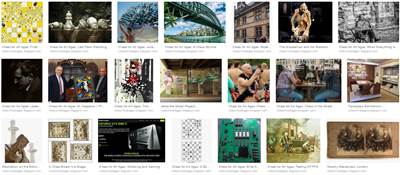
Google image search on 'site:chessforallages.blogspot.com flickr'

The screen capture shows a few of the many images I've used from Flickr. Note that the layout of the Google image search results has changed since the last time I used the same technique, in Chess and Impressionism.

With the 2018 Olympiad currently underway, a FIDE presidential election next week, and a World Championship match next month, I hope we get some serious 'October Yahoos'. If not, there are plenty of alternative mainstream news sources.

25 September 2018

Carlsen / Caruana Record 2017-18

I started last week's post, Karpov Talks Carlsen - Caruana, stating,

With only 50 days remaining before the start of the 2018 Carlsen - Caruana World Championship match, I'd like to start running a weekly post about the match.

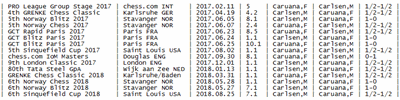
Yesterday's post, Carlsen's Record 2017-18, gave me the raw material for a comparison of the two players' records against each other over the last two years. It makes a total of 15 games.

For another, larger view of the same data, see >2016: Carlsen - Caruana (chessgames.com). How did the players score against each other? The data gives us the means to look at the record according to the time control (slow games vs. fast):-

  • Slow: +2-0=7 in favor of Carlsen
  • Fast: +3-1=2 (ditto)

If we take the 12 match games to be played at slow time control, Carlsen has the edge. If we take the tiebreak at fast time control, Carlsen also has the edge. It appears that Caruana is facing an uphill battle to become World Champion. This is confirmed by the lifetime record of the two players against each other (also chessgames.com):-

Classical games: Magnus Carlsen beat Fabiano Caruana 10 to 5, with 18 draws.
Only rapid/exhibition games: Magnus Carlsen beat Fabiano Caruana 13 to 6, with 4 draws.

As for openings, the Chessgames.com data shows that both players are comfortable in all sorts of systems. 1.e4, 1.d4, 1.c4, 1.Nf3, irregular openings -- anything is possible.

24 September 2018

Carlsen's Record 2017-18

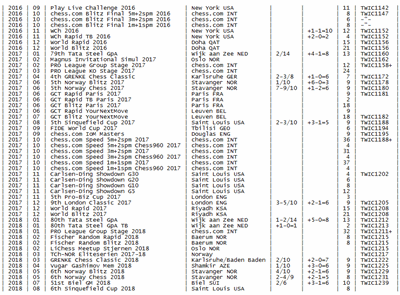
After the previous posts, Carlsen's Events 2017-18 and Carlsen's Chess.com Events 2017-18, I prepared the data I had collected into a format similar to Magnus Carlsen's Tournament, Match, and Exhibition Record (2000-; Last updated 2016-09-26). The result, including TWIC references, is shown in the following chart.

It's not easy to read, but is only an intermediate version and serves to introduce a few discussion points. Since I addressed the same issues two years ago -- see Carlsen's Record 2015-16 (September 2016) and Carlsen's TMER 2015-16 (ditto) -- I only have to follow the precedents set then:-

  • Multi stage events, e.g. 2017 PRO League -> different events
  • Different time controls, e.g. 2017 Carlsen - Ding Showdown -> separate scores in notes
  • Chess960 (Fischer Random) -> mention in notes

Some multi stage events are shown in the table with a small '+' after the TWIC reference. These were all Chess.com events which were played over a period of several months and are covered by multiple TWICs.

23 September 2018

Medieval Figures Analyze Modern Theory

For this month's edition of Flickr (Not) Friday, I had a tough choice among another intriguing example of an AI chess image (as in Not so Flickrless Friday earlier this year), an unidentified chess set priced in the stratosphere, or a series of images like the one shown below. For the other choices see 'Flickr Favorites' in the right sidebar (although you might have to scroll if you're reading this long after the date of the post.)


Alphonso teaches Bronstein © Flickr user Sofia Eulgem under Creative Commons.

The full title of the Flickr image is 'Alphonso teaches Bronstein, Nicolas Sphicas, Museum of Byzantine Culture, 27/6/2018-2/9/2018; Thessaloniki, Greece', and is one of several images with the same title. One paragraph of the the description says,

The artist is inspired by the medieval figures of the “Book of Games” (Libro de ajedrez, dados, y tablas, 1283) by Alphonso X called the Wise (1221-1284), King of Castile and Leon. The abstract figures are mobilized so as to illustrate the “King’s Indian opening”. It is an opening studied by David Bronstein, a leading chess player of 20th century, which influenced even world chess champions.

The paragraph is from the page “Alphonso teaches Bronstein!” (mbp.gr), where 'mbp' means Museum of Byzantine Culture, Thessaloniki. The page continues,

In the world of Nicolas Sphicas the medieval figures, whose garments reflect the stylish Northern gothic styles, are depicted analyzing the modern chess theory.

The Alphonso X painings were part of my earliest introduction to chess art and to chess history on the web. I wonder how they've evolved through the years.

21 September 2018

Google Search Coverage

I ended last week's post, Google Search Console ('to catch up on the many Google notices I've received since the beginning of the year'), on hold:-

The 'Performance' page for the old HTTP version of my site confirmed a large drop in search traffic since 2018-08-17. This should have been balanced by a corresponding increase in search traffic for the new HTTPS version, but Google told me 'Oops, you don't have access to this property'. After procuring the access, I received the message 'Processing data, please check again in a few days'.

A few days later, I received another email from Google:-

To: Owner of https://www.mark-weeks.com/ • Google systems confirm that on Sep 13, 2018 we started collecting Google Search impressions for your website in Search Console. This means that pages from your website are now appearing in Google search results for some queries. Here’s how you can monitor your site’s performance in search using Search Console.

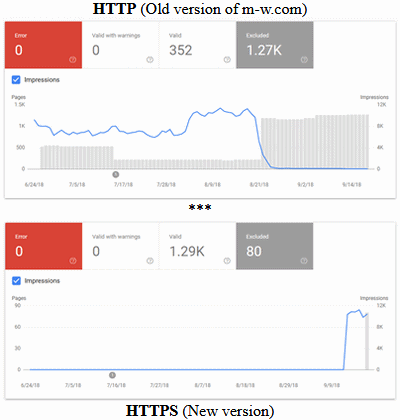
The message pointed to a console resource called 'Coverage' that showed me how many of my pages were included in Google's search engine results. Here are the current charts for both the old and new versions of the site.

The rectangles at the top of each display say 'Error' (in red), 'Valid with warnings', 'Valid' (both white), and 'Excluded' (gray). Why are some pages on the old HTTP version marked 'Valid'? More importantly, why are other pages on the new HTTPS version marked 'Excluded'? The 'Excluded' pages fall into two categories:-

  • 'Duplicate without user-selected canonical'
  • 'Crawled - currently not indexed'

The Google help page, Index Coverage Status report (support.google.com), explains,

Duplicate page without canonical tag: This page has duplicates, none of which is marked canonical. We think this page is not the canonical one. You should explicitly mark the canonical for this page. (We're working on a tool to show you which page was selected as canonical, but we're not quite there yet.)

and

Crawled - currently not indexed: The page was crawled by Google, but not indexed. It may or may not be indexed in the future; no need to resubmit this URL for crawling.

What does 'canonical' mean? From Consolidate duplicate URLs:-

If you have a single page accessible by multiple URLs, or different pages with similar content (for example, a page with both a mobile and a desktop version), Google sees these as duplicate versions of the same page. Google will choose one URL as the canonical version and crawl that, and all other URLs will be considered duplicate URLs and crawled less often.

For my site this refers to small pages that show some aspect of a position, like a chess trap, where all of the pages are structured similarly. The pages marked 'Crawled - not indexed' are of the same type. It's not really a problem, although my obsession with a topic that has nothing to do with chess might be a problem. In my next post I'll move on to another topic.