Once again, we change the calendar for the monthly post on American chess from 50 and 25 years ago. For last month's post, see
December 1972 & 1997 'On the Cover'
(December 2022).
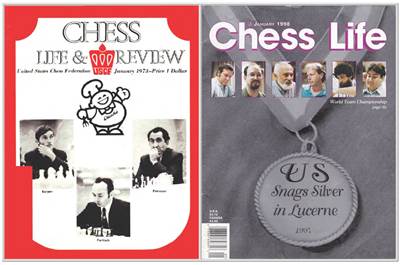
Left: 'Churchie • Karpov, Portisch, Petrosian'
Right: 'World Team Championship; U.S. Snags Silver in Lucerne 1997'
Chess Life & Review (50 Years Ago)
The three winners of Church's Fried Chicken International Tournament, San Antonio 1972: Anatoly Karpov (left), Tigran Petrosian,
(right), and Lajos Portisch. The other guy on the cover is a
registered trademark of Church's Fried Chicken, Inc. See [inside]
for tournament results. Photos by Burt Hochberg.
After introducing the winners, the tournament report inside only listed the final results of the 16 players. The introduction started,
Church's Fried Chicken. Inc. First International Chess Tournament ended
December 11 in a triple tie for 1st.
Anatoly Karpov, the most promising of
the USSR's young grandmasters, won 7
games and lost only one (to Portisch) to
add the San Antonio tournament to his
recent string of important successes.
Veteran former World Champion Petrosian, with 6 wins and no losses, achieved
his greatest tournament success in about
ten years to tie for top honors. Hungarian GM Portisch, after scoring only 4 1/2
points in the first 8 rounds, scored 6
points in the last 7 rounds to tie with
Karpov and Petrosian with 10 1/2 points.
Full reports on this significant event
will appear in forthcoming issues.
All of the North American players, except Duncan Suttles of Canada in 6th-7th place, finished in the bottom half of the tournament.
Played just a few months after the
1972 Fischer - Spassky title match
(m-w.com; 'Reykjavik, VII-VIII, 1972'), the 1972 San Antonio tournament will always have a guaranteed place listed among
Strong American Chess Tournaments
(August 2016).
Despite all the fuss about 1972 Fischer - Spassky, the match did not usher in a golden era of American chess tournaments.
The next event on the list of 'Strong American Tournaments' was 1982 Chicago.
The January 1973 CL&R featured interviews of Fischer, Spassky, and Gudmundur Thorarinsson, president of the Icelandic Chess Federation.
The issue also included the last four games of the Fischer - Spassky match, annotated by Robert Byrne.
Between the two articles was a 'Keres Annotates' column titled 'Two Karpov Wins'. GM Keres, a three-time champion of the USSR who finished 5th at 1972 San Antonio, wrote,
Karpov has a solid grounding in opening play, due partly to his second,
Furman, wbo is considered one of the best in this field in the USSR. His
general style of play is rather cairn. centered on positional considerations and
somehow recalling Capablanca's attitudes towards the game. His technique is
reasonable, but of course a player of only 21 still has some things to learn in
this area. It seems to me that in five years Karpov will be able to replace
any current leading Soviet grandmaster, provided he continues to make normal
progress.
We know now that Karpov would become World Champion in 1975, after Fischer declined to defend the title. One positive outcome of the boom for American chess was a new generation of American players attracted to the royal game during the peak interest in Fischer. Their rise to the top of U.S. rating lists was undoubtedly one of the reasons behind the next part of this 'On the Cover' post.
Chess Life (25 Years Ago)
A gold cover would
have been much nicer
than silver. But silver is
better than bronze (see
the February 1997 cover).
And it would have been a
gold cover if not for a
miraculous finish by the
Russians at the World
Team Championship,
held in Lucerne, Switzerland. Our team played
hard and well, garnering
three board prizes along
with second place.
GM Larry Christiansen's eight-page tournament report, 'World Team Championship', cast doubts on the legitimacy of the Russian victory.
Last year we saw the February 1997 cover in
February 1972 & 1997 'On the Cover'
(February 2022). There we find the same six players shown on the January 1998 CL cover:
GMs Yermolinsky,
Benjamin,
Gulko,
De Firmian,
Kaidanov,
and
Christiansen.
The numbers 2, 4, and 6 were all home-grown American talent. The others emigrated from the USSR in the 1980s.




 Posts
Posts

